OEM vs ODM Metal Manufacturing Explained
When sourcing metal products, two terms often surface: OEM (Original Equipment Manufacturer) and ODM (Original Design Manufacturer). Both play key roles in the supply chain, but they differ in responsibility, process, and ideal use cases. Understanding OEM vs ODM metal manufacturing helps companies make informed decisions for projects ranging from custom medals to industrial hardware.
Fundamental Differences Between OEM and ODM
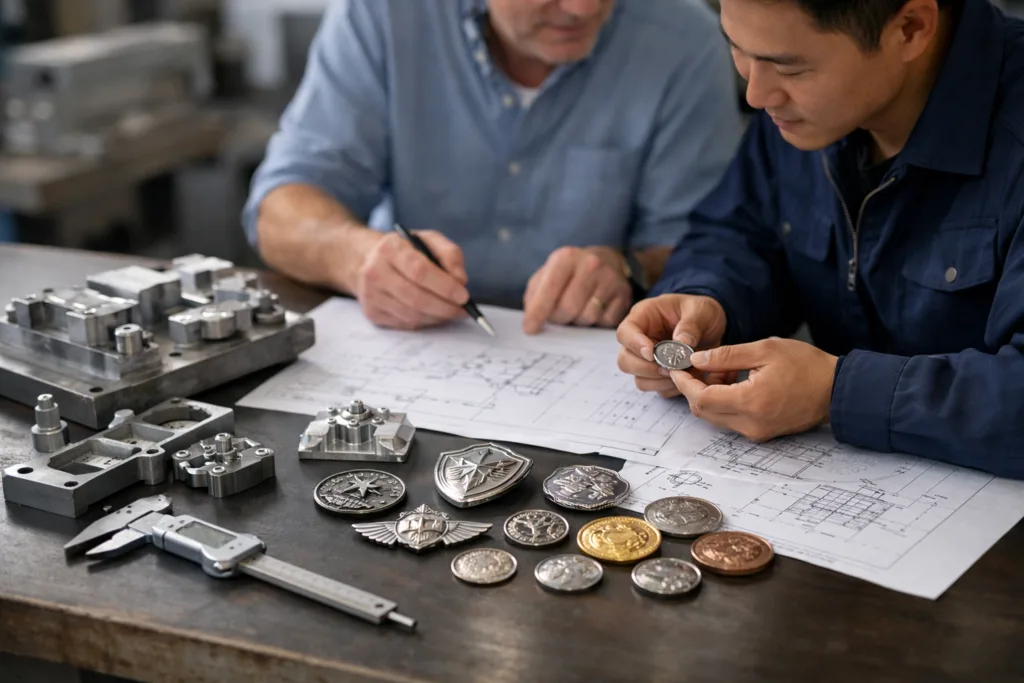
OEM and ODM are more than buzzwords. They define the level of control a buyer has over design and production—and influence cost, IP, timelines, and product uniqueness.
- OEM: The buyer provides designs and specifications. The manufacturer builds exactly what the buyer requests, often under the buyer’s brand.
- ODM: The manufacturer owns (or develops) the product design. The buyer can customize certain features but typically chooses from existing options, often branding the product as their own.
| Model | Design Ownership | Customization Level | Typical Cost | Lead Time |
|---|---|---|---|---|
| OEM | Buyer | Full (including unique molds, specs) | Higher (NRE, tooling) | Longer (design and validation) |
| ODM | Manufacturer | Partial (materials, color, branding) | Lower (shared design/tooling) | Shorter (ready-made base) |
How Responsibilities and Rights Differ
The division of ownership, IP (intellectual property) rights, and quality accountability shape business risks and opportunities.
OEM Responsibility Breakdown
- Design Control: Full—buyer submits engineering drawings, 3D models, material specifications (e.g., zinc alloy or stainless steel 316).
- IP Ownership: Retained by buyer—tooling and molds belong either wholly or partially to buyer unless agreed otherwise.
- Quality Standards: Buyer defines expectations—tolerances, surface finish (e.g., mirror polish or antique plating), and test methods (such as plating thickness per XRF or adhesion per ASTM D3359).
- Production Risk: Manufacturer executes, but any design errors rest with the buyer.
ODM Responsibility Breakdown
- Design Control: Manufacturer—uses proven designs, sometimes with modular options.
- IP Ownership: Manufacturer—tooling and core design are proprietary.
- Quality Standards: Manufacturer sets baseline; buyer may choose surface finish (e.g., matte black electroplating) or add logo/special packaging.
- Production Risk: Manufacturer is responsible for compatibility and performance of the standardized product, easier QC.
OEM ODM Metal Manufacturing: Process Deep Dive
The heart of any project is its process. Whether ordering medals or technical hardware, understanding each step unlocks savings and reliability.
OEM Workflow
- Specification Submission: Buyer delivers detailed drawings, CAD files, and required tolerances. Example: a custom 2D relief badge in die-cast zinc alloy at 3mm thickness.
- DFM Review: Manufacturer reviews for manufacturability, cost, and possible improvements. Relief heights, fill depths, and Pantone color specs are checked.
- Mold Creation: Wire EDM machines carve precise steel molds for die casting or stamping.
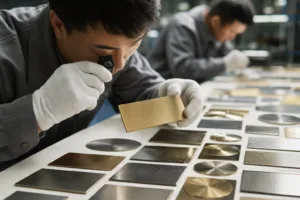
- Sample Production & Approval: Samples undergo surface finish checks (e.g., gold or gunmetal plating, salt-spray hours), dimensional inspections, AQL sampling (ANSI/ASQ Z1.4), and RoHS/REACH compliance if for wearables.
- Mass Production: Full lot produced, deburred and finished (brushed, sandblasted, powder coated), then assembled—split rings, butterfly clutches, or magnetic backs.
- Packing & Delivery: Bulk or custom packaging (OPP bags, velvet boxes, blister packs, branded cards) to buyer’s spec.
ODM Workflow
- Product Selection: Buyer reviews existing catalog or modular choices (size, finish, logo placement).
- Customization: Manufacturer allows options like soft or hard enamel color fills, packaging style, or engraving pattern.
- Quote & Sample Cycle: Faster quotation, often with in-stock samples; only minor changes mean no new mold lead time.
- Production & QC: Manufacturer ensures consistency per established standard—tolerance, plating thickness, RoHS/REACH checks for compliant goods.
- Packing & Delivery: As per buyer choice; often standard packaging, quick turnaround.
Choosing OEM or ODM: Ideal Scenarios
Should you choose OEM or ODM metal manufacturing? The answer depends on the project goals, target market, and business priorities.
When OEM Is Best
- You need unique designs—custom-shaped brand badges, military challenge coins, or medals for exclusive events.
- You require strict property or compliance specs—EN 1811 nickel release, high VH hardness, or specific finish (e.g., PVD for luxury hardware).
- Your brand reputation and IP protection are paramount—exclusive molds ensure no one else can produce your product.
- MOQ (minimum order quantity) can be higher—custom tooling costs spread across larger runs.
When ODM Is Best
- You want speed—ready-to-go molds and proven designs make sampling and production quick.
- You’re working with lower volumes—no large upfront tooling fees, better for test launches or promotional gifts.
- Product differentiation needs are light—custom logo or finish on popular medal, keychain, or nameplate base.
- Cost and reliability are the priority—not exclusivity, but uniform quality and prompt delivery.
Expert Insight: Gairun’s engineers recommend OEM for new product launches and brand-defining items, but ODM for bulk promotional orders where speed and affordability matter.
Material and Process Selection in OEM/ODM Projects
The choice of material and production method impacts not just cost, but durability, appearance, and compliance with industry standards.
Common Metals for Badges, Medals, Coins, and Crafts
- Zinc Alloy: Popular for die-cast medals and badges; durable, good for fine details, typically 2–5 mm thick.
- Brass: Stamped coins and nameplates; corrosion-resistant, ideal for antique finishes.
- Stainless Steel (304/316): Premium feel, superior hardness (HV > 200), ideal for decorative hardware.
- Aluminum (6061/5052): Lightweight, anodizable; used in luggage tags, furniture hardware.
- Iron: Cost-effective, but less corrosion resistance; suitable for temporary promotional pieces.
Production Techniques
- Die Casting: High complexity, good for 3D relief medals.
- Stamping/Pressing: Flat badges, coins, thinner parts (≤3 mm), best for mass production.
- Photo-Etching: Fine detailing, layered nameplates, thin metal up to 0.5 mm.
- CNC Milling/Turning: Prototyping and precise custom shapes (especially for OEM).
- Laser Engraving: Branding and serial numbers, custom artwork on finished parts.
Finishes and Surface Treatments
- Electroplating: Gold, nickel, gunmetal, antique finishes; thickness checked by XRF.
- Anodizing: For aluminum; colorfast and corrosion-resistant.
- Powder Coating: Matte/texture finishes, extra protection.
- Brushed/Satin/Mirror Polish: Varies visual impact and tactile feel.
- Sandblasted/Satin: Textural accent, popular in medals and decorative crafts.
OEM ODM Metal Manufacturing in Real Projects
Let’s look at practical scenarios. For a custom marathon medal, a sports organizer may choose OEM manufacturing to guarantee a unique design with deep 3D relief, colored enamel fills, and a branded ribbon attachment. This process takes longer, costs more, but achieves the wow factor and brand exclusivity needed for top-tier events.
Example: ODM Keychains for Promotions
A retailer orders bulk ODM metal keychains for a summer campaign. The manufacturer offers catalog shapes, several finish options (chrome, gunmetal, colored enamels), and prints the retailer’s logo. No new mold costs, short lead time, and consistent quality keep budgets and deadlines on track.
Compliance, Testing, and Quality Standards
B2B buyers expect more than looks. Quality assurance includes tolerance inspection, plating thickness checks, adhesion tests, and compliance with technical standards.

Core Measures in Metal Manufacturing
- Dimensional Tolerance: ±0.05 mm common for precision parts; measured with digital calipers.
- Plating Thickness: Verified by XRF; typical range 5–12 μm for durable medals or badges.
- Adhesion: Tape peel tests per ASTM D3359 for paints, powder coat, or enamel layers.
- Corrosion Resistance: Salt-spray (ASTM B117) testing up to 48–96 hours for outdoor/award items.
- Hardness: Measured in Vickers (HV); stainless steel parts need >200 HV for scratch resistance.
- Color Difference: ΔE checked for brand consistency, especially for large events.
- Sampling Plan: AQL sampling under ANSI/ASQ Z1.4 ensures lot uniformity.
- Regulatory Compliance: RoHS/REACH, EN 1811 nickel release for jewelry, CPSIA/Prop 65 for US sales.
Gairun routinely executes these tests for clients in sports, military, branding, and promotional categories, delivering reliability and longevity in every batch.
Cost Structure: OEM vs ODM Metal Manufacturing
Budget matters—especially for large runs or novel product launches. Each model carries distinct cost elements.
OEM Cost Factors
- Tooling/Mold Fees: Custom molds start at $800–$5,000 depending on complexity and size.
- NRE (Non-Recurring Engineering): Design validation, sample creation add upfront costs.
- MOQ: Minimum run requirements (often 1,000+ pcs) to justify setup.
- Unit Price: Lower on large volumes as tooling costs are amortized.
ODM Cost Factors
- No New Tooling: Uses manufacturer’s existing molds and processes.
- MOQ: Lower (as few as 100–300 pcs in many cases).
- Unit Price: Slightly higher on small MOQ, but faster delivery and zero upfront fees.
- Customization Premium: Simple branding (e.g., laser engraving, enamel fill) adds only marginal cost.
Common Applications: OEM/ODM Metal Products in Action
Both OEM and ODM serve vital roles in branding, recognition, and functional accessories. Examples include:
- Sports & Marathon Medals: OEM for exclusive events; ODM for broad distribution with logo variants.
- Military/Club Coins: Custom (OEM) art for legacy, ODM for general collectible runs.
- Brand Badges & Decorative Hardware: OEM guarantees unique shapes, finishes, and assembly; ODM provides repeatable basics.
- Souvenir Crafts & Promotional Items: Fast ODM cycles for seasonal or campaign products.
- Luggage/Furniture Accessories: Both models serve, with OEM for customized branding, ODM for proven, cost-efficient options.
How to Choose the Right Partner for OEM ODM Metal Manufacturing
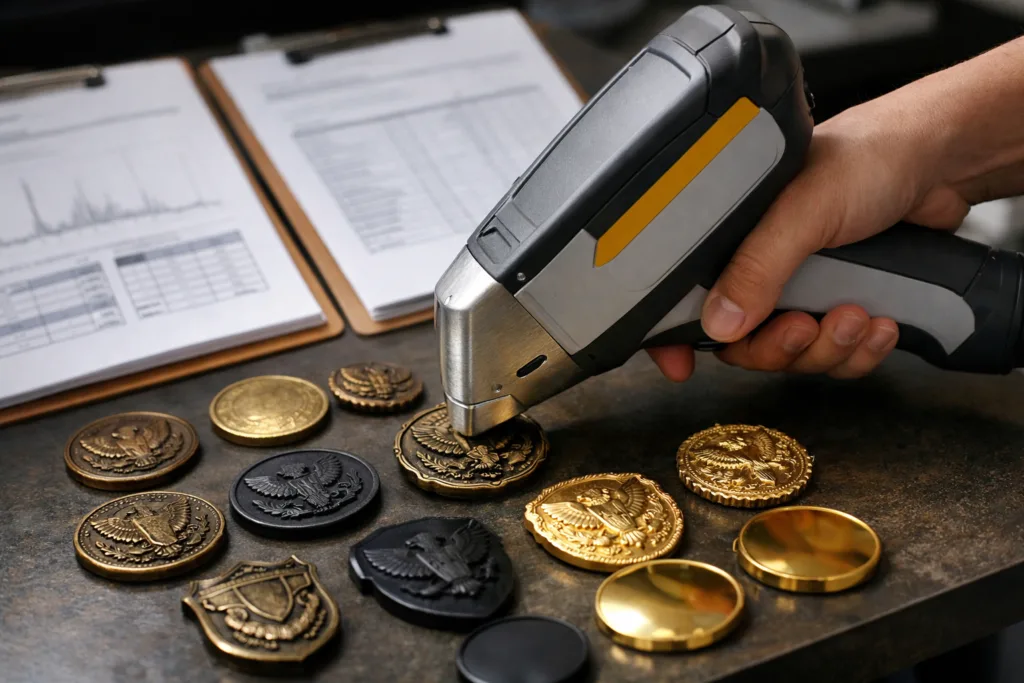
Selecting a manufacturer requires diligence. Seek partners with a proven record in quality, compliance, and communication. Gairun delivers craftsmanship, precision, and reliability to global B2B clients, whether you need fully custom or fast-turnaround catalog options.
Checklist for Sourcing
- Evaluate Experience: Review similar past projects and sample quality.
- Confirm Production Capabilities: Inspect process, material range, compliance certifications.
- Review Quality Assurance: Ask for inspection reports—plating, hardness, color matching, plating thickness.
- Assess Communication: Clear timelines, pricing, and responsiveness.
- Balance Cost and Risk: Align model to project goals—exclusive OEM, fast ODM.
Frequently Asked Questions
What is the basic difference between OEM and ODM in metal manufacturing?
OEM delivers products based entirely on buyer specifications; ODM offers ready-made designs that can be customized and branded by buyers.
Which is more cost-effective: OEM or ODM?
ODM is usually more affordable for small runs since it uses existing molds, while OEM requires upfront tooling costs but offers long-term volume savings.
Can I protect my design when using OEM manufacturing?
Yes, OEM means you own the design and molds, helping protect intellectual property and ensuring product exclusivity.
What types of products work best for the ODM model?
Standardized items like keychains, badges, and promotional crafts are ideal for ODM since quick customization and fast delivery are priorities.
How does quality assurance differ between OEM and ODM?
OEM lets you set quality standards; ODM applies established processes, with both models following compliance testing, dimensional checks, and plating verification.
What should I consider when choosing OEM or ODM metal manufacturing?
Analyze your project’s goals, design needs, budget, compliance requirements, and timeline before selecting the model that fits best.