
Bringing your favorite beach bag or goggles only to find rust on the zippers, clips, or frames is disappointing—worse yet, it can ruin a holiday. Near salt water, metal gear faces a unique and aggressive type of corrosion. Fortunately, manufacturers now rely on salt spray testing to guarantee corrosion resistance where it matters most. In this guide, we’ll unpack the science behind this testing, explore how it applies to swimwear and beach accessories, and offer clear advice on choosing gear that truly resists rust.
Salt Spray Testing: Ensuring No Rust at the Beach
Corrosion can quickly compromise the look, feel, and safety of metal components used at the shore. Salt spray testing, sometimes called the salt fog test, is the industry’s go-to method for simulating the challenging, salty, humid conditions metals are exposed to at the beach. Whether it’s a beach chair frame or a swimsuit clasp, passing this test is every high-end manufacturer’s gold standard for long-lasting quality.
Understanding Salt Spray Testing

Salt spray testing exposes metal samples to a fine mist of saltwater inside a specialized chamber. This artificial environment rapidly accelerates the corrosion process, producing results in days rather than years. Lab technicians monitor for visible rust, pitting, or coating breakdown to grade performance.
How Does Salt Spray Testing Work?
Test items are placed in the salt spray chamber, often at a specific angle. A solution—typically 5% sodium chloride, similar to seawater—is atomized and continuously sprayed at room temperature. Exposure time varies; higher resistance means a longer test duration without visible corrosion.
History and Evolution of Salt Spray Testing
Salt spray testing has been a standard since the 1930s. Over decades, international standards like ASTM B117 have refined the method. Today’s advanced chambers offer precise controls, better simulating the unpredictable conditions by the sea.
Why Corrosion Resistance Matters at the Beach
Salt air, high humidity, and temperature swings by the beach multiply the risk of corrosion on metals. Rust not only stains and weakens accessories, but can lead to breakage, sharp edges, and fast product failure—especially for swimwear zippers, buckles, and eyewear frames.
Common Corrosion-Prone Accessories
- Zippers and sliders on bags and swimwear
- Clips and hooks for snorkeling or beachwear
- Frames for sunglasses and goggles
- Bag hardware and metallic logo badges
How Salt Spray Tests Simulate Real Beach Conditions
Beach environments provide a mix of wind-driven salty mist, splash, UV exposure, and sand. While the salt spray chamber can’t mimic every variable, it is remarkably effective at debugging failures you might see after a few seasons—or faster—at the coast.
Test Parameters: What is Controlled?
- Salt concentration in the mist
- Chamber temperature and humidity
- Spray pressure and distribution
- Duration of exposure (often 24, 48, or 72+ hours)
Correlating Lab Results to Real-World Performance
Products that pass at least 48–72 hours in salt spray test conditions typically outperform untreated metals at the beach. However, true durability depends on material, manufacturing processes, and finishing quality.
Materials Used for Enhanced Corrosion Resistance
Smart manufacturers use rust-resistant metals and protective coatings to endure salt, sun, and sand. Key materials include:
- Stainless steel (various grades)
- Zinc alloy (Zamak), especially with robust electroplating
- Nickel-plated or PVD-coated brass
- Anodized aluminum (with caveats for wear abrasion)
Each has strengths and weaknesses (for more, see Aluminum vs Zinc Alloy Metal Products).
The Role of Protective Coatings
Coatings multiply base metal performance. High-quality electroplating, powder coating, epoxy domes, and PVD all increase the longevity of hardware. For custom design solutions, check How Custom Metal Product Design Works.
Industry Standards for Salt Spray Testing
The most recognized standard is ASTM B117, outlining procedures for consistent and reproducible results. Other standards include ISO 9227 and JIS Z 2371, which are sometimes required for global markets.
Test Ratings: Passing Grades and What They Mean
- 24 Hours: Basic resistance (sometimes minimal for high-use items)
- 48 Hours: Good for most outdoor use
- 72 Hours+: Preferred for premium, long-life accessories in marine environments
Best Practices for Conducting Salt Spray Tests
For meaningful and actionable results, follow these best practices:
- Test with all layers: substrate, coating, and final finish
- Sample from actual production batches, not prototypes
- Clean parts of oils and debris pre-test to avoid skewed results
- Record both aesthetic and functional changes, including pitting and discoloration
Visual Checks vs Structural Integrity
Surface rust is easy to see, but more dangerous is hidden weakening—especially for load-bearing clips or buckles. That’s why functional checks post-test are key.
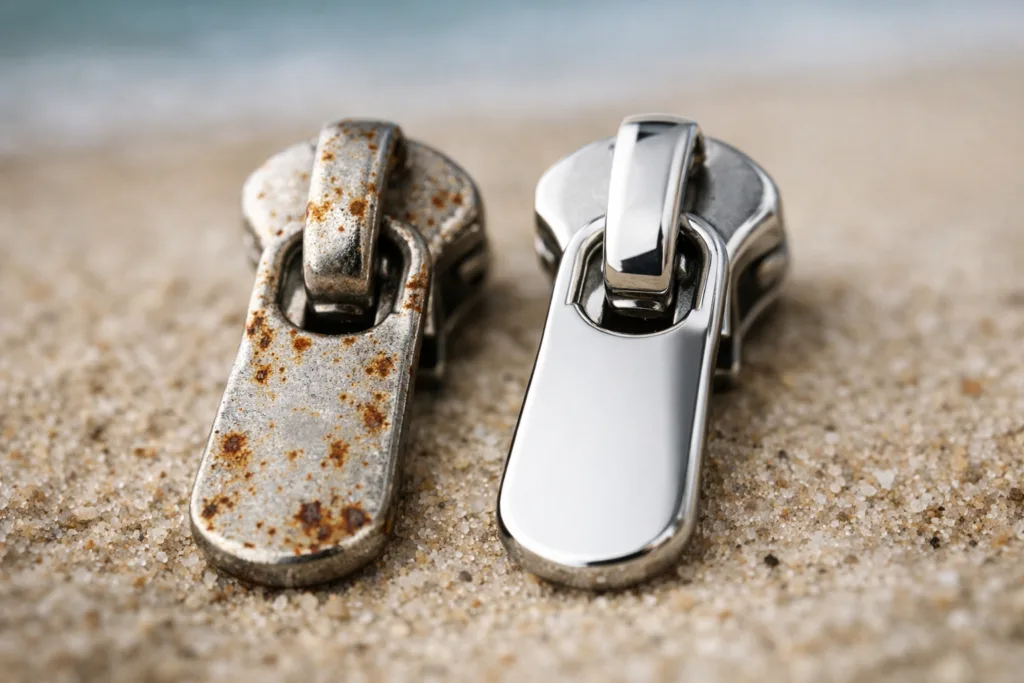
Applying Salt Spray Testing to Swimwear Accessories
Designers use salt spray test results to choose the right clips, stoppers, and slides—ensuring swimwear, beach bags, and sunglasses remain reliable summer after summer. For in-depth manufacturing insights, see Common Metals Used in Custom Metal Products.
Case Study: Upgrading Zipper Tabs
A major sportswear brand found that their branded zipper tabs corroded within weeks at resorts. By switching from low-grade steel to nickel-plated zinc alloy, verified with a 72-hour salt spray test, complaints dropped to near zero.
Choosing Rust-Resistant Materials for Beach Gear
When buying beach gear, look for products specifying stainless steel fasteners, zamac or brass with protective coatings, or epoxy-filled logos. Avoid plain steel or uncoated iron parts—they are prone to rapid rusting at the seaside.
Common Failures Revealed by Salt Spray Testing
Salt spray tests often reveal:
- Flaking or undercutting of cheap plating
- Rapid discoloration of untreated zinc or brass
- Coating pinholes leading to local corrosion
- Galvanic corrosion on mixed-metal assemblies
Swimwear Accessories: From Design to Durability
Durability starts with smart design. Features like drainage holes, smooth radius corners, and minimal moving parts reduce the risk of water intrusion—helping products perform after multiple salt spray cycles. For the manufacturing process, see How Custom Metal Products Are Made.
Must-Know: Environmental Impact of Corrosion
Corroded accessories often end up as litter or micro-debris on the shore, raising sustainability concerns. Opting for longer-life, corrosion-resistant pieces means a lighter environmental footprint.
Comparing Test Methods: Salt Spray vs. Real-World Exposure
| Salt Spray Test | Beach Exposure |
|---|---|
| Accelerated, continuous salt mist | Intermittent wet/dry cycles; sun, sand, and water |
| Standardized, reproducible | Random, hard to control |
| Results in hours/days | Takes months or years |
| Best for comparing products quickly | Reveals full real-life complexity |
How Gairun Maintains Stringent Salt Spray Standards
Gairun, as a leading specialist in luxury beach accessories, tests all hardware to a minimum 48-hour salt spray standard. Using virgin zamac and advanced rack plating, only the highest-quality, defect-free parts are approved for final production. Stringent inspection ensures not just function, but that the visual finish meets top-tier expectations (see Quality Control in Custom Medal Manufacturing: What Buyers Should Look For).
Salt Spray Testing and Coating Technologies
Certain coatings, such as physical vapor deposition (PVD), offer both beauty and resilience. Thicker multi-layer plating, epoxy domes, and advanced polymers extend beach hardware life, as confirmed by passing salt spray benchmarks.
Design Tips for Maximum Corrosion Resistance
- Avoid sharp corners and crevices where salt can linger
- Choose larger grain size or peened surfaces to resist pitting
- Specify rack plating over barrel plating for even, durable finishes
- Request post-plating passivation where possible
Salt Spray Test Certification and How to Read It
Many premium brands now offer a certificate or test report. Look for mentions of “ASTM B117” and a minimum number of hours (e.g., “Passed 72-hour salt spray test”). Don’t hesitate to ask for specifics if you’re investing in high-use beach gear.
Consumer Checklist for Rust-Proof Beach Accessories
- Look for features like “salt spray tested” or “marine-grade” in product descriptions
- Inspect fasteners and hardware for smooth, thick coatings
- Choose known corrosion-resistant metals: stainless steel, zamac, nickel-brass alloy
- Avoid “cheap alloy” or unlabeled hardware in accessories labeled as “beach” or “marine”
Salt Spray Testing vs Other Corrosion Tests

- Cyclic corrosion testing: Simulates more natural wet/dry/sun cycles but takes longer
- Humidity testing: Focuses on prolonged damp environments
- Sweat/skin tests: For wearables like swim goggles and frames
Frequently Asked Questions
What is salt spray testing and why is it important?
Salt spray testing is a laboratory method that simulates harsh, salty environments to measure how well metals and coatings resist corrosion. It is essential for predicting product durability in beach conditions.
How does salt spray testing simulate beach conditions?
The test exposes parts to a continuous fine mist of saltwater in a controlled chamber, replicating the accelerated corrosive effects found in coastal areas.
Which metals and coatings are best for beach-use accessories?
Stainless steel, nickel-plated brass, zamac with quality coatings, and PVD or epoxy finishes provide excellent corrosion resistance for beach accessories.
How do manufacturers use salt spray test results?
Manufacturers use the results to refine material choices and coatings, set minimum quality standards, and ensure long-lasting products for harsh coastal use.
How can I tell if a product is rust-resistant?
Check for claims of salt spray tested durability or look for details on materials like stainless steel or special rust-resistant finishes in product descriptions.
Are there industry standards for salt spray testing?
Yes, standards like ASTM B117 define procedures and benchmarks for salt spray testing, offering common ground for comparison across manufacturers.
Related Reading
- Choosing Between Aluminum and Zinc Alloy for Rust-Resistant Beach Accessories
- Your Guide to the Most Corrosion-Resistant Metals for Swimwear and Beach Gear
- Behind the Scenes: How Custom Beach Metal Accessories Are Manufactured
- What True Quality Control Means for Outdoor Metal Accessories
- The Smart Design Strategies that Stop Rust Before It Starts