Why Laser Engraving Makes Medals Stand Out
Events today demand more than plain medals. Personalizing each award adds a sense of achievement and value for participants. Laser engraving enables organizers to inscribe names, numbers, or even QR codes on every medal, creating keepsakes that are as unique as the accomplishment itself. This unlocks new ways to track achievements, integrate technology, and protect against counterfeiting. Gairun ensures that every engraving meets the highest standards of legibility and durability—no matter the event size.
Understanding Laser Engraving on Medals
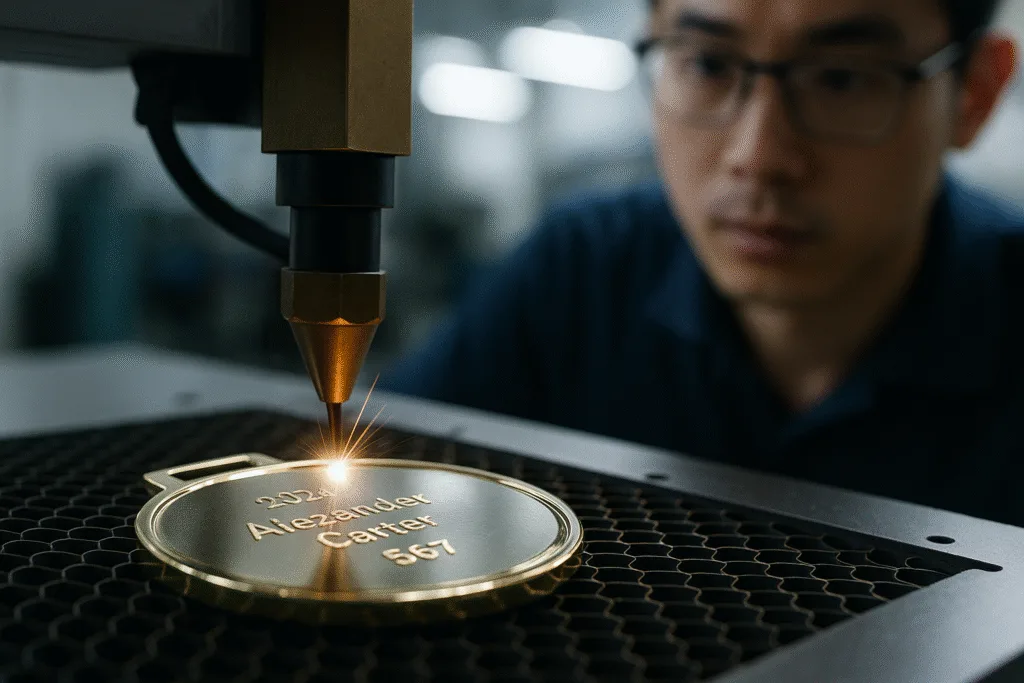
Laser engraving is a precise process that uses a focused beam of light to mark or etch the surface of a medal. The laser vaporizes a thin layer of metal or coating, revealing a sharp, permanent design. This technique works well on metals with or without plating, depending on the type and thickness. Compared to traditional methods like rotary engraving or chemical etching, laser engraving provides finer detail and does not require custom tools for each batch.
- Fast turnaround for large orders—data can be varied on each medal.
- Supports complex shapes and fine lines, such as logos and QR codes.
- Works after plating—so finish remains clean and consistent.
The Engineering Behind Laser Engraving
Most factories, including Gairun, use fiber lasers or CO2 lasers for these jobs. Fiber lasers excel on metals and plated surfaces, while CO2 lasers work best for organics and some coated metals. The choice of laser ensures crisp contrasts and high resolution, even on small, intricate details such as serial numbers.
Table: Comparing Engraving Methods
| Method | Process | Detail/Tolerance | Cost Impact | Finish |
|---|---|---|---|---|
| Laser Engraving | Non-contact, post-plating | Up to 0.01 mm | Low for variable data | Sharp, permanent, no extra steps |
| Rotary Engraving | Mechanical, pre- or post-plating | 0.05 mm or more | High for small runs | Can roughen or chip plating |
| Chemical Etching | Mask & acid, usually pre-plating | 0.03 mm | Medium/high | Less contrast, not ideal for variable data |
Laser Engraving on Medals: Adding Names, Numbers, and QR Codes
Event organizers often require unique details on each medal—winner’s name, bib or serial number, event position, date, or QR code for digital verification. Laser engraving excels at adding this variable data quickly and accurately, even on plated medals. You can update each design just minutes before production, making last-minute corrections easy before your event deadline. Let’s look at some practical applications:
- Names: Engrave participant or winner’s full name for personal value.
- Serial Numbers: Add unique codes for marathon finishers, limited editions, or anti-counterfeit measures.
- Positions and Dates: Clearly mark “1st Place,” “2nd Place,” or actual date of achievement for reference.
- QR Codes: Link to digital certificates, photos, or result databases—scannable even after years of handling.
What Information Can Be Engraved?
You are not limited to text. Laser systems can render:
- Lettering (plain or stylized, including non-Latin scripts)
- Sequential, variable, or random numbers
- Logos (monochrome, up to 1:1 detail if art is provided)
- Basic graphics and icons
- QR and barcodes (tested for scan reliability)
Each element is programmed digitally and can be adjusted to fit within even compact medal layouts.
Supported Materials for Laser Engraving
Not all metals respond equally well. The ideal base metals for laser engraving include brass, stainless steel (304/316), zinc alloy, and anodized aluminum. Iron/steel medals can also be engraved, though the finish must be correctly prepared to avoid rust after marking.
| Material | Plating/Finish | Tolerance | Best Suited Applications |
|---|---|---|---|
| Brass | Gold, nickel, antique finishes | 0.01 mm | Premium sports, corporate medals |
| Zinc Alloy | Gold, silver, dual plating | 0.02 mm | High-relief, 2D/3D medals |
| Stainless Steel | Matte, mirror, black PVD | 0.01 mm | Military, commemorative |
| Anodized Aluminum | Colored anodize | 0.015 mm | Lightweight, youth events, fun run medals |
Safe Plating and Coatings for Laser Engraving
- Electroplated gold, silver, and nickel—if thickness ≤ 10 µm
- Antique brass, gunmetal, matte black plating
- PVD or powder coatings on steel/aluminum—fiber laser preferred
Soft enamel and resin dome (epoxy) surfaces cannot be engraved directly. For two-stage medals, color is filled first, then the laser creates a window for contrast. This dual-layer technique ensures crisp, visible markings even with colored details.
How the Laser Engraving Process Works Step by Step
Let’s break down the practical process at Gairun, from artwork to finished award:
- Data Preparation: Names, numbers, and QR codes are formatted in vector design files (coreldraw, AI, or PDF). Serial numbers are generated automatically for large runs.
- Fixture Setup: Medals are mounted in precision jigs, often 20–100 units at a time, ensuring each medal aligns perfectly under the laser head.
- Parameter Selection: Laser power, speed, and frequency are matched to metal/plating. Regular test marks confirm clean depth (0.01–0.05 mm typical) and good contrast.
- Engraving: The laser’s computer-controlled path vaporizes metal with no contact. Complex designs or variable text are completed in seconds per medal.
- Cleaning & Quality Control: Each part is wiped to remove residue, then checked for legibility and uniformity. Inspection uses AQL sampling and, where needed, confirmation against lists for names/serials.
Quality & Compliance Considerations
For event medals, it’s vital that engraving withstands regular touch, handling, and sweat. Gairun tests engraved surfaces for abrasion resistance, salt-spray exposure, and—where relevant—uses XRF (X-ray fluorescence) to measure plating depth. Finished medals are RoHS and REACH compliant (Learn more about REACH) with no harmful residues. For medals worn on skin, nickel release limits are also checked under EN 1811.
Why Laser Engraving Suits Variable Data on Event Medals
Medals with personalized laser engraving offer logistical and branding advantages over generic awards. For one, the process scales easily: Whether you need 20 commemorative medals or 10,000 marathon finishers, artwork and data change at no extra tool cost. Organizers can send their data spreadsheet just days before event packing—names, finish results, or QR codes for instant digital linking.
- Track medals by unique code for results authentication.
- Prove distribution and winner data to sponsors/regulatory bodies.
- Reduce risk of counterfeiting—laser-engraved codes are hard to replicate.
- Add personal, emotional value for recipients to cherish and display.
When to Choose Laser Engraving (Over Printing or Stamping)
If your event medals require serialized or participant-specific data, laser engraving is almost always the better investment. UV printing or direct pad printing can’t match the scratch resistance or permanence of a deep mark. Stamping is ideal for large, fixed designs but not practical for batch-variable customization. Laser work also requires little secondary cleaning, reducing handling costs and error rates.
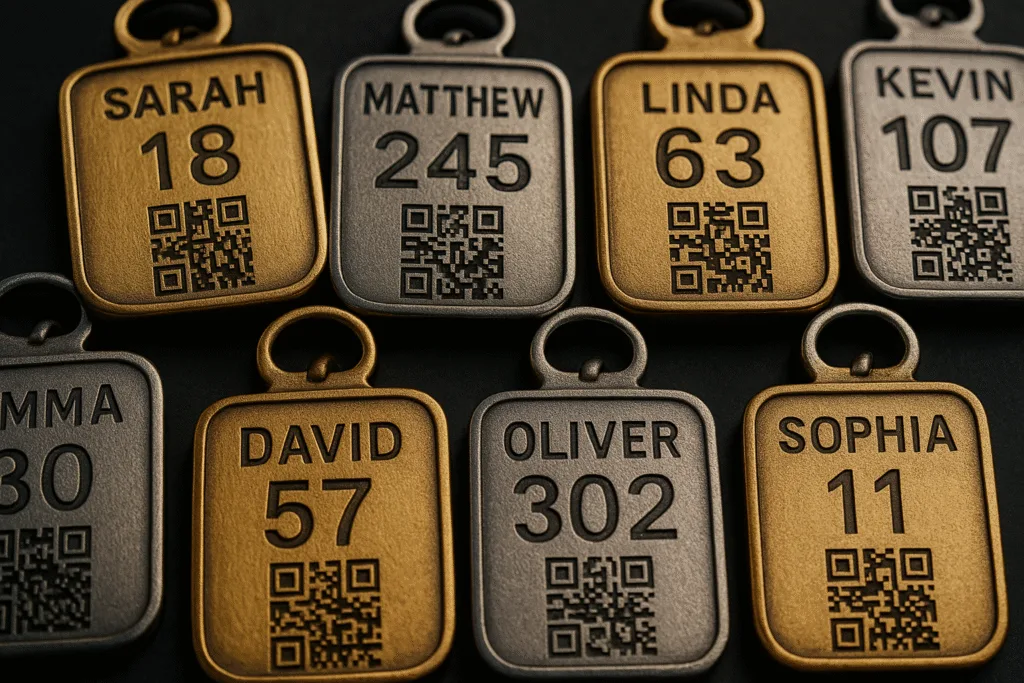
Expert Tip from Gairun: Use laser engraving for short deadlines and frequent data changes; rely on die-stamped or cast design for fixed graphics and branding.
Design Tips for Laser Engraving Medals with Variable Data
Best Size and Layout Practices
Text height should be a minimum of 1.5 mm for basic legibility, with 2 mm+ preferred for quick scanning or older recipients. QR codes should measure at least 10 x 10 mm for reliable scannability, with a white or lightly contrasted background area for best digital recognition.
Font Selection
- Choose simple, sans-serif typefaces for clarity.
- Avoid ultra-thin or outlined fonts that may fill in.
- Stick to solid logos or icons (no gradients or color-dependent detail).
Data Management
Preparing spreadsheets with one column per variable (name, number, QR link) prevents duplicates and allows for bulk error checking at the factory before engraving begins. Secure data sharing keeps personal information confidential while enabling fast changes if team lists or results shift last-minute.
Color & Contrast Strategies
If you desire high contrast on dark-plated or antique-finished medals, consider leaving a polished or lightly sandblasted window for the engraving zone in your die design. This ensures the area marked by the laser stands out against the background metal for enhanced readability.
Durability, Care, and Compliance of Laser Engraved Medals
Engraved data should last as long as the medal itself. After laser marking, Gairun can provide post-process cleaning, passivation (to prevent rust on steel/iron), and final quality checks before packaging. Packaging options include clear OPP bags, velvet presentation boxes, or custom cards with event/branding details. For schools and youth sports, certificates of compliance (CPSIA/Prop 65) can be supplied on request.
- Wear Resistance: Mark remains readable after 1,000+ rubs or typical medal handling.
- Corrosion Protection: Surface is tested after 24–48 hours of salt spray per ASTM B117.
- Color Stability: No discoloration or fading over time.
Ordering Laser Engraved, Personalized Medals—What to Expect
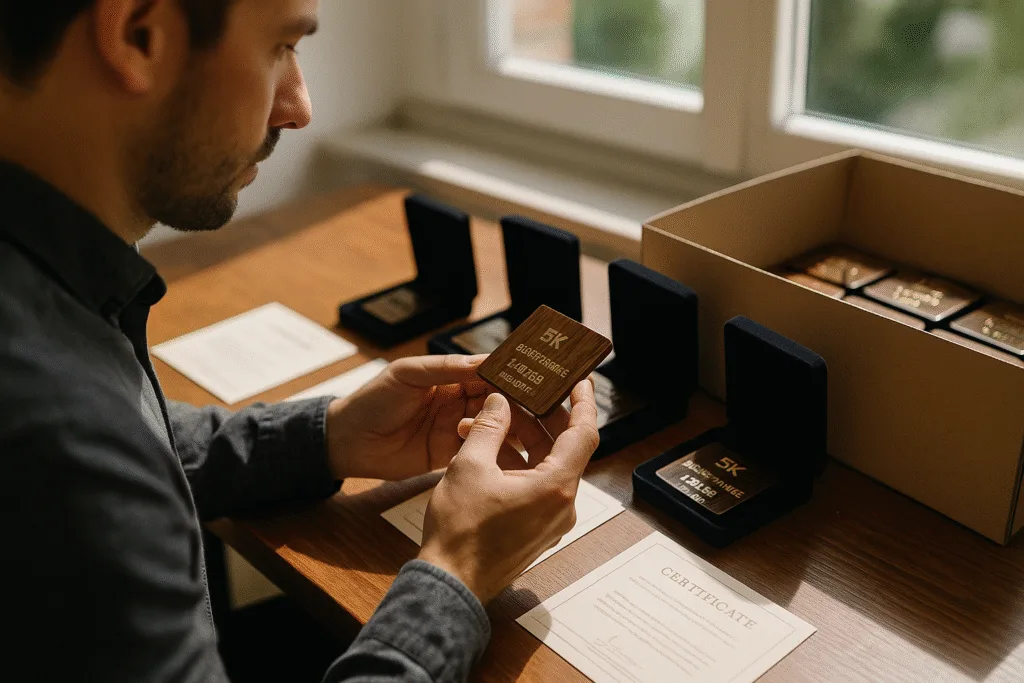
The process for event organizers is straightforward. After medal design approval, variable data (names, positions, numbers, destination URLs for QR) is uploaded in a standard spreadsheet. Gairun’s OEM/ODM team provides rapid data proofing, test samples where needed, and full digital previews for signoff before mass production. Typical lead times for engraved medals run 7–15 days, even for batches exceeding 5,000 units.
- MOQ starts as low as 50 pieces for simple events.
- Bulk runs see cost curve benefits, particularly for races/sporting series.
- All variable engraving is included in the run price—no per-name upcharge.
Final Quality Assurance
Every finished batch is inspected against ANSI/ASQ Z1.4 AQL standards for variable text accuracy, plating integrity, and engraving quality. Batch retention samples are kept for future reference or proof-of-origin inquiries. Gairun’s reputation is built on getting every detail right for event organizers, from the biggest city marathons to school competitions worldwide.
Frequently Asked Questions
What medals can be laser engraved?
Most zinc alloy, brass, stainless steel, and anodized aluminum medals can be laser engraved after plating. Soft enamel and resin domed medals require special process adjustments for clear marking.
Can you engrave each medal with a unique name or number?
Yes, laser engraving supports full variable data. Each medal in a batch can have a different name, number, position, or QR code at no extra tooling cost.
Will laser engraving affect the finish or plating durability?
Properly controlled, laser engraving removes only a thin layer to reveal the base metal without damaging surrounding plating or the overall medal finish.
How small can the engraved details be?
Engraved text can be as small as 1 mm tall, but 1.5–2 mm is recommended for clear readability. QR codes should be at least 10 mm square for reliable scanning.
Is the laser engraving permanent?
Yes, the process creates a long-lasting, abrasion-resistant mark. The engraving will not wash off or fade with normal handling, display, or wear.
What file formats and data are needed for production?
Vector artwork files (AI, CDR, DXF, or high-res PDF) and an Excel spreadsheet with required names, numbers, or QR links are typically sufficient for bulk production.