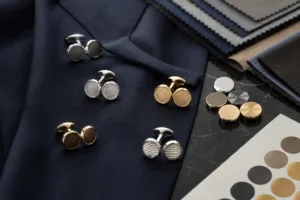
Custom cufflinks can add a quiet but powerful layer of branding to corporate uniforms. For procurement teams, hospitality groups, airlines, private clubs, luxury retail brands, and companies with client-facing dress codes, they are more than decorative accessories. Well-designed cufflinks help reinforce brand identity, maintain a polished appearance across teams, and create consistency between uniforms, accessories, and the overall customer experience. From our manufacturing perspective, the most successful cufflink projects balance visual identity with practical concerns such as metal choice, finish durability, closure structure, logo legibility, and repeatable bulk production quality.
If your uniform program involves branded apparel details beyond cufflinks, OEM clothing accessories manufacturing support becomes important early in the planning stage. Many buyers need matching metal trims, coordinated finishes, logo consistency, custom packaging, and approval-ready samples across several accessory types at once. We support these projects by helping teams compare materials, refine artwork for metal production, confirm plating and attachment choices, develop samples and molds, and prepare bulk production standards that fit long-term uniform rollout needs.
Why custom cufflinks matter in corporate attire
In corporate attire, small details often carry more visual weight than large logos. A cufflink appears at the wrist, close to handshakes, presentations, service gestures, and formal interactions. That makes it especially relevant for executive teams, concierges, luxury hospitality staff, ceremonial teams, uniformed sales staff, and formal event personnel.
Custom cufflinks work best when the branding is intentional rather than loud. In many programs, the goal is not to turn the accessory into a promotional item. Instead, the goal is to create a refined branded object that supports dress standards and signals professionalism. That is why material finish, shape discipline, and logo interpretation usually matter more than oversized graphics.
We often advise buyers to think of cufflinks as part of a wider accessory system. If the same company also uses tie clips, uniform buttons, or branded name badges, the cufflinks should visually align with those pieces. For buyers reviewing adjacent trim options, projects involving engraved logo uniform buttons often reveal how much consistency in finish tone and logo depth affects the final uniform impression.
How cufflinks support professional image and brand identity
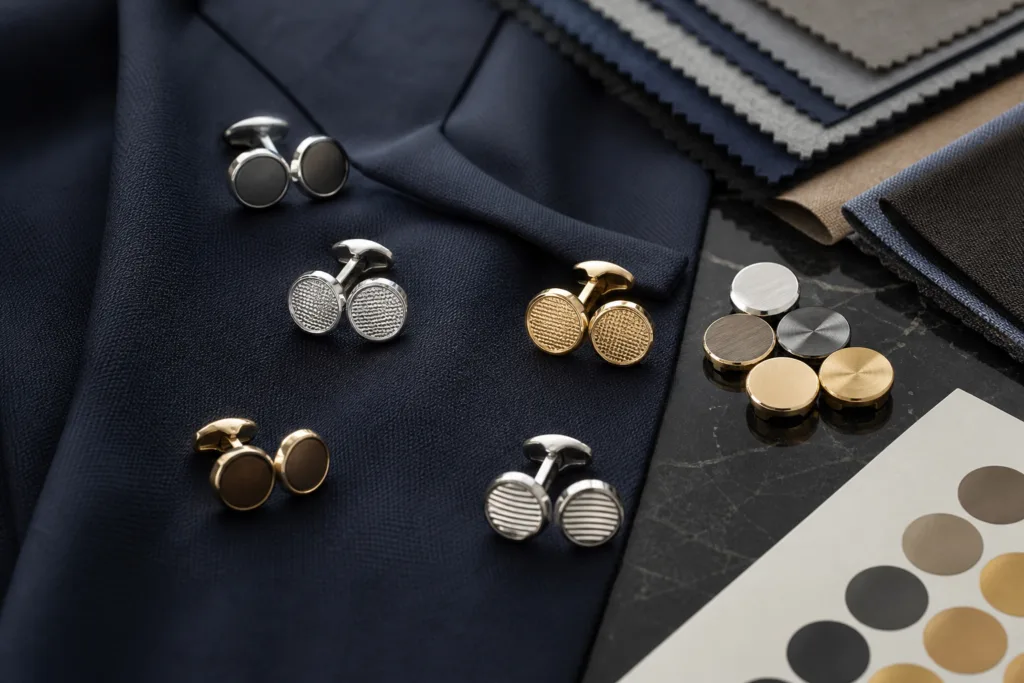
A strong cufflink design supports brand identity in subtle ways. Shape can echo a logo symbol. Plating can match a company’s preferred hardware tone. Enamel color can reflect a master brand color when used carefully. Edge treatment and surface texture can also influence whether the result feels modern, traditional, premium, understated, or ceremonial.
For corporate buyers, the practical question is not simply whether a logo can be placed on a cufflink. The more important question is whether the logo can be translated into metal at the chosen size without losing clarity. A complex logo mark with fine lines may work better as laser engraving on a polished face, while a simple geometric symbol may suit die-struck or enamel-filled construction.
At Gairun, we usually recommend starting with the uniform environment first. A bank, hotel, premium retail chain, or membership club will each have different expectations for shine level, brand visibility, and formality. Once that context is defined, the artwork and production method become much easier to choose.
Best use cases for corporate uniforms, events, and client-facing roles
Not every uniform program needs cufflinks, but some use cases fit them especially well:
- Hospitality and concierge teams: cufflinks support a polished, high-service image in luxury or heritage environments.
- Executive and leadership uniforms: ideal for senior representatives at formal events or international client meetings.
- Ceremonial and protocol roles: useful where visual consistency and prestige matter.
- Private clubs and member-facing staff: help reinforce exclusivity and institutional identity.
- Corporate gifting tied to formal dress codes: suitable for internal recognition, anniversaries, or VIP client sets.
- Event staffing for premium launches: works well for short-run formal uniforms where accessories carry branding discreetly.
In contrast, highly active industrial uniforms or casual service roles may not benefit much from cufflinks, especially if garments are short-sleeved, heavily washed, or subject to snagging risks. Buyers should match the product to actual wear conditions rather than selecting it purely for image.
Popular custom cufflink design styles for brands
Most branded cufflinks fall into a few design families. Each has different implications for manufacturing, appearance, and cost control.
| Design style | Best for | Visual effect | Manufacturing note |
|---|---|---|---|
| Round or oval face | Classic corporate programs | Formal and balanced | Good for engraved or die-struck logos |
| Square or rectangular face | Modern brands | Structured and clean | Works well with geometric identity systems |
| Custom silhouette | Distinctive branding | Memorable and tailored | Requires careful mold design and edge control |
| Soft enamel face | Brands using controlled color accents | More visible logo color | Best with simple shapes and separated color areas |
| Laser-engraved polished face | Luxury or understated branding | Subtle and refined | Excellent for fine logo detail |
| Antique relief style | Heritage, club, or ceremonial programs | Traditional depth and character | Relies on relief contrast and finishing quality |
Buyers sometimes ask whether novelty movement or rotating parts are worth adding. For most corporate uniform programs, we recommend restraint. Simpler structures usually age better visually, perform more reliably in repeated use, and are easier to keep consistent across larger orders.
Material options for custom cufflinks
Material selection affects not only appearance, but also weight, detail sharpness, corrosion behavior, finish compatibility, and overall cost-performance balance. Buyers comparing options can benefit from understanding the common metals for custom metal accessories before approving a final construction.
Brass
Brass is a strong choice for cufflinks that need a refined feel, crisp engraving, and a more classic premium look. It is commonly chosen for die-struck or engraved pieces where detail definition matters. Brass can provide a satisfying weight without becoming overly heavy if size is controlled properly.
Zinc alloy
Zinc alloy is often suitable for custom shapes, dimensional forms, and projects needing flexible die-casting design. It performs well for sculpted or thicker face structures and can be a practical option when the design is not purely flat. For brands seeking shape freedom at reasonable cost, zinc alloy is often worth evaluating.
Stainless steel
Stainless steel can suit contemporary cufflinks with a cleaner industrial or minimalist look. It is particularly attractive for brushed surfaces, laser engraving, and modern corporate styling. However, its processing route differs from cast or stamped decorative metals, so the design should be matched to what stainless production does well.
Iron or other economy options
For budget-sensitive formal events or short-term programs, some buyers explore lower-cost base metals. This can work, but only if plating quality and wear expectations are discussed honestly. Thin plating over lower-cost substrates may not deliver the same long-term appearance under repeated daily use.
Finish and decoration choices that affect appearance and lifespan
The same cufflink design can look completely different depending on finish. This is where many corporate buyers either elevate the product or unintentionally make it feel generic.
Plating choices
Common plating directions include bright gold tone, nickel tone, black nickel tone, gunmetal tone, and antique finishes. The right choice depends on uniform color, shirt hardware, watches commonly worn by staff, and the intended brand mood. Bright plating tends to feel more formal and visible. Antique or brushed effects feel more muted and textural.
Plating quality is not just cosmetic. Repeated handling at the cuff, skin contact, and storage friction all affect long-term appearance. Buyers assessing durability should understand plating choices that improve durability and corrosion resistance in custom cufflinks, especially when comparing coating systems for higher-use uniform programs.
Laser engraving
Laser engraving is one of the most practical solutions for logos with fine lines, text, or subtle branding. It creates a disciplined look and reduces the risk of visual clutter. It is often a smart choice for law firms, financial institutions, luxury hospitality, and corporate gifting.
Soft enamel and hard enamel
Soft enamel introduces color with visible recessed areas between raised metal lines. It can create a stronger logo presence, but works best when the artwork is simple and the color palette is limited. Hard enamel offers a smoother surface and more polished look, though it is not always necessary for conservative corporate styling.
Antique and textured effects
Antique plating, sandblasted backgrounds, and matte textures can help create contrast on relief logos. These finishes are useful for heritage organizations, institutions, clubs, and brands wanting lower reflectivity. They are also forgiving when the goal is understated elegance rather than mirror shine.
How to match cufflink design with different corporate attire styles
Corporate attire is not one category. A cufflink that suits a five-star hotel may look too ornate for a modern consulting firm, while a minimal polished plate may feel too plain for ceremonial use.
| Corporate attire style | Recommended cufflink direction | Why it works |
|---|---|---|
| Classic business formal | Round or oval engraved brass with silver or gold tone plating | Timeless, conservative, easy to standardize |
| Modern executive | Rectangular stainless or polished zinc alloy with laser logo | Clean lines match contemporary tailoring |
| Luxury hospitality | Antique or satin finish with refined relief emblem | Signals service quality without over-branding |
| Ceremonial or institutional | Relief crest with antique finish or enamel accents | Supports formal identity and tradition |
| VIP gifting with uniform link | Presentation pair with custom box and subtle logo face | Creates premium brand continuity |
One common mistake is designing cufflinks in isolation from the shirt and suit style. The width of the cuff, the fit of the sleeve, the likely shirt color, and whether the uniform already includes a tie clip, badge, or buttons all influence whether the final piece feels balanced.
Logo placement, size, shape, and detail considerations
Cufflinks have limited surface area, so scale discipline matters. Many artwork problems start when a company tries to fit a full logo, slogan, and decorative border onto a small face. In production, this often leads to shallow lines, crowded enamel cells, or unreadable engraving.
We usually suggest prioritizing one of three branding approaches: a symbol-only mark, an abbreviated monogram, or a simplified wordmark with enough stroke weight to survive production. The smaller the face, the more important simplification becomes.
- Use bold logo elements: fine hairlines often disappear or fill in during production.
- Respect negative space: crowded layouts look worse in metal than on screen.
- Match shape to artwork: circular logos suit round faces, while monograms often work better in square or rectangular formats.
- Plan border width carefully: too thin looks weak, too thick reduces branding area.
- Limit text: small text is one of the most common approval-stage disappointments.
For buyers working across several metal accessories at once, a broader custom metal crafts manufacturing overview can help align logo treatment, finish consistency, and packaging strategy across the entire branded program.
The custom cufflink manufacturing process from artwork to bulk production
The best cufflink projects move through a disciplined sequence rather than jumping from concept straight to mass production. At Gairun, we typically guide buyers through artwork review, process matching, material selection, mold or tooling planning, sampling, finish confirmation, and then bulk production control.
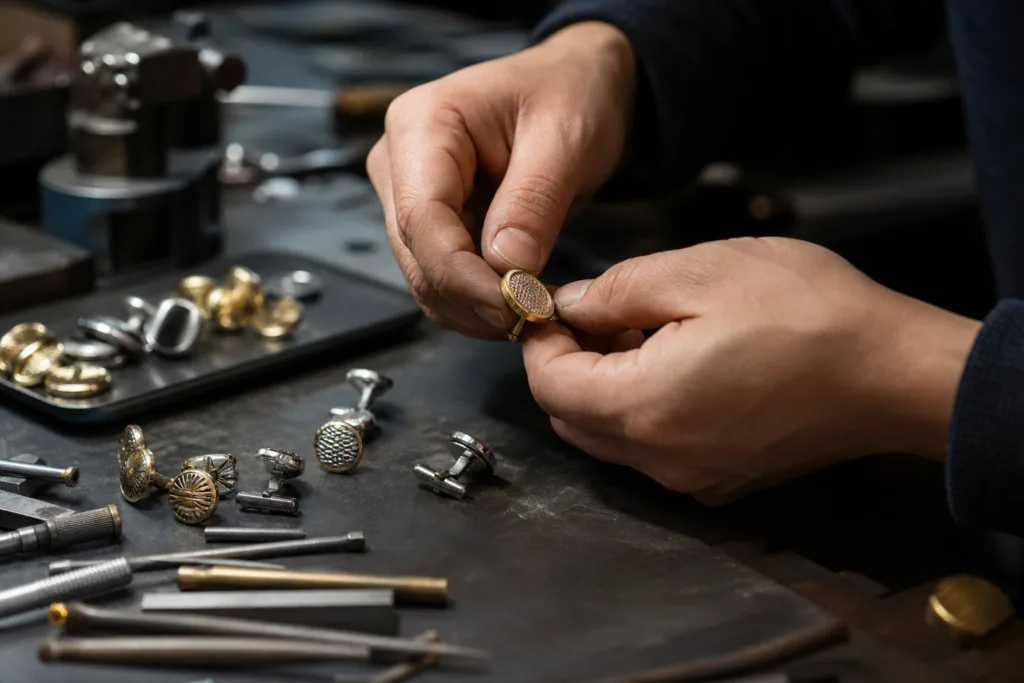
Artwork review
We first examine whether the logo and product shape are suitable for engraving, die striking, stamping, etching, or die casting. This is where line thickness, recessed areas, edge geometry, and closure compatibility are assessed.
Tooling or mold development
If the cufflink requires a custom face shape or relief structure, a mold or die is developed. Tooling quality has a direct effect on edge crispness, relief depth, and repeatability over the production run.
Forming and detailing
Depending on design, the face may be cast, stamped, or otherwise formed, then trimmed, polished, and prepared for decoration. Decorative steps may include engraving, enamel filling, surface texturing, or relief enhancement.
Plating and assembly
The face is plated to the required finish, then assembled with the cufflink finding or closure component. This stage requires alignment control so the finished pair feels consistent and functions properly.
Inspection and packing
Before packing, appearance, color, plating quality, logo legibility, and closure function should be checked against approved standards.
Sampling, mold development, and approval steps
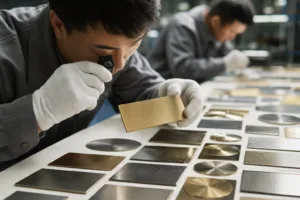
Sampling is where many avoidable problems are caught. Corporate buyers should not treat the sample as a formality. It is the point where size, weight, reflectivity, logo readability, closure comfort, and overall brand feel can be judged in physical form.
We encourage teams to compare digital artwork against actual sample appearance under real lighting and with the intended shirt fabric. A logo that looked clear on a screen may look too subtle once engraved on a mirror surface, while a plated tone may look warmer or cooler than expected next to the actual uniform.
This is exactly why sample approval before bulk production is critical. It helps buyers verify product structure, finish expectations, packaging details, and approval criteria before the order reaches a scale where corrections become slower and more expensive.
MOQ, lead time, and cost drivers for corporate orders
MOQ depends on construction complexity, custom tooling needs, packaging requirements, and whether the order is part of a wider uniform accessories program. In general, highly customized cufflinks with new molds and presentation packaging require more planning than plain stock-form adaptations.
Main cost drivers usually include:
- custom mold or tooling development
- metal choice and weight
- size and thickness
- plating type and finish complexity
- engraving or enamel decoration steps
- closure quality and assembly requirements
- custom packaging and insert design
- sample revisions before final approval
Lead time should include more than the factory production window. Buyers also need to account for artwork revision, sample discussion, packaging confirmation, and internal sign-off. For multinational uniform programs, this approval time can exceed actual manufacturing time if stakeholders are not aligned early.
Quality control checks that matter for custom cufflinks
Good cufflinks are judged at close range, so quality control needs to focus on details that users immediately notice. We typically recommend checking the following points during sample approval and bulk inspection:
| QC checkpoint | What to confirm | Why it matters |
|---|---|---|
| Plating consistency | Uniform color tone and coverage | Mismatched pairs look unprofessional |
| Surface finish | Scratches, pits, over-polishing, or cloudy areas | Visible at first glance on polished pieces |
| Logo clarity | Readable engraving, clean relief, controlled enamel edges | Protects brand presentation |
| Alignment | Face orientation and closure positioning | Affects pairing and wear appearance |
| Closure function | Smooth movement, secure retention, no excessive looseness | Directly impacts usability |
| Edge quality | No sharp burrs or uncomfortable roughness | Important for wearable safety and comfort |
| Packaging accuracy | Correct pair matching and box presentation | Important for gifting and distribution programs |
For employee-worn accessories, buyers should also think about general product safety and metal-contact expectations. It is sensible to review jewelry safety expectations when sourcing custom cufflinks for employees so supplier discussions cover material representations, finish consistency, and wearable item due diligence more clearly.
Packaging options for internal distribution, gifts, and uniform programs
Packaging should reflect how the cufflinks will be used. Internal issue packs for staff distribution may only need protective individual bags or simple branded boxes with SKU labels. Executive gifting programs may need rigid presentation boxes, foam inserts, sleeves, or paired sets coordinated with other accessories.
When packaging is planned late, buyers often face avoidable delays. Box dimensions affect shipping density. Insert structure affects how securely the cufflinks present. If the company wants private label presentation or multilingual inserts, that should be included during early approval rather than after the metal parts are completed.
For larger rollout programs, it is helpful to define whether packaging is for storage, daily issue, event gifting, or retail-style presentation. The same cufflink can need very different packaging depending on the distribution model.
Common design mistakes and how to avoid them
Many cufflink problems are preventable with better planning. The most frequent mistakes we see include:
- Overcomplicated logos: simplify artwork before tooling.
- Mismatch between finish and uniform: test plating against actual garment colors.
- Too much shine for conservative programs: consider satin, antique, or brushed effects.
- Ignoring weight: oversized faces can feel awkward on fine shirting.
- Weak closure selection: function matters as much as face design.
- Late packaging decisions: packaging should be planned with the product, not after it.
- Approving from renderings only: always inspect a physical sample.
A useful internal review question is simple: would this piece still look appropriate in daily wear after repeated handling and formal use, not just in a presentation image? If the answer is uncertain, the design likely needs refinement.
How companies use custom cufflinks to strengthen uniform branding
In practice, companies usually get the most value from cufflinks when they are tied to a clear uniform purpose. A luxury hotel may use them to distinguish concierge or management tiers. A private bank may use understated engraved pairs for senior client-facing staff. A corporate events team may include them in executive protocol attire for high-visibility launches or ceremonies. Membership organizations may use crest-based cufflinks for internal identity and formal occasions.
The strongest programs do not treat cufflinks as isolated souvenirs. They connect them to a broader appearance standard, including tie accessories, badges, buttons, or packaging. That integrated approach makes ordering more efficient and helps the accessories feel intentional rather than decorative add-ons.
How to choose a manufacturer for custom cufflinks
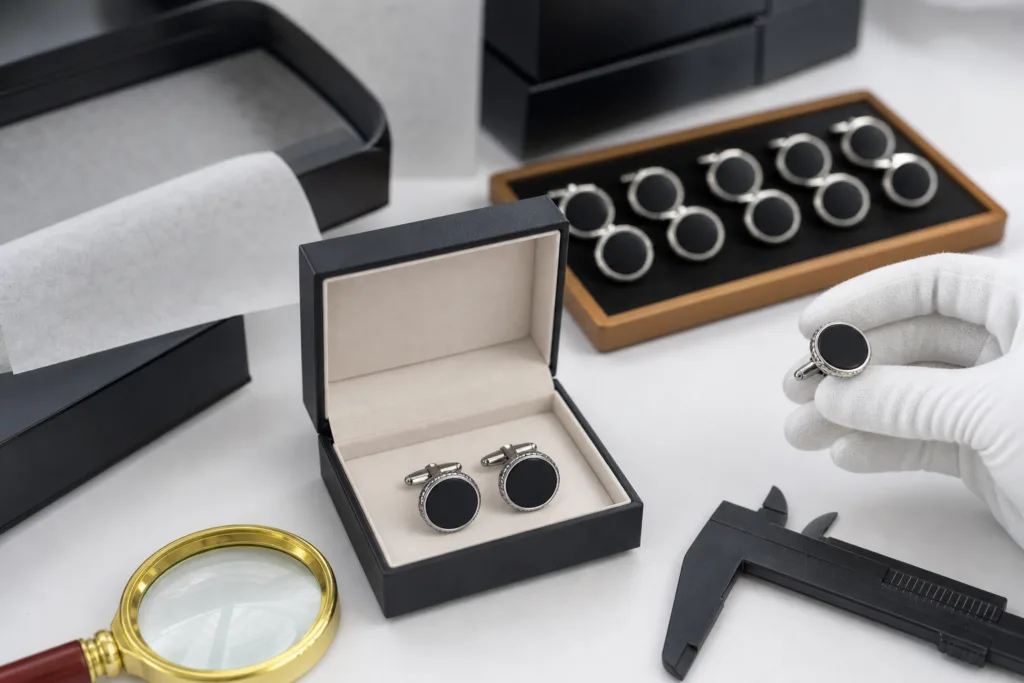
For procurement teams, supplier selection should go beyond unit price. The right manufacturer should be able to explain which process suits your artwork, how material choice affects appearance, what plating risks exist, how samples will be evaluated, and how quality standards will be maintained in bulk orders.
Useful evaluation questions include:
- Can the supplier explain why a specific material and process fit the logo and size?
- How will tooling, sample revision, and approval be managed?
- What plating and finish options are realistic for the target wear condition?
- How is pair alignment and closure function checked?
- Can packaging be coordinated with the wider uniform program?
- How are color, finish, and logo consistency controlled across production lots?
From our side as a manufacturer, the best projects happen when buyers share real use conditions, target image, expected quantity range, and reference garments early. That allows design and process choices to be made on practical grounds, not assumptions.
Conclusion
Custom cufflinks can be a valuable part of corporate attire when they are designed with discipline and manufactured with the right process controls. For brand managers and procurement teams, the key is to align the cufflink with the uniform environment, choose materials and finishes that support real wear conditions, simplify artwork for metal production, and treat sampling as a serious approval step. When those fundamentals are handled well, custom cufflinks can deliver a refined, brand-consistent result that supports formal presentation without feeling overstated.
FAQs
What material is best for custom cufflinks?
The best material depends on the design and use environment. Brass is often preferred for classic engraved styles and a refined feel, zinc alloy works well for custom shapes and dimensional designs, and stainless steel suits modern minimalist looks with laser engraving. The right choice should balance logo detail, finish style, weight, durability, and budget.
Are enamel cufflinks suitable for corporate uniforms?
Yes, but they work best when the brand identity can be expressed with simple color areas and a controlled visual style. For conservative corporate uniforms, enamel should usually be used in a subtle way rather than with bright multi-color decoration. If the goal is understated elegance, engraved or relief designs may be a better fit than enamel.
How large should a custom cufflink be for formal corporate attire?
Most formal corporate cufflinks work best at a moderate size that keeps the logo readable without overpowering the shirt cuff. The correct dimensions depend on face shape, closure structure, and logo complexity. During sampling, buyers should evaluate not only appearance but also comfort, proportion, and whether the cufflink feels too heavy for the intended shirt fabric.
Why is sample approval so important before bulk production?
Sample approval confirms that the actual product matches expectations for finish, weight, logo clarity, plating tone, closure function, and packaging. A digital rendering cannot fully show how reflective surfaces, engraved lines, or enamel colors will appear in real use. Approving a physical sample reduces the risk of costly adjustments after production has already scaled.
What quality issues should buyers check in custom cufflinks?
Buyers should check plating consistency, surface scratches, edge smoothness, logo legibility, pair matching, closure movement, and packaging accuracy. For polished or engraved styles, even minor defects can be obvious at close range. It is also important to confirm that the cufflinks feel secure and comfortable when worn with the actual uniform shirt.
Can custom cufflinks be packaged for both employee issue and executive gifting?
Yes. The same cufflink design can be packed differently depending on the distribution purpose. Employee issue programs may use simple protective or labeled packaging, while executive gifting often uses presentation boxes, inserts, and coordinated branding. Packaging plans should be discussed early because they affect budget, approval flow, and shipping preparation.