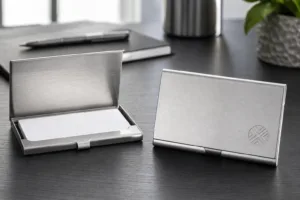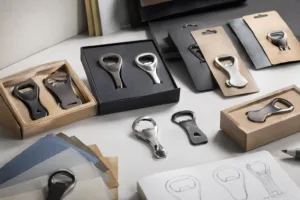
A metal business card holder with an engraved logo sits at an interesting point between utility and brand presentation. For B2B buyers, it is not just a desk accessory or gift item. It is a custom metal product that needs the right material, structure, engraving method, finish, and packaging to represent a company well in meetings, trade shows, corporate gifting programs, and internal brand kits. From our manufacturing perspective, buyers get better results when they evaluate these holders the same way they would evaluate any other branded metal product: by looking closely at material behavior, logo detail, production method, and consistency in bulk orders.
If your project also involves brand identification parts, equipment branding, or durable decorative components, OEM metal label and nameplate manufacturing support can be relevant beyond business card holders alone. Many buyers who start with a card holder program later need matching metal branding elements, such as engraved plates, tags, or presentation hardware, and we often help connect those needs through material selection, artwork refinement, surface finishing, sample approval, and coordinated bulk production planning.
What a metal business card holder with an engraved logo actually includes
In simple terms, this product is a metal holder designed to store and present business cards while carrying a customized brand mark. That brand mark may be a logo, company name, person’s name, title, slogan, or even a QR code, depending on the format and available decoration area. The primary value comes from combining practical organization with a more lasting brand impression than paper-based promotional materials alone.
For buyers, the key point is that not all holders are the same. Some are made as slim pocket cases for sales teams and executives. Others are desktop holders used in reception areas, meeting rooms, hotel counters, real estate offices, or trade show booths. The customization area, opening structure, card capacity, wall thickness, hinge quality, and edge finish all affect how premium the final item feels.
In many projects, the decoration principles overlap with other branded metal parts, especially engraved logo nameplates for branding, where line clarity, surface contrast, and readable detail determine whether a logo looks sharp or weak after production.
Why engraved metal card holders matter in professional settings
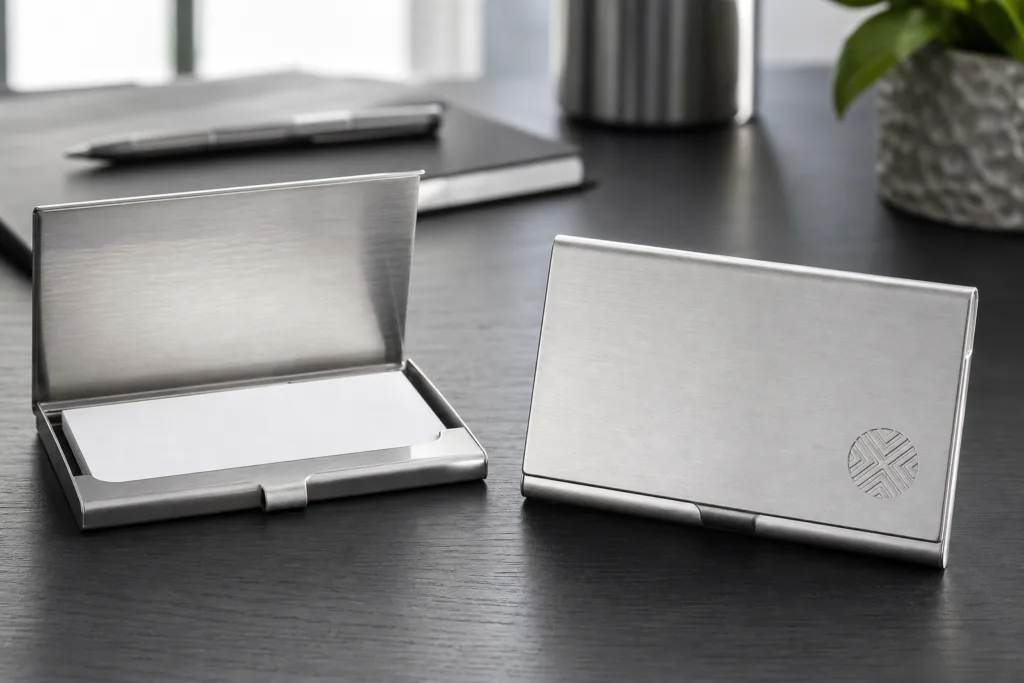
Professional branding often works through small physical signals. A well-made metal holder suggests order, permanence, and attention to detail. That matters in environments where people judge quality quickly: client meetings, boardrooms, premium retail counters, hospitality desks, and formal events.
Engraving adds a different impression than printed decoration. Printed marks can be colorful and cost-effective, but engraved branding tends to feel more integrated with the product itself. It creates depth, texture, and a sense of permanence. For corporate gift buyers, that can be especially useful when the goal is to present a practical item that still carries a subtle brand presence rather than a loud promotional look.
We also see these holders used when companies want consistency across a broader identification system. In those cases, branded holders may sit alongside durable metal plates for identification and tracking or other fixed branding components used in offices, equipment kits, or presentation sets.
Common use cases for corporate buyers
Networking events and trade shows
At events, a metal holder helps keep cards neat and accessible while reinforcing a more polished image. Buyers should think about portability, opening speed, scratch resistance, and whether the logo needs to be visible while the holder is in use on a table.
Client meetings and executive use
For direct client-facing teams, slim profile and understated branding usually matter more than high decoration coverage. A brushed stainless steel or matte black plated finish with a small engraved logo often works better than a highly reflective surface with oversized artwork.
Reception and front-desk display
Desktop formats need a stable base, enough card capacity, and a visible front logo zone. Here, the holder acts as a mini brand fixture, so front-face angle, card exposure, and edge quality become important.
Corporate gifting
As a gift item, presentation quality matters almost as much as the holder itself. Buyers should plan insert cards, protective wrapping, gift boxes, and whether personalization such as employee names or titles will be added.
Metal material options for a metal business card holder
Material choice affects not only cost, but also weight, corrosion behavior, engraving appearance, dent resistance, and perceived value. The most common options are stainless steel, aluminum, brass, and zinc alloy.
| Material | Main strengths | Possible limits | Best-fit use cases |
|---|---|---|---|
| Stainless steel | Good corrosion resistance, clean modern look, durable edges | Harder material may increase processing difficulty for some shapes | Executive holders, daily-use pocket cases, minimalist premium branding |
| Aluminum | Lightweight, easy to anodize or brush, comfortable for portable use | Can scratch or dent more easily than some thicker steel structures | Trade show distribution, lightweight gift programs, portable cases |
| Brass | Warm premium tone, excellent for classic engraving aesthetics | Heavier, usually higher material cost, may require more finish care | Luxury gifting, heritage-style branding, formal presentation pieces |
| Zinc alloy | Flexible for shaped parts and decorative structures, good for custom forms | Less ideal for very thin high-flex components if design is not engineered well | Decorative desktop holders, custom form factors, multi-part builds |
Stainless steel is often the safest all-around choice for buyers who want a professional appearance with dependable long-term use. Surface condition and alloy choice influence how well it resists handling marks and environmental exposure. Buyers comparing stainless options can learn how stainless steel grade and surface finish affect corrosion resistance and long-term presentation, which is especially useful when holders will be used frequently or stored in mixed office and travel conditions.
Aluminum is attractive when low weight matters. It works well for promotional distribution, portable cases, and modern matte-finish designs. Brass is more specialized but offers a richer visual character for premium gifting. Zinc alloy becomes relevant when the design includes cast structural features, decorative frames, or non-flat forms that are easier to create through die casting than from bent sheet metal.
Design styles and holder formats
Desktop holders
These are built for display and repeated access. Capacity matters more than compactness. The front face becomes the main branding area, so logo placement should stay visible even when the holder is full of cards.
Pocket and slim cases
These prioritize portability. The right design balances thinness with enough rigidity to avoid deformation in bags or pockets. Hinge strength, closure fit, and corner safety are key details here.
Foldable or hinged formats
These look formal and can carry interior or exterior branding. However, hinge construction and alignment need close quality control because poor fitting becomes obvious quickly.
Minimalist designs
Minimalist holders often have less decoration area, which means the engraved logo must be especially precise. Small errors in centering, line depth, or finish contrast are easier to notice on a clean, simple surface.
Engraving techniques explained
The term engraved logo can mean different production approaches, and buyers should confirm the exact method before approving samples.
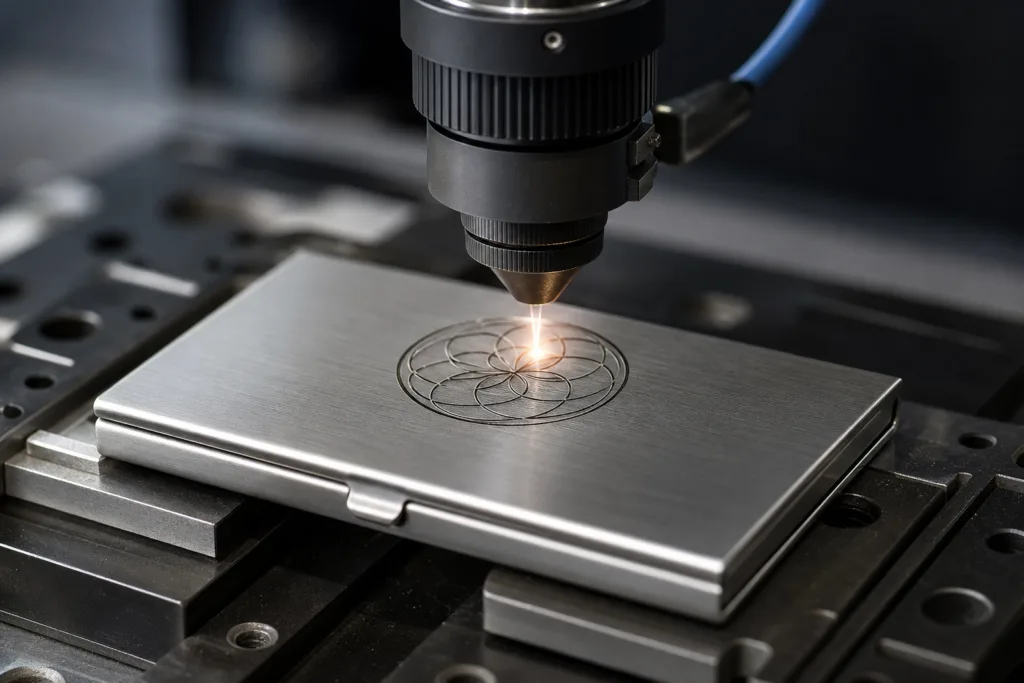
Laser engraving
Laser engraving is widely used for clean, accurate marks on stainless steel, aluminum, coated surfaces, and some plated materials. It is well suited for logos, names, and serial personalization. It works best when artwork is clean and vector-based.
Chemical etching
Etching is useful for fine lines and more controlled recessed detail across flat metal surfaces. It can create elegant logo definition, especially when paired with filled color or contrast finishing.
Debossed or stamped detail
On some metal parts, recessed branding can be formed mechanically during stamping or mold shaping. This is more relevant when the holder includes decorative metal plates, shields, or mounted logos rather than when the entire holder body is directly engraved.
Filled engraving
After engraving or etching, recessed areas can sometimes be filled with black, white, or brand colors to improve contrast. This is helpful when logos contain fine lines or need stronger visibility from a distance.
When buyers want very crisp and consistent branding, we often recommend reviewing precision engraved logo detailing options from similar small-format metal products, because the same principles of depth control, edge clarity, and finish contrast apply to card holders too.
How logo placement and artwork detail affect branding
A logo can be centered, aligned to one corner, placed on a mounted plate, repeated as a pattern, or engraved on both exterior and interior surfaces. The right choice depends on how visible the holder should be during use.
For B2B buyers, the most common mistake is trying to fit too much detail into too small an area. Thin lines, tiny text, gradients, and highly detailed seals may not translate well on every metal and finish combination. A more simplified logo version often produces a stronger result than the full corporate mark.
Artwork quality is also critical. We strongly prefer vector files because they preserve line definition and scale accurately for production. If the supplied file is low-resolution, the engraving can become soft, uneven, or overcorrected during artwork cleanup. Buyers preparing files should review vector artwork preparation for clean engraving before sample making, especially when logos include fine lettering or geometric lines.
Finish options that change the final look
Surface finish changes both style and functionality. It affects how fingerprints show, how engraving contrasts, and how scratches become visible over time.
| Finish | Visual effect | Practical note |
|---|---|---|
| Polished | Bright, reflective, formal | Shows fingerprints and fine scratches more easily |
| Matte | Soft, understated, modern | Good for subtle branding and reduced glare |
| Brushed | Linear texture, professional, technical | Helps hide minor handling marks better than mirror polish |
| Antique | Aged, classic, decorative | Better for heritage or souvenir-style branding than minimalist office use |
| Electroplated | Decorative metallic color such as nickel, black nickel, gold tone, chrome-like look | Requires finish consistency and good substrate preparation |
For stainless surfaces, polishing quality directly affects both appearance and branding sharpness. Buyers comparing brushed and polished finishes can see how polishing and electropolishing influence the look and durability of stainless steel finishes, which helps explain why finish preparation matters before engraving and final inspection.
Electroplated finishes can be attractive for gift programs or luxury-style presentation, but they require a supplier that controls surface cleanliness, plating consistency, and post-plating protection. Matte black, satin nickel, and brushed steel looks are often more forgiving for daily use than mirror-bright decorative finishes.
Customization ideas that add practical value
Beyond a standard logo, buyers can increase usefulness with selective personalization. Good options include:
- Individual names for executives or sales teams
- Job titles for premium onboarding kits
- A short slogan or brand statement inside the holder
- QR codes linked to a digital profile or product page
- Department marks for internal distribution
- Edition marks for events, anniversaries, or conferences
The key is balance. Too many elements can make the holder look crowded. For most professional uses, one primary brand mark and one secondary information element are enough.
How to choose the right holder for different industries
Finance, legal, and consulting
Choose clean lines, restrained branding, and stainless steel or brass with subtle engraving. These sectors usually prefer formal presentation over decorative styling.
Technology and design firms
Brushed steel, matte aluminum, or black plated finishes often fit better. Minimalist logos and QR-enabled personalization can work well here.
Hospitality and real estate
Desktop visibility matters. Larger logo areas, stable structures, and premium gift packaging are often more useful than ultra-slim cases.
Trade show and promotional distribution
Weight, budget control, and production scale become more important. Aluminum or simplified stainless designs may offer the best cost-performance balance.
Key manufacturing factors buyers should check
From our metal manufacturing perspective, a card holder should not be evaluated by appearance alone. Structural details determine whether the product still feels good after weeks or months of use.
Thickness and rigidity
Very thin metal can reduce weight and cost, but if the body flexes too easily, the holder quickly feels low-grade. Desktop units need base stability, while pocket cases need shell rigidity.
Capacity
Card thickness varies by paper type and finish. Capacity claims should be tested using realistic card stock, not only thin sample cards.
Edge safety
Edges should be smooth and comfortable. Sharp corners or poorly deburred openings are unacceptable for a product handled frequently.
Closure and hinge quality
For foldable cases, closure force and hinge alignment should be checked over repeated opening cycles. Poor assembly tolerances can make even a good-looking sample fail in use.
At Gairun, we usually advise buyers to define the holder’s actual use environment before confirming structure, because travel use, desk display, and gift presentation do not require the same balance of thickness, weight, and opening design.
Sample, MOQ, and lead time considerations
Custom engraved holders usually involve several stages: artwork review, structural confirmation, sample development, finish approval, packaging check, and then bulk production. MOQ depends on whether the holder uses a standard existing structure with custom engraving, or a fully custom body with new tooling or custom components.
In general, standard-form holders with custom logos are easier to sample and faster to produce. Fully custom structures with special hinges, cast parts, mounted plates, or individualized packaging take longer because more variables must be approved.
Buyers should ask suppliers:
- Is the holder based on an existing model or a new structure?
- Will there be tooling or mold charges?
- Can a pre-production sample match the final finish exactly?
- How are personalized versions handled in bulk?
- What is the approval deadline to protect shipment timing?
Quality control checklist for engraved holders
A reliable QC process should cover both visual and functional points. We recommend checking the following during sampling and bulk inspection:
- Logo position is centered or aligned as approved
- Engraving depth or mark contrast is consistent
- Small text remains legible
- Finish color and texture are uniform across units
- No major scratches, pits, stains, or plating defects
- Edges and corners are smooth
- Holder opens and closes correctly
- Card capacity matches the approved specification
- Packaging protects the surface during transit
For aluminum versions, protective packing matters more than many buyers expect because finished surfaces can mark during storage or shipping if units are not separated or wrapped properly. That is one reason why surface protection should be discussed before mass production, not after damage appears.
Packaging options for corporate gifting and presentation
Packaging affects first impression, transit protection, and perceived value. For regular B2B distribution, a polybag, tissue wrap, or protective sleeve may be enough. For gifting programs, buyers often need presentation boxes, EVA inserts, paper sleeves, branded cards, or outer cartons organized by recipient name.
When the holder has a polished or plated finish, protective film or soft internal packing may be needed to reduce abrasion. This matters even more when multiple products are packed together in a set. Good packaging planning also reduces rework risk from fingerprint transfer, corner rubbing, or mixed personalized names.
Common mistakes buyers make when ordering custom metal card holders
- Approving artwork without checking minimum readable text size
- Choosing a mirror finish without considering fingerprint visibility
- Focusing on unit price while ignoring hinge or edge quality
- Skipping sample approval for personalized versions
- Not defining whether the holder is for pocket carry, desk display, or gifting
- Using a highly detailed logo that loses clarity after engraving
- Leaving packaging decisions until the end of the project
Most of these issues can be prevented by aligning product use, material, finish, and logo method early in the sourcing process.
How to evaluate a metal products manufacturer for this project
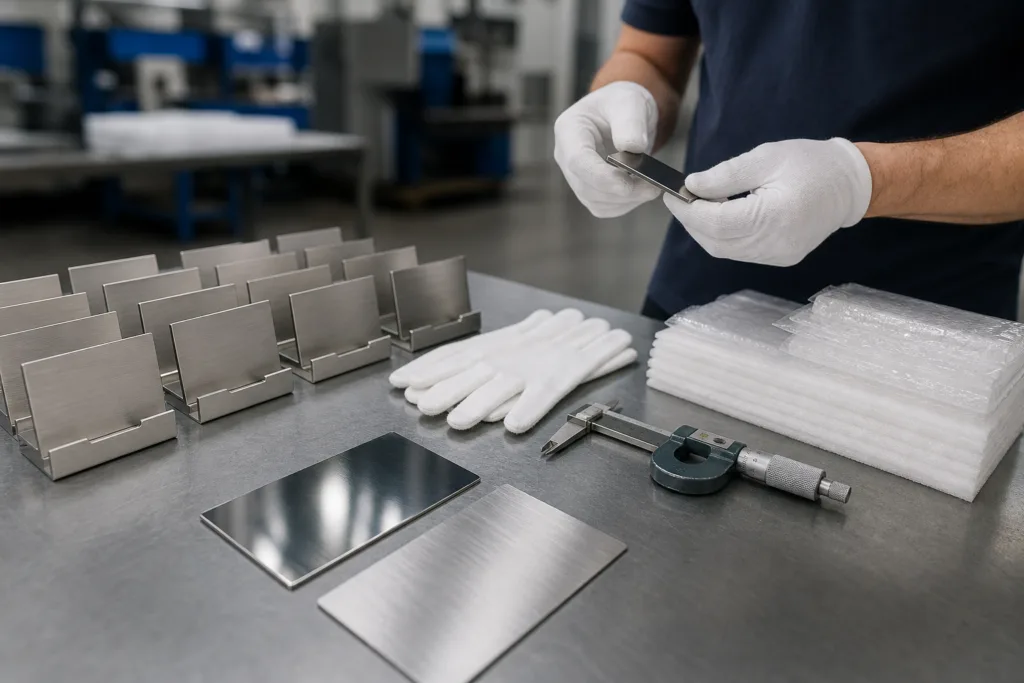
Buyers should look for a manufacturer that can discuss the product as a real metal item, not only as a decoration surface. That means asking how the supplier handles material recommendation, engraving readability, finish matching, sample correction, protection in packing, and consistency in bulk production.
A capable manufacturer should be able to explain:
- Which materials suit your budget and use environment
- Whether engraving, etching, stamping, or mounted plates are the better branding method
- How sample comments will be controlled in production
- What inspection points are used for logo and surface quality
- How OEM or private label packaging can be organized
This is especially important for sourcing teams managing multiple branded metal products across one program. The more clearly a supplier understands custom metal production logic, the easier it is to maintain consistency across holders, tags, plates, accessories, and packaging elements.
Conclusion
A metal business card holder with an engraved logo can be a practical branding tool, a polished desk accessory, or a refined corporate gift, but only when the product is matched carefully to the use case. Material choice, structure, engraving method, logo detail, finish, packaging, and QC all influence the final result. For B2B buyers, the safest approach is to treat the holder as a custom metal product project rather than a simple off-the-shelf item with a logo added at the end. That mindset leads to better sampling decisions, clearer supplier communication, and stronger brand presentation in the final order.
FAQs
What is the best material for a custom metal business card holder?
There is no single best material for every project. Stainless steel is often the most balanced option for professional appearance, corrosion resistance, and daily durability. Aluminum is better when low weight matters, brass suits premium or classic styling, and zinc alloy can help when the design needs decorative shaping or multi-part construction.
Will an engraved logo last longer than printed branding?
In many professional-use cases, yes. An engraved logo is cut into or marked on the metal surface, so it generally feels more permanent than surface printing alone. However, long-term appearance still depends on the base material, finish type, handling conditions, and whether the engraving method was matched properly to the holder surface.
How much logo detail can fit on a metal holder?
The answer depends on holder size, engraving area, and the production method. Simple logos, initials, and short text usually reproduce well, while very fine lines, tiny text, and complex seals may need simplification. A vector file and a sample review are the safest way to confirm how much detail will remain clear after production.
Can each holder be personalized with a different name or title?
Yes, many custom programs support variable personalization, especially with laser engraving. The important point is to confirm the data format, name list accuracy, layout rules, and inspection method before mass production begins. Personalized orders also need careful packaging control so each item reaches the correct recipient.
What MOQ should buyers expect for engraved metal card holders?
MOQ varies based on whether you are using an existing holder model or developing a more custom structure. A standard holder with a custom engraved logo usually has a lower entry quantity than a fully custom design with tooling, special finish work, or personalized packaging. Buyers should ask separately about MOQ for samples, bulk units, and individualized versions.
What should I check before approving a production sample?
Check logo size and position, engraving clarity, finish consistency, edge smoothness, opening and closing function, card capacity, packaging protection, and overall feel in hand. It is also wise to compare the sample against the intended use scenario, because a holder that looks good in photos may still be too heavy, too reflective, or too delicate for the actual application.