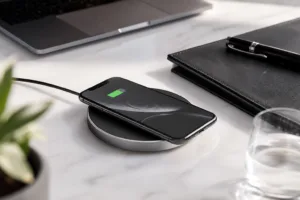
Wireless chargers with metal housings are increasingly relevant for offices that want cleaner desks, better durability, and a more polished device experience for employees, visitors, and shared workspaces. For procurement teams, the decision is not only about charging speed. It also involves enclosure material, thermal behavior, finish quality, stability on the desk, long-term wear, and whether the product still looks professional after months of daily use. From our manufacturing perspective, housing choice has a direct effect on product feel, heat spread, visual consistency, and service life, especially in environments where chargers are handled repeatedly.
When a project also involves custom branding, accessory integration, or durable hardware for workplace products, buyers often need to think beyond electronics alone. Although this article focuses on wireless chargers, the same evaluation logic used in Gairun metal product development applies to enclosure planning: material selection, surface finish, structural details, sample review, packaging, and consistency in bulk production all influence the final user experience in office use.
What Are Wireless Chargers with Metal Housings?
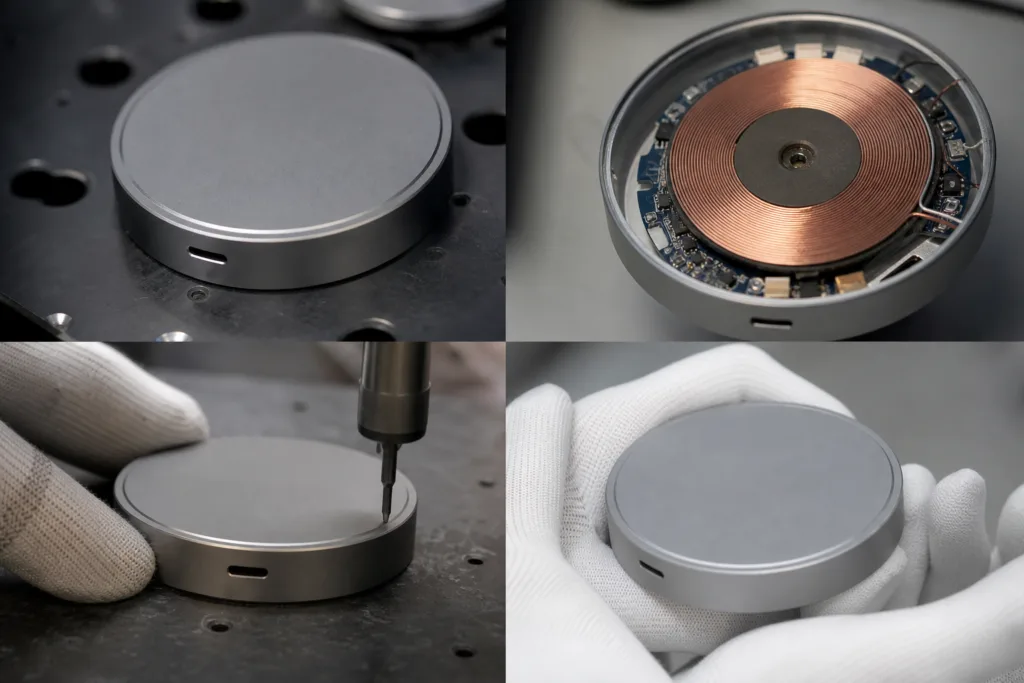
Wireless chargers with metal housings are charging pads, stands, or desktop modules that use a metal outer shell instead of a fully plastic enclosure. The charging function still depends on the internal wireless charging coil, control board, shielding design, and power management system, but the external body is built with materials such as aluminum alloy, stainless steel, zinc alloy, or mixed constructions that combine metal and non-metal parts.
In practice, many office-oriented models use aluminum for the visible exterior because it offers a good balance of weight, appearance, machining flexibility, and heat spreading. Some premium models use stainless steel for a more rigid and upscale feel, while others combine a metal frame with a silicone or TPU charging surface to improve grip and reduce phone movement. This mixed construction is common because the housing has to support appearance and durability without interfering with practical user handling.
For B2B buyers, the phrase “metal housing” should be verified carefully. Some products have only a decorative metal ring, while others use a true metal shell with meaningful structural and thermal value. That difference matters when you are evaluating cost, desk appearance, longevity, and brand presentation across dozens or hundreds of units.
Why Metal Housings Matter: Aesthetics, Durability, and Heat Dissipation
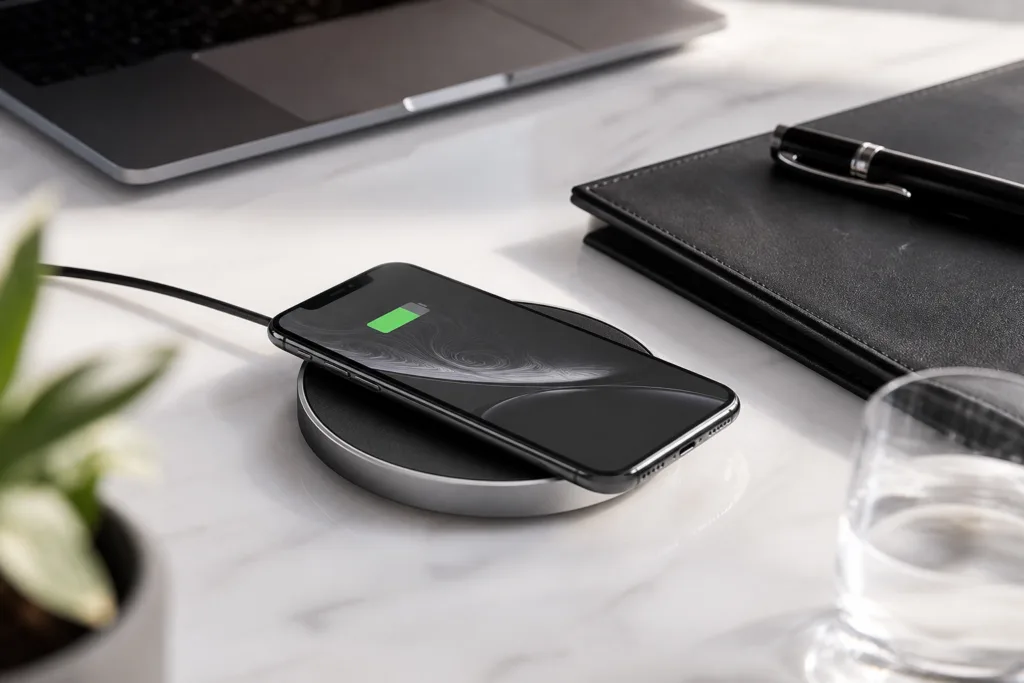
A more professional office appearance
In offices, visual consistency matters more than many buyers first expect. A charger may be small, but it sits on desks, meeting tables, reception counters, and executive workspaces where it becomes part of the environment. Metal housings usually deliver a cleaner, more premium impression than glossy low-cost plastic. They pair naturally with laptops, monitor stands, docking stations, task lamps, and conference room hardware that already use silver, black, graphite, or brushed metallic finishes.
This does not mean every office needs luxury styling. It means the charger should look intentional rather than disposable. For visitor-facing areas, that can improve brand perception subtly. For internal use, it helps maintain a neat, organized workstation standard.
Better resistance to daily wear
Plastic housings can work well, but lower-grade plastic surfaces often show scratches, edge whitening, gloss loss, and deformation sooner in heavy office use. Metal housings generally resist casual abrasion better, especially when anodized, bead-blasted, brushed, or coated appropriately. They also tend to feel more solid when picked up and repositioned repeatedly.
That matters in shared desks and meeting rooms, where chargers are not treated gently. A wireless charger that slides, tips, scuffs easily, or develops visible wear after a short period can make a workplace accessory program feel poorly chosen, even if the electronics still function.
Heat spreading advantages
Heat management is one of the most practical reasons buyers consider metal housings. Wireless charging produces heat through energy transfer, conversion losses, alignment variation, and device-side battery management. A well-designed metal enclosure can help spread localized heat across a larger surface area rather than trapping it in one small zone. Material selection plays a real role here, and why housing material affects heat dissipation is an important engineering point when comparing aluminum and stainless steel with lower-conductivity alternatives.
That said, metal is not automatically better in every charger. Good thermal performance still depends on internal layout, coil spacing, shielding, ventilation strategy, and how the metal parts are separated from charging components. A poorly engineered metal charger can still run warm, while a well-designed plastic model can perform reliably. Buyers should assess the complete product, not only the material label.
Metal vs. Plastic Housings: Performance and User Experience Comparison
| Factor | Metal Housing | Plastic Housing |
|---|---|---|
| Visual impression | Usually cleaner, more premium, more office-friendly | Can range from basic to good, but often looks more consumer-grade |
| Durability | Better scratch and structural resistance in many daily-use settings | Depends heavily on resin quality and wall thickness |
| Heat spread | Can help distribute heat when engineered correctly | Usually less effective at spreading heat |
| Weight and stability | Often heavier and more stable on the desk | Lighter, sometimes easier to shift accidentally |
| Surface feel | Cool, dense, precise, often more refined | Can feel lighter or less substantial |
| Cost | Usually higher due to material and finishing processes | Often lower and more flexible for budget deployments |
| Branding execution | Works well with engraving, laser marking, anodized finishing | Works well with pad print or molded branding, but may wear faster |
| Impact damage behavior | May dent or mark, but often remains structurally intact | May crack, chip, or show stress marks depending on grade |
For office procurement, the comparison is usually not “Which is universally better?” but “Which is better for this usage pattern?” If the chargers are for executive desks, boardrooms, reception counters, premium employee kits, or long-life workplace installations, metal housings often justify their higher cost. If the project is a budget-wide rollout to temporary desks or short-cycle promotions, plastic may still be the rational choice.
We see similar trade-offs in many product categories: the right material depends on touch frequency, visual exposure, expected service life, and brand standards, not only unit price.
Best Office Applications for Wireless Chargers with Metal Housings
Executive desks
Executive workspaces typically benefit from low-profile chargers with stable bases, understated finishes, and minimal visual clutter. Metal housings fit these environments because they integrate well with premium desk accessories and maintain a professional appearance over time.
Meeting rooms
In shared conference spaces, chargers should be intuitive, durable, and easy to reposition without feeling flimsy. A slightly heavier metal charger is often more stable when multiple people use it during back-to-back meetings. If a meeting room setup also includes branded hardware or desk accessories, buyers often evaluate finish matching in the same way they would for custom metal keychains or other visible branded metal items: consistency matters when products are part of a curated workplace kit.
Reception and waiting areas
These spaces need chargers that look clean, feel reliable, and support casual guest use. Fingerprint resistance, anti-slip surfaces, and cable strain protection are especially important here because no one “owns” the product. A charger that visually communicates quality can reinforce a more considered brand environment without needing oversized branding.
Shared desks and hot-desking zones
For hot-desking, a wireless charger should be easy to use, stable, compatible with common phone models, and simple to wipe clean. Metal housings can be advantageous if they use durable coatings and rounded edges that tolerate repeated handling. In these settings, buyers should also think about cable routing and whether the charger stays aligned in a standardized desk layout.
Corporate gifting and onboarding kits
Wireless chargers with metal housings are also suitable for internal gifting, employee welcome kits, or distributor programs where product presentation matters. This is where custom logo execution, packaging quality, and finish control become more important than raw charging speed alone.
How Sleek Metal Designs Support Modern Desk Setups and Brand Image
Office accessories contribute to the overall feel of a workspace. A charger with sharp molding lines, uneven color, or a glossy consumer look can feel out of place next to premium laptops, aluminum monitor arms, and minimalist storage systems. Metal housings help create a calmer, more integrated setup because they usually rely on simpler geometry and more controlled finishes.
From a buyer standpoint, this matters for three reasons. First, employees are more likely to keep and use accessories that fit their desk environment. Second, visitor-facing spaces benefit from products that look intentional rather than promotional. Third, branded workplace products should reflect the organization’s standards. Subtle laser engraving, brushed grain direction, edge smoothness, and matte treatment can all influence whether a charger looks like a lasting office tool or a short-term giveaway.
For teams comparing product presentation across multiple custom accessories, the same finish logic used in custom lapel pins and metal identity items can be useful: the surface treatment defines the perceived quality almost as much as the structure itself.
Key Material and Construction Factors to Evaluate Before Buying
Aluminum vs. stainless steel
Aluminum is the most practical option for many office chargers because it is lightweight relative to steel, supports clean CNC or die-cast forms, and can deliver attractive anodized or painted finishes. It also offers meaningful heat-spreading benefits. Stainless steel gives a more rigid and dense feel, but it is heavier, usually more expensive to process, and can show fingerprints more easily depending on finish.
One-piece shell vs. decorative panels
Some chargers use a true structural metal shell. Others use a plastic body with a thin metal plate attached for appearance. Buyers should ask which construction method is used. A structural shell typically provides better perceived quality and stability, while a decorative panel may mainly serve visual goals.
Edge quality and user contact points
In daily office use, edge finishing matters. Look for smooth transitions, no sharp seams, and well-controlled chamfers or radii. A charger may be handled hundreds of times over its life, and poor edge quality quickly becomes noticeable.
Top surface material
Many metal chargers still use a non-slip charging surface made from silicone, rubberized coating, or a fine-texture polymer insert. This is often a good sign. Phones need grip and surface protection. A fully exposed hard metal top can look attractive, but it may allow more sliding unless the design includes a retaining ring or textured contact area.
Base design and anti-slip pads
A stable base is essential in office environments. Soft feet, a balanced center of gravity, and adequate base diameter reduce accidental movement when the device is placed one-handed during calls or meetings.
Compatibility, Power Output, and Charging Efficiency Considerations
Buyers sometimes focus too heavily on housing material and overlook charging fundamentals. That is a mistake. Before approving a model, verify device compatibility, input power requirements, supported charging profiles, alignment tolerance, and charging behavior with cases attached.
For procurement teams, one of the simplest risk-reduction steps is to verify Qi-certified compatibility and procurement checklist requirements rather than relying on vague “Qi compatible” wording. In an office, a charger should work reliably across common employee and visitor devices without creating avoidable support issues.
Power output should also match real use conditions. A high advertised wattage does not guarantee a better user experience if thermal throttling, poor alignment, or low-quality power adapters reduce actual performance. In many workplaces, consistent mid-to-high reliable charging is more useful than chasing the highest number on the box.
Ask suppliers the following:
- Which phone families were validated during testing?
- Is the stated power output dependent on a specific adapter?
- How sensitive is charging speed to off-center placement?
- Does the charger work well with standard office phone cases?
- What happens if foreign objects are placed on the pad?
These questions reveal more about product quality than marketing phrases do.
Heat Management and Safety: What Buyers Should Check
Heat is normal in wireless charging, but uncontrolled heat is a warning sign. A good office charger should maintain stable operation over repeated charging sessions without becoming uncomfortable to touch or causing frequent stop-start charging behavior.
When we evaluate metal-based products from a manufacturing perspective, we look at both material and system design. Housing choice helps, but internal architecture matters just as much. Buyers should ask whether the charger includes temperature protection logic, foreign object detection, overcurrent protection, and sensible spacing between coil, shielding, and enclosure parts.
It is also wise to review how the charger behaves during realistic office use: long meetings, multiple back-to-back users, warm room conditions, and charging through thin cases. If sample testing is possible, run the product in these conditions rather than only trying it for a few minutes on a showroom table.
For larger deployments, create a basic acceptance checklist that includes surface temperature feel, charging continuity, cable connector firmness, underside stability, and visible finish changes after repeated use. This type of practical validation often prevents returns and user complaints later.
Surface Finish, Stability, and Daily Use Experience in Office Environments
Surface finish is not only a cosmetic choice. It affects grip, scratch visibility, fingerprint resistance, and how easily the charger blends into the workspace. Matte anodized aluminum is often a strong choice for office use because it looks refined and hides minor handling marks better than glossy coatings. Brushed finishes can also work well, but the grain direction and consistency should be checked carefully in bulk orders.
Dark finishes can look elegant, but they may reveal dust, skin oils, and wear around high-contact edges more quickly. Silver, graphite, and soft metallic neutrals often age more gracefully in shared office settings. If branding is required, laser marking or subtle engraved logos usually hold up better visually than large printed graphics.
Stability is equally important. A charger that shifts each time someone places a phone on it creates a poor user experience. Weight distribution, rubber feet, cable exit angle, and underside flatness all contribute to real-world performance. These are the kinds of details buyers often notice only after deployment, which is why pre-production evaluation matters.
Teams that already manage other branded desk or identity products, including custom challenge coins, often recognize that perceived quality comes from consistency in small details. The same principle applies here.
How to Select the Right Wireless Charger for Your Workspace or Bulk Purchase
The right selection process starts with use scenario, not catalog browsing. Procurement teams should define where the chargers will be used, who will use them, and what level of appearance and durability is expected.
Match the charger to the environment
- Executive or premium desks: prioritize finish quality, slim profile, metal stability, and discreet branding.
- Meeting rooms: prioritize easy placement, broad compatibility, cable durability, and shared-use stability.
- Reception areas: prioritize appearance, wipe-clean surfaces, anti-slip design, and guest-friendly usability.
- Bulk employee rollout: balance price with reliability, standardization, and replacement planning.
Ask for samples before bulk approval
Sample review should include actual desk use, not only visual inspection. Test with several phone models, common protective cases, and different users. Check whether the charger stays in place, whether the finish shows marks quickly, and whether charging remains stable over longer periods.
Review packaging and deployment details
If the chargers are part of a workplace rollout or branded kit, packaging quality matters. Individual box protection, barcode labeling, user instructions, cable organization, and master carton consistency all affect receiving, distribution, and user satisfaction.
In broader OEM and custom hardware programs, we use the same discipline found in projects such as custom medals: clear specifications, sample confirmation, finish approval, packaging review, and bulk consistency checks reduce surprises during rollout.
Balance cost against service life
A cheaper charger may not be cheaper over the full lifecycle if it wears out quickly, looks poor after several months, or creates compatibility complaints. For office procurement, total usability often matters more than the lowest initial cost.
Maintenance Tips to Extend Product Lifespan
Maintenance is straightforward but should not be ignored. Dust, desk debris, and skin oils can affect appearance and, in some designs, charging stability. Use soft cloth cleaning and avoid harsh chemicals that may damage anodized, painted, or coated finishes. Check that the cable connection remains firm and that anti-slip feet are not peeling or flattening over time.
It is also useful to give internal users simple guidance: place the phone centrally, avoid stacking metal objects on the pad, and disconnect visibly damaged cables promptly. In shared spaces, routine wipe-downs keep the product looking professional and reduce premature cosmetic aging.
Common Buying Mistakes to Avoid

Choosing based on appearance alone
A sleek metal shell is not enough. Buyers still need to verify charging reliability, certification status, and ergonomic performance.
Assuming all metal housings perform the same
Aluminum, stainless steel, hybrid shells, and decorative metal trims behave differently in weight, feel, heat spread, and finish durability.
Ignoring desk stability
Some chargers look attractive in photos but slide too easily in real use. Stability should be part of sample testing.
Overlooking case compatibility
If employees commonly use protective phone cases, the charger should be tested in those conditions before approval.
Underestimating finish wear
Glossy or low-quality coated surfaces may age quickly in shared office use. Ask about finish process and abrasion resistance.
Buying without a clear deployment plan
For multi-site offices or large teams, packaging, labeling, spare units, and replacement handling should be planned early, not after delivery.
Conclusion
Wireless chargers with metal housings can be a smart choice for offices that value a cleaner look, better durability, and a more stable day-to-day user experience. The right model should do more than look premium. It should deliver reliable compatibility, sensible thermal behavior, stable desk placement, practical finish durability, and a specification that fits the actual workplace environment. For B2B buyers, the best decision usually comes from comparing materials, construction details, charging performance, and deployment conditions together rather than treating the metal housing as a purely cosmetic upgrade.
FAQ
Are wireless chargers with metal housings better than plastic models for offices?
They are often better for offices that care about appearance, durability, and desk stability, but not automatically in every case. A well-made plastic charger can still perform well. Metal housings usually make more sense when the product will be visible, handled often, or expected to maintain a professional look over a longer service life.
Do metal housings improve heat dissipation in wireless chargers?
They can help spread heat more effectively than many plastic housings, especially when aluminum is used and the internal design is engineered correctly. However, heat performance also depends on coil layout, shielding, power management, and enclosure design, so buyers should evaluate the full product rather than assuming all metal chargers run cooler.
What material is usually the most practical for office wireless chargers?
Aluminum is often the most practical choice because it offers a good balance of appearance, weight, finish options, and heat spreading. Stainless steel can feel more rigid and premium, but it is usually heavier and may be less forgiving on fingerprints and cost. The right choice depends on the desired look, handling pattern, and budget.
How important is Qi certification when buying office wireless chargers?
It is very important because office chargers need to work reliably across multiple device brands and user groups. Certification helps reduce compatibility risk and gives procurement teams a clearer basis for evaluating product claims. It is especially useful in shared workspaces, meeting rooms, and visitor-facing areas where reliability matters more than marketing promises.
What should we test in a sample before placing a bulk order?
Test charging stability with several phone models, alignment tolerance, case compatibility, desk grip, cable fit, finish quality, and heat behavior during longer sessions. Also inspect edge smoothness, branding execution, and packaging condition. These checks reveal whether the charger will perform well in real office use rather than only looking good in a product photo.
Can wireless chargers with metal housings be suitable for branded corporate programs?
Yes, especially when the goal is a more durable and professional-looking desk accessory. They work well for employee onboarding kits, executive gifts, meeting rooms, and branded workplace setups, provided the logo application is subtle, the finish is office-appropriate, and the charging performance has been properly validated before rollout.
Related Reading
- Related reading is not available because no footer links were provided for this article input.
- For production publishing, add 5 locked footer URLs and anchor texts to replace this placeholder list.
- Do not reuse body links in this section when final internal links are supplied.
- Keep the Related Reading section as the final section of the page.
- Maintain exact URL preservation for all future footer links.