Introduction: Why Award Ribbon Color Meanings and Ranking Use Matter
Behind every competition, ceremony, or celebration lies a quietly vital detail: ribbon color. Whether you’re organizing a school contest, a club award, or an international sporting event, understanding the meaning and ranking use of award ribbon colors isn’t just tradition—it’s essential for clarity, fairness, and attendee satisfaction. This guide breaks down the most common rules, explores differences across countries and events, and offers actionable tips to help schools, clubs, and event organizers standardize and elevate their award systems with the right ribbons and medal combinations.
The Significance of Ribbon Colors in Awards

The colors of award ribbons are more than decoration—they symbolize achievement, inspire participants, and instantly signal rankings. When chosen carefully and used consistently, they help participants feel recognized and valued. Misuse, however, can sow confusion or diminish the prestige of winning. That’s why the topic of award ribbon color meanings and ranking use deserves close attention from event planners and organizations that strive for professionalism and inclusivity.
The Standard Ranking: What Do Ribbon Colors Mean?
Across the globe, the most widely accepted color rankings are:
- First Place: Blue (in the US), Gold (internationally)
- Second Place: Red (in the US), Silver (internationally)
- Third Place: White (in the US), Bronze (internationally)
This foundational system is followed by many schools, clubs, and sports events—but variations do exist. Let’s look closer at how these standards developed and where they’re applied.
Comparing the 1st, 2nd, and 3rd Place Ribbon Colors
| Placement | Color (US) | Color (International/Olympic) |
|---|---|---|
| 1st Place | Blue | Gold |
| 2nd Place | Red | Silver |
| 3rd Place | White | Bronze |
The difference between American and global conventions highlights a key decision point for organizers. For local school and club events, the blue-red-white system is often preferred. For events that attract a broad or international audience, gold-silver-bronze has stronger universal recognition.
Historical Origins of Award Ribbon Color Standards
Ribbon color conventions evolved from horse shows, early athletic competitions, and military honors. The US blue ribbon for first place originated from agricultural fairs, where blue signified the highest quality. Internationally, Olympic medals popularized the gold-silver-bronze scheme, establishing a new global baseline by the early 20th century. Understanding these origins helps in making culturally sensitive choices for your event.
Ribbon Colors for Other Rankings: Beyond 3rd Place
| Placement | Typical Ribbon Color |
|---|---|
| 4th | Yellow |
| 5th | Green |
| 6th | Purple |
| 7th | Brown (or orange) |
| 8th | Pink (or gray) |
Introducing colors for places beyond third can motivate more participants and celebrate broader achievement—especially in school or youth-focused events.
Special Ribbon Colors: Participation, Honorable Mention, and More
Award programs often include additional colors for unique categories:
- Participation: Commonly green or rainbow
- Honorable Mention: Purple or orange
- Best in Show: Rainbow or tricolor rosette
These ribbons emphasize encouragement and inclusivity, key trends for modern school and community events.
Regional Differences in Ribbon Color Meanings
While the US and most Commonwealth countries use blue/red/white, consider that:
- Germany often swaps red (first), blue (second), and yellow (third)
- Japan uses purple for excellence and green or yellow for lower placements
- Latin American countries may use blue for third place
For international and multicultural events, research and respect for local traditions is essential for award ribbon color meanings and ranking use.
Award Ribbon Colors in Major Sports and Competitions
Global sports reinforce gold for first, silver for second, and bronze for third. The Olympics, World Championships, and other high-profile contests have solidified these colors as the worldwide gold standard—literally and figuratively. However, regional circuits, school competitions, and local leagues may still favor traditional systems.
How to Match Ribbons with Medals
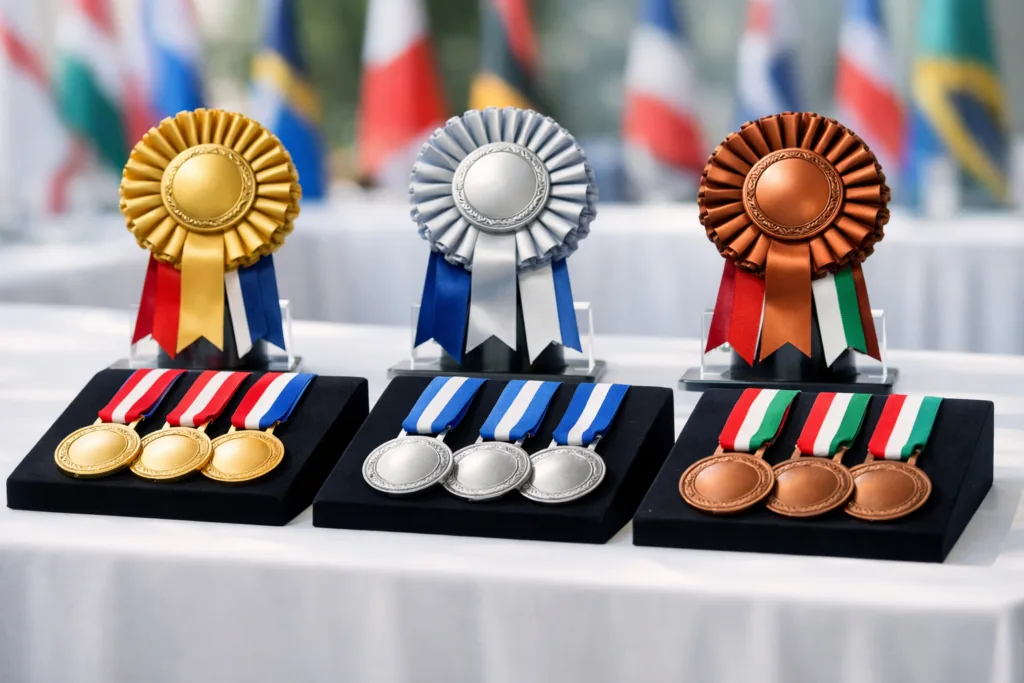
The harmony between ribbon and medal is visually striking and sends a clear message. A gold-plated medal pairs best with a blue or gold ribbon, while a silver medal usually features a red or silver ribbon, and a bronze medal often includes white, bronze, or orange. Consistency ties the visual identity of your event together—an area where Gairun’s expertise in colorfast, high-integrity ribbons truly makes a difference for premium awards.
Customizing Ribbon Colors: When Is It Okay?
Custom ribbon colors can reflect event branding, school spirit, or sponsor identities. The key: always clearly communicate rankings (e.g., by adding text or symbols). For example, incorporating event logos, custom neck ribbons, or medal center plates adds both function and flair. For detailed tips, see 7 Essential Insights to Custom Neck Ribbons for Medals.
Selecting Ribbon Colors for School Events and Clubs
Schools and clubs often balance tradition with innovation. While blue-red-white is familiar in the US, adding school colors or mascots (for participation ribbons or special categories) can boost buy-in and pride. Consistency from year to year is more important than following any single international system for recurring school events.
Best Practices for Ordering Award Ribbons
- Use colorfast, durable materials to prevent fading
- Choose eco-friendly, hypoallergenic fabrics for youth events
- Match ribbon width and length to the size of medals or badges
- Plan lead-time: custom options require longer production
Procuring in bulk for large events can optimize costs—see 13 Proven Ways to Reduce Costs and Maximize Value for Any Large-Scale Event.
Award Ribbon Color Meanings and Ranking Use
The heart of a credible reward system lies in clarity and consistency. Award ribbon color meanings and ranking use are not universal, but understanding dominant standards and their rationale will help avoid confusion and ensure your event is taken seriously. Always announce the color-ranking scheme before the event starts and include a visual guide when possible, especially for less-familiar systems or when using custom colors.
Combining Ribbons with Rosettes, Badges, and Certificates
Multilayered awards—like rosettes paired with medals or certificates—magnify recognition. Rosette ribbons often incorporate main ranking colors along with secondary or accent tones to create a dramatic effect suitable for “Best in Show,” team events, or special achievements.
Material and Manufacturing Considerations
The choice of fabric, dye method, and finishing can impact the prestige and durability of ribbons. Premium providers, such as Gairun, prioritize colorfastness, crisp edges, and eco-compliance. For luxury competitions, consider jewelry-grade satin or woven patterns with metallic threads, especially for high-ranking ribbons intended as keepsakes.
Ensuring Consistency Across Medals and Ribbons
Color mismatches between ribbons and medal finishes can detract from the experience, particularly in high-visibility or televised ceremonies. Communicate closely with both the medal and ribbon manufacturer to align Pantone references and finishing types—rack plating on medals provides better color uniformity than barrel plating, for example.
Ribbons for Special Awards: Creativity Within Convention
Certain honors, such as “Best Effort,” “Most Improved,” or “Team Spirit,” may use unique ribbon colors or combinations to stand out. As long as main ranking ribbons remain consistent, creative alternatives for these side awards foster motivation without diluting core recognition.
Award Ribbon Color Choices for Large-Scale Events
- Establish a written color policy and share it pre-event
- Consider audience backgrounds (international = gold/silver/bronze)
- Match printed event materials to awards for a unified look
Organizations that plan annual or multi-site events benefit from a centralized style guide covering all award elements.
Modern Trends: Sustainability in Ribbon Manufacturing
Today’s awards often reflect eco-conscious values. Biodegradable, recycled, or plant-based fabrics are increasingly popular, and responsible metal finishing can significantly reduce environmental impact. Brands like Gairun invest in closed-loop plating and water-based dyes that protect both the award’s brilliance and the planet.
Case Study: Matching Medals and Ribbons for Maximum Impact
An athletic association recently unified its event medals and ribbons by developing a three-tiered design where each ribbon color complemented the finish of custom medallion coins (see 11 Ways Custom Medallion Coins Redefine Awards). The result: clearer rankings, more photo opportunities, and stronger event branding overall.
Award Ribbon Colors in Digital and Virtual Events
Even in virtual races or contests, digital badges and ribbons can mirror traditional color schemes. Syncing virtual ribbons with physical medals—such as those discussed in Why Virtual Running Medals Matter—increases engagement and provides tangible rewards for online achievements.
How to Communicate Ribbon Colors to Participants

- Publish a visual guide online (website, event page)
- Mention the ranking scheme in event rules and communications
- Share examples and photos when announcing winners
Visual clarity before and after events reduces confusion and sets expectations, reinforcing the value of each ribbon earned.
Conclusion: Building a World-Class Award System
Establishing the right award ribbon color meanings and ranking use shows your commitment to fairness, credibility, and memorable experiences. Whether you’re following established traditions or designing something unique, the cornerstones are consistency, clear communication, and thoughtful design that honors every level of achievement. With a strategic approach—and support from premium partners—you can ensure that each ribbon awarded truly signifies both place and pride.
Frequently Asked Questions
What color is the 1st place ribbon in the US?
In the US, 1st place is traditionally awarded a blue ribbon, representing highest achievement at school, club, and county events.
How do ribbon colors differ between the US and international events?
US events often use blue-red-white for first, second, and third. Internationally, gold, silver, and bronze are standard for the top three placements.
Can I customize ribbon colors for my event?
Yes, but clearly communicate the ranking value—especially if you use nonstandard or branded colors—so participants understand each ribbon’s meaning.
What ribbon color is used for participation?
Participation ribbons are commonly green, rainbow, or multi-colored. These offer encouragement without conflicting with main ranking colors.
How do I match medals with ribbons for best appearance?
Align ribbon colors with medal finishes (e.g., gold with blue or gold ribbons) and ensure both the medal and ribbon reflect your event’s overall branding and quality.
Are there eco-friendly ribbon options for awards?
Yes, many manufacturers now offer biodegradable, recycled, or plant-based fabrics. Always specify your sustainability requirements when ordering medals and ribbons.
Related Reading
- Avoid Costly Mistakes: The Ultimate Guide to Custom Neck Ribbons for Medals
- Discover Award Redefinition: Design Secrets for Custom Medallion Coins
- How Virtual Running Medals Elevate Participant Engagement and Brand Value
- Slash Event Costs: 13 Proven Strategies for Bulk Medal Procurement
- 12 Expert Ideas to Define Track and Field Medal Prestige