Kinetic sculpture occupies a distinctive place in metal art because it adds time, movement, and response to form. Instead of asking viewers to look at a finished surface from one angle, a kinetic work invites them to observe motion, rhythm, balance, and changing reflections across metal. Some pieces move with wind, some respond to touch, and others depend on motors, sensors, or programmed systems. From a manufacturing perspective, that means the artwork is not only visual; it is also structural, mechanical, and often interactive. Understanding how these sculptures are conceived and built helps collectors, designers, public art planners, and creative buyers evaluate what makes a moving metal piece compelling as well as durable.
If a project needs moving components, refined finishes, formed metal parts, or a path from concept to prototype, our custom metal craft manufacturing overview gives useful context for how custom metal work is developed in practice. For kinetic and interactive pieces, buyers usually need more than appearance alone: they need material guidance, sample validation, finish planning, mechanical fit, and production support that accounts for assembly, wear, and consistency across parts. At Gairun, we approach those needs through mold development, fabrication method selection, surface finishing, sample review, and practical quality control for custom metal projects.
What Is Kinetic Sculpture in Metal Art?
At its core, kinetic sculpture is sculpture designed to incorporate real movement. In metal art, that movement can be subtle or dramatic. A suspended stainless steel assembly may rotate gently in air currents. A hand-actuated brass sculpture may fold, swing, or reveal layered imagery. A gallery installation may include motors, lights, or sensor-triggered reactions that alter the experience when a viewer approaches.
The key difference between static sculpture and kinetic sculpture is that motion is part of the artwork’s meaning, not an accessory. The artist is composing with mass, negative space, gravity, timing, friction, sound, and reflection. Metal is especially powerful in this format because it can be rigid enough to hold precise geometry while still being cut, formed, welded, cast, machined, polished, plated, and assembled into moving systems.
In practical terms, a buyer or curator evaluating kinetic sculpture should look beyond shape alone and ask: What makes the piece move? How is the movement controlled? Is the motion wind-driven, hand-driven, gravity-driven, or electronically powered? What wear points will need attention over time? These questions are not separate from aesthetics. In kinetic metal art, they are central to the artwork itself.
How Moving Parts Change the Experience of Metal Art
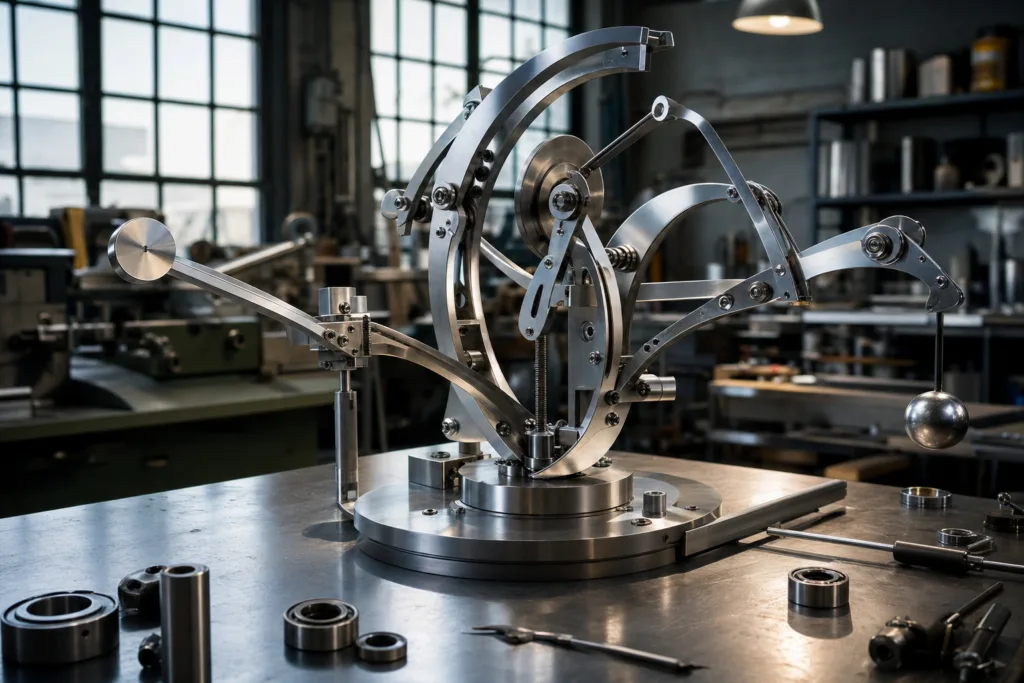
Movement transforms viewing into participation, even when no physical touch is required. A static metal surface may be appreciated through finish, line, and relief. A moving metal surface introduces expectation and surprise. The viewer begins to anticipate the next shift, the next alignment, or the next reflected flash of light.
This changes the emotional register of the work. Slow, balanced movement can feel meditative. Repetitive mechanical motion can feel industrial, precise, or hypnotic. Unpredictable interaction can create playfulness and curiosity. In public environments, moving parts also influence traffic flow and spatial behavior because people instinctively pause, circle, or re-approach the piece.
From our manufacturing perspective, this experiential shift matters because motion amplifies details that might be minor in static work. Edge quality, alignment, noise, looseness, balance, and finish consistency become much more visible once a form is moving. A sculpture that looks strong on paper can feel awkward in use if swing resistance is uneven or if a joint has excess play.
The Evolution of Interactive Metal Art
The path from static sculpture to motion-driven work reflects both artistic experimentation and technical development. Artists gradually expanded sculpture from object to system, treating air, gravity, machines, and viewers as active components. Metal became a natural medium for that shift because it could support both expressive surfaces and engineered structures.
Modern interactive metal art often combines traditions that once seemed separate: blacksmithing, machining, industrial design, electronics, public art, and installation practice. This blend is one reason kinetic sculpture remains so compelling. It does not fit neatly into one category. It can be delicate or monumental, handmade or digitally controlled, decorative or deeply conceptual.
Today, the field includes wind sculptures, motorized wall works, responsive installations, articulated table sculptures, and architectural-scale outdoor pieces. In each case, the idea is similar: movement is used to alter perception and deepen engagement.
Core Techniques Artists Use to Create Movement in Kinetic Sculpture
The movement in kinetic sculpture usually comes from one of five sources: wind, gravity, touch, internal mechanics, or electronic control. Each source creates a different relationship between viewer and object.
- Wind-driven movement: Ideal for outdoor installations where blades, vanes, spirals, or suspended forms react to changing air patterns.
- Gravity-based movement: Uses pendulums, counterweights, offset balance, and pivot points to create slow oscillation or self-correcting equilibrium.
- Touch-activated movement: Allows a viewer to rotate, push, slide, or reposition elements directly.
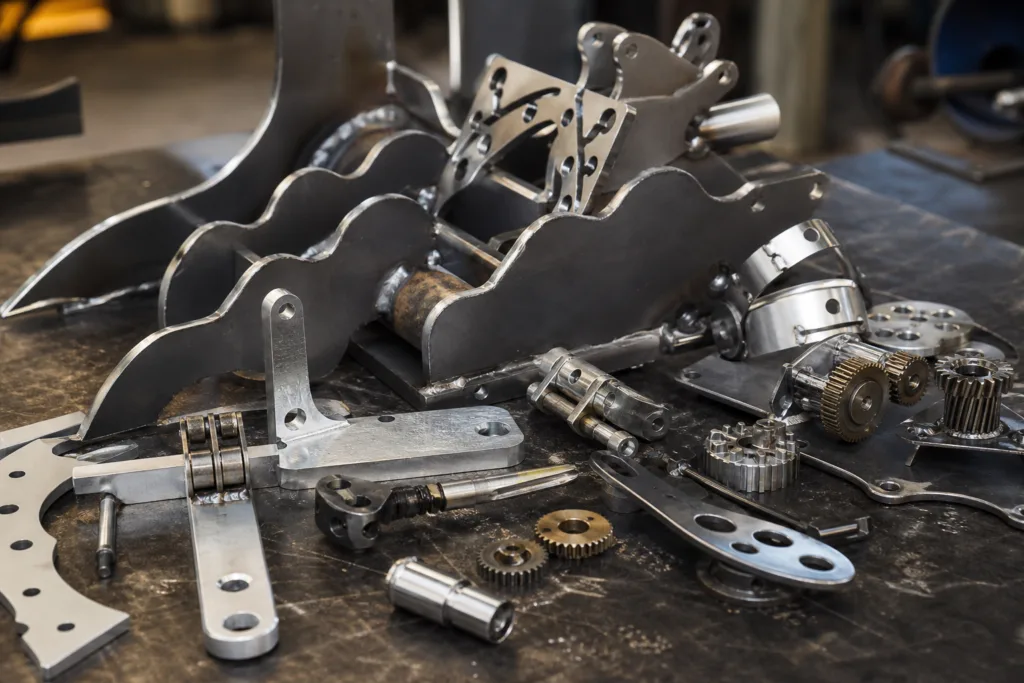
- Mechanical movement: Relies on gears, linkages, bearings, springs, shafts, and cams to create controlled action.
- Electronic movement: Adds motors, sensors, control boards, and programmable timing for repeatable or responsive behaviors.
When we review moving metal concepts, we usually start by identifying which source of movement defines the artwork. That decision influences nearly everything else, from material thickness and assembly method to tolerance, finish, maintenance, and installation planning. For a useful educational explanation of balance, structure, pivots, and motion systems, the engineering principles behind kinetic sculpture offer a strong reference point.
Mechanical Motion: Gears, Hinges, Bearings, Counterweights, and Linkages
Mechanical design is where kinetic sculpture often becomes most technically demanding. A moving piece may look effortless, but that effect usually depends on careful control of force and resistance.
Gears and synchronized motion
Gears are useful when multiple elements need timed, repeatable relationships. They can create symmetry, contrast, delay, or patterned movement. In art, exposed gears may also become part of the visual language, giving the work an openly mechanical character.
Hinges and pivots
Hinges create directional movement, while pivots allow rotation around a point or axis. Small changes in pivot placement can dramatically change how the sculpture feels in motion. A high pivot may create light swing, while a low pivot can produce a heavier, slower arc.
Bearings and reduced friction
Bearings are essential when smooth rotation matters. They help reduce friction, improve consistency, and limit wear between moving parts. In outdoor work, bearing protection and contamination control are just as important as the bearing type itself.
Counterweights and balance
Counterweights let artists make large metal forms feel surprisingly light in motion. Proper counterbalancing can reduce motor load, improve hand interaction, and protect joints from unnecessary stress.
Linkages and transferred motion
Linkages allow movement in one part of a sculpture to trigger action in another. This is useful for layered narrative effects, unfolding forms, or mechanical surprises where one visible action produces a secondary response elsewhere in the piece.
In fabrication, these systems require more than visual design. Hole position, shaft alignment, part thickness, and assembly clearances all affect how the sculpture performs over time. That is why precision tolerance control in metal fabrication matters so much for moving work. Even attractive parts can fail functionally if fit is inconsistent across pivoting or rotating assemblies.
Material Choices for Kinetic Metal Art
Material selection in kinetic sculpture is both aesthetic and mechanical. The right metal depends on the scale of the piece, the motion source, the finish goal, the environment, and the expected frequency of use.
| Material | Common Strengths | Typical Uses in Kinetic Work | Key Considerations |
|---|---|---|---|
| Steel | Strong, weldable, structurally versatile | Frames, outdoor structures, heavy mechanical forms | Needs corrosion planning and finish protection |
| Stainless steel | Corrosion resistance, clean appearance, reflective finish | Public art, polished moving surfaces, exterior installations | Higher cost and different fabrication behavior than mild steel |
| Aluminum | Lightweight, easy to form, good for suspended elements | Wind pieces, mobile components, larger forms with lower weight | Softer surface and different stiffness profile |
| Brass | Warm tone, decorative character, machine-friendly | Small mechanisms, accents, collectible sculptures | Patina and finish aging should be planned |
| Mixed metals | Visual contrast and varied performance | Layered artworks, interactive assemblies, decorative mechanisms | Watch galvanic and finish compatibility issues |
Steel is often preferred for structural integrity, especially when the piece must resist vibration or support significant mass. Stainless steel is popular for premium outdoor work where weather resistance and reflective visual effect are both priorities. Aluminum is especially valuable when the artist wants large shapes that remain easy to move. Brass offers warmth and elegance for smaller, more intimate kinetic pieces.
We also see projects that use cast or formed decorative components attached to fabricated frames. If the concept calls for compact, highly shaped details, zinc alloy molding techniques for complex forms can be relevant for ornamental housings, dimensional accents, and intricate non-structural parts within an interactive metal composition.
Fabrication Methods Behind Moving Metal Artworks
Most kinetic metal art combines multiple fabrication methods rather than relying on only one process. The visible beauty of the piece is often the result of careful coordination between structure, surface, and assembly.
Welding
Welding is essential for frames, armatures, brackets, and structural connections. In kinetic work, weld placement matters not only for strength but also for distortion control. Misalignment caused by heat can affect motion paths and final fit.
Cutting and profiling
Laser cutting, waterjet cutting, and CNC profiling are useful for repeatable shapes, layered patterns, and mechanically matched parts. These methods are especially important when a sculpture uses mirrored or nested components that must move in relation to one another.
Forming and bending
Forming gives motion a more fluid visual language. Curved metal planes catch light differently during rotation or swing, which can make a sculpture feel more alive than a flat silhouette.
Casting
Casting can create sculptural depth, relief, and organic forms that would be difficult to machine from flat stock. For smaller decorative kinetic pieces, cast elements can provide expressive detail while keeping assembly efficient. Similar thinking appears in die-cast 3D relief production options, where dimensional metal surfaces are developed with strong contour and detail control.
Assembly and testing
Assembly is where a kinetic sculpture proves itself. Parts that look correct individually may require shimming, balancing, lubrication choices, or revised fastening approaches once the system moves as a whole. Prototype assembly is often where artists discover whether the motion feels graceful, abrupt, heavy, noisy, or unstable.
Adding Technology to Metal Art
Technology can deepen interactive metal art when it supports the concept rather than distracting from it. Motors can create consistent cycles, sensors can trigger movement when someone approaches, and lighting can turn surface changes into part of the choreography.
Some artists use simple timed systems with fixed movement loops. Others build responsive installations that change based on proximity, sound, light levels, or touch. Programmable control systems allow motion to become more nuanced. A sculpture might remain still until someone enters the room, then begin a gradual sequence with light, sound, and rotational action.
From a production standpoint, adding technology introduces a second layer of planning. You are no longer balancing only mass and motion. You are also balancing wiring routes, access panels, motor load, vibration, heat, serviceability, and safety. The more integrated the technology, the more important it is to separate cosmetic design from maintenance access so that future repair does not damage the artwork.
Designing for Viewer Interaction
Interactive metal art succeeds when the method of engagement is intuitive. Viewers should understand, either immediately or through subtle cues, whether they are invited to touch, walk around, trigger, or simply observe.
There are several common interaction models:
- Direct touch: The viewer pushes, rotates, slides, or repositions a metal element.
- Proximity response: Sensors detect presence and activate motion or light.
- Environmental response: Wind, temperature, or ambient movement changes the artwork.
- Spatial engagement: The artwork changes visually as the viewer walks around it.
Good interaction design also means limiting confusion. If a component appears handle-like but should not be touched, that mismatch creates frustration. If a touch point is intended for frequent use, it must be sized, finished, and mounted for repeated handling. Edges, pinch points, and return motion all need to be reviewed carefully.
In our custom metal production work, we often advise separating decorative moving details from high-contact operating components. This helps preserve finish quality and extends the life of the mechanism, especially in public-facing installations.
The Emotional Impact of Kinetic Sculpture
One reason kinetic sculpture remains memorable is that movement can produce emotion without explanation. Slow oscillation may create calm. Repeated modular motion can feel contemplative. Unfolding elements may produce suspense. Responsive movement can make a viewer feel recognized by the object.
Metal intensifies these effects because of reflection, sound, and precision. A brushed surface softens light, while mirror polish amplifies movement through rapidly changing reflections. Dark finishes can make motion feel more dramatic and architectural. For projects that aim for a contemporary, restrained look, modern black plating surface effects can create strong visual contrast, especially when moving layers reveal highlights across edges and relief.
Unlike many static objects, kinetic artworks have personality over time. The same sculpture can feel different on a windy day, in morning light, or with a different audience. That variability is not a flaw. It is often part of the artistic intention.
Notable Artists, Influence, and the Value of Process
Many influential kinetic artists helped redefine sculpture as active rather than fixed. Some emphasized mechanical wit, some pursued balance and air, and others treated viewer response as a core medium. Their legacy is not only formal. It also established an important expectation: a moving artwork must be designed as a complete system.
That system thinking is where artists and manufacturers often meet productively. Concept sketches may communicate mood and composition, but prototypes reveal whether the movement is believable. Scale studies can test balance. Material samples can test reflection and finish. Assembly trials can reveal noise or friction issues that were not visible in digital drawings.
At Gairun, we see this same pattern across custom metal development. Whether the final object is a functional accessory, a commemorative piece, or a decorative moving artwork, the most reliable results come from early clarification of structure, finish, motion, and approval checkpoints before final production.
The Artist’s Creative Process: Concept, Prototype, Balance, and Installation
Kinetic sculpture rarely moves directly from idea to final form. The process usually develops in stages.
Concept development
The artist defines what the motion should mean. Is it atmospheric, playful, industrial, ceremonial, responsive, or contemplative? This affects the mechanism as much as the shape.
Prototype building
Simple prototypes reveal whether the movement is too fast, too stiff, too weak, or too fragile. Card models, wire mockups, rough metal samples, or 3D prints may all play a role.
Balance testing
Balance is especially important in suspended or wind-driven pieces. Small weight shifts can change how long a form rotates, where it settles, or whether it returns predictably after disturbance.
Installation planning
Installation is part of the artwork’s function. Ceiling load, anchoring points, electrical supply, weather exposure, service access, and viewer reach all shape the final design. A sculpture that works beautifully in a studio may need substantial redesign for public placement.
Technical Challenges in Kinetic Metal Sculpture
Moving art always introduces technical risk. The most common issues are friction, fatigue, corrosion, alignment drift, noise, safety, and maintenance access.
| Challenge | Why It Matters | Typical Response |
|---|---|---|
| Friction | Can slow or stop intended motion | Use better bearing surfaces, lubrication strategy, and fit control |
| Durability | Repeated movement creates wear | Reinforce joints, choose harder contact materials, test cycle points |
| Weather resistance | Outdoor exposure affects finish and motion | Select corrosion-resistant metals and protective coatings |
| Safety | Public interaction increases liability concerns | Review edges, pinch points, movement range, and structural security |
| Maintenance | Unserviceable art becomes unreliable over time | Design access for repair, cleaning, and part replacement |
For outdoor or publicly touched pieces, it is wise to treat maintenance planning as part of design, not as an afterthought. A hidden fastener that is impossible to reach later may become a major problem if a motor, axle, or bearing needs replacement.
Public Art, Gallery Installations, and Collectible Kinetic Pieces
Kinetic metal art functions differently depending on where it will live. Public art must prioritize durability, vandal resistance, environmental exposure, and safe interaction. Gallery installations often have more freedom for delicate finishes, lower-force mechanisms, or controlled lighting and sound conditions. Collectible tabletop or wall-mounted pieces may emphasize craftsmanship, intimate movement, and visual refinement over large-scale structural performance.
These differences should influence fabrication choices from the beginning. A collector’s indoor sculpture may use finer surface details and more delicate mechanical tolerances. A public plaza piece may need heavier sections, simplified motion, tamper-resistant hardware, and easier maintenance access. The artwork category changes the engineering brief.
How Audience Participation Changes Meaning
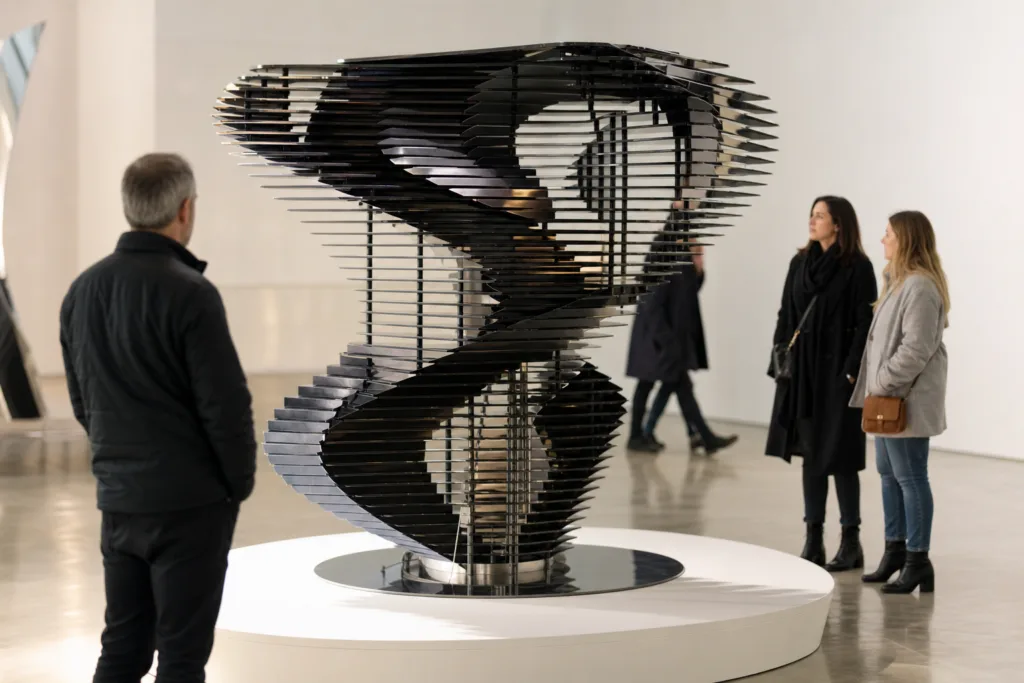
Audience participation turns the viewer into a co-creator of timing. Even a simple push, turn, or approach can alter how the work unfolds. That shift changes interpretation. The sculpture is no longer only an object made by the artist; it becomes an event completed through encounter.
This is one of the reasons interactive metal art remains so effective in exhibitions, campuses, public spaces, hospitality interiors, and curated commercial environments. It slows people down. It creates memory through action. It can make craftsmanship feel immediate rather than distant.
For artists and commissioners, the central question is not simply whether interaction is possible, but whether it is meaningful. The strongest interactive works do not add movement as a gimmick. They use movement to reveal structure, emotion, contrast, or participation in a way static form could not.
Conclusion
Kinetic sculpture expands metal art from shape into experience. It combines visual composition with mechanics, material behavior, balance, finish, and human response. Whether the work is hand-actuated, wind-driven, or electronically controlled, its success depends on the relationship between artistic intention and physical execution. From our manufacturing perspective, the most effective projects are those that respect both sides of that equation: the expressive power of movement and the practical demands of fabrication, fit, durability, and maintenance. When those elements are aligned, interactive metal art can create exactly what great moving sculpture should create: wonder, clarity, and lasting engagement.
Frequently Asked Questions
What makes a kinetic sculpture different from other metal art?
A kinetic sculpture is designed so that movement is part of the artwork itself, not just a display feature. That movement may come from wind, touch, gravity, motors, or sensors, and it changes how viewers experience the piece over time. In practical terms, the design must account for structure, balance, wear points, and motion behavior in addition to appearance.
Which metal is best for kinetic sculpture?
There is no single best metal because the right choice depends on scale, motion type, environment, and finish goals. Steel is often chosen for strength, stainless steel for corrosion resistance, aluminum for lighter moving elements, and brass for smaller decorative mechanisms. The most suitable option is the one that supports both the visual concept and the mechanical demands of the piece.
How are moving parts tested before final production?
Moving parts are usually tested through prototypes, balance checks, assembly trials, and repeated motion review. Artists and fabricators look at smoothness, resistance, return motion, noise, alignment, and wear at contact points. For larger or interactive works, installation conditions such as wind, reach, load, and service access should also be considered before final approval.
Can kinetic metal art be made for outdoor installation?
Yes, but outdoor pieces need more planning around corrosion resistance, drainage, finish protection, structural support, and maintenance access. Wind load, dirt, moisture, and temperature changes can all affect performance over time. Materials, coatings, bearings, and fasteners should be chosen with long-term exposure in mind rather than based only on studio appearance.
Do interactive sculptures need motors and electronics?
No. Many successful interactive sculptures use simple mechanical ideas such as pivots, counterweights, suspended balance, or hand-actuated motion. Motors and sensors can add precision or responsive effects, but they also increase complexity, wiring needs, and maintenance requirements. The best choice depends on whether technology strengthens the concept or simply adds complication.
What should a buyer or curator ask before commissioning a kinetic sculpture?
Key questions include what drives the motion, how viewers are expected to interact, which materials are being used, how the finish will age, what maintenance will be required, and how the work will be installed safely. It is also important to review prototypes or motion studies early, because movement quality, not just appearance, should be approved before final fabrication.