Introduction: Getting Accurate Quotes for Perfume Bottle Caps
Ordering custom perfume bottle caps for OEM production requires buyers to be clear and complete when communicating their requirements. Many project delays and unnecessary costs result from missing details or unclear specifications at the RFQ (Request for Quotation) stage. This article acts as a detailed guide to explain what information your supplier truly needs for a precise quote and successful manufacturing outcome.
For a more focused look at production capabilities and supplier categories, readers planning the next sourcing step may want to explore how manufacturers present their approach to specifying perfume bottle caps effectively.
When Suppliers Struggle to Provide Accurate Quotes

It’s common for suppliers to return vague or inconsistent pricing if the RFQ lacks key details. The most frequent scenarios include:
- Only rough sketches or reference images are provided, not technical drawings.
- Material is described only as “metal” or “plastic” without further detail.
- Desired surface finishes or plating styles are not stated.
- There is ambiguity about cap compatibility with bottles or sprayers.
Understanding what causes quote discrepancies helps buyers prevent costly misunderstandings later in the production timeline.
Common Reasons for Price Gaps
- Lack of critical dimensions
- Unknown decorative processes (engraved vs. printed logo)
- Unspecified tolerance requirements
- No reference for texture or weight expectation
What Suppliers Need but Often Don’t Receive
- Precise technical drawings or CAD files
- Sample caps or bottles for fit-checking
- Clear brand standards (e.g., Pantone color, logo rules)
Essential RFQ Details: The Perfume Cap Specification Checklist
To streamline your custom perfume cap RFQ, ensure that your request contains:
| Specification Aspect | Typical Options | Best Practice |
|---|---|---|
| External Cap Dimensions | Diameter, height, shape | Indicate all critical sizes in millimeters |
| Material & Grade | Zamac, ABS, aluminum, brass | Specify alloy and purity tier if known |
| Weight Target | 20–60g typical | Match brand feel; inform if heavy/luxury feel is key |
| Surface Finish | Polished, brushed, plated, painted | Share reference images or physical swatches |
| Logo Application | Laser, emboss, print, decal | State location and size on drawing |
| Color Standard | Pantone, RAL, custom match | Label on all drawings/references |
| Inner Fitting / Liner | Plastic, cork, snap-fit, screw, magnet | Provide sample bottle for fit test |
| Compatibility | Sprayer specification, neck finish | Give bottle drawing & thread spec or send sample |
Supplier Tip: The Devotion to Detail Pays Off
Suppliers can deliver faster, more reliable quotes and short prototypes with complete checklists. In premium segments, such as luxury zamac caps, providing detailed specs ensures both aesthetics and function meet brand standards.
Required Drawings and Reference Samples for RFQ
Supplying clear technical artwork is non-negotiable. Advances in 3D modeling and rendering have made it easier for buyers to create accurate digital files. Still, what matters is the content, not just the file type:
- 2D engineering drawings (with tolerances and annotations)
- 3D STEP/STP/IGS files, showing all faces and details
- Physical sample or color swatch for surface/feel reference
- Bottle and sprayer sample for compatibility testing
Make sure to label files clearly (project name, client, date, revision number) so that no confusion arises during communication with suppliers.
Best Practices for Drawings
- Including exploded views to show inner parts (liners, magnets, inserts)
- Details for logo placement, font size, and orientation
- Marking critical dimensions (fit zones, assembly directions, safety clearances)
Easily Overlooked Technical Items in Your Cap Brief
Some technical requirements can be missed, even in well-intentioned perfume cap RFQs. To avoid headaches during production:
- Tolerances: Indicate allowable variation (+/–0.1mm typical for caps).
- Closure Feel: Explain if a tight “click” or smooth push-on is needed.
- Assembly Direction: Show which way the liner, logo, or magnet should be mounted.
- Plating/allergy standards: Note if the EU nickel-free requirement applies.
- Salt spray test/time: Required for coastal/humid climate launches.
Supplier Brief Example: Clear vs. Vague
- Vague: “Gold cap with logo; fit our 15mm neck bottle.”
- Clear: “Zamak cap, mirror-polished, 23.5mm diameter x 35mm height, 45g, luxury weight. Inner: PP liner (dimension detailed in attached STEP file), bright gold plating (Pantone 872C reference), laser-engraved logo 10mm central on top. Tolerance +/–0.15mm overall, closure to have strong snap-fit, pass 48-hr salt spray. Attachments: 2D + 3D drawings, physical swatch, reference bottle and sprayer.”
Pre-Sample (Pre-Production) Confirmation Checklist
Before suppliers invest in tooling or sampling, double-check that the following have been confirmed in writing:
- All technical drawing revisions align between both parties
- Color, finish, and logo details signed off (digital or physical proof)
- Material spec (alloy code, grade, liner resin, plating type) agreed
- Sample bottle and sprayer provided to the cap supplier
Being thorough at this pre-production confirmation stage can prevent costly mold changes or wasted pre-production runs.
How to Specify a Perfume Bottle Cap for OEM Production: The Buyer’s RFQ Checklist
This RFQ checklist will help ensure both price accuracy and manufacturing quality:
- Finalized 2D and 3D drawings (with clear labeling)
- Material detail: alloy, resin, weight target, plating/coating intentions
- Surface finish, color code, and logo technique specified
- Liner/interior structure requirements
- Bottle/sprayer fitment details
- Brand identity rules (if strict design guidelines apply)
- Tolerance requirements, closure feel, and functional benchmarks
- Required compliance standards (e.g., RoHS, nickel-free)
- Package and transit expectations (packaging to protect against abrasion, etc.)
Downloadable Template (Recommended)
Consider preparing a template in Excel or Word that covers these categories for every project. Suppliers can quickly fill in any missing info, reducing back-and-forth emails.
Anatomy of a Perfect Perfume Cap Supplier Brief
An effective supplier brief clearly nests all essential data and anticipates the manufacturer’s questions. Here’s what a strong brief includes:
- Visuals: Final cap design renders plus comparative reference items
- Specs Table: All dimensions, materials, finishes, logos, tolerances listed
- Fitment Diagram: Exact fit to bottle/sprayer; assembly step if multipart cap
- Performance Standard: Snap/click test, salt spray result, nickel-free, etc.
- Packaging Method: Whether individual bag, foam tray, or bulk carton
- Contact chain: Who signs off on technical and visual approvals
Such a brief dramatically increases the odds of smooth sampling and full production.
RFQ Pitfalls: Common Buyer Mistakes in Custom Perfume Cap Projects
Even seasoned buyers may stumble on cap projects. Here are common error cases and how to avoid them:
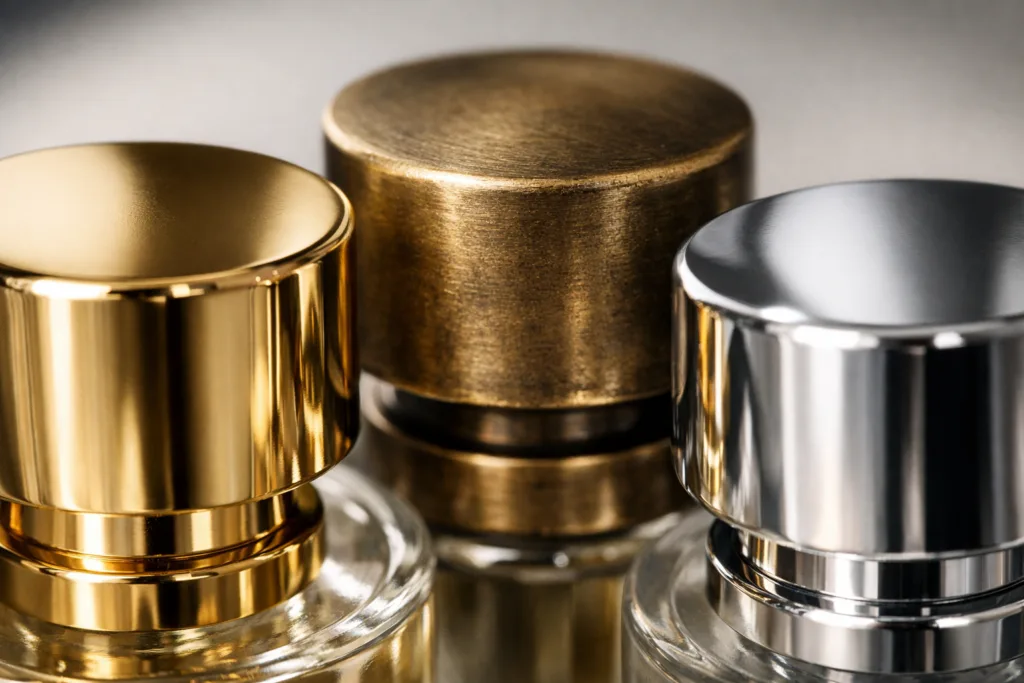
- Assuming all Zamac or brass sources meet global standards—specify purity, test for lead content.
- Not requiring logo position and orientation proofs—could result in off-center branding.
- Ignoring weight distribution—imbalanced caps disappoint luxury end-users.
- Underestimating color-matching: Gold is not “just gold”; even minor hue drift stands out.
- Leaving tolerance discussion to the tooling stage—fix at the drawing/RFQ phase instead.
Material Choices: Impacts on Cap Quality and Pricing
Material selection is more than just cost—it directly impacts cap weight, tactile feel, and the sharpness of details. It’s wise to review material comparison insights when preparing a technical brief. For luxury brands, virgin Zamac 3 or high-grade brass allows for cleaner casting, better polishing, and jewelry-grade surface finishes. Always request certificates showing purity, and clarify if recycled content is acceptable for your project.
Surface Finishes and Logo Techniques: Communicating Expectations
Describing plating, color, and texture in simple words often leads to misinterpretation. Where possible, supply physical samples or Pantone/RAL swatch codes. For logo application (emboss, deboss, laser, print), detail not only size but also depth, location, and orientation. Request that suppliers provide a pre-sample or rendering for sign-off before bulk production begins.
Dimensioning and Fit: Avoiding Assembly Surprises
One of the most frequent headache sources is unclear dimensions around the fit zone—how the cap attaches and aligns with sprayer and bottle. Technical drawings should clearly mark every internal diameter, especially if the liner or magnet system is complex. It’s also critical to share bottle drawings (or at minimum, a sample bottle) with suppliers, so they can test mechanical fit before approving tooling design. This small step saves costly rework later.
Understanding Tolerance and Quality Inspection Needs
Tolerances dictate how much the actual part can vary from the drawing—and they matter in both look and mechanical function. In luxury fragrance, Gairun advocates for tighter tolerances and rigorous QC testing, using high-precision CNC molds to deliver perfectly balanced caps that click smoothly and match bottles consistently across large batches. For global brands, request salt spray testing and plating adhesion certificates for every production lot.
Final QC and Pre-Shipment Approvals: What to Check
No less important than design specs is a good system for final inspection. Key checks before shipment include:
- Surface: Inspect for pitting, peeling, or plating color drift
- Logo: Check for sharpness, correct position, and consistent size
- Fit: Confirm smooth assembly, secure closure, and alignment with bottle/sprayer
- Function: Test for required closure force (not too loose, not too stiff)
- Finish: Ensure no visible scratches, chips, or defects
Request inspection samples, preferably chosen at random from production, and sign off only when they meet your RFQ brief.
Packaging and Shipping Concerns for Perfume Caps
Specifying cap packaging is not just about protection, but also about presentation. Luxury caps may require individual bagging, foam inserts, or rigid trays. Bulk-packed caps are at higher risk of abrasion or denting, which leads to rejections on arrival. Clearly state shipping carton size, inner tray design, and labeling requirements at the RFQ stage to head off misunderstandings.
Supplier Communication: Keeping Projects on Track
Consistent communication including project milestone updates, photographic progress reports, and prompt clarification of any ambiguities prevents delays. When in doubt, ask the supplier to echo back your brief point-by-point and sign off on every revision—this simple practice dramatically reduces approval loop times.
Best Practices in Perfume Cap OEM Projects
- Double-check all provided drawings and files before RFQ submission
- Refer to technical standards: RoHS, REACH, California Prop 65 if required
- Specify when approval samples are non-negotiable
- Provide an approval hierarchy—who in your team makes final decisions?
- Always document QC findings and feedback after sampling
- If possible, visit factories or request in-process inspection photos
If your broader project includes more than just caps, explore packaging accessories for additional options and manufacturing perspectives.
Template: Perfume Cap RFQ/Specification Example
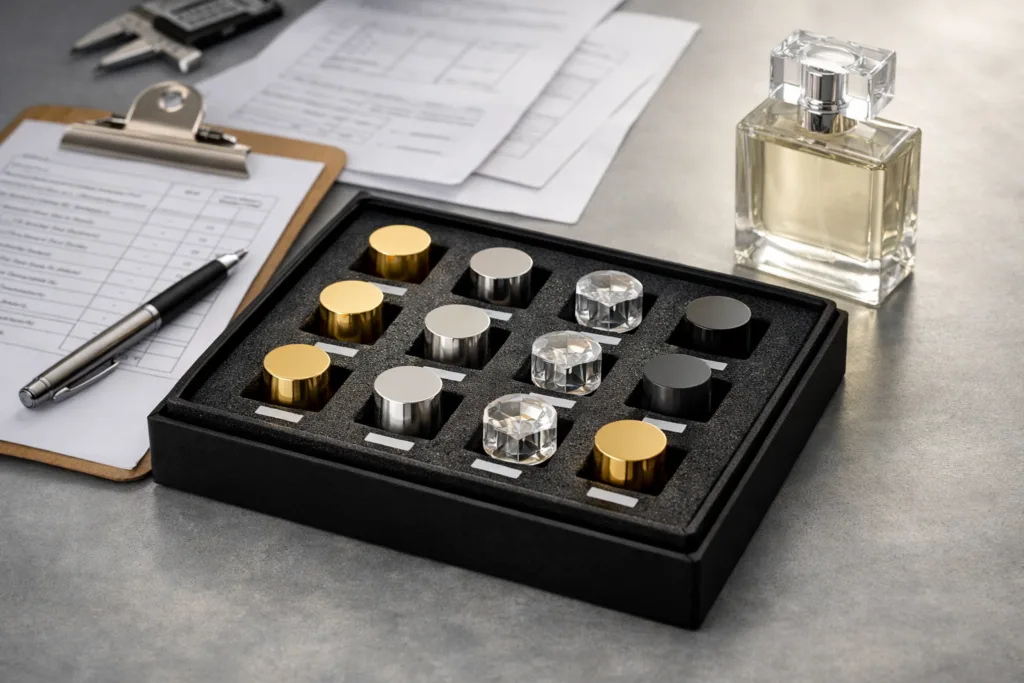
Here is a summary table you can adapt for your RFQ submission:
| Category | Specification | Notes |
|---|---|---|
| Cap Material | Zamak 3, lead-free | Certificate required |
| Color/Finish | Bright gold, mirror | Pantone 872C, rack plating |
| Weight | 45g ±0.5g | Luxury target—balance feels premium |
| Logo | Laser, top center, 10mm | Vector file provided |
| Liner/Inner | PBT snap-fit, white | Fits 15mm neck (see bottle drawing) |
| Tolerance | ±0.1mm critical fit zones | Overall ±0.15mm |
| QC | Salt spray test 48hr, logo check | Random check 5% of batch |
| Packaging | Foam tray + inner box | 150pcs/carton; label as shown |
Conclusion: Specifying Perfume Bottle Caps for Success
By articulating complete, precise requirements in your RFQ, you empower perfume cap suppliers to deliver accurate quotes, beautiful samples, and consistent production quality. Remember, the costliest mistakes usually trace back to missing or vague specs. Follow this checklist, communicate thoroughly, and your custom perfume cap project will meet your brand’s expectations—without the snags and surprises of unclear communication.
Frequently Asked Questions
What technical drawings are essential for a perfume bottle cap RFQ?
You need 2D engineering drawings with all dimensions and tolerances, plus 3D step files to show assembly and logo placement for accurate supplier quotes.
How should I specify the material for a custom cap?
State the alloy (like Zamac 3 or brass), intended purity, and if you require certification (e.g., lead-free, RoHS compliance) to avoid confusion in manufacturing.
Why is it important to send bottle or sprayer samples to the supplier?
Supplying actual bottles or sprayers ensures the cap is tested for a perfect fit and avoids tolerance mistakes that cause loose or overly tight assemblies.
What is a typical pre-production sample approval process?
After reviewing finish and fit on the sample, approval should be provided in writing; only then should full production begin to prevent costly errors.
How can I prevent plating defects or color mismatches?
Request random batch sampling, require salt-spray or adhesion reports, and provide physical or Pantone samples for precise color matching.
What are the main pitfalls in RFQ documents for perfume caps?
Missing fit details, unclear color/finish specifications, and a lack of tolerance information are the most common errors leading to inaccurate quotes and bad samples.