Keychain bottle openers remain one of the most practical promotional metal products because they combine daily-use function with strong logo visibility. For brands, event organizers, beverage promotions, souvenir programs, and distributors, they are easier to justify than novelty-only giveaways because the product has a clear purpose, a long service life, and enough surface area for branding. From our manufacturing perspective, the buying decision is rarely just about shape. It usually comes down to material, opening performance, finish durability, logo method, and whether the structure can hold up in bulk production without creating quality problems later.
If your project needs a practical giveaway that also reflects brand quality, our custom bottle opener keychain production work is relevant because these items often require more than a simple logo imprint. Buyers may need help balancing opener strength, material thickness, plating or anodized finish, attachment hardware, retail or event packaging, and sample approval before a campaign launch. We support that process from product structure review and mold development to finish selection, packaging planning, and bulk production consistency, which is especially important when the opener must perform well and still look clean as a branded metal product.
Why keychain bottle openers remain a classic giveaway
Many promotional items are noticed once and forgotten. A bottle opener attached to a keyring has a different value pattern: it is small, useful, portable, and repeatedly handled. That makes it suitable for beverage brands, bar programs, music festivals, outdoor events, sports clubs, travel souvenir ranges, and corporate campaigns that want a product with everyday relevance.
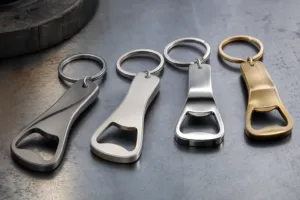
The reason these products stay popular in B2B buying is simple. They sit in a practical middle ground between low-cost disposable giveaways and premium custom metal souvenirs. A buyer can choose an economical flat aluminum style for mass distribution, or move into zinc alloy, stainless steel, or brass when a heavier and more permanent feel is needed. That flexibility lets the same product category serve very different campaign goals.
We also see buyers choose this product when they want stronger perceived value than paper, plastic, or fabric items can provide. Metal gives a cooler touch, more stable structure, and better edge definition for many logo concepts. For teams comparing campaign ROI, that matters because perceived quality often affects whether the item is kept or discarded.
Who typically buys keychain bottle openers
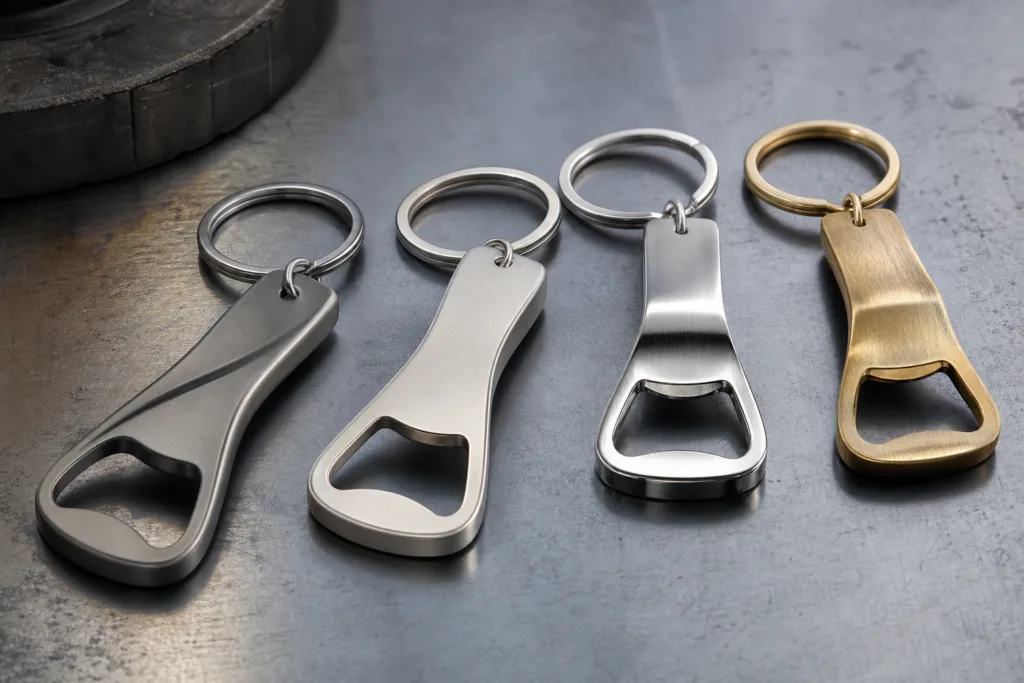
The buyer base is broader than many people expect. Beverage companies are obvious users, but they are far from the only segment. Event organizers use them for entrance packs, brand activations, and VIP merchandise. Promotional product distributors buy them because the category works across many industries. Souvenir wholesalers and tourism programs use them when a functional product is preferred over a decorative-only keepsake.
Corporate gift buyers also use them when they want a compact item for product launches, hospitality packs, or branded accessories. In some projects, the opener is not the only item in the range. It may need to coordinate visually with badges, coins, tags, or other accessories. In those cases, broader metal product sourcing and customization overview planning becomes useful so the finish, color tone, and packaging style stay consistent across the collection.
Distributors often care about reorder stability, while direct brand buyers care more about identity and user experience. A manufacturer has to recognize both priorities. The right solution for a beer festival with 10,000 units may be very different from the right solution for a premium beverage launch with 500 boxed units.
Why metal is usually the preferred choice
Plastic versions exist, but metal is normally the preferred material for keychain bottle openers when durability and perceived value matter. The opening point takes repeated force, and the keyring area also experiences mechanical stress over time. A weak or overly thin structure can deform, scratch badly, or break at the ring hole.
Metal also provides better finishing possibilities. Buyers can choose polished, matte, sandblasted, antique, brushed, plated, anodized, or color-filled looks depending on the base material and product structure. That flexibility supports both low-cost utility designs and more branded premium pieces.
Durability is not only about the base metal. Surface protection and finish quality matter too. In general manufacturing terms, coatings and finishes help reduce corrosion risk and improve long-term appearance, which is why finish choice should be discussed early rather than treated as a final decoration step. For buyers comparing plated and coated options, general principles of corrosion protection and durability are worth understanding, especially when products may be used outdoors, in humid hospitality settings, or carried daily with keys.
Common material options and how they compare
Material selection affects cost, weight, surface detail, finish compatibility, and production method. We usually guide buyers through this decision before final artwork approval, because a good logo on the wrong material can still lead to a weak product outcome.
| Material | Main Advantages | Common Limitations | Typical Use Case |
|---|---|---|---|
| Zinc alloy | Good for die-cast custom shapes, solid feel, suitable for plating and 3D detail | Tooling needed, heavier than aluminum | Custom branded shapes, souvenir-style openers |
| Aluminum | Lightweight, cost-effective, suitable for flat styles, can be anodized in color | Less premium feel, not ideal for deep 3D structure | Large-volume event giveaways |
| Stainless steel | Strong, corrosion resistant, clean modern look | Harder material, limited decorative depth compared with die casting | Simple durable utility designs |
| Brass | Premium weight, good engraving and plating base | Higher material cost | Higher-end corporate or souvenir projects |
| Plastic with metal insert | Can reduce cost or add color | Lower perceived value, less durable overall | Budget mixed-material promotions |
When buyers are uncertain, a practical starting point is to compare target budget, desired product weight, and logo complexity. We often recommend reviewing a keychain material comparison guide early, because many sourcing mistakes begin when expectations for feel, durability, and finish are not matched to the right metal.
Key product structures and styles
Flat opener styles
These are common for aluminum or stamped stainless steel products. They are efficient, slim, and easy to distribute in high quantities. Branding is usually done by engraving, printing, anodized color contrast, or simple recessed detailing.
Carabiner-style designs
These add clipping utility and can be attractive for outdoor, sports, or travel campaigns. Buyers should check whether the carabiner is decorative or load-bearing in appearance, because users may assume more strength than intended. Clear product positioning matters.
Die-cast custom shapes
These allow more creative silhouettes, mascots, bottles, animals, landmarks, and fully branded forms. They usually use zinc alloy and can include 2D or moderate 3D relief. This is where supplier capability becomes important, because opener function still has to work even when the outline is customized.
Multi-function designs
Some combine a bottle opener with token features, spinning parts, soft enamel logos, mini rulers, or decorative inserts. These can stand out, but each added function increases tooling complexity, assembly time, and quality risk. A product that tries to do too much can become less durable and more expensive than expected.
Customization options for branding and visual impact
The best custom keychain designs match branding method to product structure instead of forcing a logo onto an unsuitable surface. A narrow opener body may work well for text and line art but poorly for a detailed crest. A broad die-cast body may support recessed logo areas, color fill, and edge texture.
Common customization options include:
- Custom outer shape
- Brand logo engraving or debossing
- Soft enamel or color filling
- Laser marking for precise fine text
- Plated finishes such as nickel, chrome, gunmetal, brass tone, or antique finishes
- Anodized color on aluminum
- Different keyring, split ring, or clasp attachments
- Retail cards, polybags, gift boxes, or custom printed packaging
Some buyers also build collection concepts around beverage accessories. When that happens, it can be useful to review related metal bottle cap product options so opener designs align with wider promotional or souvenir hardware themes.
Manufacturing methods that affect quality
Not every keychain bottle opener should be made the same way. Manufacturing method determines detail sharpness, tooling cost, unit consistency, edge feel, and how the product performs during actual use.
Die casting
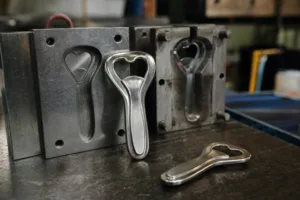
Die casting is a strong choice for zinc alloy openers with custom shapes, recessed logos, sculpted surfaces, and heavier presentation. It works well when the buyer wants stronger visual individuality. Mold design is critical because the opener mouth, leverage point, ring hole, and decorative relief all need to coexist without creating weak points.
Stamping
Stamping is commonly used for flatter products, especially where clean outlines and thinner profiles are acceptable. It can be efficient for large volumes. Tooling can still be required, but structure is simpler than many cast products.
Laser engraving and etching
These methods are useful for logos, serial details, fine text, or a more understated look. They are especially relevant for stainless steel and some plated surfaces. Buyers should confirm expected contrast because a laser-marked logo may look more subtle than filled enamel artwork.
Electroplating and surface finishing
Plating changes both appearance and surface behavior. Nickel tone, chrome tone, black nickel, antique brass, antique silver, and related looks can all shift the product style significantly. From a process standpoint, buyers should understand that metal plating and finishing processes involve distinct finishing operations, which is why not every base material and every decorative target are equally practical in production. Early alignment on finish helps avoid sample revisions.
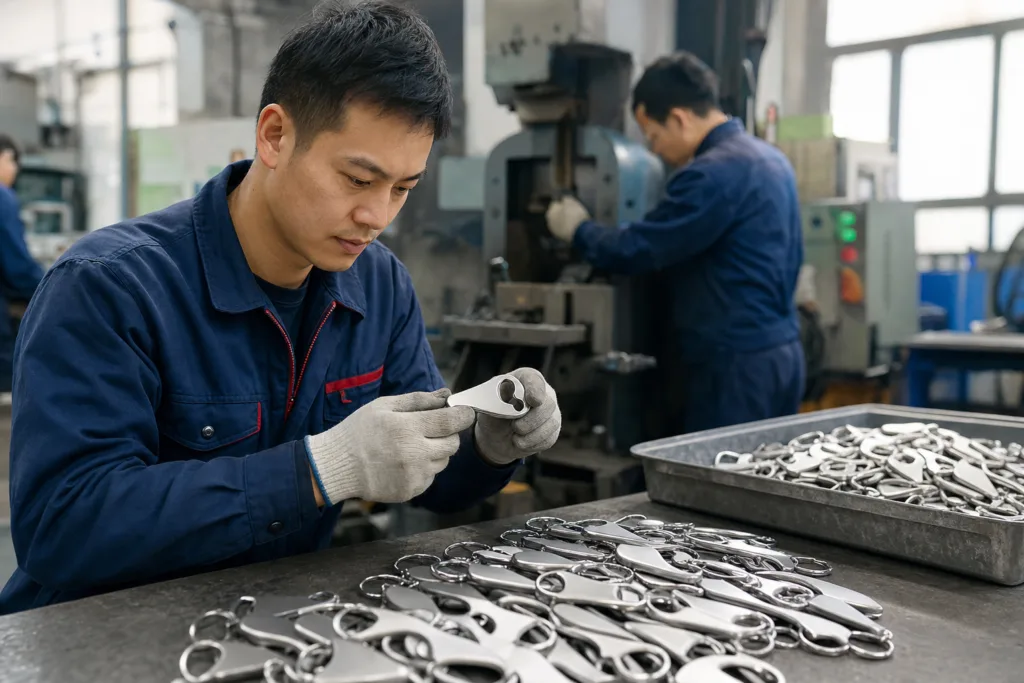
In our production work, we advise buyers to judge process choice not only by appearance but also by how often the product will be handled, whether it may contact moisture, and how much abrasion the surface is likely to face in use and shipping.
Finish and decoration choices that change the final impression
Finish is often the difference between a generic giveaway and a product that feels intentionally developed. Even with the same structure, a polished nickel look creates a different impression from a matte black finish or an antique brass effect.
| Finish Type | Visual Effect | Best For | Buyer Note |
|---|---|---|---|
| Polished | Bright and reflective | Corporate branding, clean logo presentation | Shows scratches more easily |
| Matte | Modern and understated | Contemporary lifestyle or tech branding | Good for subtle logos |
| Antique | Vintage depth with shadow | Souvenirs, heritage themes, craft-beverage branding | Works well with raised and recessed detail |
| Sandblasted or textured | Soft industrial feel | Outdoor and rugged themes | Needs a design that suits texture |
| Color-filled | Stronger brand color visibility | Logos, mascots, campaign artwork | Requires clean separated artwork areas |
At Gairun, we often remind buyers that edge quality and finish consistency matter as much as front-face branding. A beautiful logo cannot compensate for rough edges, thin plating coverage, or weak attachment hardware.
Artwork and file preparation tips for better logo detail
Many production delays start with artwork that is visually attractive on screen but unsuitable for metal manufacturing. Fine gradients, hairline strokes, tiny enclosed spaces, and overly small text may not translate well to casting, stamping, or enamel filling.
To improve sample accuracy, buyers should prepare vector artwork when possible and identify the following clearly:
- Final product size
- Target thickness
- Logo placement area
- Raised, recessed, engraved, or printed logo preference
- Color references if enamel or printing is required
- Attachment style and ring size
- Front-only or double-sided decoration
Where logo detail is dense, simplifying the artwork usually produces a better physical product. We often help clients adapt artwork for manufacturability rather than merely reproducing a file exactly as received. That step reduces revision cycles during sampling.
Sample development, mold cost, and MOQ planning
Buyers should expect product development requirements to vary by structure. A simple flat opener may need relatively low tooling complexity, while a die-cast custom silhouette can require dedicated mold work. Mold cost is usually affected by outline complexity, thickness variation, 2D or 3D detail, and whether multiple cavities are used for efficiency.
MOQ also depends on process and finish. Standardized styles with simple decoration may support lower entry quantities than highly customized plated and color-filled products. However, chasing the very lowest MOQ is not always the right strategy. In many projects, a slightly larger run produces better unit cost, more stable color control, and more efficient packaging planning.
This is where manufacturer communication matters. Strong custom keychain manufacturing support should help a buyer understand which costs are one-time development costs, which are volume-sensitive, and where design changes can simplify production without weakening brand impact.
Lead time, bulk production, and QC checks buyers should confirm
Lead time should never be discussed as a single number without context. Sample time, mold preparation, finish selection, plating queue, color application, assembly, packaging, and inspection all affect actual production scheduling. For event-driven orders, buyers should build in review time for pre-production samples and shipping buffers.
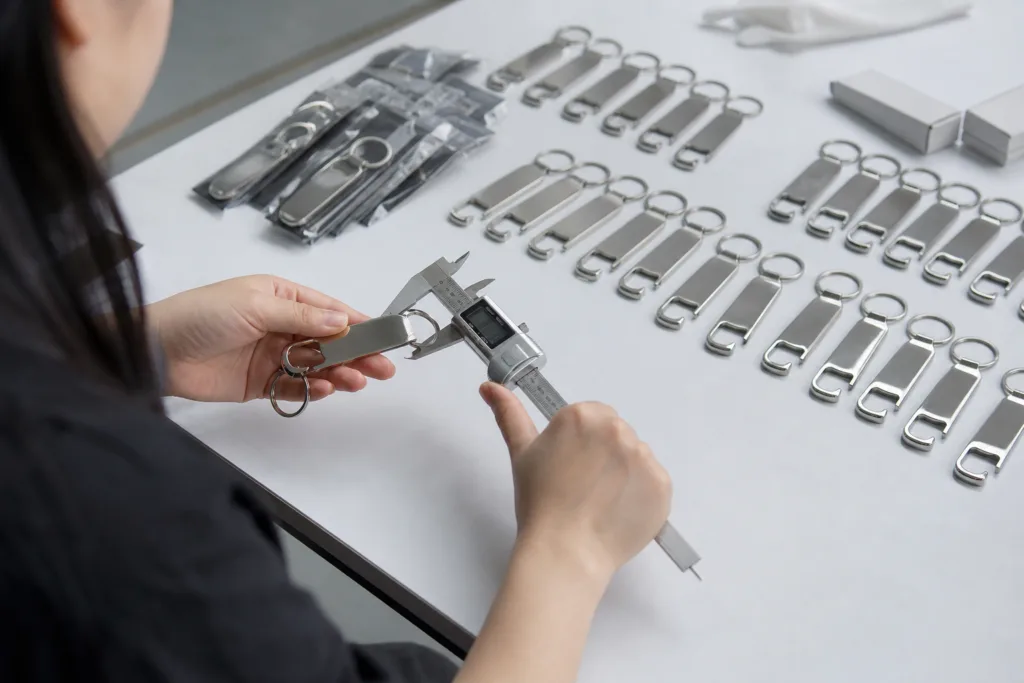
QC for keychain bottle openers should include both cosmetic and functional checks. We typically focus on:
- Opening edge shape and actual bottle-opening performance
- Overall size and thickness tolerance
- Weight consistency within acceptable range
- Sharp edge and burr inspection
- Plating or surface finish consistency
- Logo clarity and color fill accuracy
- Keyring attachment security
- Packaging count accuracy and barcode or label matching if required
For importer and distributor projects, it is also wise to confirm end-user assumptions and compliance scope before production begins. Promotional hardware is not automatically risk-free simply because it is small or common. Intended audience, coatings, attachments, and artwork changes can affect review needs, so buyers should discuss audience and use conditions early and refer to applicable promotional product safety guidance when appropriate.
As a manufacturer, we also recommend documenting the approved sample carefully with finish notes, ring style, plating tone, logo position, and packaging method. That reference becomes important for repeat orders and helps reduce disputes over acceptable variation.
Packaging options for retail, event, and corporate use
Packaging is often treated as an afterthought, but it changes both presentation and logistics. Event giveaways may only need bulk polybag packing by quantity. Retail-oriented souvenir programs may need backing cards, barcodes, or hang-ready formats. Corporate gifting may require individual bags, paper cards, or presentation boxes.
Packaging choice affects more than appearance. It can influence scratching risk, sorting speed, and labor cost. Heavy plated products packed loosely can rub against each other and reduce perceived quality on arrival. For premium finishes, individual protective packing may be worth the added cost.
When buyers are sourcing across multiple custom accessories, Gairun typically advises planning packaging at the same time as the product itself. That helps align insert size, logo card dimensions, barcode position, and carton packing efficiency before mass production begins.
What usually drives cost
Buyers often ask for a price before product specifications are stable, but key cost drivers are usually predictable. The most important are base material, product size, thickness, process type, custom shape complexity, plating or color decoration, packaging, and quantity.
In practical terms:
- Die-cast custom shapes usually cost more than simple flat forms
- Heavier products use more material and increase freight cost
- Multiple enamel colors and antique finishes add process steps
- Special packaging adds labor and material cost
- Smaller quantities carry less tooling efficiency
- Tight tolerances or complex assembly increase QC time
The goal is not always the lowest unit price. A better B2B outcome is usually the most appropriate cost-performance balance for campaign purpose, expected lifespan, and brand image.
How to choose the right opener for your campaign goals
A successful choice starts with the real use scenario. If the item will be distributed at a large public event, light weight and budget control may outweigh premium feel. If it will be sold in a souvenir shop or included in a beverage gift set, a heavier die-cast style with better finishing may be more appropriate.
We usually suggest buyers review five questions:
- Is the item meant for mass distribution, resale, or premium gifting?
- Does the brand need bold color, fine engraving, or a subtle metal look?
- Will users carry it daily with keys, or use it only occasionally?
- Does the logo need a simple standard shape or a fully custom silhouette?
- What lead time is available for sample review and production correction if needed?
When those answers are clear, the right material and process path becomes much easier to define.
Common buying mistakes to avoid
One common mistake is choosing style before deciding the actual performance requirement. A visually impressive shape may not function well as an opener if leverage and opening geometry are weak. Another is underestimating thickness. Very thin products may reduce cost but can bend, feel cheap, or disappoint end users.
We also see buyers approve artwork without checking how small text, thin borders, or filled color areas will translate into metal. That often creates unnecessary revisions. Another avoidable problem is selecting a finish only from a digital image. Real samples are important because antique depth, gloss level, and metal tone can look very different in person.
Finally, some buyers focus only on headline MOQ and unit price while ignoring tooling, packaging, and inspection details. In manufacturing, incomplete specification is one of the fastest ways to create misunderstanding. A precise quotation based on complete information is far more useful than a fast but vague low price.
Conclusion
Keychain bottle openers continue to work as classic promotional giveaways because they combine utility, repeat brand exposure, and flexible metal customization. For B2B buyers, the strongest results usually come from making early decisions about material, structure, logo method, finish, packaging, and inspection standards rather than treating them as separate steps. From our perspective as a metal products manufacturer, the product may look simple, but the quality difference between a basic opener and a well-developed custom piece is significant. When buyers align campaign purpose with the right manufacturing method and finish, they are far more likely to get a product that performs well, looks consistent in bulk, and supports the brand long after the event is over.
FAQs
What is the best material for custom keychain bottle openers?
The best material depends on your target price, desired weight, and branding style. Aluminum is often suitable for high-volume promotional use because it is lightweight and economical, while zinc alloy is better for custom shapes and a heavier feel. Stainless steel works well for simple durable designs, and brass is often chosen when a more premium appearance is needed.
Can keychain bottle openers be made in custom shapes?
Yes, custom shapes are common, especially when zinc alloy die casting is used. A custom outline can match a logo theme, mascot, bottle silhouette, or souvenir concept, but the opener area still needs to be engineered for real function. Good design should balance shape creativity with leverage, strength, and comfortable handling.
How should I prepare artwork for a metal bottle opener keychain?
Vector artwork is usually the safest starting point because it helps define clean outlines, text, and logo areas. You should also specify product size, thickness, color references, front or back decoration, and whether the logo should be engraved, recessed, raised, or color filled. If the artwork has very fine detail, it may need simplification for better manufacturing results.
Do custom keychain bottle openers require a mold?
Many custom designs do require a mold, especially die-cast or stamped products with unique shapes. Simple standard styles with only a logo change may have lower development requirements, but fully customized structures usually involve tooling cost. Buyers should ask whether the quotation includes mold charges, sample cost, and any revision terms before approval.
What quality checks matter most before bulk production?
The most important checks are opener function, edge smoothness, plating or finish consistency, logo clarity, ring attachment security, and packaging accuracy. A pre-production sample should confirm not only appearance but also actual usability. For repeat orders, keeping a signed reference sample and detailed specification record helps maintain consistency.
What packaging is suitable for promotional versus retail use?
Promotional distribution often uses bulk packing or simple individual polybags to control cost and speed handling. Retail programs may require backing cards, barcode labels, or hang-ready presentation, while corporate gifting may call for cleaner individual presentation such as custom cards or boxes. The right packaging depends on how the item will be distributed, displayed, and protected during shipping.