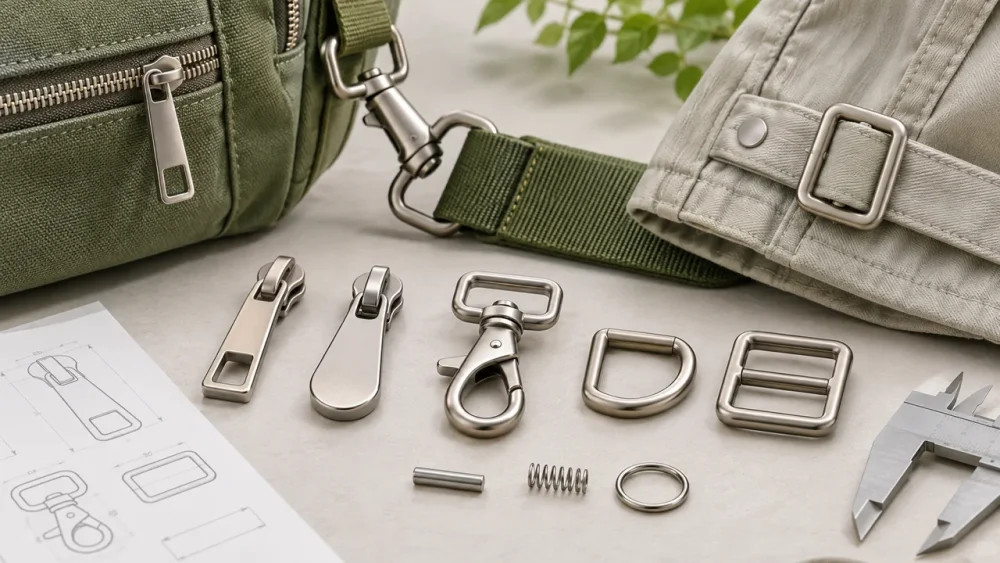
Custom Zinc Luggage Hardware for Bags and Garments
Plan zinc zipper pullers, bag clasps and garment hardware by item and finish. Define moving parts, textile interfaces and packing for your collection.
Discuss your requirements
Bring Gairun your zipper pullers, bag clasps or garment buckle designs as a defined hardware collection. Each item needs its own attachment, finish and operating requirements. The proposal should state whether you are buying decorated metal bodies, moving assemblies or components with specified textile attachments.
Bag and accessory brands often coordinate several small parts across one collection. Matching their appearance is only one decision: the slider connection, strap passage and clasp motion must suit the actual fabric and hardware. Define those interfaces before approving a shared cosmetic sample.
Build a collection order that purchasing can maintain
Give each body, finish and mechanism combination a part reference.
Record whether pins, springs, rings or straps are included. A clasp that appears identical from the front can use a different rear attachment and may not be interchangeable in sewing or assembly.
Where you are replacing a source, supply an approved reference and identify which defects prompted the change.
Focus the review on those causes, such as rough strap-contact edges or inconsistent closure movement. A price comparison without that acceptance history can repeat the same problem.
Distinguish pullers, sliders and clasps
A zipper puller gives the user a grip and connects to the slider.
The slider itself controls engagement of the zipper elements. A decorative puller should not be described as evidence that the supplier produces or qualifies the complete zipper mechanism.
Bag clasps and buckles may use moving latches, pins or springs.
Identify which components create retention and release. A cast shell can support that mechanism without being the only material in the working assembly.
Garment hardware can be decorative, functional or both.
A small logo plate attached to a bag has a different duty from a buckle retaining a loaded strap. The drawing and test plan should follow the actual consequence of failure.
For belt-specific constructions, the separate belt buckle page covers the relationship between a branded face and its strap-retention system.
Keeping those tasks distinct helps avoid carrying inappropriate attachment assumptions from one accessory to another.

Connect metal to straps and fabric
Provide the width, thickness and material of the strap or textile.
Soft components vary in compression, friction and resistance to cutting. A fitting that works with one webbing may slip or damage another even when their nominal dimensions are similar.
Edges and transitions at textile contact points need deliberate control.
Burrs, sharp corners or rough internal openings can abrade the material during repeated movement. These regions may be less visible than the front face but more important to service behavior.
Define whether the metal is sewn, riveted, looped, clamped or otherwise attached.
The joining method determines access, hole geometry and local loading. If the customer performs the final attachment, agree the component condition and installation information needed for that operation.
For decorative plates, consider the backing and any contact with the contents of the bag or garment.
Protruding fasteners can create damage or discomfort. A finished external appearance should not hide an unresolved reverse-side construction.
Springs, pins and closure motion
Moving clasps need sufficient clearance to open and close without excessive looseness.
The relationship between the cast body, pin and moving element should be defined on the drawing. Coating thickness and polishing can change that relationship.
Spring performance belongs to the selected spring and its installed geometry.
The body must support it without creating unintended contact or preventing movement. A general statement that the clasp is spring-loaded does not establish release force or retention behavior.
Review accidental-release conditions relevant to the product.
The user should be able to operate the clasp as intended, while ordinary pulling or rubbing should not defeat retention. The responsible product designer should define how those competing requirements will be evaluated.
Assembly instructions should identify orientation, pin retention and any controlled fastening operation.
The metal assembly page explains why the complete bill of materials and joining method need to be part of approval.
Skin contact and cosmetic consistency
Hardware can contact hands or skin directly, or it may remain separated by fabric.
Describe the actual exposure and intended user group. Substance and coating requirements should be selected for the product and destination market rather than assumed identical across all accessories.
Perspiration, cosmetics and cleaning can affect appearance and material compatibility.
If these exposures are relevant, include them in the qualification program. A coating color reference does not establish resistance to the chemicals encountered during use.
Collections often combine pullers, clasps, rings and logo plates from different geometries or substrates.
Approve the visible set together to establish acceptable matching. Bright, satin and antique effects can appear different on curved and flat surfaces even when the nominal finish is shared.
Use the surface finishing guidance to distinguish color approval from coating-performance requirements.
Samples for testing should represent the actual finish and construction, including components that may contribute substances or affect corrosion.
Wear and assembly qualification
Test with representative straps, fabrics and mating parts.
Pulling, repeated opening, movement and exposure may need separate evaluation. The test should define the assembled configuration, conditions and failure criteria so the result has a clear meaning.
Inspect contact regions after trials where wear is relevant.
Damage may occur in the textile before it appears on the metal. A component-only strength test can therefore miss the failure mode most important to the customer.
Dimensional and appearance checks remain useful during production.
They should focus on the features that preserve the approved assembly and visual reference. The quality page explains how to connect these routine checks with initial qualification evidence.
Changes to a strap, spring, pin or coating may affect the approved result.
Maintain the component identities and revisions in the order record. A visually identical substitution should not be accepted automatically where its properties influence retention or wear.
Build a hardware collection brief
Provide drawings for each component and an assembly view showing its use.
Include the textile specifications, finish references, quantities by version and required accessories. State whether the order includes loose metalwork, assembled clasps or a packaged hardware kit.
Packing should keep finishes separated and versions identifiable.
Small components that look similar may have different strap widths, pin lengths or installation orientations. Clear identification reduces assembly errors and unnecessary handling.
Request a luggage hardware collection review with item references, finishes and mating straps or sliders.
Establish the supplied assembly for each item so quotations and repeat orders remain comparable.