Custom Zamak Perfume Caps for Fragrance Brands
Discuss custom zamak perfume caps with bottle, pump and liner references. Compare shell-only and assembled supply, finish approval and protective packing.
Discuss your requirements
Custom zamak perfume caps combine a decorative metal shell with a liner or retention system fitted to the bottle and pump. The material is also called zamac in packaging enquiries. Send Gairun the cap concept and actual mating components to discuss the shell, finish and requested assembly scope.
For fragrance brands, the key purchasing distinction is shell-only supply versus a cap assembly with an agreed liner. The metal controls much of the visible form and weight; the liner usually controls retention and removal. Approve the combination before treating the cap as ready for a packaging launch.
Compare shell-only and liner-fitted cap prices
List the metal shell, perfume cap liner, any adhesive or magnetic elements, assembly and protective packing separately.
Identify who owns the liner design and who supplies the bottle and pump references. This avoids comparing a decorative shell price with a complete closure proposal.
For multiple fragrance sizes, request a compatibility list linking each shell-and-liner version to its bottle and pump.
A shared external design does not establish that one internal fit will work across the range.
Start with the bottle and pump assembly
Use drawings or physical references for the actual components that will be supplied in production.
A nominal neck designation does not describe every external pump dimension, collar detail or tolerance affecting a decorative cap. The internal clearance must accommodate the selected closure without pushing on an actuator unintentionally.
Consider the height of the pump, the finished collar and the gap between the cap and bottle shoulder.
The cap should sit at the intended position without relying on uncontrolled contact with glass. A square or asymmetric cap may also need a defined orientation relative to the bottle decoration.
If several bottles will share one cap, compare the assemblies rather than assuming interchangeability.
A common outer shell may require different liners. Each combination needs a controlled part reference so purchasing and assembly teams know which components belong together.
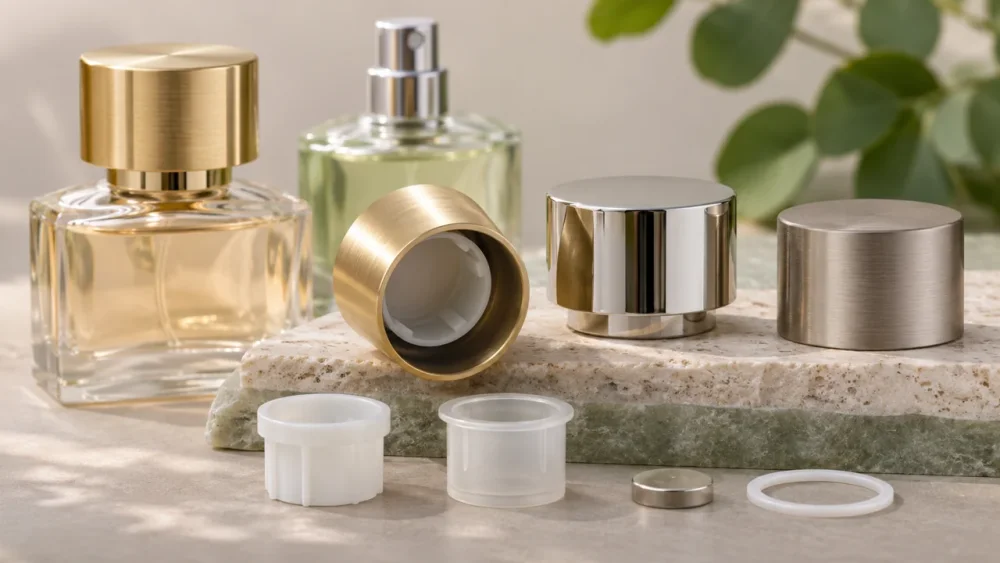
Weight and silhouette
Zinc alloy can give a compact cap a substantial feel and can reproduce formed details in a reusable die.
That does not mean a solid, heavy cap is always the best design. Weight affects handling, shipping, balance and the impact if the cap is dropped.
Review wall distribution and internal cavities with the external shape.
Thick concentrations of metal can complicate casting and surface preparation. A hollow construction may retain the desired silhouette while reducing mass, provided the liner and shell remain adequately supported.
Fine edges, sculpted corners and deep recesses influence polishing access.
The design should distinguish crisp visual boundaries from areas that can accept a radius. Approving this distinction early helps preserve the intended brand character through the finishing route.
The liner controls the fit
The liner material, retention features and assembly method determine insertion and removal behavior.
Specify how the liner locates in the metal shell and how the complete cap engages the pump or collar. A secure liner must remain in place when the user removes the cap repeatedly.
Define any target pull-off behavior through an agreed test rather than a subjective description alone.
Test conditions should reflect the final bottle assembly, component tolerances and expected conditioning. Adhesive, press-fit and mechanical retention approaches each require their own compatibility and assembly review.
For magnetic constructions, polarity, retention and surrounding components also matter.
A magnetic concept is not an automatic production option: it changes the component list and the validation requirements. Confirm the complete assembly route before selecting it as a design feature.
Polishing and plated appearance
Large reflective surfaces make small imperfections visible.
Indicate the primary viewing faces, acceptable joint locations and the areas that may be hidden by the liner. A visual reference should establish color, gloss, texture and the treatment of edges.
Different plating effects may require different preparation and coating sequences.
Terms such as gold or chrome describe an appearance imperfectly unless the intended coating system is also agreed. Avoid treating a metallic color name as a guarantee about precious-metal content or corrosion performance.
Review the surface finishing options with the cap geometry.
Samples should show how the finish behaves around lettering, recessed logos and curved surfaces, not just on a flat comparison swatch.
Chemical exposure and handling
Perfume can reach the cap through spills, residue or routine use.
Assess compatibility of the coating, liner and any adhesive with the actual formulation and cleaning conditions. A metal shell that does not normally contact the liquid can still experience incidental exposure.
Include abrasion, repeated removal and transport protection in the review where relevant.
An appearance test on an untouched sample does not establish resistance to repeated handling. Keep chemical and mechanical acceptance criteria separate so a failure can be traced to the correct interface or material.

Sample approval on the actual bottle
Evaluate the assembled cap on representative bottle and pump components.
Check alignment, seating, removal, liner retention and visible gaps. Include the intended decoration and packaging when confirming the visual standard.
Document the approved components and revisions.
A later pump or liner substitution can change fit even when the outer shell remains identical. The inspection plan should identify which checks apply to incoming parts and which apply to the final assembly.
Request a cap development review
Discuss your custom zamac perfume cap with the bottle, pump and liner information available. Agree the shell-or-assembly scope and the sample combination needed to evaluate fit, appearance and handling.
