Custom Metal Bookmarks with Cast Decorative Details
Compare thin metal bookmark bodies with cast decorative toppers. Define paper contact, artwork, joints and presentation before selecting a supply route.
Discuss your requirements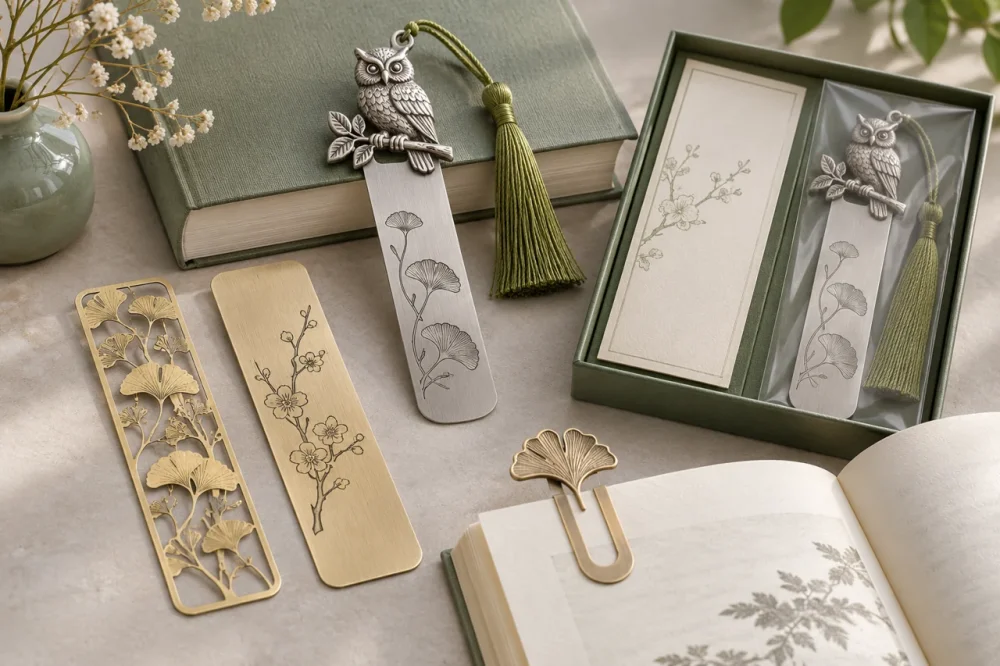
A custom metal bookmark should protect the reading experience as well as carry the design. Thin sheet bodies suit some formats, while cast bookmark toppers or hanging ornaments can add raised detail outside the page area. Send Gairun the intended format so the material and forming route can be reviewed by component.
Museum, publishing and gift buyers should distinguish a flat bookmark, a page clip and a cast decoration joined to another body. The proposed supply scope needs to identify the body, decoration, tassel and presentation. A zinc casting route is not automatically suitable for every thin metal bookmark.
Compare a thin body with a dimensional topper
Etched brass bookmarks are a useful alternative to consider when a thin outline or openwork body is the priority; this route must be separately confirmed in the supply proposal.
A cast topper instead places depth and weight above the paper-contact area. Compare the complete construction, including the joint and finish.
For a bookshop or museum collection, specify the card, message and individual protection with the metalwork.
Decide whether the bookmark should remain flat in shipping or be presented in a fitted box. This affects both packing cost and the product's arrival condition.
Match the metalwork to the book
Consider the size and type of book in which the bookmark will be used.
A product intended for a compact notebook may need different proportions from one supplied with a large presentation volume. The object should remain practical when the book is closed.
Identify which surfaces contact paper and where the decoration sits.
A raised topper outside the page edge can have more depth than the portion inserted between pages. This separation helps preserve the visual design without making the working body too thick.
If the bookmark clips onto a page, define how it grips and releases.
A metal shape that holds firmly should not tear or permanently mark the paper during ordinary use. Test representative papers rather than assuming all books behave alike.

Sheet body or cast decoration
Etching, stamping or another sheet-based route may suit thin outlines and openwork designs.
Zinc casting may suit a dimensional emblem attached to a separate body. The correct comparison concerns the finished object, including any joining operation.
Avoid specifying zinc die casting solely because the item is described as a metal gift.
A thin, flexible product can place demands that are better served by another material or forming method. Explain the intended behavior so suitable alternatives can be evaluated.
Edges, thickness and flexibility
Paper-contact edges require deliberate control.
Burrs, pointed cutouts or rough transitions can damage pages even if the broad surfaces look attractive. The appearance inspection should therefore include the practical contact regions.
Thickness affects how the book closes and how easily the bookmark bends.
Flexibility may be useful for one format and undesirable for another. Define whether the product is expected to remain flat, flex during use or support a raised decorative feature.
Openwork areas need sufficient support for handling and packing.
Very narrow bridges may be vulnerable to deformation. Review these features at the actual product size rather than judging their proportions on an enlarged artwork display.
Artwork on narrow surfaces
Bookmarks often have a long, narrow visual area.
Prioritize the text, emblem or pattern that must remain readable. Trying to reproduce a complex logo at a very small width can lead to detail that has little value in the finished product.
Etched, stamped, filled and printed decoration create different effects.
The chosen method should suit the material and surface shape. A screen proof establishes layout, while a physical reference is needed to judge metallic appearance and fine detail.
If the design includes a commemorative date or a series of messages, maintain a controlled version list.
Variable text may require a separate operation from the main forming process. Define how each version will be identified during packing.
Toppers, tassels and presentation
A cast topper or charm introduces a joint and changes the balance of the bookmark.
Define how it connects to the main body and whether it can move. A decorative element should not become detached during ordinary handling.
Tassels, ribbons and cords need a suitable hole or attachment feature.
Check the contact edges so they do not cut the soft material. If the attachment is supplied assembled, include its material, color and orientation in sample approval.
Presentation packaging should support the thin body without bending it.
A fitted card or box can help, provided the retention method does not damage the finish. The assembly page addresses the relationship between component construction and final packing.
Prepare a bookmark project
Provide dimensions, artwork, intended format and any thickness or flexibility requirements.
Include the topper or tassel details, finish, quantities and presentation concept. State the target market and user group where they affect product testing.
Submit your bookmark format and artwork to compare suitable body and decorative-component routes.
Request a defined scope for the metalwork, attachments and presentation before commissioning a sample.
