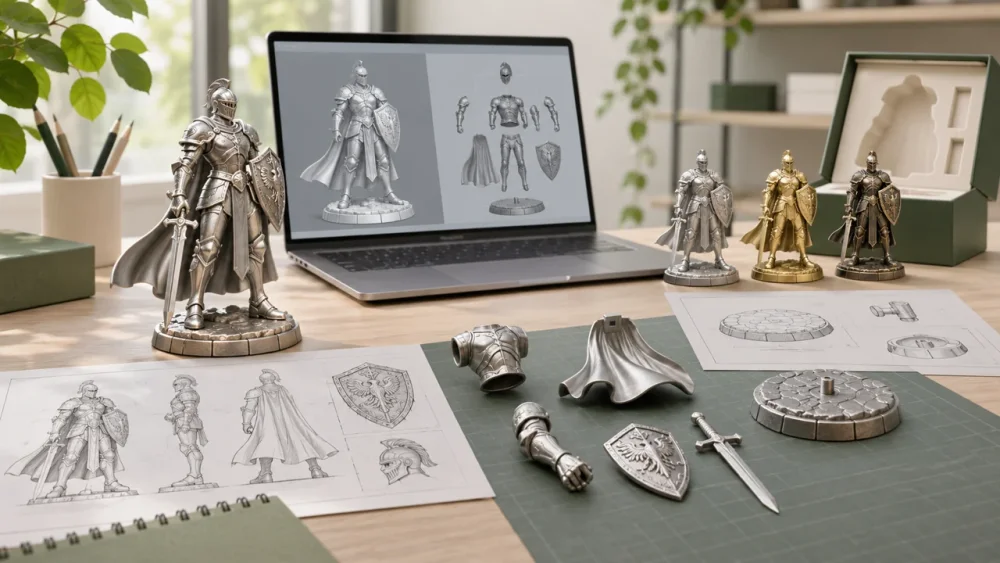
Custom Die Cast Figurines for Collectible Projects
Plan custom die cast figurines and miniature models. Separate sculpt development, metal parts, finishing and presentation before approving production.
Discuss your requirements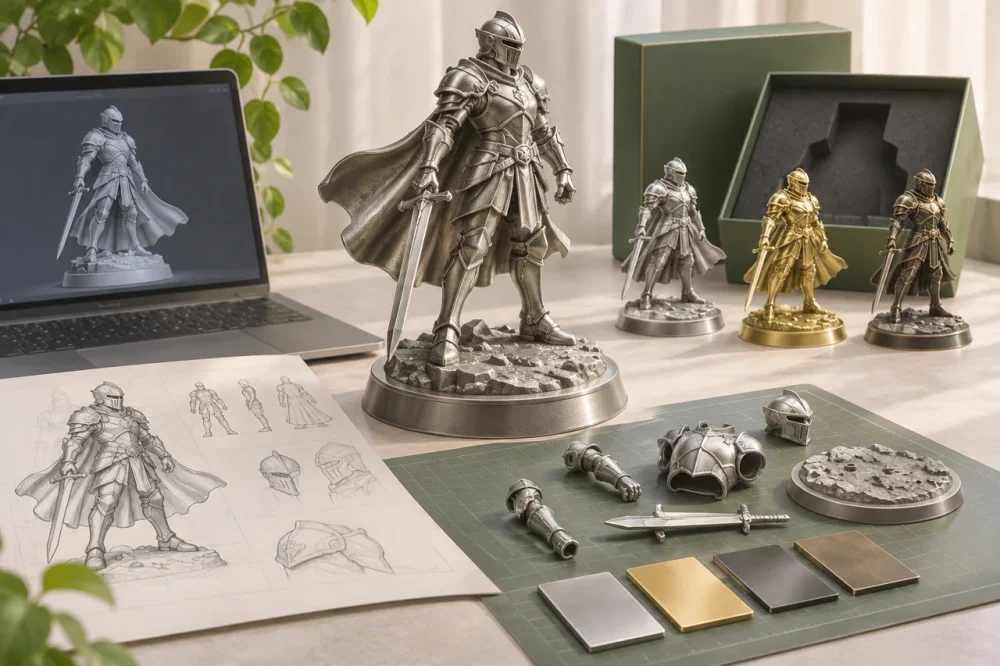
A custom die cast figurine enquiry starts with a complete three-dimensional subject and its intended use. Gairun can review zinc miniature models or sculpted metal collectibles for a suitable part breakdown, finish and assembly route. Flat reference artwork may need further modeling before the object can be priced for production.
Collectible brands should distinguish the sculpture, base, joined features and presentation packaging. Small projections, undercuts and the balance of the finished model affect both cost and approval. Toy or children's-product classification must be established from the actual intended product and market.
Separate sculpt development from production approval
Ask whether the enquiry is for manufacturing from a finished model or also includes model-development work.
The two scopes should be agreed separately. A visual render can approve the pose but cannot demonstrate part joints, stability or the final coating.
For a series, identify changes in base text, accessories and paint or plated effects.
Pricing a single reference image can conceal those differences. Approve the modeled geometry first, then use a representative physical construction to evaluate the assembled object and its presentation.
Turn reference art into a complete object
Develop the form from several viewpoints.
The back, underside and transition between major features can affect both appearance and manufacture. Ambiguous geometry should be resolved in the model rather than left to interpretation during toolmaking.
Scale changes the design. A detail that is convincing on a large sculpture may become fragile or unreadable in a miniature. Decide which features should be simplified, emphasized or represented through surface decoration at the final size.
The visual approval should include proportion and pose as well as surface detail.
Small changes to a face, emblem or characteristic outline can alter recognition. Keep the approved model revision connected to the later tooling and sample records.
Resolve undercuts and part divisions
The tool needs a way to open and release the part.
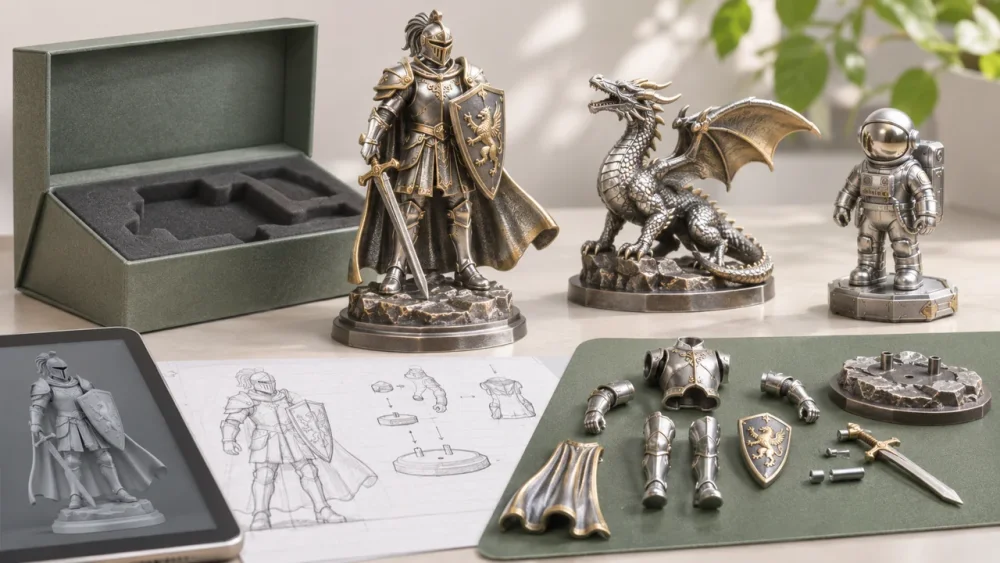
Deep undercuts, enclosed spaces and projecting limbs can prevent straightforward extraction. The manufacturing review should identify where the object might be divided into separate cast elements.
Part divisions affect both the appearance and the assembly.
A joint can sometimes follow a natural boundary in the subject, but it still needs sufficient support and a reliable joining method. Avoid placing a seam solely for convenience if it undermines the intended visual result.
Some details may be better made from another material or process.
A thin flexible element, transparent feature or very fine projection may not benefit from being cast in zinc. Define which substitutions are acceptable before the production route is fixed.
Support fine features and the base
Small projections need to survive forming, finishing, assembly and transport.
Their risk is not limited to normal display use. Handling during production can expose them to loads that a final owner would not apply.
The base should support the intended pose and provide adequate stability.
Review the center of mass and the contact footprint, particularly where the object is tall or asymmetric. A heavy material does not guarantee that the finished figurine will resist tipping.
If the model attaches to a separate stand, define the locating and retention features.
The joint may need to remain hidden while still being accessible for assembly. The assembly page helps clarify how those requirements become a controlled production operation.
Join and finish the sculpture
Choose the joining method with the visible finish in mind.
A seam or attachment that appears unobtrusive on raw parts may become obvious after polishing or plating. Review representative assembled samples before accepting the final appearance.
Deep recesses and overlapping forms can limit finishing access.
Identify the main viewing surfaces and areas where a different texture or preparation level is acceptable. This allows the finish specification to follow the actual object rather than a uniform instruction that is impractical to execute.
Painted, filled, printed and metallic effects should support the subject's hierarchy.
More effects can introduce more alignment and approval variables. The surface finishing guidance explains how to define the selected result clearly.
Collectible or toy classification
Clarify the intended user and the way the item will be marketed and used.
An adult display collectible and a toy can require different safety assessment. Simply labeling a miniature as decorative does not resolve its classification if its design and foreseeable use indicate otherwise.
Small detachable parts, accessible edges and material exposure may need evaluation under applicable requirements.
The product owner should identify the target markets and required tests before the construction is finalized. A metal composition report alone does not establish complete toy compliance.
The quality page explains how to distinguish product testing from certification and factory documents.
Keep the tested construction aligned with the actual materials, joints and decoration that will be supplied.
Approve a miniature for production
Provide the complete model, dimensions, viewing references, base arrangement and finish concept.
Include quantities, packaging and any applicable product requirements. Identify whether a display case or fitted insert is part of the order.
Send your figurine references and development stage to define modeling, metal parts and finishing responsibilities.
The next milestone should establish the part breakdown and the sample needed to judge the complete collectible.