Custom Metal Keychains and Logo Keyrings
Request custom metal keychains and logo keyrings from Gairun. Define rings, mixed materials, decoration and packing for the complete branded accessory.
Discuss your requirements
Gairun manufactures custom metal keychains for merchandise and promotional projects, with the design, attachments and decoration agreed for each order. Specify the complete carried item: a zinc alloy emblem, its links and ring, and any leather or other material included in the design.
Custom logo keyrings need to remain comfortable to carry while keeping the branding readable. A quote for the decorated metal piece alone may exclude keychain attachments or final packing. Define those items early so the offer matches the product you intend to distribute.
Choose the supplied keychain assembly
Ask the proposal to identify the ring, connecting links and any mixed-material section.
Leather metal keychains also need an agreed leather specification, stitching or fastening method and appearance reference. The metal tool cannot define those details by itself.
For several logos or colors, list each variant and its quantity.
Approve the assembled keychain's weight and movement alongside its artwork so the reference represents the item customers will carry.
Define the carried object
Consider the keys or other items that will share the ring.
A keychain needs enough space and movement to function without trapping the keys against the body. Long chains or large attachments can change how it sits in a pocket or bag.
The user's experience depends on weight and overall dimensions.
A substantial metal piece may suit a presentation gift, while a lighter construction may be preferable for routine carrying. Evaluate the full assembly, including rings, links and any leather or fabric elements.
Identify surfaces that frequently contact other objects.
Raised details can experience abrasion, and pointed outlines can catch on fabric. A design that looks striking in a display image should still be comfortable to handle and practical to carry.
If the keychain contains a moving element, opening feature or separate insert, define that function explicitly.
It introduces another interface that needs approval and inspection. The bottle opener page covers the additional requirements of an opening mechanism.

Cast shape and practical weight
Zinc die casting can create shaped bodies, recessed branding and raised details in a repeatable tool.
The design should use those features purposefully. Solid thickness everywhere can add unnecessary weight and may complicate the manufacturing route.
Review narrow necks and the area around attachment holes.
These locations may carry the load when the keychain is pulled or snagged. Their performance depends on geometry and material condition, not simply the overall thickness of the decorative face.
An open outline or cutout can reduce mass and create a recognizable silhouette.
It also introduces edges and smaller sections that need attention during forming and finishing. The design review should consider whether those details remain practical at the intended product size.
Approve relief in its actual dimensions.
Fine lettering and closely spaced lines can disappear visually when reduced. A clear central mark often communicates better than placing all available brand information on a small carried object.
Rings, links and attachment holes
The split ring, connector link and attachment hole form a load path.
Each needs to be suitable for the intended use. A strong metal body does not compensate for a poorly closed link or an undersized connection.
Specify the ring size and type, the number of links and the way the body is connected.
Confirm whether the attachment can rotate freely and whether it rubs against a decorated surface. Assembly photographs or a sample reference can make this relationship easier to communicate.
Attachment holes need adequate edge distance and a finish that does not leave damaging burrs.
Polishing should not remove so much material that the connection becomes weak. The finished geometry should be checked with the actual ring or link.
For multiple-piece keychains, define the order and orientation of each component.
Separate charms may collide during use or obscure the main logo. Their movement and packaging should be evaluated as an assembly rather than as isolated parts.
Relief, enamel and printed branding
Raised metal, recessed color and printed graphics create different effects and wear patterns.
Place important information where it remains visible in the normal carried position. Avoid depending on tiny text in an area repeatedly struck by keys.
Color-filled designs need metal boundaries that can separate the intended areas.
Printed designs need a suitable surface and registration control. A clear coating can change appearance and handling, so include it in the specification if selected.
Finish matching should use an approved reference rather than a color name alone.
Antique, bright and matte surfaces reflect light differently and can emphasize different details. The surface finishing guidance explains how to document the intended result.
Leather and mixed-material combinations
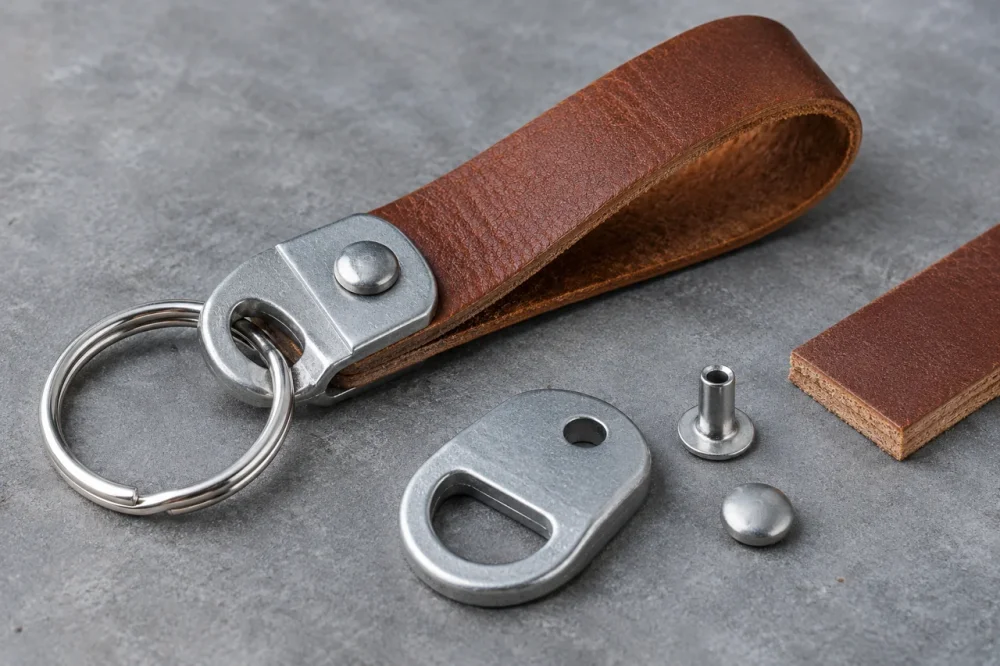
A leather-and-metal keychain needs a defined relationship between the soft component and the metal fitting.
Hole position, fold thickness, rivets, stitches or other attachments can affect both appearance and retention. Specify which materials are included in Gairun's scope of supply.
The metal edges should not cut or abrade the adjacent material during movement.
Review the joint under realistic bending and pulling conditions. Material variation in the soft component can also affect assembly fit, so the acceptance plan should account for the complete construction.
Adhesive joints, if proposed, need compatibility and use-condition review.
Mechanical retention and adhesive retention should not be treated as interchangeable without testing. The quotation should identify the actual assembly method being offered.
Wear checks and packing choices
Agree checks that reflect ordinary carrying and the intended distribution program.
Attachment retention, accessible edges, moving parts and surface abrasion may all matter. State the method and acceptance criterion for any required functional test.
Appearance inspection should distinguish the main display face from areas likely to experience routine contact.
The sample establishes the as-supplied standard; it does not by itself prove a particular service life. Avoid turning a short handling test into an unsupported durability promise.
Individual protection can prevent rings and bodies from marking one another in transit.
A backing card or presentation box should hold the assembly without loading its attachment unnecessarily. For mixed variants, identify the design and quantity clearly on the packing documentation.
Prepare a keychain production brief
Provide artwork, dimensions, preferred weight or construction, attachment details, finish and order quantities.
Include packaging, destination and any requirements related to the user group or market. A physical reference can help explain feel and movement, but the final drawing should control the agreed geometry.
Send your branded keychain brief with the full attachment arrangement and packing requirement.
Request a proposal for the assembled product or clearly identify any components your own team will add.
