For audio brands, private label sellers, and OEM product teams, custom headphones with metal plate design can add a more durable and premium branding element than printed plastic alone. A well-made metal plate gives the product a stronger visual identity, supports finer logo detail, and helps differentiate a model at retail or in a promotional program. From our metal manufacturing perspective, the real challenge is not simply adding a decorative part. It is choosing the right metal, finish, thickness, attachment method, and quality standard so the plate looks refined, fits the headphone housing correctly, and stays consistent through bulk production.
If your project needs decorative branding parts, trim badges, or logo hardware that must match both product styling and production realities, our custom metal manufacturing solutions are relevant at the early planning stage. We help buyers evaluate metal type, logo method, surface finish, adhesive or mechanical attachment, sample development, and mold feasibility before bulk orders move forward, which is especially useful when headphone programs need a branded look without adding avoidable weight, fit problems, or finish inconsistency.
What metal plates on headphones are and why brands use them
A metal plate on headphones is usually a custom-made decorative or branding component applied to the ear cup, headband side piece, hinge cover, slider trim, or packaging accessory. In some projects it is a slim logo badge. In others it becomes a more visible design feature that frames the product style. The part may be attached to plastic, leather-like wraps, aluminum housings, or coated composite shells.
Brands use these plates for several practical reasons. First, metal can communicate a higher-value finish than a simple screen print. Second, engraved, etched, stamped, or cast logos often hold sharper detail over time. Third, the plate can create a repeatable brand signature across headphones, speakers, accessories, and retail packaging. We often see buyers treat the metal plate as a small part, but in visual merchandising it can strongly influence perceived build quality.
The most successful projects decide early whether the plate is purely decorative, semi-structural, or part of a wider trim system. That decision affects material, thickness, back construction, and mounting method. A decorative badge can be very thin and light. A trim cover around a hinge may need tighter tolerances, stronger edges, and better scratch resistance.
The main benefits: premium appearance, durability, and stronger brand identity
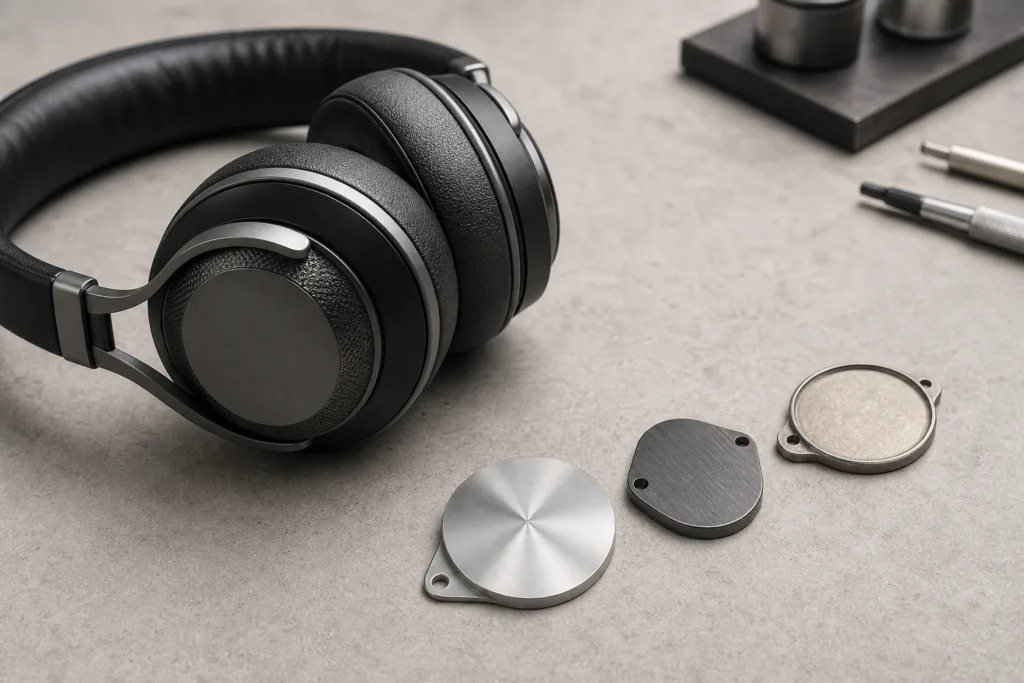
The biggest benefit is controlled visual contrast. A brushed aluminum plate on a matte polymer shell, a bright nickel logo against a dark housing, or a recessed antique brass emblem on a heritage-style headset can instantly elevate the product language. The effect is not just aesthetic. It helps buyers recognize the brand and creates a more tactile finish than ink alone.
Durability is the next advantage, but only when the part is engineered correctly. A poor metal choice, weak coating, or badly selected adhesive can create more problems than value. A good plate should resist edge lifting, visible scratches, plating discoloration, and logo wear under normal handling. It should also stay dimensionally stable across temperature changes and not create sharp points that irritate the user during wear or storage.
Brand identity also improves when the logo method suits the use case. For example, buyers considering engraved metal plate options often do so because engraving or etching can produce cleaner fine lines than some printed decoration methods, especially for minimalist brand marks, serial branding, or model identification.
What well-designed headphone branding plates get right
From our experience, the strongest headphone branding plates are rarely the heaviest or most complex. They succeed because the brand team aligns styling with production logic. The logo is sized for real manufacturing detail, the finish matches the product mood, and the plate is proportioned to the headphone body instead of appearing oversized.
Good projects usually get five details right:
- They match the plate shape to the headphone geometry rather than forcing a generic rectangle.
- They keep thickness low enough to avoid a bulky look.
- They choose a finish that tolerates handling and skin oils.
- They use attachment methods appropriate for the substrate and assembly line.
- They review prototypes under real lighting, not just on digital mockups.
Another smart move is to treat the metal plate as part of the total industrial design system. If the headphone uses cool metallic accents elsewhere, the plate should reinforce that direction. If the product is sporty and lightweight, a thin brushed or anodized look usually makes more sense than a heavy ornamental badge.
Do metal plates affect sound quality?
This is a common question, and the honest answer is: sometimes, but usually less than buyers fear if the plate is small and correctly positioned. Decorative metal plates do not automatically harm sound quality. The risk comes when the part changes cup mass distribution, interferes with venting, alters resonance behavior, or requires aggressive adhesives or fasteners near acoustic pathways.
For over-ear and on-ear headphones, plates applied to the exterior of the cup generally have limited acoustic impact when they are thin, lightweight, and mounted away from vents and driver-critical zones. Problems are more likely when a heavy zinc alloy plate is placed on a very light housing, when attachment changes the cup wall behavior, or when design revisions happen after acoustic tuning is already finalized.
Our recommendation is simple: involve the acoustic and industrial design teams early. If the headphone shell has ports, microphone pathways, wireless antenna areas, or tuned chamber structures, the plate must be planned around them. In many cases aluminum or stainless steel nameplates with modest thickness provide the desired premium look while keeping mass change manageable.
Designing custom headphones with metal plate design
When buyers plan custom headphones with metal plate design, the best results come from balancing brand visibility with comfort, weight, and assembly efficiency. A plate that looks great in isolation may still fail if it catches on a pouch lining, leaves a sharp edge at the corner, or causes fit variation on a curved plastic cup.
| Design factor | What to decide | Why it matters |
|---|---|---|
| Shape | Flat, curved, round, shield, bar, custom contour | Must follow housing form and visual language |
| Thickness | Very thin decorative badge or thicker dimensional part | Affects weight, feel, and edge profile |
| Logo method | Engraved, etched, stamped, cast, printed, enamel filled | Controls detail, depth, and durability |
| Finish | Brushed, polished, plated, painted, antique, anodized look | Changes style and scratch visibility |
| Attachment | Adhesive, pins, tabs, screws, insert fit | Determines assembly reliability and serviceability |
| Packaging | Standard protection or premium retail presentation | Prevents scratching before final use |
Best metal materials for headphone plates
Aluminum
Aluminum is often the first material to consider when weight matters. It is light, modern in appearance, and suitable for brushed, anodized-style, engraved, or coated finishes. For slim branding plates on premium consumer electronics, aluminum can give a clean technical look without adding too much mass. It is a strong candidate when the headphone housing is already lightweight and the brand wants a subtle metallic effect.
Zinc alloy
Zinc alloy is useful when brands want more dimensional shapes, raised logos, curved profiles, or decorative relief. It performs well in die casting and supports richer form language than flat sheet processes. The trade-off is weight. On larger cup badges, zinc alloy can feel substantial, but on weight-sensitive headphones it should be used carefully and sized appropriately.
Stainless steel
Stainless steel is a practical option for thin, durable plates with a crisp edge and strong resistance to wear. It works well for etched or engraved plates and can suit minimalist branding. It is especially valuable when the part needs a stable feel, thin profile, and a refined industrial appearance.
Brass
Brass is usually chosen for a warmer, heritage, or luxury-inspired look. It can plate beautifully and supports decorative finishes well, but it is heavier and typically used in more style-driven projects. For limited editions or special collaborations, brass may provide the exact visual tone a brand wants.
| Material | Main strength | Main caution | Typical use |
|---|---|---|---|
| Aluminum | Lightweight | Can dent if too thin | Modern slim logo plates |
| Zinc alloy | Dimensional form | Higher weight | Raised decorative badges |
| Stainless steel | Thin and durable | Harder shaping limits for some designs | Fine-line branding plates |
| Brass | Warm premium tone | Weight and cost | Special edition styling |
Finish and decoration options
Finish selection changes both appearance and long-term performance. Polished surfaces look bright but show fingerprints and scratches more quickly. Brushed finishes often hide handling marks better. Electroplated finishes can create gold-tone, gunmetal, nickel, black nickel, and other decorative effects, but they need stronger corrosion and adhesion control. Painted or coated finishes can achieve color matching with plastics and packaging, while antique finishes create depth on raised details.
For darker consumer electronics styling, many buyers evaluate matte black plate finishes because they reduce glare and often integrate well with black, gray, and soft-touch housings. The key is to confirm whether the desired black look comes from plating, painting, powder-like coating, anodized appearance, or another treatment, since each behaves differently in scratch visibility, color consistency, and edge appearance.
Decoration methods should match the logo style. Laser engraving is precise for thin line work and serialized branding. Chemical etching is useful for recessed detail and refined textures. Stamping suits sheet-based plates with embossed or debossed features. Enamel filling can add color highlights, though it must be assessed carefully for headphone aesthetics because too much color fill can move the part away from a clean electronics look.
Design details that matter in production
Shape, thickness, and edge quality influence the user experience more than many buyers expect. If the headphone surface is curved, a flat plate may leave gaps or rely too heavily on adhesive stress. A lightly curved badge may solve that issue but needs fit validation on actual production housings, not only CAD geometry.
Thickness needs cost-performance balance. Ultra-thin plates can look elegant, but if they are too thin for the selected material or logo depth, they may deform during handling or application. Thick plates can look premium on some studio-style products, yet they may feel visually heavy on lightweight consumer models. We usually advise buyers to review several thickness options against the exact product shell and intended finish.
Attachment method is critical. Pressure-sensitive adhesive is common for decorative nameplates, but surface energy, housing texture, assembly cleanliness, and storage conditions all affect bond strength. Pins or tabs may improve location accuracy but require the plastic part to be designed for them. Screws increase serviceability but change assembly time and industrial design. The right choice depends on the headphone substrate, assembly workflow, and whether replacement or repair is expected.
How these metal plates are manufactured
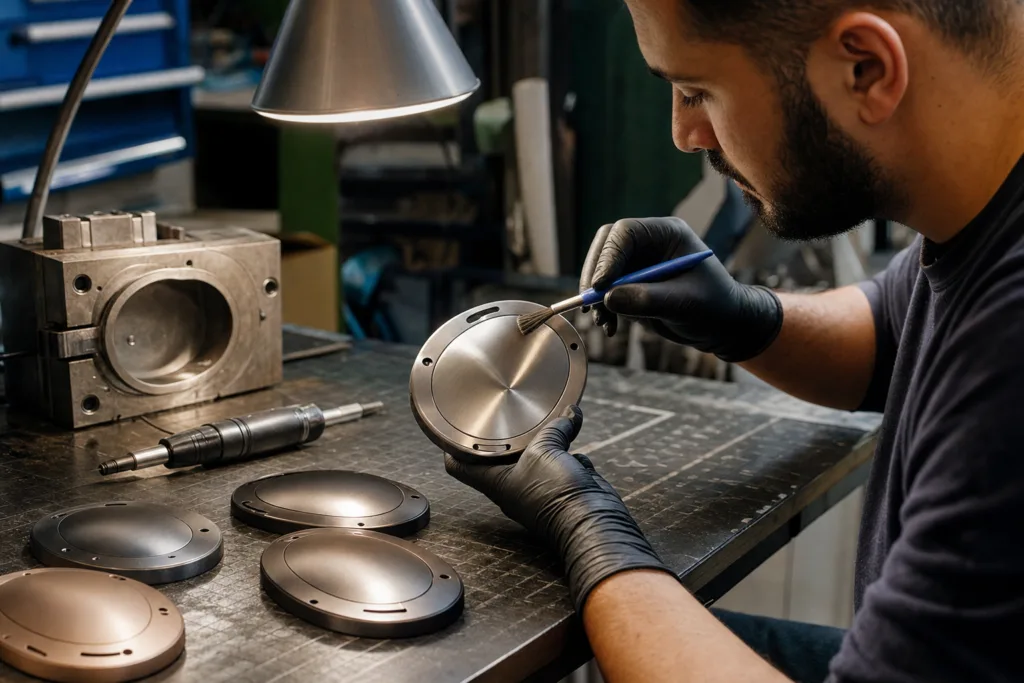
The manufacturing route depends on geometry, material, and finish target. Flat stainless steel or aluminum plates often start with stamping, etching, or CNC-style cutting depending on thickness and detail. Zinc alloy parts typically begin with die casting when the brand wants relief, curves, or sculpted logos. After forming, parts move through deburring, polishing, texturing, plating, painting, engraving, filling, and inspection.
At Gairun, we look first at the use scenario: consumer electronics branding part, wearable skin-adjacent trim, retail gift edition, or private label accessory. That defines whether we prioritize low weight, sharp engraving, stronger corrosion resistance, smoother edges, or easier assembly. Only after that should a brand finalize the logo treatment, because the same artwork can behave very differently across die cast zinc, etched stainless steel, and brushed aluminum.
Artwork, sampling, and fit checks before mass production
Artwork quality has a direct effect on tool accuracy and logo clarity. Vector files, real size dimensions, line thickness control, corner radius intent, and finish notes all matter. Even a small headphone plate can fail visually if the logo strokes are too thin for plating buildup, if recessed text becomes unreadable, or if the artwork ignores the actual curved mounting surface.
For that reason, we encourage buyers to prepare production-ready files early and review artwork prep for custom metal plates before approving molds or sampling. In sampling, the goal is not only to confirm appearance. It is also to verify fit on the true housing material, adhesive behavior after aging, color match under different light, and whether the plate still looks correct once the full headphone is assembled.
Fit checks should include edge alignment, corner lift risk, logo orientation, left-right consistency, and packaging abrasion risk. If the headphone ships in a zipper case or a tight pouch, the metal surface should be tested against repeated contact rather than approved only from a desk sample.
MOQ, lead time, and cost drivers
MOQ depends on the process, material, finish complexity, and whether custom tooling is required. A simple flat etched plate may support lower entry volumes than a custom die-cast emblem with multiple finish steps. Buyers should also separate sample MOQ from bulk MOQ because development runs, pilot runs, and final purchase quantities often involve different costing logic.
Lead time is usually shaped by mold making, sample revision rounds, finish approval, and production queue planning more than the small size of the part itself. Many delays come from artwork changes after tooling, unclear surface standards, or late requests to color match other headphone components. The more precisely the buyer defines the product at the start, the smoother the order flow will be.
Main cost drivers include material choice, part size, thickness, tooling complexity, surface treatment, logo depth, attachment hardware, packaging protection, and inspection level. Decorative electronics parts may also require tighter cosmetic standards than generic promotional items, which can add sorting and rework cost.
Quality control and durability tests
A metal plate for headphones should be judged as both a cosmetic component and a functional assembly part. We recommend QC checkpoints for dimensions, edge smoothness, logo readability, finish consistency, plating coverage, attachment reliability, and packed-part protection. If the plate will sit on a user-handled surface, scratch visibility and finger-mark behavior should also be reviewed.
For coated or plated parts, brands should define corrosion expectations in advance. Durability testing for plated or coated plates is often discussed through ASTM B117 salt-spray practice when screening decorative finishes for corrosion resistance, especially for parts exposed to sweat, humidity, or storage variation. This does not replace full product validation, but it gives buyers a shared reference point when comparing finish robustness.
Adhesion is equally important for painted, coated, or printed surfaces. Adhesion checks before sample sign-off are commonly framed around ASTM D3359 tape-test methods so that the team can judge whether a finish is bonding consistently before approving shipment. For headphone badges, that matters because a finish can look excellent on day one and still fail later if coating adhesion is weak.
Compliance should not be ignored either. If the part has skin-contact potential or enters regulated markets, buyers should ask for appropriate material declarations and review metal safety and compliance testing requirements early, especially when plating systems, decorative coatings, or imported component combinations are involved.
How to choose the right manufacturer for headphone metal plates
The right supplier is not simply the one that quotes a small badge quickly. You need a manufacturer that can discuss materials, finishing trade-offs, fit tolerance, attachment method, and cosmetic quality in relation to your headphone program. A useful supplier asks about cup material, curvature, assembly method, packaging, and use environment before recommending a process.
We suggest evaluating a manufacturer on these points:
- Ability to recommend the correct process for flat versus dimensional plates.
- Experience with decorative finishes that must remain consistent in bulk.
- Sample discipline, including fit validation and finish approval.
- Communication quality on artwork, tolerance, and defect criteria.
- Packaging and handling controls for scratch-sensitive parts.
For OEM and ODM buyers, it also helps if the supplier can support private label packaging, barcode sorting, and lot traceability for easier integration into final assembly or kitting operations.
Common mistakes to avoid

The first mistake is choosing material by appearance alone. A beautiful heavy zinc part may be wrong for a lightweight foldable headphone. The second is approving a finish without defining acceptable cosmetic variation. Terms like brushed, antique, or matte black sound clear until the first production lot arrives with a texture or tone that the brand did not expect.
The third mistake is underestimating the attachment system. Even a good metal plate can fail if the housing texture is too rough, the curve is too aggressive, or the adhesive area is too small. The fourth is skipping packaging trials. Metal surfaces that survive factory inspection may still rub against zipper pulls, trays, or hard inserts in transit.
Finally, some teams move to bulk order before completing realistic wear checks. For a headphone product, it is worth testing normal handling, sweat exposure, pouch insertion, desk contact, and wipe cleaning before final sign-off. That small discipline often prevents large rework costs later.
Conclusion
Custom headphones with metal plate design work best when the metal component is treated as part of the product engineering plan, not just a last-stage decorative add-on. The right solution balances brand expression with weight, fit, finish durability, and assembly practicality. From our manufacturing perspective, buyers who define material, logo method, attachment, sample criteria, and QC expectations early usually get smoother development and more stable mass production outcomes.
If your team is sourcing branded headphone trim, logo badges, or decorative metal nameplates, focus on production fit as much as aesthetics. A smaller, well-finished plate with the right attachment and inspection standard will usually outperform a more complicated design that ignores use conditions.
FAQs
What is the best material for custom headphone metal plates?
The best material depends on the product goal. Aluminum is often preferred when low weight matters, stainless steel works well for thin and durable branding plates, zinc alloy suits more dimensional shapes, and brass fits warmer premium styling. The right choice should consider cup size, target weight, finish, attachment method, and whether the part is purely decorative or more integrated into the headphone trim.
Can a metal plate on headphones affect comfort or sound?
Yes, but usually only if the plate is too heavy, poorly positioned, or placed near vents or acoustically sensitive areas. Small decorative badges on the outer cup often have minimal impact when thickness and weight are controlled. Comfort issues are more likely if edges are sharp, the plate catches during handling, or the part creates pressure points on foldable or compact models.
Which logo method is most durable for headphone branding plates?
Engraving, etching, and well-controlled stamped details are usually strong options for durability because the branding is formed into the metal instead of relying only on a surface print. The final answer still depends on the finish system. A durable logo method can be weakened by poor plating, coating, or paint adhesion, so brands should review the complete construction rather than the logo technique alone.
Do custom metal headphone plates require a mold?
Not always. Flat etched or stamped nameplates may use simpler tooling than a fully custom die-cast emblem, while sculpted zinc alloy parts usually require a dedicated mold. Brands should confirm this during quotation because tooling affects both upfront development cost and lead time. If the project is likely to evolve, it is better to identify that risk before approving production tools.
What should brands check before approving a sample?
Sample approval should cover more than appearance. Brands should verify true fit on the headphone housing, edge smoothness, logo clarity, color and finish consistency, adhesive or mounting reliability, left-right alignment, and packaging abrasion risk. It is also wise to review the sample under different lighting and after light handling, because some finishes look very different once the product is used normally.
How can buyers reduce risk in bulk orders for custom headphones with metal plate design?
Risk drops when the buyer gives complete artwork, defines finish expectations clearly, confirms dimensions against the final housing, approves the attachment method, and sets cosmetic and durability checkpoints before production starts. Bulk consistency is easier when the supplier and buyer agree on inspection criteria, packaging protection, and revision control at the sample stage instead of resolving those issues after the first shipment is produced.