For outdoor brands, carabiner keychains sit in an interesting middle ground between accessory and tool. They are small, visible, easy to carry, and genuinely useful in daily routines, which is why they continue to perform well in retail programs, event kits, membership packs, travel promotions, and branded merchandise lines. From our manufacturing perspective, the strongest projects are the ones that treat carabiner keychains as practical branded hardware rather than as generic giveaways. When the design, material, finish, and logo method all match the intended use, the product feels more aligned with outdoor consumers and more credible as part of an outdoor gear ecosystem.
If your project needs a product that combines portability, logo visibility, and real day-to-day utility, our custom keychain manufacturing support can help define the right direction early. We typically help buyers compare metals, choose between lightweight and premium structures, review gate style and attachment details, prepare artwork for engraving or color fills, and plan samples, packaging, and bulk production around the actual campaign or retail scenario rather than around a generic template.
What carabiner keychains are and why outdoor brands use them
Carabiner keychains are compact clip-style accessories designed to hold keys, tags, zipper pulls, small tools, or promotional attachments. In the outdoor market, they are attractive because they naturally fit the language of movement, utility, travel, and readiness. A branded bottle, backpack, duffel, lanyard, or gear organizer already has multiple attachment points, so a clip-based accessory makes more sense than a purely decorative key ring.
For brand teams, this creates two advantages. First, the item is visible during use, which helps branding last longer than a desk-only giveaway. Second, the object has a built-in use case, so the customer is less likely to discard it. That does not mean every design works equally well. An outdoor brand audience usually notices when a keychain looks too glossy, too fragile, or too disconnected from actual use. The hardware, finish, and shape should communicate rugged practicality, even when the item is promotional.
We often advise buyers to start with the user situation before the sketch. Is the product meant for a hiking event pack, a retail checkout add-on, a premium campaign kit, a national park souvenir line, or a travel-ready corporate gift? The answer changes the right material, weight, shape complexity, and branding method.
How carabiner keychains work as everyday outdoor gear accessories
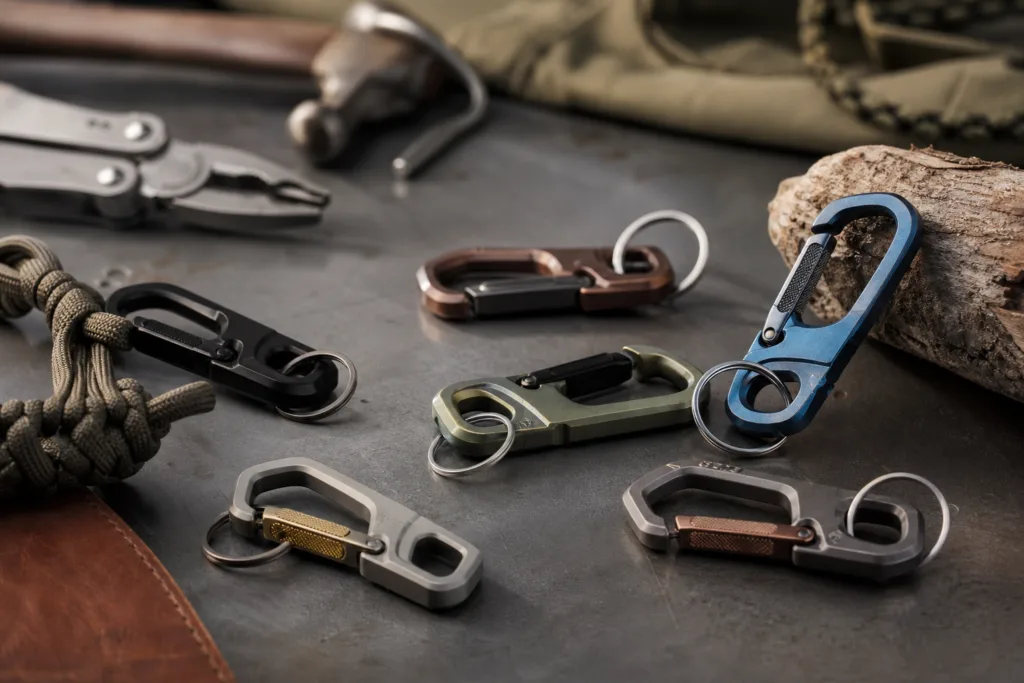
The strongest appeal of carabiner keychains is not that they replace technical climbing equipment. It is that they solve small everyday carry problems quickly. They can clip keys to a belt loop, hold an ID card holder on a backpack, keep a flashlight accessible, organize cord loops in luggage, or attach a tag to a duffel bag. In event settings, they also work well for race packets, campsite passes, locker tags, and branded utility kits.
That practical role matters in positioning. Buyers should be careful not to market accessory carabiners as safety gear, climbing-rated hardware, or personal protective equipment unless the product is actually designed, tested, and certified for those purposes. In safety-sensitive language, the distinction is important, and OSHA’s fall-protection definitions and connector requirements are useful for understanding why decorative or promotional clips should not be presented as life-safety equipment.
From our side, we usually recommend clear product communication in both packaging and buyer approvals. If the item is intended for keys, tags, small accessories, and low-load attachment use, that should be stated cleanly. This helps the brand avoid misleading claims and keeps expectations aligned with the actual design.
Utility scenarios that fit outdoor-brand programs
- Camping kits: attaching keys, whistle tags, or campsite pass holders.
- Hiking events: clipping participant tags, timing chips, or lightweight accessories.
- Travel promotions: organizing luggage tags, compact tools, or zipper pulls.
- Retail merchandise: offering a small add-on item with visible logo retention.
- Brand collaborations: combining the clip with a bottle opener, tag plate, or mini-tool silhouette.
Material options for carabiner keychains
Material selection is one of the biggest factors in whether the finished product feels disposable or intentional. Outdoor buyers usually compare weight, corrosion behavior, shape flexibility, finish range, and cost. There is no single correct material for every project, but there are clear trade-offs.
| Material | Main advantage | Limitations | Typical fit |
|---|---|---|---|
| Aluminum | Lightweight, easy to carry, modern outdoor look | Less premium weight feel than heavier metals | Event giveaways, travel accessories, active lifestyle branding |
| Zinc alloy | Flexible for custom shapes and integrated details | Heavier than aluminum | Custom silhouettes, molded logos, multi-part designs |
| Stainless steel | Strong appearance, corrosion resistance, clean industrial style | Higher cost in some structures, less flexible for complex casting looks | Premium utility items, minimalist outdoor branding |
| Iron or steel with plating | Good structure and cost control in some formats | Finish choice matters for corrosion protection | Value-focused promotional runs |
Aluminum is especially common when the brief prioritizes light carry, frequent use, and a sporty outdoor feel. For many everyday accessory applications, its low weight is a major advantage, and the broader background on Aluminum’s lightweight, corrosion-resistant properties helps explain why it remains a popular choice for portable branded hardware.
Zinc alloy becomes more attractive when shape customization drives the concept. If the brand wants an integrated mountain outline, compass-inspired profile, embossed logo field, or multi-level decorative face, cast zinc alloy provides more freedom. Stainless steel makes sense when the visual goal is more technical, sleek, or durable-looking, especially for laser engraving and understated branding.
When buyers need a wider comparison across appearance, cost, and application, our keychain material comparison guide is often a useful starting point before finalizing the structure.
Durability factors that actually affect performance
Durability in carabiner keychains is not just about the metal itself. It is a combination of structure, gate function, surface treatment, edge quality, and how the item is actually used. A strong-looking body can still feel poor in daily use if the spring gate is inconsistent, if burrs remain on the edge, or if plating wears too quickly on contact points.
What buyers should review during development
- Gate tension: smooth opening and reliable closure without feeling weak or overly stiff.
- Body thickness: enough substance for the intended use and target price level.
- Edge finishing: reduced sharpness, cleaner touch points, better handling.
- Surface protection: anodizing, plating, paint, or other finish selected for wear expectations.
- Attachment junctions: split rings, jump rings, or screw points that do not loosen easily.
One common sourcing mistake is focusing on a nominal size, such as 60 mm or 80 mm, without reviewing cross-section thickness and gate construction. Two carabiner keychains can have the same length but feel completely different in use. We encourage buyers to evaluate samples in hand, with actual keys or tags attached, rather than approving only from drawings.
Another critical point is load language. Outdoor branding can unintentionally create a technical impression, especially with rugged styling and utility messaging. If the product is an accessory clip, keep claims conservative. Avoid any suggestion that it is climbing-rated unless the hardware truly meets the relevant technical standard and intended-use requirements.
Branding opportunities for outdoor gear programs
Outdoor brands usually need more than a logo dropped onto a blank body. The most successful branding choices work with the product’s shape, finish, and use context. In our production work, we often see three branding directions perform well:
- Understated premium branding: laser engraving or debossed logos on matte or brushed surfaces.
- Bold retail branding: filled color logo zones, high contrast plating, or two-tone layouts.
- Adventure-themed identity: custom silhouettes, terrain-inspired lines, utility add-ons, or hardware-focused textures.
Logo placement should account for how the item is held and clipped. A small logo near the gate hinge may be visible in artwork but almost hidden in use. Flat body sections, rotating tag plates, or added emblem zones often improve legibility. If the project calls for a more dimensional identity element, die-cast logo keychain production can provide raised or recessed branding with better presence than flat printing alone.
Color matching also matters. Outdoor palettes often rely on dark neutrals, earth tones, rescue orange, trail green, stone gray, or muted metallics. Those shades should be chosen with the finish process in mind. Some colors are cleaner in enamel fills, some in painted recesses, and some through anodized aluminum or plated metal plus selective print.
Customization methods and when to use them
Different logo and decoration methods solve different problems. Procurement teams often ask which process is best, but the practical answer depends on shape, budget, detail level, and wear expectations.
| Method | Best for | Visual result | Notes |
|---|---|---|---|
| Laser engraving | Minimalist logos, serial marks, fine line branding | Clean, precise, understated | Very suitable for stainless steel and coated aluminum |
| Screen or pad printing | Simple color logos on flat areas | Bright and direct | Less ideal for heavy abrasion zones |
| Soft enamel filling | Color brand marks, outdoor icons, bold contrast | Tactile, branded, decorative | Works well with cast or stamped recessed areas |
| Molded raised logo | Premium shape integration | Dimensional, durable-looking | Requires good mold planning |
Laser engraving is a strong choice when the brand wants a subtle technical feel. Enamel filling works better when the item will be sold at retail or used in event campaigns that depend on immediate visual recognition. Molded logos are useful when the hardware itself is supposed to carry the identity rather than relying on a secondary print layer.
Shape development is another big lever for differentiation. Outdoor consumers respond well to compact forms that reference mountains, tents, route markers, compass geometry, bottle silhouettes, trail signs, or hardware-inspired industrial lines. If your concept depends on the silhouette itself, our custom shape keychain options can help translate artwork into a manufacturable structure with balanced proportions and practical clip access.
Design ideas that fit outdoor consumers
Outdoor audiences tend to reward products that look usable, not ornamental for its own sake. That means successful carabiner keychains usually share a few design traits: compact dimensions, a clear clipping path, low unnecessary bulk, and a finish that does not look too delicate.
Design directions that usually work well
- Rugged minimalist: matte black, gunmetal, brushed steel, laser logo.
- Lightweight active: anodized aluminum, bright accent color, simple engraved branding.
- Multi-function utility: integrated opener edge, tag plate, or cord loop point.
- Souvenir outdoor style: custom mountain or campsite contour with branded insert area.
For promotional products, multi-function features can improve retention if they are genuinely useful and not just added for novelty. A good example is combining clip access with opener functionality or a secondary tag section. Buyers exploring that direction often review multi-use metal keychain designs to see how utility can be integrated without making the product feel oversized or awkward.
The key is balance. A very sculpted shape may look exciting in a render but reduce opening clearance, create weak narrow points, or limit where the logo can be placed. In sample development, we often simplify a dramatic concept slightly so the final product performs better in hand.
Balancing aesthetics, portability, and practical performance
In B2B product planning, trade-offs are normal. A thicker cast body may feel premium but become too heavy for everyday use. A bright painted logo may stand out well in a campaign but show wear faster on a high-contact area. A highly customized outline may strengthen branding but increase mold complexity and lead time.
At Gairun, we usually help buyers make these decisions by ranking priorities in order: carry comfort, visual impact, budget, logo detail, and packaging format. Once that order is clear, many design decisions become easier. If portability is the priority, aluminum and simpler geometry often win. If shelf presence matters more, zinc alloy with molded branding and stronger finishing options may be the better fit. If the product must support a premium private-label kit, packaging quality may deserve as much attention as the keychain itself.
Using carabiner keychains in promotional campaigns and outdoor events
Carabiner keychains work well in outdoor campaigns because they are easy to bundle with related items. They can be attached to hang cards, included in race kits, paired with drinkware, combined with trail maps, or inserted into welcome packs for tours and festivals. For brands, that flexibility helps them serve multiple channels with one core product design.
We often see buyers segment the same base design across different uses. For example, a matte engraved version may be used for retail, while a lighter printed version serves as an event giveaway. Another variation may add serialized identification for staff access or limited-edition collection programs. This kind of modular planning can improve consistency while controlling development cost.
What to ask a manufacturer before placing a bulk order
Commercial investigation buyers usually need straightforward answers before they can move forward. In our experience, the most useful manufacturer discussions cover the following points early:
- MOQ: Is it based on structure, finish, packaging, or logo process?
- Sampling: Will the sample be 3D rendered, hand sample, or production-equivalent mold sample?
- Mold ownership and modification: Can the mold be adjusted if opening clearance or logo depth needs correction?
- Lead time: How long for artwork review, sample approval, mass production, and packaging?
- Packaging: Is the item bulk packed, carded, bagged, boxed, or inserted into a set?
- Inspection standard: What cosmetic and functional checkpoints are reviewed before shipment?
Carabiner keychains may look simple, but bulk consistency depends on getting these details aligned. Sample approval should not be treated as a formality. Buyers should review gate action, logo visibility, plating or coating consistency, edge smoothness, and how the product sits in its packaging.
Quality control considerations for outdoor accessory orders
Quality control for this product category should focus on both function and appearance. If the gate does not close cleanly or the keyring connector is weak, the customer will notice immediately. If the logo is crisp but the coating scratches too easily, the brand impression drops after short-term use.
QC checkpoints we recommend
- Incoming material review: confirm the correct alloy or sheet material for the approved design.
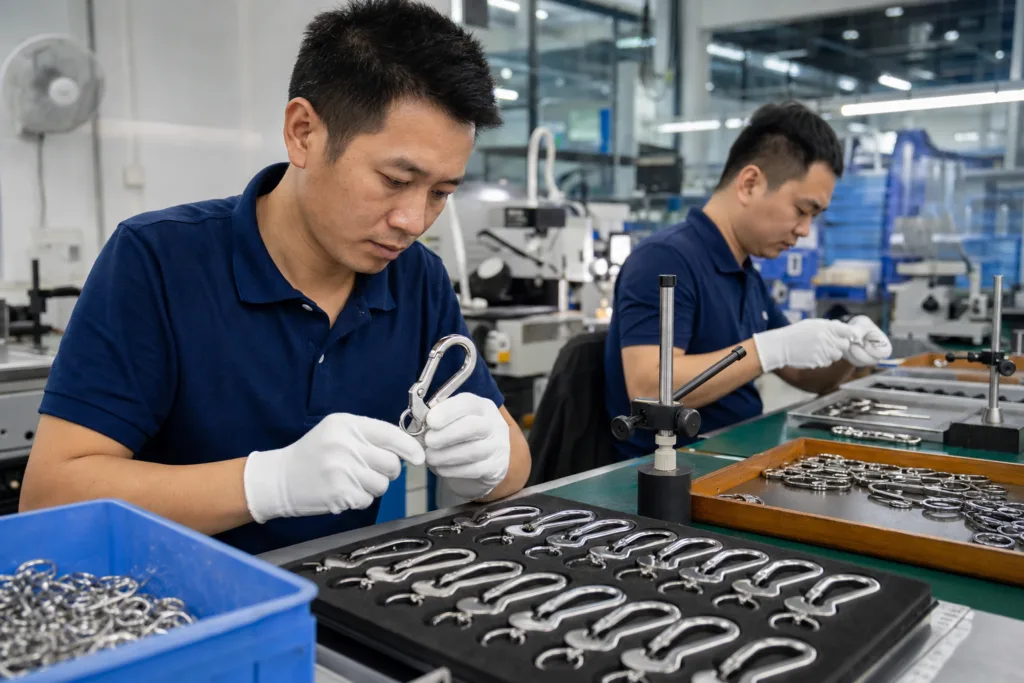
- In-process dimensional checks: verify opening size, body thickness, and ring compatibility.
- Finish inspection: monitor color tone, plating consistency, or engraving depth.
- Functional testing: repeated gate opening and closure, ring attachment security, and assembly alignment.
- Pre-shipment inspection: sample-based review for cosmetic defects, logo placement, and packaging accuracy.
For outdoor-brand programs, wear points deserve extra attention. Contact areas near the gate edge, ring loop, and logo field should be checked for coating stability and visual consistency. If the keychain is part of a retail line, packaging scuff risk during transit should also be reviewed before the full run ships.
Packaging and presentation ideas for retail, gifts, and giveaways
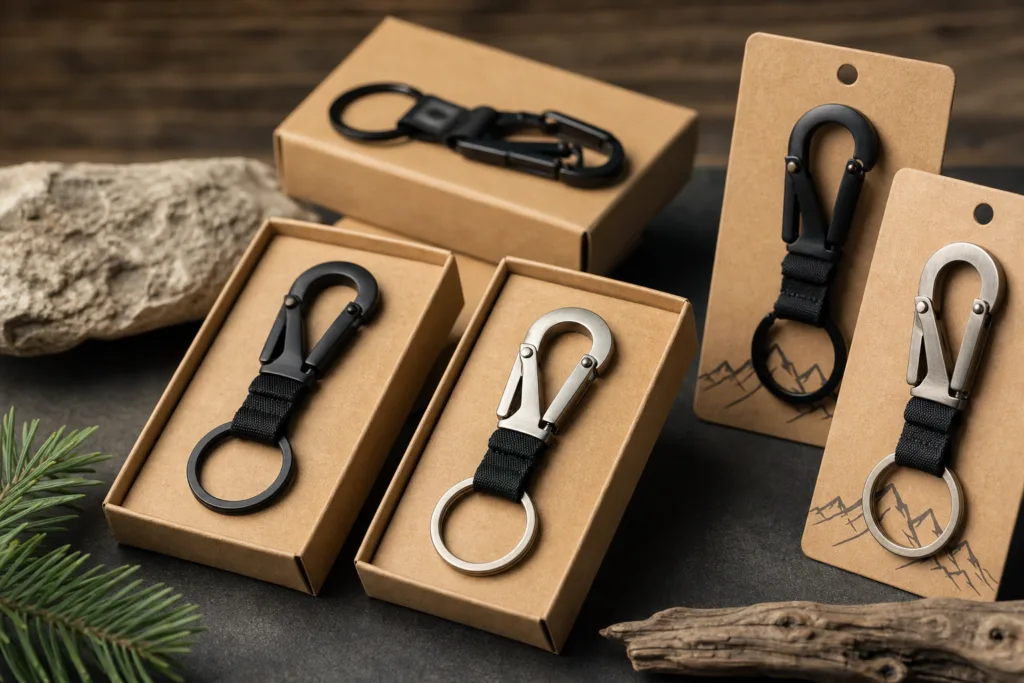
Packaging has a larger impact than many buyers expect. A simple polybag may be enough for bulk event distribution, but a retail-ready hang card, recycled paper sleeve, or insert card can improve presentation and make the product feel more integrated with the brand’s outdoor story.
For value-driven event use, lightweight individual bags with a printed insert usually work well. For retail, die-cut cards that show the clip profile and communicate intended use are often more effective. For premium gift sets, foam inserts or kraft paper boxes can elevate the keychain and reduce movement during transit.
Private label buyers should also consider whether the packaging needs barcode space, care language, origin labeling, or a usage disclaimer. Those details are easier to handle during development than after the bulk order is packed.
Common mistakes outdoor brands should avoid
The most common sourcing mistakes are surprisingly consistent across projects:
- Choosing by appearance only: the product looks good in a mockup but feels poor in hand.
- Ignoring use claims: promotional accessory language drifts too close to safety-hardware claims.
- Overcomplicating the shape: logo area shrinks, gate access worsens, and mold risk rises.
- Skipping packaging planning: the item arrives correct but not ready for the sales channel.
- Approving samples too quickly: no one checks ring strength, finish wear, or gate consistency.
We encourage buyers to test the sample in the real scenario: on a backpack loop, in a pocket, with keys attached, in the planned package, and after repeated daily handling. That simple step often reveals whether the product is merely branded or genuinely useful.
How to evaluate a supplier for OEM and ODM carabiner keychain production
Supplier evaluation should go beyond price and catalog range. A suitable manufacturing partner should be able to explain how the design will be made, where the risk points are, and how to adapt the structure if the initial concept is not ideal for production. That is especially important for outdoor-brand projects where the accessory must look credible, function smoothly, and remain consistent across a full order.
Good evaluation questions include whether the supplier handles mold development directly, what decoration methods are available in-house or through controlled partners, how samples are documented, what finish limitations are disclosed in advance, and how quality issues are communicated if they appear during mass production.
From a manufacturer perspective, the best OEM or ODM cooperation happens when both sides share reference images, artwork layers, packaging requirements, and realistic use expectations early. That reduces revision loops and helps make sure the final carabiner keychains match both the brand image and the practical use case.
Conclusion
For outdoor brands, carabiner keychains are effective when they do more than carry a logo. The right product combines portability, everyday utility, finish durability, and branding that suits the outdoor customer rather than fighting against it. Material choice, gate function, logo method, shape, packaging, and quality control all influence whether the final item feels like thoughtful branded hardware or like a short-lived giveaway.
In our experience, the most successful bulk orders start with honest positioning: define the intended use, select a material that supports that use, keep branding practical, and verify samples against real handling conditions. When those basics are handled well, carabiner keychains can become a reliable extension of an outdoor gear brand’s merchandise, event, or retail program.
FAQs
Are carabiner keychains suitable for real outdoor use?
Yes, they are suitable for many low-load everyday outdoor uses such as holding keys, attaching tags, organizing small accessories, or clipping lightweight items to a bag. However, brands should clearly distinguish accessory keychains from climbing or life-safety hardware and avoid implying technical load ratings unless the product is specifically designed and certified for that purpose.
Which material is usually best for custom carabiner keychains?
The best material depends on the project goal. Aluminum is often preferred for lightweight carry and a sporty outdoor look, zinc alloy works well for custom shapes and molded branding, and stainless steel suits premium or minimalist designs that need a cleaner industrial appearance. The right choice should match the intended use, target price, finish, and logo method.
What branding method lasts longest on a carabiner keychain?
For long-term appearance, molded logos and laser engraving are usually the most durable branding directions because they are integrated into the structure or surface rather than relying only on a printed layer. Enamel filling and printing can still work very well, but they should be placed in areas less exposed to repeated abrasion if wear resistance is a priority.
What should buyers review in a pre-production sample?
Buyers should review the gate opening and closure, overall weight, edge smoothness, logo clarity, finish consistency, attachment strength, and packaging fit. It is also important to test the sample in the real usage scenario, such as clipping it to a bag or carrying it with keys, because handling often reveals issues that do not show clearly in artwork proofs alone.
How do MOQ and lead time usually affect customization?
More complex customization usually increases both MOQ sensitivity and lead time because custom molds, special finishes, or retail packaging add production steps. Simpler engraved or printed designs may move faster, while fully custom shapes, multiple components, or private-label packaging often require longer planning. Buyers should confirm these variables before approving artwork.
Can carabiner keychains work for both retail and event giveaways?
Yes, many brands use the same core design across both channels with small adjustments. A retail version may use a heavier material, premium finish, or carded packaging, while an event version may simplify the finish or packaging to control cost. Planning those variations together can improve consistency while making the product more commercially flexible.