QR Code Custom Keychains give brands a practical way to connect a durable physical item with a digital action. Instead of treating a keychain as a simple giveaway, buyers can use it as a scannable tool that opens a website, social page, registration form, product guide, warranty page, event check-in flow, or customer support path. From our manufacturing perspective, the real value is not only the code itself, but how well the code survives daily handling, how easily it scans on a small metal surface, and how clearly the branding and attachment structure support the intended use.
For buyers comparing materials, logo methods, and production routes, custom keychain manufacturing solutions matter because scanability depends on much more than adding a graphic file. The right supplier should help evaluate metal type, keychain size, QR placement, engraving or printing method, plating contrast, sample testing, and packaging before bulk production. We regularly support OEM and private label projects where the keychain must carry both brand identity and a reliable digital function, especially for events, corporate programs, product access, and serialized identification.
What Are QR Code Custom Keychains and Why Brands Use Them
A QR code keychain is a custom keychain that includes a machine-readable code linked to digital content. The concept is simple, but the business use can vary widely. Some buyers use the code as a direct website shortcut. Others use it for member authentication, product registration, visitor guidance, lead capture, digital business cards, loyalty programs, or support documentation.
Brands choose this format because the keychain remains visible and reusable long after a paper card, event badge insert, or flyer is discarded. For schools, clubs, sports organizers, and corporate teams, the item can work as both an identity accessory and a practical scanner-based tool. For distributors and sourcing teams, the challenge is choosing a format that balances branding impact with long-term readability.
We typically advise buyers to define the scan purpose first. If the keychain only needs to open a homepage, there is more design freedom. If it must open a unique user page, asset record, or registration record, then data structure, code density, serial logic, and production consistency become more important. Buyers comparing QR code keychain product options usually find that the right structure depends on whether they need a general campaign item or a durable identification tool.
How QR Codes Work on Metal Keychains
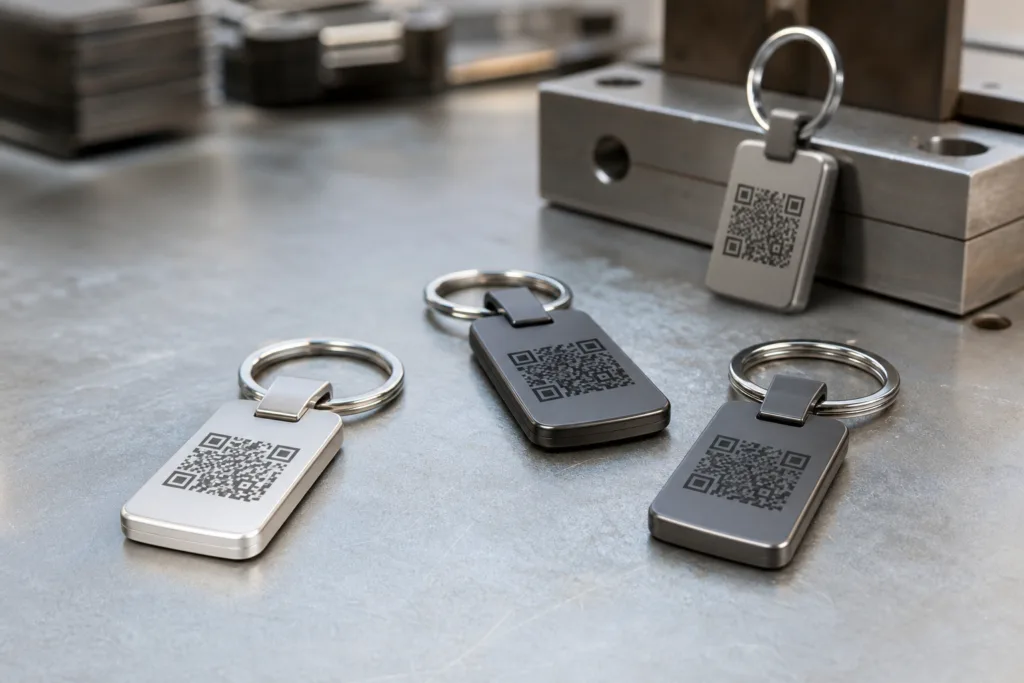
Scanability starts with data density
A QR code is not just a square graphic. It is a structured symbol made of modules, spacing, finder patterns, and error correction. On a small keychain, every design decision affects whether a phone camera can read the code quickly. A short URL generally creates a simpler code than a long dynamic link with many parameters. That means better readability on a small surface.
We often encourage buyers to shorten the destination URL before artwork approval. The less complex the code, the larger each module can be on the same tag size. This is especially important for branded keychains under 35 mm where there is limited room for both logo and code.
Quiet zone and contrast matter
Every scannable QR code needs enough blank area around the symbol so the camera can detect its boundaries correctly. On custom metal parts, quiet zone is often lost when designers push logos, frames, textures, or decorative borders too close to the code. Attractive artwork can easily reduce function if this spacing is ignored.
According to ISO/IEC 18004, QR code design should follow standard symbology rules rather than improvised visual adjustments, especially when code size is compressed onto a small accessory. In production, that means we look at module clarity, border spacing, and whether plating glare or decorative backgrounds may interfere with reading.
Error correction is helpful, but not a cure-all
QR codes include error correction, which can help recovery if part of the symbol is damaged or visually interrupted. However, some buyers overestimate how much damage the code can tolerate. A metal keychain is exposed to abrasion, oil from hands, scratches from keys, and impact against hard surfaces. If the code is too small or the contrast is weak from the start, error correction cannot fully rescue the user experience.
Our recommendation is to treat error correction as support, not as permission for aggressive decoration. When the code must stay reliable in daily use, simpler data, stronger contrast, and protective surface choices usually matter more than trying to hide too much branding inside the symbol.
Phone scanning behavior affects the destination experience
When a customer scans the code with a phone camera, the next step should feel immediate and clear. Apple’s documentation on scanning data with the camera reflects the common mobile behavior buyers should expect: users scan, recognize, and tap through quickly. That is why we tell branding teams to plan the landing page at the same time as the keychain artwork. A durable keychain with a slow or confusing destination wastes the physical product’s value.
Best Materials for QR Code Custom Keychains
Zinc alloy
Zinc alloy is one of the most flexible choices for custom metal keychains because it supports complex shapes, recessed areas, raised logos, and die-cast structures at practical production cost. It works well when the buyer wants a custom outline, layered look, or integrated cutout. For QR code use, zinc alloy is often suitable when the code is laser marked on a smooth insert zone or printed onto a flat protected area.
The main caution is surface texture. Highly textured die-cast areas are not ideal for small scannable codes. If zinc alloy is selected, we usually suggest reserving one flat dedicated zone for the code.
Stainless steel
Stainless steel is a strong option when durability and crisp engraving are priorities. It is especially useful for industrial, identification, asset management, or minimalist branded projects. A stainless steel keychain can support laser engraving with clear line definition, and the material resists wear well in many everyday environments.
For buyers needing a practical, long-life code without heavy decorative styling, stainless steel often provides a clean balance between scan reliability and professional appearance.
Brass
Brass is often chosen for a premium feel, sharper stamped details, and rich plating or antique finishing. It can work well for hospitality, heritage branding, club accessories, and presentation-focused products. However, when using brass for QR functionality, the buyer should carefully review contrast. A beautiful antique finish may not produce the strongest machine readability if the code becomes visually muted.
In brass projects, we often separate the decorative front from a more functional back panel where the code can be engraved or printed for clearer scanning.
Acrylic insert or mixed-material construction
Some projects benefit from combining metal with an acrylic insert, epoxy window, or printed panel. This can be a smart route when the code needs very high contrast, color flexibility, or variable data printing. Mixed-material construction also helps when a buyer wants a branded metal frame but needs the code itself on a smoother, more controlled surface.
The trade-off is that mixed construction may add assembly steps and slightly change the product feel. It is useful when function is more important than all-metal purity.
Manufacturing Methods for QR Code Keychains
Die casting
Die casting is often used for zinc alloy keychains with custom contours, 3D logos, and shaped silhouettes. It gives buyers strong design freedom and is common in branded promotional and souvenir products. When buyers request die-cast metal keychain production, we usually review where the QR zone will sit before the mold is finalized, because a visually attractive die-cast structure can still fail if the scan surface is too curved, too textured, or too small.
Stamping
Stamping is suitable for flatter shapes and clean metal outlines, often in brass, iron, or stainless steel. It can be efficient for certain badge-like or plate-style keychains where a flat code area is easy to preserve. For QR functionality, stamping can be advantageous because flatter geometry makes scan performance easier to control.
Laser engraving
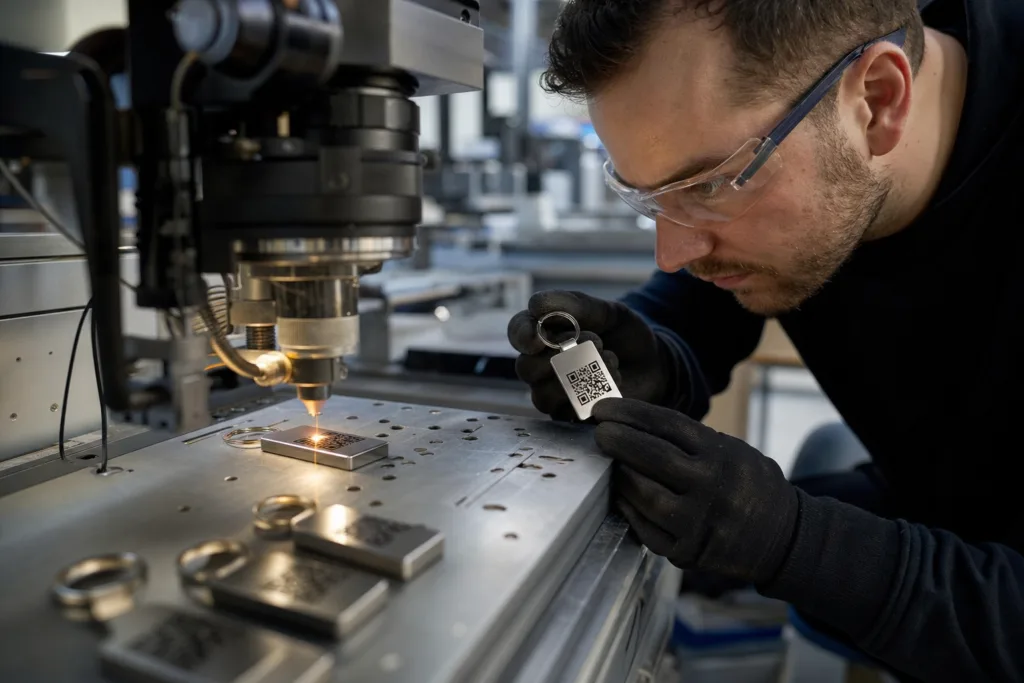
Laser engraving is one of the most practical methods for durable QR code marking on metal. It offers permanence and good line precision, especially for serial codes, identification programs, and long-life accessories. However, the final readability depends on contrast after plating or finishing. We normally test the engraved result after the full finishing sequence rather than assuming raw-metal readability will remain unchanged.
Printing
Printing is useful when the code must show very crisp black-on-light contrast, dynamic color framing, or variable campaign graphics. It can be the easiest route for complex high-density codes, but it may be less wear-resistant than engraving unless protected properly. For event or short-cycle campaign items, this can be a strong option. For hard-use industrial or daily-carry applications, extra caution is needed.
Enamel filling and decorative color
Soft enamel or color-filled decoration can add branding value to the rest of the keychain, but we rarely recommend using enamel to build the QR modules themselves unless the code is large and carefully tested. Enamel can create edge variation, reflectivity differences, or contour inconsistencies that affect small codes. In many projects, the better approach is to keep the QR code in a separate clean zone and use enamel for logos, borders, or brand colors elsewhere.
Design Rules That Keep QR Codes Scannable on Small Surfaces
The best-looking concept is not always the most reliable one. On a small keychain, design discipline matters.
| Design Factor | Better Choice | Higher-Risk Choice |
|---|---|---|
| Destination link | Short URL or managed redirect | Long raw URL with many parameters |
| Code area | Flat dedicated panel | Curved, textured, or interrupted surface |
| Contrast | Dark code on light background or strong inverse contrast | Reflective low-contrast decorative combinations |
| Branding layout | Logo separated from QR zone | Logo crowding into code quiet zone |
| Finish | Controlled matte or clear readable surface | Heavy glare or uneven antique effect over code |
| Testing stage | Prototype scan test before approval | Artwork approval without physical scan test |
When buyers want a special silhouette, we suggest planning the outside shape separately from the code area. In other words, creativity can happen in the perimeter while the code sits inside a protected functional panel. That is why many teams ask for custom shape keychain design support early in the sampling stage instead of trying to fit the QR code into a finished decorative concept afterward.
We also recommend viewing the sample under real use conditions: indoor office light, event hall light, outdoor daylight, and typical phone camera distance. A code that scans perfectly under studio lighting may behave differently on a reflective plated surface in a crowded event setting.
Customization Options Beyond the QR Code
Shape and structure
Round, rectangular, shield, tag, bottle-opener, mascot, and custom-outline keychains are all possible. For pure scan reliability, rectangular or plate-style formats are often easiest. For stronger branding, custom outlines can still work if the QR panel remains flat and clear.
Logo placement
Many buyers put the logo on one side and the QR code on the other. This is often the cleanest option. If both must appear on one side, the logo should not compete with code contrast or quiet zone. Raised logos, recessed borders, and small decorative text can be positioned around the code, but the code itself needs visual breathing room.
Attachment styles
Split ring, lobster clasp, short chain, cable loop, and carabiner-style attachments all influence how the keychain hangs and how easily users can present the code for scanning. A heavy decorative attachment may look premium but can twist the keychain awkwardly during use. We suggest matching the attachment to the real scenario: event use, staff carry, hotel use, asset management, or retail merchandise.
Packaging
Packaging affects both presentation and protection. Individual polybags reduce surface scratching during transport. Backing cards can explain scan purpose. Gift boxes can elevate premium campaigns. If the code is personalized or linked to a user record, packaging control also helps prevent mix-ups in fulfillment.
Marketing and Branding Uses
QR code keychains are versatile because they sit between merchandise and utility. In branding projects, we commonly see these use cases:
- Website shortcut for campaigns or product launches
- Social profile access for creator or community engagement
- Event landing pages, maps, agendas, or check-in steps
- Product registration and after-sales support
- Membership, club, or school information access
- Lead capture linked to a specific offline activation
- Digital business card or sales rep profile access
For identification or asset-related projects, buyers may also need unique coding rather than one repeated campaign link. In those cases, pairing the QR with numbering logic is often more useful than a generic shared destination. We see demand for serialized keychain tagging for tracking when procurement teams want each piece linked to a person, device, locker, room, account, or maintenance record.
Practical Everyday Use Cases for Personal and Corporate Programs
For corporate programs, QR code keychains can support visitor guidance, employee information access, equipment control, room allocation, or service workflows. For hospitality, they can connect to check-in instructions, amenity information, or local guide pages. For schools and clubs, they can link to membership details, schedules, or emergency contacts. For retail and brand activations, they can become a reusable campaign touchpoint instead of a disposable printed coupon.
In our custom metal product production work, the best projects are usually the ones where the offline use and online destination are planned together. A keychain that opens a mobile page in one second and clearly tells the user what to do next is far more effective than a beautiful item that leads to a generic homepage with no context.
Cost Drivers, MOQ, Sampling, and Lead Time
Pricing for QR code custom keychains depends on several combined variables rather than one single factor.
| Cost Driver | What Increases Cost | What Helps Control Cost |
|---|---|---|
| Material | Premium metals or mixed-material assembly | Standard zinc alloy or straightforward stainless formats |
| Shape | Complex custom silhouettes and multi-part structures | Simple tag or plate shapes |
| Code method | Variable-data marking or protected print layers | Same code repeated across the order |
| Finish | Multi-step plating, antique effects, epoxy, special textures | Standard finishes with controlled contrast |
| Packaging | Individual premium boxes or coded fulfillment sorting | Bulk pack or simple polybag packing |
| Sampling | Multiple revisions after unclear artwork | Clear vector files and destination logic before sampling |
MOQ varies by process, material, and whether the code is identical or unique on each piece. Sample development is especially important for this product type because scan testing should happen before bulk approval. Lead time depends on mold making, finishing complexity, variable data handling, and packaging requirements.
At Gairun, we usually advise B2B buyers to review three things before approving a sample: how the code scans across different phones, how the surface looks after finishing, and how the item will be packed to avoid abrasion in transit. This helps prevent common bulk-order surprises.
Quality Control Checks That Matter Most
For a normal decorative keychain, buyers may focus mainly on appearance. For a QR code keychain, quality control must include both appearance and function.
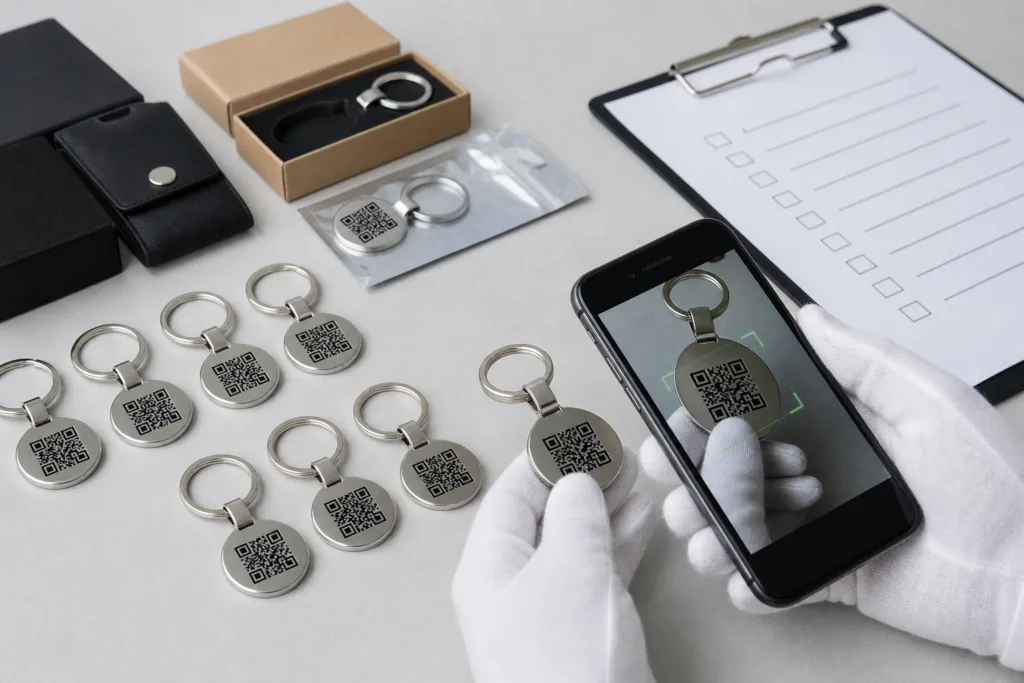
Scan test
Every sample should be scanned from normal user distance under different lighting conditions. If the order contains variable codes, spot checks during production are important.
Surface durability
Printed or engraved areas should be checked after plating, polishing, and handling simulation. The code should remain visible and distinct after routine contact.
Color accuracy and contrast
If printed graphics are used, contrast should remain strong after the full finishing process. Metallic reflections, tinted coatings, and decorative fills can reduce practical readability even if the digital artwork looked correct.
Edge and attachment quality
The keychain still needs to function as a physical accessory. Burr-free edges, secure ring attachment, and consistent assembly matter because a damaged or bent piece can also make scanning inconvenient.
Common Design Mistakes to Avoid
- Making the QR code too small for the available scanning distance
- Using a long URL that creates an overly dense code
- Placing logos, frames, or text too close to the quiet zone
- Choosing low-contrast plating and code combinations
- Adding texture, glitter, or antique effects directly over the code area
- Approving digital artwork without a physical sample scan test
- Ignoring the mobile landing page experience after the scan
- Using one design for all scenarios without considering carry environment
A common sourcing mistake is treating the code as a decorative element instead of a functional mark. Once the keychain enters daily use, performance matters more than mockup appearance.
How to Choose a Manufacturer for QR Code Custom Keychains
Buyers should look for a manufacturer that can discuss both metal production and code usability. That includes material recommendation, surface treatment planning, code marking method, sample testing logic, packaging control, and bulk consistency. A supplier that only focuses on appearance may miss practical issues such as glare, insufficient quiet zone, or code distortion after finishing.
Ask clear questions during evaluation:
- Which process is better for my required shape and scan zone?
- Can the supplier recommend engraving versus printing for my use case?
- How will sample scan testing be handled?
- Can they support serialized or variable data production if needed?
- How do they protect the finished surface during packing?
- What QC checkpoints apply to function, not just appearance?
From our metal manufacturing perspective, a good project brief includes the destination type, expected use environment, code size target, logo file, preferred material, finish preference, packaging requirement, and whether every piece has the same or different data. That level of clarity speeds up artwork evaluation and reduces costly revisions later.
Conclusion
QR Code Custom Keychains work best when they are designed as functional metal products, not just branded accessories with a code added at the end. For B2B buyers and branding teams, the key decisions involve material, flat scan area, contrast, code density, finishing method, and real-world testing. When those factors are handled correctly, a small keychain can become a durable digital gateway for campaigns, identification, support, registration, and everyday user engagement.
The most effective orders usually start with a simple question: what should happen immediately after the scan? Once that answer is clear, the right structure, process, and finish become much easier to define during sampling and production.
Frequently Asked Questions
What is the best material for QR code custom keychains?
The best material depends on the project goal. Stainless steel is strong for crisp engraved codes and long-term durability, zinc alloy is flexible for custom shapes and branded structures, brass suits premium decorative projects, and mixed-material designs can help when very high contrast printing is required. In most cases, the better question is which material gives you a flat, durable, readable code area after finishing.
Is laser engraving better than printing for a QR code keychain?
Laser engraving is usually better for long-term wear resistance, especially when the keychain will be handled daily or used for identification purposes. Printing can deliver sharper visual contrast for dense or complex codes, but it may need extra protection depending on the environment. The right choice depends on expected abrasion, finish contrast, and whether the code is standard or variable from piece to piece.
How large should a QR code be on a metal keychain?
There is no single perfect size because readability depends on code complexity, surface contrast, scanning distance, and phone camera conditions. As a practical approach, buyers should keep the destination link short, avoid overly dense data, preserve quiet zone around the code, and request a real sample scan test before approval. If both code and branding must fit in a small area, simplifying the payload is often more effective than shrinking the code further.
Can each keychain have a different QR code?
Yes, many projects use variable data so each keychain links to a different record, user page, asset file, or tracking destination. This is common in identification, equipment control, access programs, and serialized brand campaigns. Buyers should confirm early whether the manufacturer can manage file mapping, code generation, production separation, and packing control accurately for variable-data orders.
What affects the MOQ for custom QR code keychains?
MOQ is influenced by the base process, material, mold requirement, finishing complexity, and whether the order uses one repeated code or unique codes on each item. Standard shapes and simpler finishes usually support more flexible production planning, while fully custom shapes, premium packaging, or variable data workflows may raise setup requirements. It is best to align MOQ discussion with the full product specification rather than asking only for a general minimum.
How can buyers reduce the risk of scan problems in bulk production?
The most reliable way is to test early and test physically. Use a short destination link, keep strong visual contrast, reserve a flat dedicated code panel, avoid decorative interference near the quiet zone, and approve a production sample only after scanning it across different phones and lighting conditions. During bulk production, the supplier should also check finishing consistency, mark quality, and protective packing so the code arrives readable and remains readable in use.