Working with a custom metal products manufacturer is very different from buying standard promotional items from a catalog. In B2B sourcing, the real job is not only choosing a product type, but also matching the right material, process, finish, structure, packaging, and production plan to your budget and end use. Whether you are developing medals for a race, lapel pins for a brand launch, challenge coins for an association, keychains for retail, or metal tags for apparel and packaging, the final result depends on early technical decisions that affect appearance, durability, consistency, and delivery.
If your project includes branded accessories, retail souvenirs, or event merchandise, our custom keychain manufacturing solutions can be a practical reference point because they combine many of the same B2B decisions found across custom metal products: material selection, mold development, plating and color planning, attachment structure, packaging, sample approval, and bulk quality control. From our manufacturing perspective, these details matter most when buyers need repeatable production rather than a one-off prototype.
What Custom Metal Products Are and Where They Are Used
Custom metal products cover a wide range of branded and functional items made to a buyer’s artwork, dimensions, finish requirements, and application needs. In our production work, the most common categories include medals, badges, lapel pins, challenge coins, keychains, bottle openers, metal tags, nameplates, zipper pulls, hang tags, garment trims, and packaging accessories.
These products are used in sports events, marathons, schools, clubs, military and association programs, tourism souvenirs, brand campaigns, apparel collections, premium packaging, and private label retail programs. Some orders are purely decorative, while others need better abrasion resistance, stronger attachments, cleaner edge quality, or more controlled plating consistency because they will be handled often or sold in a retail setting.
For buyers, the biggest sourcing mistake at this stage is treating all metal items as interchangeable. A souvenir keychain, a premium challenge coin, a uniform badge, and an engraved nameplate may all look similar in photos, but they often require different materials, surface treatments, tolerances, and quality checkpoints.
Why Buyers Choose a Metal Products Manufacturer Instead of a Trading Supplier
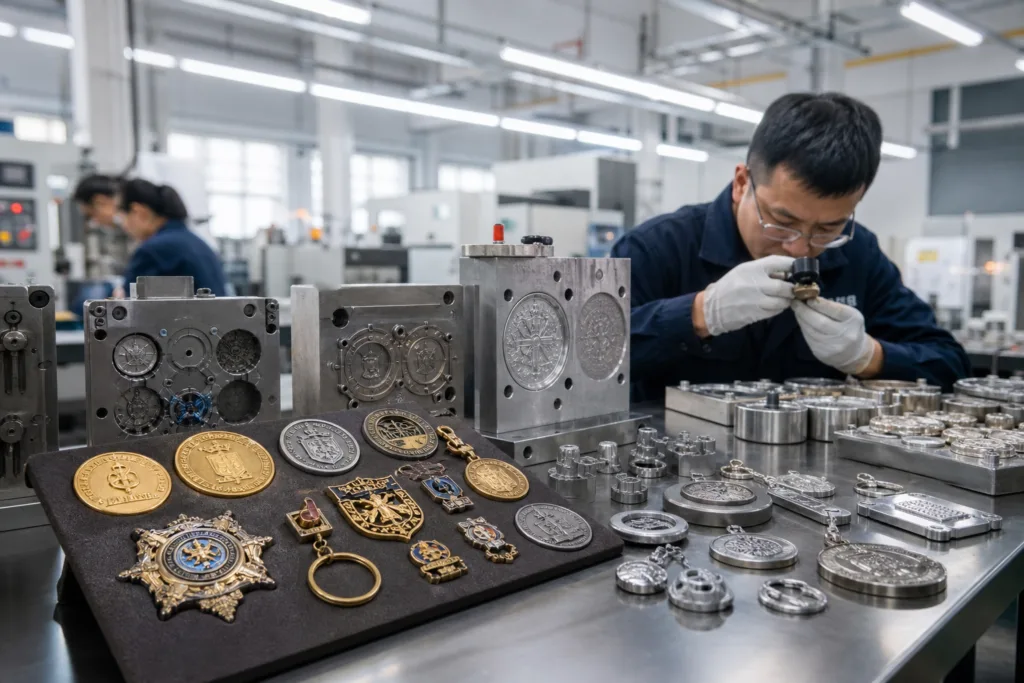
For simple repeat orders, a trader may appear convenient. But when a project involves custom shapes, logo detail, multiple finishes, assembly parts, branded packaging, or production risk control, direct manufacturer communication usually becomes more efficient. That is especially true when artwork must be adjusted for mold feasibility, when thickness or attachment options affect cost, or when finish expectations need to be aligned before sampling.
As a manufacturer, we can normally discuss process fit earlier: whether a design should be die cast or stamped, whether recessed areas should use soft enamel or engraving, whether antique plating will hide minor surface marks better than bright plating, or whether a heavy product needs a different ring, clasp, screw, or pin backing. This shortens the feedback loop between design intent and production reality.
Buyers also gain better visibility into mold ownership, sample revision logic, QC checkpoints, bulk scheduling, and packaging coordination. In many B2B projects, that visibility matters more than a slightly lower quoted unit price because the larger cost often comes from remake risk, delayed approvals, or finish inconsistency across batches.
Common Custom Metal Product Categories for B2B Orders
Medals
Custom medals are common for sports events, school competitions, and commemorative programs. Buyers usually focus on size, thickness, ribbon slot design, 3D relief, antique finish, and back-side personalization. A race medal often needs stronger visual impact at arm’s length, so deeper relief and broader shapes can work better than fine line detail.
Badges and lapel pins
Badges and lapel pins are usually smaller and require better logo clarity. Attachment choice is important: butterfly clutch, rubber clutch, safety pin, magnetic backing, or screw-nut fittings all suit different use cases. Small logos with multiple color zones may need simplification to avoid enamel overflow or poor readability.
Challenge coins
Challenge coins are often chosen for recognition programs, association events, police and military-style commemoratives, and collector series. Thickness, edge detailing, dual plating, and both-side design all influence the feel of value. A coin intended for presentation usually benefits from tighter edge quality and more premium packaging.
Keychains
Keychains sit at the intersection of decoration and daily use, so structure matters as much as appearance. Ring diameter, connector strength, thickness, wear resistance, and logo placement all affect durability. Buyers exploring die-cast logo keychain design often need to balance bold shape freedom with reasonable weight and clean plating coverage.
Tags, nameplates, and accessories
Metal tags and nameplates are common in apparel, bags, packaging, wine boxes, gift boxes, and branded equipment. Some require adhesive backing, rivets, sewing holes, or bent structures. Compared with souvenir items, these parts often need more consistent dimensions because they must fit another product precisely.
Material Options Explained: Zinc Alloy, Brass, Stainless Steel, and Aluminum
Material choice affects not only appearance, but also process suitability, unit cost, weight, plating behavior, and achievable detail.
| Material | Typical Strengths | Best Uses | Watchouts |
|---|---|---|---|
| Zinc alloy | Good for die casting, 3D shapes, moderate detail, versatile finishes | Keychains, medals, badges, coins, souvenir parts | Usually heavier than aluminum; small structural parts need proper mold design |
| Brass | Clean stamping feel, premium weight, strong for polished or enamel items | Lapel pins, badges, premium coins, nameplates | Material cost is typically higher than iron or zinc alloy |
| Stainless steel | Good corrosion resistance, modern look, suitable for etching and laser marking | Nameplates, tags, minimalist accessories | Less suitable for deep die-cast style relief |
| Aluminum | Lightweight, workable, often cost-effective for some tags and plates | Light tags, some keychains, information plates | Premium feel may be lower for heavy commemorative products |
| Iron | Common for stamped items, economical for some pin styles | Basic badges, pins, flat products | Plating and rust resistance require careful finish control |
In many custom projects, zinc alloy is selected because it supports shape flexibility, cut-outs, layered surfaces, and sculpted relief at a practical cost level. Brass is often preferred when buyers want a crisper stamped feel or a more premium weight for badges and coins. Stainless steel tends to suit cleaner industrial or modern branding where etching or engraving is more important than heavy relief.
Manufacturing Methods Compared
Die casting
Die casting is commonly used for zinc alloy products with dimensional relief, custom outlines, openwork, and more sculpted surfaces. It is useful when a buyer wants a more substantial form, especially for souvenir items and thicker keychains. For projects emphasizing volume and contour, 3D metal keychain craftsmanship often starts with evaluating whether the relief depth will cast cleanly and plate evenly.
Stamping
Stamping is often used for brass, copper, or iron parts where the design can be formed by pressure into a die. It works well for medals, badges, and pins that need a classic raised-and-recessed look without very deep undercuts. Stamped products can feel crisp and traditional, especially when combined with enamel filling or polished metal lines.
Etching
Etching suits flatter items with fine line detail, text, maps, or graphic layouts that are difficult to achieve cleanly in deep molds. Stainless steel and brass tags often use this method. Etching can be a strong option for thinner products where precision matters more than relief.
Laser engraving
Laser engraving is generally used for serial numbers, names, variable data, or surface personalization rather than forming the whole product structure. It is useful for back-side coding, branding, and traceability, particularly on nameplates, tags, and premium commemorative products.
The right process depends on shape complexity, logo density, thickness, quantity, and budget. In our experience, many delays happen because the buyer chooses a process based on a reference photo rather than on the actual production logic behind that look.
Surface Finishing Options and What They Change
Finishing does more than change color. It affects corrosion behavior, wear visibility, tactile feel, and how premium the product looks in hand. Typical options include shiny gold, shiny nickel, black nickel, matte finishes, antique brass, antique silver, antique copper, sandblasting, mirror polishing, brushed effects, soft enamel, hard enamel style filling, and epoxy coating.
When we discuss plating with buyers, we explain both decorative and functional expectations. Decorative plating improves visual appeal, while certain finishing systems also help with surface protection and wear resistance. The EPA overview on electroplating explains how plating is used for corrosion and wear performance in addition to decoration; buyers can learn how electroplating improves corrosion and wear resistance when defining finish requirements for custom metal items.
Antique finishes are often a practical choice for medals and coins because they visually emphasize relief and can hide minor handling marks better than highly reflective plating. Bright polished plating works well when the logo lines are broad, clean, and intended to catch light. Sandblasted backgrounds can improve contrast by making raised areas stand out more clearly.
Color filling must also match design intent. Soft enamel gives a textured effect with recessed color areas; polished metal lines remain slightly raised around the color. Hard enamel style surfaces look flatter and smoother, but they often require tighter production control and may increase cost.
How Logo Detail, Thickness, Weight, and Shape Affect the Final Product
Many buyers first focus on front-face artwork, but physical structure often decides whether the product feels cheap, premium, light, or durable. A larger product with very thin thickness can look impressive in photos but feel underweight in person. On the other hand, extra thickness increases material use, polishing time, and shipping weight.
Shape complexity affects mold design and edge finishing. Deep cut-outs, narrow bridges, small holes, and pointed corners can create weakness or polishing challenges. If a keychain has multiple finishes, such as two-tone metal keychain styling, the separation areas must be engineered to stay clean during finishing and assembly.
Logo detail should always be reviewed against actual product size. A seal or crest that looks readable on a screen may become crowded on a 25 mm pin. Fine serif text, thin outlines, and overlapping color zones usually need simplification before sampling. Good manufacturers point this out early rather than reproducing artwork exactly and hoping for the best.
Artwork Preparation and File Requirements
Clear artwork saves time in almost every custom order. Vector files are generally preferred for logos, borders, text, and shape paths because they define edges cleanly for mold making or line interpretation. Raster images can be used as references, but low-resolution files increase the chance of guesswork during redraw.
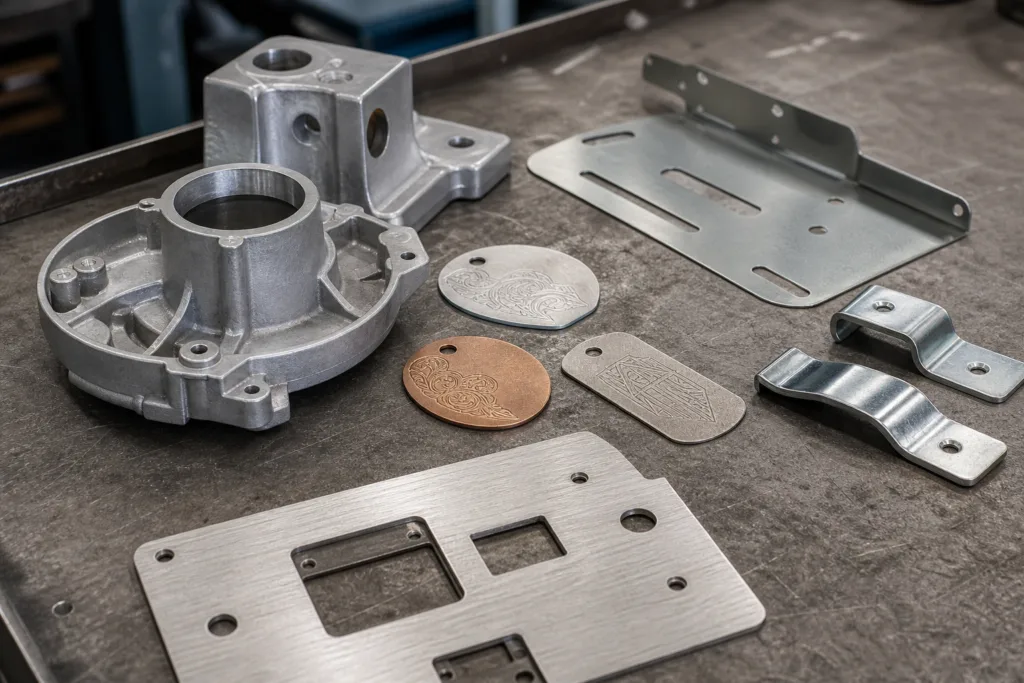
Buyers should ideally provide product size, thickness target, front and back design, attachment type, plating preference, color references, packaging requirements, and any special effect notes such as glitter enamel, translucent enamel, cut-outs, or laser serial numbering. Our usual recommendation is to review artwork preparation for metal production before final quotation so line thickness, negative space, and text sizing are aligned with actual process limits.
It is also helpful to mark non-visible tolerances. For example, if back-side texture can vary slightly but front-face logo sharpness is critical, that priority should be stated. This helps the production team focus QC attention where the product value is highest.
Sampling, Mold Development, and Sample Approval
Most custom metal products require mold development or tooling preparation before production. The mold translates a flat concept into a manufacturable object with draft angles, relief depth, edge structure, attachment points, and feasible polishing access. At this stage, some artwork adjustments may be recommended to improve mold release, plating flow, or color separation.
Sample approval is not just a visual confirmation. It is the buyer’s chance to verify size, weight feel, edge comfort, attachment performance, finish tone, logo readability, enamel fill quality, and packaging fit. If the product is intended for resale or formal presentation, we advise approving the sample under real lighting and with the intended packaging, not only from phone photos.
Sample revisions are common when buyers are comparing antique versus bright plating, testing color depth, or fine-tuning details on the back. That is normal. What matters is whether the manufacturer communicates clearly about what can be changed within the existing mold and what would require mold modification.
MOQ, Lead Time, and Cost Drivers in Bulk Orders
MOQ depends on the product type, process, packaging complexity, and whether custom tooling is required. Standard-looking products with simple finishes may allow lower order quantities, while highly customized items with unique packaging or multiple assembled parts often need a higher MOQ to distribute setup cost more reasonably.
Lead time is influenced by artwork clarity, mold schedule, sample revisions, plating queue, assembly steps, and final packaging work. Buyers often underestimate how much time is added by waiting for internal approvals. In practical terms, fast decision-making on artwork, color, and finish usually shortens delivery more than pressuring the factory after production has started.
| Cost Driver | Why It Matters | Common Buyer Decision |
|---|---|---|
| Material | Affects weight, process, and finish quality | Choose zinc alloy for shape flexibility, brass for premium feel, aluminum for lighter weight |
| Size and thickness | Increase metal usage and shipping cost | Balance visual impact with budget |
| Mold/tooling | One-time setup cost for custom production | Amortize across future repeat orders |
| Finish complexity | Dual plating, antique effects, or epoxy add process steps | Use premium finishes only where they add visible value |
| Packaging | Cards, boxes, inserts, and labeling add labor and material | Match packaging level to sales channel or event use |
Quality Control Checks That Matter Most
In bulk custom metal product production, QC should not focus on one point only. We typically review dimensions, thickness tolerance, plating appearance, color fill cleanliness, attachment strength, edge smoothness, front-back orientation, engraving legibility, and packaging correctness.
For plated items, buyers should ask about color consistency between sample and mass production, especially for antique finishes and black nickel. For enamel products, it is important to define acceptable variation in color tone, line cleanliness, and fill level. For nameplates and tags, hole placement and adhesive backing alignment may matter more than ornamental finish.
At Gairun, we find that the clearest QC programs start with agreed priorities. If the most important concern is sharp logo detail on a premium coin, the QC standard should reflect that. If the order is for a large event medal run, the key risks may instead be ribbon-slot consistency, antique tone uniformity, and packing count accuracy.
Packaging, Private Label, and Custom Insert Options
Packaging should be decided earlier than many buyers expect. A basic polybag protects the item during transport, but presentation products may need velvet boxes, paper cards, custom backer cards, EVA inserts, barcode labels, or retail-ready cartons. Packaging choices affect not only appearance but also packing speed, carton size, and shipping cost.
Private label programs often require coordinated packaging artwork, insert dimensions, warning labels, SKU labels, and carton marks. If the product will be sold online or in retail stores, package drop resistance, presentation angle, and anti-scratch protection all become more relevant. For apparel and packaging accessories, the package may also need to support assembly at the buyer’s downstream factory.
How to Evaluate a Metal Products Manufacturer Before Ordering
Before placing a large order, buyers should evaluate more than quoted price. The real questions are whether the supplier understands your product type, communicates process limits honestly, controls finishing quality, and can maintain consistency in bulk production.
A practical evaluation checklist includes:
- Can the supplier explain why a design should be die cast, stamped, etched, or engraved?
- Do they review artwork proactively and point out line or size risks?
- Can they explain finish options in terms of appearance and durability, not just color names?
- Do they define sample timing, mold ownership, revision handling, and bulk lead time clearly?
- Can they support custom packaging and private label needs if required?
- Do they have a clear QC process for plating, color, dimensions, and packing?
Responsible sourcing also includes environmental and compliance due diligence. For example, plating and finishing operations involve process controls and waste-handling responsibilities, so buyers should check whether your supplier follows proper metal finishing waste controls when screening long-term manufacturing partners.
If the item will be used as jewelry-like accessories or may be accessible to children in some markets, material and coating compliance should also be confirmed in advance. The U.S. Consumer Product Safety Commission provides a helpful overview to confirm safety requirements for metal jewelry and accessories before finalizing specifications and market plans.
Common Mistakes Buyers Make When Sourcing Custom Metal Products
One common mistake is approving artwork without considering actual size. Another is asking for a premium visual effect on a budget process without understanding the compromise required. Buyers also sometimes compare quotes without matching specifications, which makes pricing look inconsistent when the suppliers are actually quoting different materials, thicknesses, or packaging levels.
Other frequent issues include:
- Choosing too many small design elements for a small product size
- Not confirming the attachment method early
- Ignoring packaging until after production starts
- Assuming the sample and bulk order will look identical without defining acceptable variation
- Rushing approval and then requesting structural changes after tooling is completed
From a manufacturer guide perspective, the safest sourcing path is to define the end use first, then align material, process, finish, and packaging with that use case.
Decision Checklist for Choosing the Right Product, Material, and Process
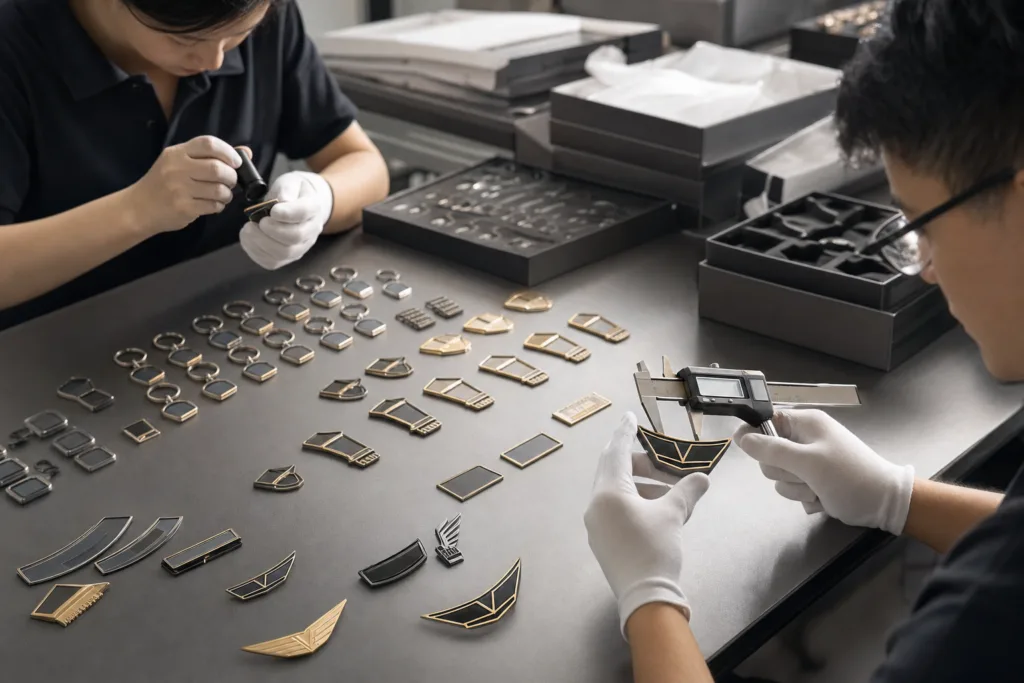
When buyers ask us where to start, we usually suggest a simple sequence. First, define the use scenario: event award, retail souvenir, brand accessory, uniform item, apparel trim, or packaging component. Second, decide whether appearance, weight, durability, or cost is the main priority. Third, select a material and process that support that priority. Fourth, simplify artwork so it suits the actual item size. Fifth, confirm packaging and delivery timing before sample approval.
As a custom metal products manufacturer, we have seen that the strongest projects are rarely the most complicated. They are the ones where buyer expectations, artwork logic, material choice, finish plan, and QC standard all support the same goal.
Conclusion
Choosing the right custom metal products manufacturer is not only about finding production capacity. It is about finding a manufacturing partner that can translate design intent into a repeatable, quality-controlled product that fits your market, budget, and delivery schedule. For medals, badges, coins, keychains, tags, and branded accessories, success usually comes from early alignment on material, process, finish, artwork, sample approval, packaging, and QC expectations. When those points are clear, B2B sourcing becomes more predictable and bulk production becomes much easier to manage.
Frequently Asked Questions
How do I choose between zinc alloy, brass, stainless steel, and aluminum?
Choose based on product structure and end use rather than price alone. Zinc alloy is often practical for die-cast shapes and 3D forms, brass suits many stamped premium-looking badges and coins, stainless steel works well for etched or engraved tags and plates, and aluminum is useful when lower weight matters. The right choice depends on shape complexity, finish expectations, durability needs, and how the item will be used.
What is the difference between die casting and stamping for custom metal products?
Die casting is typically better for thicker products, 3D contours, custom outlines, and more sculpted surfaces, while stamping is often better for flatter products with crisp raised and recessed detail. If the design needs openwork, layered relief, or a more dimensional form, die casting is usually considered first. If the product needs a classic badge or coin feel with cleaner flat geometry, stamping may be the better fit.
What should I prepare before requesting a quote?
Prepare artwork, target size, thickness idea, quantity, finish preference, color requirements, attachment method, packaging needs, and deadline. If possible, send vector artwork and mark which details are essential. A clear RFQ helps the manufacturer judge whether the design should be cast, stamped, etched, or engraved, and it reduces back-and-forth during quotation and sampling.
How do samples help reduce bulk production risk?
Samples let you confirm more than appearance. They help you assess logo readability, weight feel, edge smoothness, attachment strength, plating tone, enamel fill quality, and packaging fit before mass production begins. A sample also reveals whether the design needs simplification or whether the finish looks different in real lighting than it did on screen.
What affects MOQ and lead time most in custom metal orders?
MOQ and lead time are mainly affected by tooling needs, product complexity, finish steps, packaging requirements, and approval speed. A simple product with standard packaging usually moves faster than a custom-shaped item with multiple colors, dual plating, and retail inserts. Internal buyer delays on artwork or sample confirmation can also add significant time to the schedule.
How can I evaluate whether a manufacturer is suitable for long-term cooperation?
Look for clear process knowledge, realistic design feedback, transparent sample and tooling communication, defined QC checkpoints, and the ability to support repeat consistency. A suitable manufacturer should explain trade-offs honestly, not only provide a fast quote. It is also useful to confirm how they handle packaging, production planning, finish control, and any compliance or due diligence questions relevant to your market.