Trolley coin keychains are a practical category of custom metal promotional product because they combine daily usefulness with long-term brand exposure. Instead of functioning as a disposable giveaway, they solve a small real-world need: helping people unlock shopping carts that require a coin or token. For B2B buyers, that matters. A branded item that stays on a keyring and gets used repeatedly can create better visibility than novelty merchandise that is quickly forgotten. From our manufacturing perspective, this product works best when the buyer plans it as both a utility item and a branded metal accessory, with attention to material, shape, thickness, edge quality, and logo clarity.
If your project needs a trolley token format that also reflects your logo standards, finish requirements, packaging plan, or campaign distribution goals, our OEM keychain manufacturing support is relevant because we help buyers move from artwork and material selection to mold development, sample approval, attachment choice, and bulk production planning. That is especially useful for distributors, retailers, event organizers, and corporate buyers who need consistent branding, repeatable quality, and practical guidance on plating, enamel, and packaging before placing a larger order.
What trolley coin keychains are and how they work
A trolley coin keychain is a metal keychain that includes a coin-shaped insert, token, or integrated coin form used to release shopping carts in supermarkets or retail environments where a coin deposit system is used. The coin may be fixed into the overall design or made as a removable token attached to a ring or clasp. In both versions, the value comes from convenience. The user keeps it with their keys and has a ready tool when visiting a store.
That simple function creates a strong promotional logic. The product is small, affordable compared with many premium branded items, and easy to distribute, but it avoids being purely decorative. For many campaigns, usefulness is what keeps a branded item in circulation.
We usually recommend that buyers start by deciding whether they want a standard round trolley coin, a custom silhouette around a coin insert, or a multi-function concept that combines the trolley token with other functional promo keychain options. That early structural choice affects tooling, weight, attachment strength, and the amount of space available for branding.
Why trolley coin keychains are effective promotional keychains
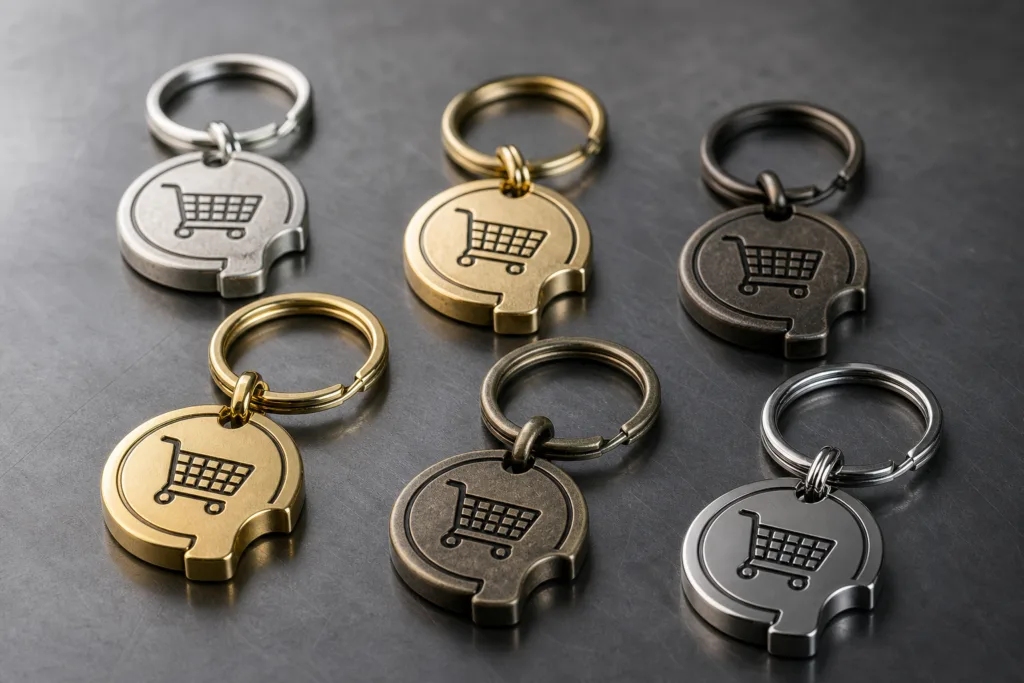
The strongest promotional products do not rely on one-time visibility. They create repeated, low-friction exposure in normal life. Trolley coin keychains do that well because they stay attached to keys, are easy to carry, and are likely to be handled regularly. Even when the trolley function is not used every day, the keychain still travels with the user.
For B2B buyers, the value is not just “people see the logo.” The real value comes from a better combination of retention, usefulness, and perceived substance. Metal products generally feel more durable and intentional than lightweight disposable plastic giveaways. When the product has a good finish, balanced weight, and a clean logo execution, it can support brand messages such as reliability, practicality, organization, or service.
This is also why trolley coin keychains often outperform generic printed key tags in certain campaigns. They have a clearer use case, a longer product life, and better chances of remaining on the customer’s keyring. That gives the brand more opportunities for repeated recall.
Everyday use cases that create repeated brand exposure
Brand visibility improves when an item fits natural routines. Trolley coin keychains are especially useful in routine shopping, commuting, family errands, and travel. The user may not consciously think of the promotional message each time, but repeated contact still reinforces familiarity.
Where repeated exposure usually happens
- At supermarkets and shopping centers that use coin-release carts
- At home, where keys are stored in visible places
- During commuting, when keychains are handled often
- In cars, bags, and office desks, where the product remains present
- In public settings, where other people may notice a distinctive shape or finish
These exposure patterns matter because they are organic. The item does not need a formal event to be seen. It follows the user through daily life.
Best-selling applications for businesses, events, and retail campaigns
In our custom metal product production work, trolley coin keychains are most often considered for campaigns where the buyer wants a practical giveaway with stronger staying power than printed paper or low-cost novelty items. They are especially suitable for:
- Retail store promotions and loyalty programs
- Supermarket partnerships and local business campaigns
- Municipal, transport, and service-brand promotions
- Trade show giveaways where usefulness helps retention
- Corporate gifts for customer onboarding packs
- Charity, school, and association fundraising merchandise
- Tourist souvenir programs in regions where cart-token use is common
For a sports club, for example, a trolley coin keychain can become a low-cost branded accessory for members. For a retail chain, it can work as a loyalty item. For a distributor, it can be offered as a practical catalog product with multiple finish levels depending on the end client’s budget.
Some buyers also expand the concept by moving beyond a plain round token and using 3D mascot keychain design ideas when the campaign needs more personality, especially for clubs, family brands, attractions, or event merchandise.
Material options for trolley coin keychains
Material choice affects durability, logo detail, edge feel, weight, and cost. For trolley coin keychains, the most common base metals are zinc alloy, brass, stainless steel, and aluminum. The right choice depends on your design structure and finish goals rather than on price alone.
Buyers comparing these options often benefit from a broader metal material selection guide, but the product-specific logic is usually as follows.
| Material | Common strengths | Best use cases | Points to watch |
|---|---|---|---|
| Zinc alloy | Good for die-casting, custom shapes, 3D relief, balanced cost-performance | Most custom trolley coin keychains with shaped frames or detailed logos | Plating quality and mold accuracy matter for long-term appearance |
| Brass | Premium feel, clean stamping response, good detail | Higher-end promotional items or classic coin-like designs | Usually higher material cost and different process suitability |
| Stainless steel | Modern look, strong corrosion resistance, good for engraving | Minimalist designs, engraved branding, slim structures | Not ideal for all deep 3D forms; process choice matters |
| Aluminum | Lightweight, economical, easy color use in some formats | Lightweight campaigns and simpler structures | Lower perceived weight may feel less premium in some markets |
Because trolley coin keychains are handled frequently and may be exposed to moisture, friction, and pocket wear, buyers should ask how the base metal and plating system will hold up in daily use. Where corrosion resistance is a concern, it helps to understand corrosion-resistant plating standards for everyday-use metal keychains so material and finish discussions are grounded in realistic durability expectations rather than appearance alone.
Customization options: shape, size, logo, color, and double-sided design
Customization is where this product shifts from a simple token into a more strategic branded item. The most common choices include:
- Standard round coin with one- or two-sided logo
- Custom outer frame with integrated coin center
- Flat or 3D raised logo
- Soft enamel or imitation hard enamel color filling
- Cut-out details, recessed text, or engraved messaging
- Split ring, lobster clasp, carabiner, or detachable token structure
- Matte, polished, antique, or brushed surface finishes
Size needs to match function first. If the token does not fit the intended cart system, the design fails no matter how attractive it looks. Once the functional dimensions are set, we help buyers optimize the visible area for logo placement, edge proportion, and brand readability.
Double-sided design is often worth considering. One side can carry the main logo, while the reverse side can include a slogan, website, QR instruction, campaign message, or event identity. This can improve information value without making the front look crowded.
Manufacturing methods that fit different designs
The main manufacturing routes for trolley coin keychains are die-casting, stamping, laser engraving, and enamel filling. The right combination depends on shape complexity, logo style, finish expectation, and budget.
Die-casting
Die-casting is often the best choice for zinc alloy trolley coin keychains with custom outlines, 3D relief, recessed areas, or integrated frames. It allows more sculptural design freedom and works well when the buyer wants a more distinctive branded form. Many custom die-cast logo keychains use this route because it supports logo dimension and custom shape development efficiently.
Stamping
Stamping suits flatter metal forms and can work well for coin-like products in brass or iron where crisp lines and defined raised-recessed areas are important. For simpler designs, stamping can be cost-effective and visually clean.
Laser engraving
Laser engraving is useful for fine text, serial details, minimalist branding, or projects where a precise, non-color logo style is preferred. It is especially effective on stainless steel and some plated surfaces.
Enamel filling
Soft enamel adds color contrast and makes brand elements easier to recognize at a glance. It is popular for logos, icons, and campaign color systems. If the product needs a more filled and smoother look, buyers can discuss enamel style and topcoat options during sample development.
How design choices affect durability, weight, and perceived value
Two trolley coin keychains can look similar in an artwork file but feel very different in hand. That difference often comes from thickness, edge finishing, attachment hardware, and plating quality.
Thicker products generally feel more substantial, but more thickness also means more material weight and potentially higher cost. Sharper edges may create a technical look, but rounded edges often feel better in daily handling. A bright polished plating can create strong visual impact, while antique finishes may be better for heritage, club, or craft-oriented branding.
From our manufacturing perspective, perceived value often comes from small details:
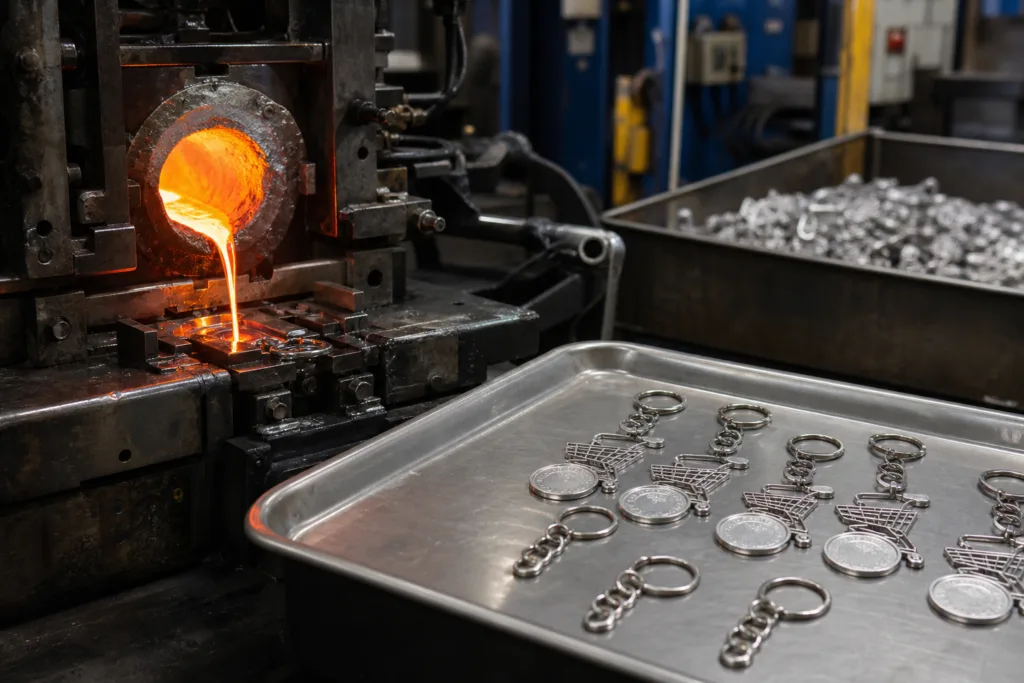
- Whether the logo remains legible at real-use size
- Whether enamel areas are clean and evenly filled
- Whether the keyring attachment feels secure
- Whether the edge finish feels smooth in the hand
- Whether front and back surfaces look consistent across the batch
This is where the product moves beyond “cheap giveaway” and becomes a durable branded accessory.
Target markets and ideal buyer profiles
Trolley coin keychains are not right for every campaign, but they are highly relevant for certain buyer groups. The best fit usually includes organizations that want a practical metal item with broad appeal and repeated use.
- Retail brands and supermarket-linked promotions
- Promotional product distributors serving practical giveaway categories
- Corporate gift buyers who want functional branded accessories
- Associations, schools, and clubs selling low-cost merchandise
- Tourism and souvenir buyers seeking small useful metal items
- Importers sourcing compact custom metal products for resale
- Service businesses wanting a practical leave-behind item
At Gairun, we usually see the best project results when the buyer already knows the campaign audience, the intended distribution channel, and the preferred quality level before finalizing the structure.
Branding strategy: how to match the coin keychain to your message
A useful promotional product still needs the right branding logic. The design should match what the brand wants to communicate.
| Brand message | Suitable design direction | Recommended finish style |
|---|---|---|
| Practical and dependable | Simple round coin, clear logo, readable text | Nickel, matte silver, or brushed finish |
| Friendly and community-focused | Color-filled icon, rounded shape, softer edges | Soft enamel with bright plating |
| Premium and established | Stamped or die-cast relief, double-sided detail | Antique brass, polished brass, or dark nickel |
| Modern and minimal | Slim profile, engraved logo, low-clutter layout | Stainless steel look or matte black plating |
When the item’s visual language aligns with the brand, the product feels more intentional and more worth keeping. That matters for retention.
Sampling, MOQ, lead time, and bulk production planning
Most B2B buyers should not jump directly from artwork to mass production. Trolley coin keychains are small, but small products still need careful approval because logo detail, fit, and finish can vary noticeably at compact size.
We generally advise buyers to confirm these points during sample development:
- Exact trolley coin dimensions and fit requirements
- Base metal and production method
- Thickness and finished weight target
- Plating color and surface texture
- Color references for enamel areas
- Attachment hardware style
- Packaging format for final distribution
MOQ depends on process, design complexity, and whether a new mold is required. Lead time depends on sample approval speed, plating choices, and packaging requirements. If the item is tied to an event or campaign launch, artwork approval and sample sign-off should be scheduled early to avoid compressing production and inspection time.
Quality control checks buyers should request
For trolley coin keychains, the most important quality checks are not complicated, but they should be systematic. In our bulk production workflow, we focus on appearance consistency and functional reliability together.
Key QC points
- Logo lines are clean and readable
- Coin dimensions match the approved requirement
- Plating tone is consistent across the batch
- Enamel fill is even and within boundaries
- Edges are smooth without unsafe burrs
- Split rings, clasps, or detachable parts are secure
- Front and reverse orientation are correct
- Packaging count and packing method match the order plan
For campaigns distributed to a wide public audience, especially family-oriented promotions, buyers may also want supplier documentation around material screening and finish compliance. That is where product safety and lead-content checks for promotional metal accessories become a useful discussion point during supplier evaluation.
Packaging options for gifting, retail display, and campaign distribution
Packaging should match the distribution channel. A trolley coin keychain handed out in bulk at an event needs different packaging from one sold in a retail store or included in a premium customer welcome kit.
- Individual poly bags for simple bulk distribution
- Backing cards for retail or trade show presentation
- Paper cards with barcode or campaign information
- Velvet or paper boxes for premium gifting
- Custom printed envelopes for direct mail or welcome packs
Packaging also affects labor planning and shipping volume, so it should be decided early rather than after the metal part has already been approved.
Cost drivers and how to balance budget with brand impact
Cost is influenced by more than just size. Buyers should look at the full structure of the product.
Main cost drivers
- New mold development
- Base metal type
- Thickness and total weight
- Single-sided versus double-sided detail
- Number of enamel colors
- Plating type and finish complexity
- Special attachments or detachable token structures
- Packaging style and packing labor
If budget is limited, we usually recommend protecting the fundamentals first: functional size, readable logo, reliable hardware, and a durable finish. It is often better to simplify color count or surface complexity than to reduce the product to a point where it feels too light or the branding becomes unclear.
Common mistakes to avoid when ordering custom trolley coin keychains
Some of the most common problems are preventable at the quoting and sample stage.
- Approving artwork without checking functional trolley dimensions
- Using logo details that are too fine for the chosen size
- Choosing a finish based only on appearance, not wear resistance
- Ignoring keyring or clasp quality
- Adding too much information to a very small face area
- Leaving packaging decisions until after production planning
- Assuming all metal keychains feel equally durable regardless of thickness
Buyers should also avoid comparing quotes without checking process assumptions. One supplier may be quoting stamped iron, another die-cast zinc alloy, and another stainless steel engraving. The unit prices may differ for good reasons.
Example campaign scenarios
A local retailer may use a simple nickel-plated trolley coin keychain with a clean one-color logo as a loyalty giveaway. A tourist attraction may prefer a shaped token with color-filled branding to make it more collectible. A corporate distributor may specify a dual-purpose product that combines trolley use with another practical function to improve perceived value for end clients.
These projects succeed when the product format matches the audience. If the campaign needs stronger character branding, a shaped or mascot-led design may work better. If the audience is broad and practical, a standard coin format with refined finishing often performs well.
How to choose a metal products manufacturer for custom promo keychains
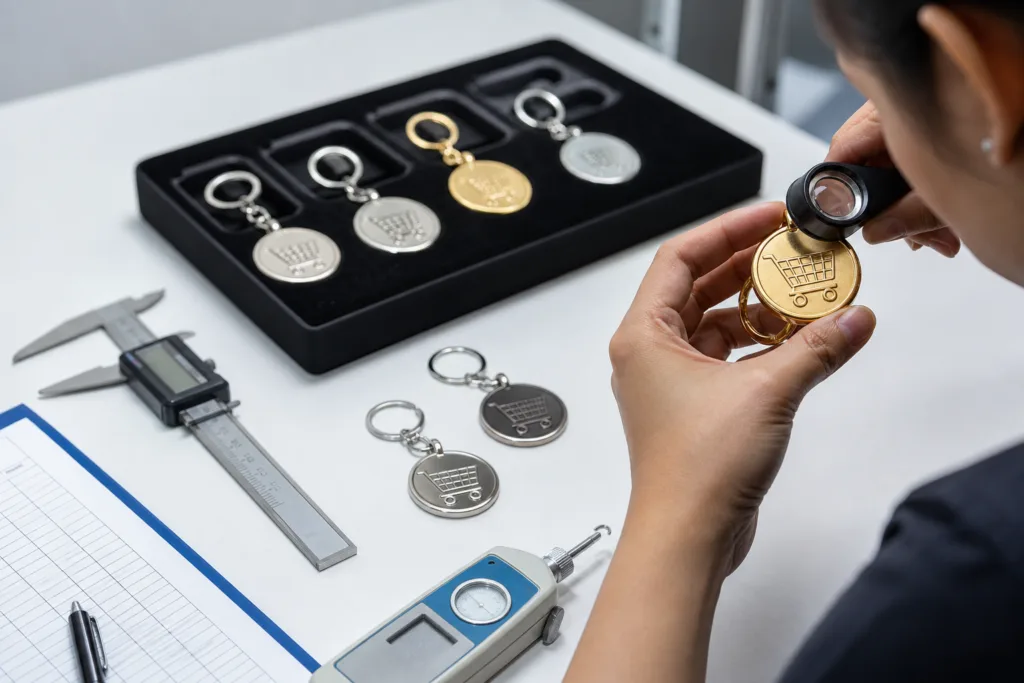
B2B buyers should evaluate a manufacturer based on process fit, communication clarity, and production control rather than on unit price alone. A good manufacturing partner should be able to explain which process suits your artwork, where detail limits exist, how plating and color options affect durability, and what sample checkpoints should be approved before bulk production.
Useful questions to ask include:
- Which base metal and process do you recommend for this design, and why?
- Will this logo reproduce clearly at the intended size?
- What thickness and edge finish do you suggest for daily handling?
- How will you control plating consistency and attachment strength?
- What sample stage approvals are needed before mass production?
- Can you support custom packaging or private label packing?
A manufacturer-informed discussion usually leads to a better product than a quote-only discussion. That is particularly true for promotional products that need to be both useful and brand-consistent.
Conclusion
Trolley coin keychains are a practical promotional tool because they sit at the intersection of usefulness, portability, and repeat brand exposure. For B2B buyers, the real opportunity is not just putting a logo on a coin-shaped item. It is designing a metal product that functions well, feels durable, reflects the intended brand position, and can be produced consistently at scale. When material choice, process, finish, packaging, and QC are planned together, trolley coin keychains can become a compact but effective part of a broader promotional strategy.
FAQs
What file format should we prepare for custom trolley coin keychains?
Vector artwork is usually the safest starting point because it helps define logo lines, text, outlines, and recessed or raised areas clearly for mold or tooling review. If your design includes enamel areas, special textures, or double-sided details, it also helps to provide color references and note which areas should be polished, matte, engraved, or plated differently.
What is the usual MOQ for trolley coin keychains?
MOQ depends on the manufacturing method, whether a new mold is needed, and how complex the design is. A standard shape with simple finishing may support a different order structure than a fully custom die-cast design with enamel and custom packaging. Buyers should compare MOQ together with tooling, finish, and packaging assumptions rather than looking at quantity alone.
How long does production usually take?
Production time depends on artwork readiness, sample approval speed, mold development, plating schedule, and packaging requirements. In practical sourcing terms, buyers should plan for separate stages: design confirmation, sample production, approval revision if needed, and then bulk production. Campaign deadlines are easier to protect when packaging and shipping plans are confirmed early.
Which material is best for a durable trolley coin keychain?
The best material depends on the design and finish you want. Zinc alloy is often a strong all-around choice for custom shapes and die-cast structures, brass can suit more premium coin-like designs, stainless steel works well for engraved minimalist styles, and aluminum can be useful when light weight matters. Durability comes from the full combination of base metal, thickness, plating, and hardware quality.
Can trolley coin keychains be made with double-sided branding?
Yes, and double-sided branding is often a practical upgrade because it separates the main logo from supporting information. One side can present the primary brand identity, while the other side can carry a slogan, event name, contact detail, or campaign message. This usually improves readability compared with trying to fit too much onto one small face.
What finish should we choose for a promotional campaign?
The right finish depends on your audience, usage level, and brand style. Bright nickel or silver tones often suit practical everyday campaigns, antique finishes can support heritage or club identity, matte surfaces fit modern minimalist branding, and enamel-filled designs can improve color recognition. Buyers should evaluate finish choice not only by appearance but also by how the product will be handled and distributed.