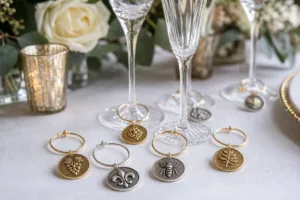
When buyers compare coasters for hospitality, retail, events, or branded gift programs, the real choice is rarely just decorative. It usually comes down to how the coaster will perform under condensation, repeated handling, cleaning, stacking, transport, and long-term brand presentation. In this comparison, we look at coasters from a practical sourcing perspective, with specific attention to etched metal options and cork backed constructions, so procurement teams can evaluate style, durability, maintenance, and cost without relying on vague lifestyle claims.
If your project involves branded drinkware accessories, premium packaging inserts, or custom tabletop items with logo detail and finish control, our metal craft sourcing and production overview is a useful starting point. We support product planning from material selection and artwork review to mold development, etched or engraved detailing, surface finishing, sample approval, and bulk QC, which is especially relevant when buyers need a coaster program that balances visual impact, anti-slip function, packaging fit, and production consistency.
What Are Etched Metal Coasters and Cork Backed Coasters?
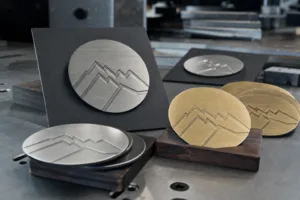
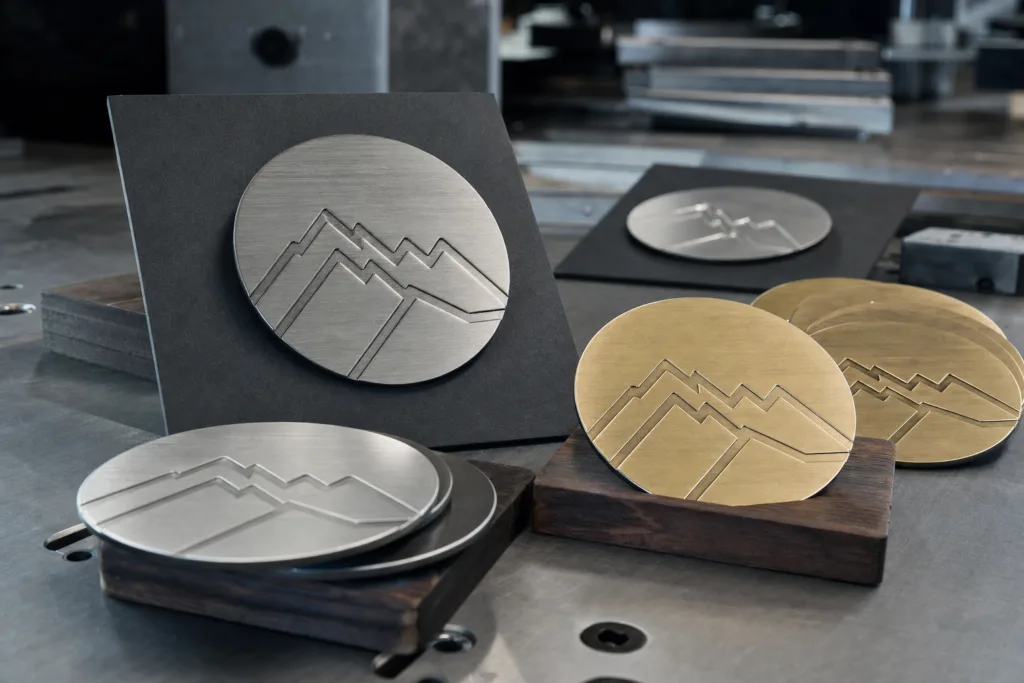
Etched metal coasters are typically made from stainless steel, brass, aluminum, iron, or other sheet-based metals that can carry recessed or surface-defined artwork. The visible design may be created through chemical etching, laser marking, engraving, stamping, or a combined finishing process, depending on the desired look. In buyer language, “etched metal” usually signals a cleaner, more precise graphic effect than printed decoration, especially for logos, line art, borders, monograms, and architectural patterns.
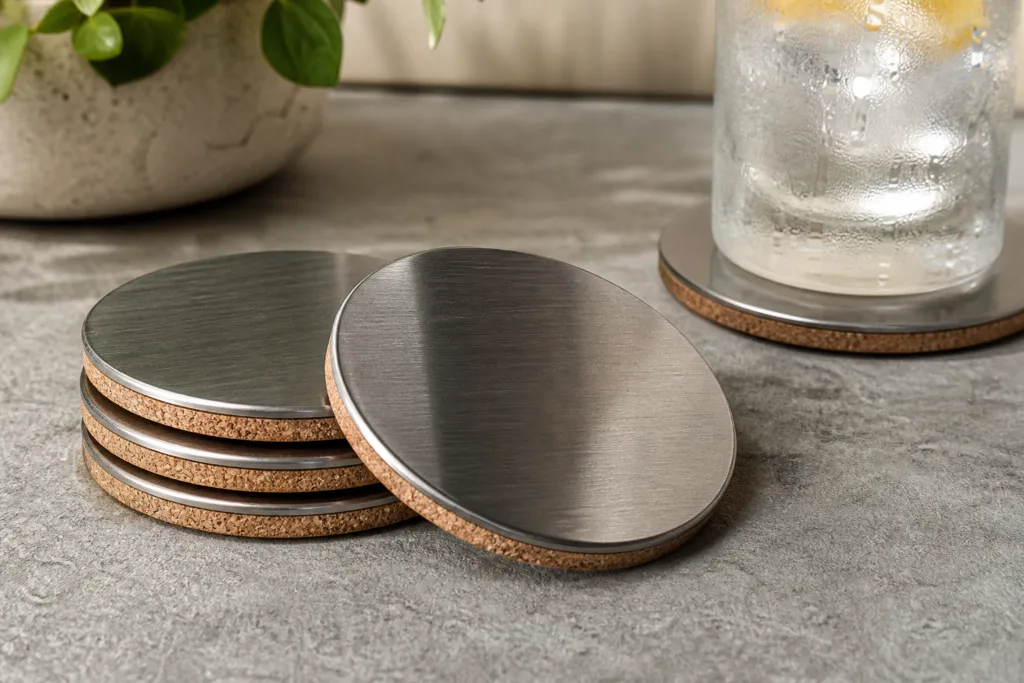
Cork backed coasters are a broader product category. They often combine a top decorative layer with a cork base that adds grip, cushioning, and surface protection. The top can be metal, ceramic, MDF, stone, laminated board, or another decorative face material. In many commercial projects, the cork layer is not the visual hero. It is the functional layer that improves table contact, reduces sliding, softens placement noise, and helps protect furniture.
For buyers, that means the comparison is not only metal versus cork as raw materials. It is often a comparison between an all-metal or metal-dominant presentation and a multi-material coaster designed for comfort and grip.
Why This Comparison Matters for Buyers, Brands, and Custom Product Projects
Coasters seem simple, but small product decisions can create avoidable complaints in bulk orders. A visually strong coaster may still fail if it scratches delicate furniture, slides on glossy tabletops, shows water marks too quickly, or arrives with inconsistent edges. On the other hand, a highly practical coaster may underperform in premium gift sets if the finish looks too ordinary or the logo treatment lacks definition.
In our custom metal product production work, buyers usually care about five decision points first: visual style, moisture behavior, tabletop safety, customization method, and cost structure. A hospitality buyer may prioritize easy cleaning and long service life. A corporate gift buyer may focus on logo refinement and packaging impression. A retail brand may want a natural material story. A distributor may need stable quality across repeat orders.
That is why a structured comparison matters. It reduces the risk of choosing a coaster type based only on appearance samples while ignoring how the product will be used in offices, bars, meeting rooms, guest rooms, souvenir sets, or e-commerce packaging.
Etched Metal Coasters: Material, Appearance, and Core Benefits
Etched metal coasters usually appeal to buyers who want a sharper, more premium, and more permanent-looking product. Common materials include stainless steel for a modern, corrosion-aware appearance, brass for a warmer and more traditional luxury feel, and aluminum where lighter weight matters. Surface treatments can include brushed texture, mirror polishing, matte blasting, antique effects, plating, or clear protective coatings.
From a manufacturing perspective, etching is useful when a design contains fine lines, repeated patterns, subtle recessed textures, or a logo that needs crisp separation from the background. Buyers often ask what “etched metal” really means. In technical terms, metal etching is a recognized surface-processing approach, and ASTM guidance on metal etching and surface preparation helps explain why etched surfaces can create controlled detail and texture rather than relying only on printed graphics.
The core benefits of metal in coaster applications are structural firmness, strong visual definition, good perceived value, and long design life when the finish is chosen correctly. Etched details do not peel the way poor surface printing can. They also work well with monochrome branding, crests, line icons, and minimalist luxury packaging concepts.
That said, metal is not automatically the practical winner in every environment. A thin metal coaster with no backing can slide more easily on polished tables. A mirror finish can show fingerprints quickly. Some plated surfaces require careful process control so the appearance remains consistent across batches. This is where process planning matters more than material name alone.
Cork Backed Coasters: Structure, Look, and Practical Advantages
Cork backed coasters are chosen because they solve several everyday-use problems in a simple way. Cork adds a soft contact layer between the coaster and the table. That makes the coaster quieter to place, less likely to shift, and less likely to leave abrasion marks on sensitive surfaces. For cafes, offices, and household-style gift sets, that functional comfort is often more important than a dramatic finish.
The performance comes from cork’s natural cellular structure. When buyers want a material explanation rather than marketing language, cork’s structure and moisture-resistant properties are well documented in material research, especially its elasticity, low permeability, and cushioning behavior. In practical terms, that helps explain why cork backing improves grip and provides a more forgiving base during everyday use.
Visually, cork introduces a warmer and more natural tone. It works well with rustic hospitality themes, eco-focused retail sets, casual gifting, and products where the buyer wants the item to feel approachable rather than formal. Even when the top surface is metal, the cork layer changes the user experience by making the piece feel less cold and less severe on a tabletop.
The practical advantage is clear: many users care more about anti-slip behavior and table protection than they do about absolute edge sharpness or a reflective finish. Cork backed designs are often the safer choice for broad-use settings where furniture protection and user comfort matter every day.
Side-by-Side Comparison of Coasters for Everyday Performance
| Factor | Etched Metal Coasters | Cork Backed Coasters |
|---|---|---|
| Visual impression | Modern, premium, precise, often more gift-oriented | Natural, practical, softer, more casual or balanced |
| Logo detail | Strong for fine lines, recessed details, crisp geometry | Depends on top surface; cork itself is less ideal for very fine branding |
| Grip on table | Needs texture, coating, feet, or backing for better anti-slip performance | Usually better due to cork friction and cushioning |
| Furniture protection | Good if edges and back are controlled properly | Usually stronger because cork softens table contact |
| Moisture behavior | Does not absorb like cork, but visible water can remain on surface | Better at comfortable handling and reducing slip through textured backing |
| Cleaning | Easy to wipe, but finish may show marks | Top surface may wipe easily; cork base should not stay soaked |
| Durability perception | High if finish, thickness, and corrosion resistance are appropriate | Balanced durability, especially for indoor daily use |
| Cost structure | Higher sensitivity to material, finish, and process detail | Can be cost-efficient, depending on top material and assembly |
Durability, Scratch Resistance, and Moisture Performance
Durability in coasters is not just about whether the product breaks. It includes how the surface looks after repeated use, whether the edges remain clean, whether the base stays attached, and whether the piece continues to protect the table.
Etched metal coasters generally have stronger long-term shape stability than soft or fiber-based alternatives. They do not warp easily under normal indoor use, and recessed designs remain legible over time. However, the surface can still scratch depending on the finish. High-polish surfaces show hairline marks faster than matte or brushed finishes. Plated decorative coatings can also vary in wear behavior if they are selected only for color appeal without considering real handling conditions.
For moisture exposure, metal itself does not absorb condensation, but that does not mean all metal coasters perform equally well. Corrosion resistance depends on the base material and finish quality. Stainless steel is usually the safer choice where repeated moisture is expected, while decorative iron or plated surfaces need better process control and storage awareness. Buyers comparing finish longevity should remember that appearance durability depends on both substrate and coating quality, which aligns with established thinking around corrosion resistance and finish durability of metal coasters.
Cork backed coasters handle daily tabletop contact differently. The cork layer can help reduce sliding when moisture is present and provides a more forgiving landing surface for cups and glasses. The trade-off is that cork is still an organic material layer. If the coaster is repeatedly soaked, stored wet, or exposed to poor adhesive bonding, the base can degrade faster than the metal top.
In short, metal usually wins on structural permanence, while cork backing often wins on practical surface interaction.
Aesthetic Differences: Modern, Premium, Traditional, and Natural Styles
If the product is part of a premium gift set, executive desk accessory, hotel suite item, or commemorative package, etched metal usually gives the stronger first impression. It feels intentional and engineered. Brushed stainless steel communicates a contemporary style. Antique brass feels more classic. Blackened or matte-coated metal can support a minimalist, architectural, or industrial visual language.
Cork backed styles are broader and more flexible in mood. They can still look premium when paired with metal, ceramic, stone, or well-finished printed tops, but they usually lean warmer and more relaxed. That makes them useful for cafés, lifestyle retail, winery merchandise, museum shops, eco-positioned branding, and casual corporate gift programs.
We usually advise buyers to ask a simple question: should the coaster feel like a display object, or like an everyday-use object? If it needs to impress immediately in a presentation box, etched metal often has the edge. If it needs to blend into daily use while remaining pleasant and reliable, cork backed construction is often the smarter fit.
Maintenance and Cleaning Requirements for Daily Use
Maintenance is often overlooked during sourcing because sample evaluation happens before real use begins. Buyers should think beyond the first unboxing moment.
Etched metal coasters are usually easy to wipe clean. Coffee drips, drink rings, or dust can be removed with a soft damp cloth. The issue is not cleaning difficulty; it is finish behavior. Mirror and dark-coated surfaces show fingerprints, smudges, and dried mineral marks more easily. Brushed or matte textures are more forgiving in service environments.
Cork backed coasters are easy to live with but need slightly better moisture discipline. The top surface may clean quickly, yet the cork base should not stay saturated for long periods. In restaurants or bars with heavy turnover and frequent washing, buyers should consider whether the product will be wiped, rinsed, or exposed to standing water. For high-contact branded programs, planning customization with color matching for branded metal finishes also helps reduce the temptation to use visually sensitive coatings that become maintenance complaints later.
For office, lounge, and gift settings, both types can work well. The right answer depends more on the cleaning method and the finish choice than on the category name alone.
Environmental Impact: Recyclability, Renewable Materials, and Longevity Considerations
Sustainability discussions around coasters should be practical. Metal has strong recyclability potential, especially when the product is single-material or easy to separate by component. Cork has a renewable material story and a natural feel that many retail brands value. The trade-off appears when products combine layers with adhesives, coatings, or mixed substrates, because end-of-life recovery becomes less straightforward.
For buyers building a sustainability brief, the useful question is not “which material sounds greener?” but “how long will this item stay in use, and how easy is it to recover or separate later?” An etched metal coaster that remains attractive for years may justify its material intensity through longevity. A cork backed coaster may better align with a natural-material brand story and a softer use profile. General waste hierarchy thinking, such as the EPA framework on recycling and sustainability considerations for coaster materials, is helpful here because durability, reuse, and recoverability all matter.
Price Points and Cost Drivers
Price differences between these coaster types are influenced by more than raw material. Buyers should look at the full structure of the product.
For etched metal, major cost drivers include base metal choice, thickness, etching depth or complexity, finishing steps, plating or coating requirements, polishing level, edge treatment, and packaging format. Small details such as individual polybags, velvet boxes, or foam inserts can change total landed cost more than expected.
For cork backed products, cost is shaped by the top material, cork quality and thickness, adhesive method, assembly labor, cutting precision, and packaging. If the top is simple and the assembly method is efficient, cork backed products can be very cost-effective. If the top includes metal plus decorative finishing, the price can approach premium tiers quickly.
At Gairun, we often remind buyers that sample cost and bulk cost may tell different stories. A visually simple coaster can become expensive if tolerances are tight and packaging is elaborate. A premium-looking metal coaster can remain commercially reasonable if the design is optimized early and avoidable process complexity is removed.
Best Use Cases for Etched Metal Coasters
Etched metal coasters are a strong fit for executive gifting, spirits branding, commemorative sets, hotel VIP rooms, museum stores, club merchandise, and high-perceived-value retail. They also work well when a buyer wants a product that matches other metal accessories in a boxed set, such as bottle openers, challenge coins, tags, or desk items.
They are especially effective when the brand identity depends on line clarity, metallic contrast, crest detail, or a contemporary premium tone. If the product will sit inside a gift box rather than remain permanently on a wet bar counter, all-metal styling becomes easier to justify.
Best Use Cases for Cork Backed Coasters
Cork backed coasters suit cafés, restaurants, conference rooms, lifestyle gift packs, winery sets, bookstore merchandise, home décor channels, and volume-friendly corporate giveaways. They are also well suited to projects where table protection matters more than metallic impact.
We usually recommend this format when the coaster is expected to be handled by a broad range of users, used on polished furniture, or shipped in larger quantities where comfort, practicality, and lower complaint risk matter. This is also the safer direction for buyers who want a natural touch in the user experience.
Customization Options: Logos, Shapes, Finishes, Backing, and Packaging
Customization quality depends on matching the method to the design. Buyers sometimes over-specify decoration without considering how the artwork will behave at coaster size. For metal tops, etched details, engraving, stamping, filled color, brushed backgrounds, antique finishes, and protective coatings are all possible, but they should be selected based on actual logo complexity and use environment. Our article on custom metal manufacturing capabilities is useful for understanding how process selection affects product outcome.
Shape options can include round, square, hexagonal, shield, crest, or fully custom profiles. Cork backed constructions can use full-sheet backing, segmented pads, or integrated anti-slip layers. Packaging may include kraft sleeves, rigid boxes, window gift boxes, bulk inner packs, or retail-ready barcode labeling.
For branded projects, color accuracy also matters. If a buyer expects filled enamel areas or plated surfaces to coordinate with a wider brand system, they should review finish expectations early and avoid assumptions. That is one reason we encourage buyers to study common design pitfalls in metal products before locking artwork.
What Buyers Should Check Before Ordering
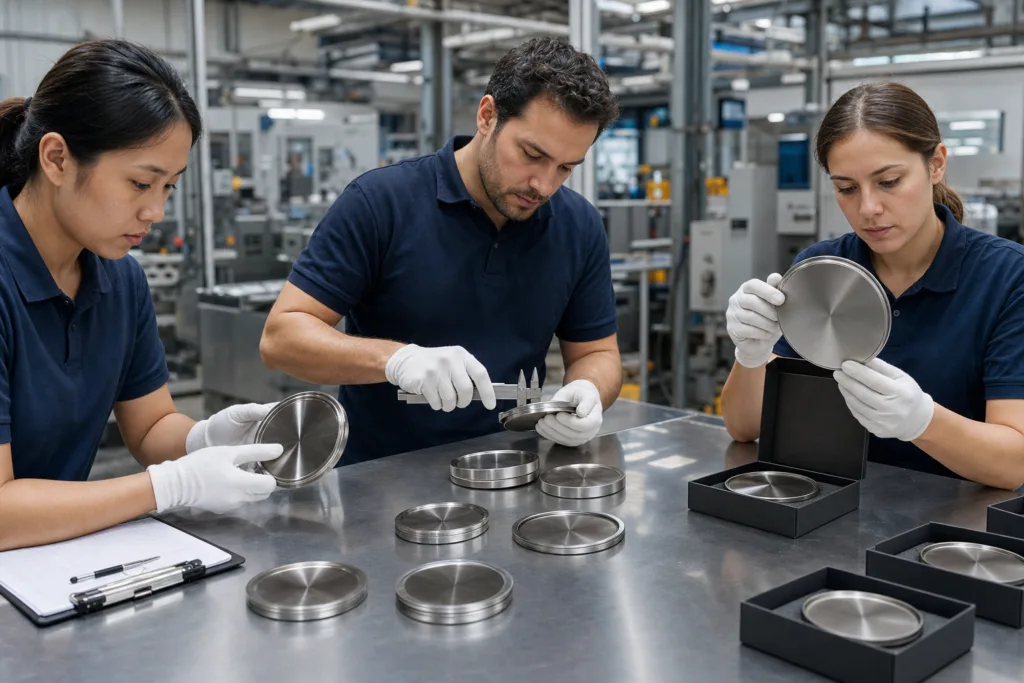
Before approving production, buyers should confirm thickness, coaster diameter or footprint, edge treatment, base attachment method, moisture-use scenario, and packaging count per carton. This is also where tolerances matter. A coaster that looks simple still needs consistent size, flatness, corner finish, and backing alignment. Reviewing metal manufacturing tolerance guidance helps buyers ask better questions about flatness, edge consistency, and assembly fit.
- Thickness: Too thin can feel weak or slide more easily. Too thick can add unnecessary cost and shipping weight.
- Anti-slip performance: Ask whether the coaster uses cork, feet, texture, or a coated underside.
- Edge safety: Confirm deburring, corner radius, and smoothness for hand comfort and furniture safety.
- Etch quality: Fine details should remain clean, not muddy or over-etched.
- Backing bond: For cork backed structures, adhesive quality and alignment should be checked in the sample.
- Packaging: Bulk packing and retail gift packing create different scratch-risk profiles.
Common Mistakes When Selecting Coasters for Events, Retail, or Corporate Gifts
The most common mistake is buying only for first impression. A shiny metal sample may look excellent under showroom lighting but create fingerprints, slip complaints, or table-marking concerns in real use. Another common mistake is assuming cork backed automatically means low end. In many applications, it is the more intelligent functional choice.
We also see buyers underestimate artwork scale. Fine lines that look elegant on screen may become too small once adapted to a compact coaster size. Another issue is failing to define the use scenario. A coaster for a boxed commemorative set is not the same product as a coaster for daily use in a busy hospitality setting.
Finally, some teams do not test packaging interaction. Metal surfaces can rub during transport, while cork layers can compress if packed too tightly. Sample review should include not only the coaster itself, but also how it arrives, stacks, and stores.
How to Choose the Right Coaster Type for Your Brand, Audience, and Budget
Choose etched metal when your project needs visual sharpness, premium presentation, long-lasting logo definition, and a stronger metallic identity. It is usually the better option for commemorative gifting, executive branding, premium retail, and multi-item metal gift sets.
Choose cork backed when your project needs anti-slip comfort, furniture-friendly daily use, a natural or approachable style, and broader practicality across mixed users. It is often the stronger choice for casual hospitality, office use, large-volume branded programs, and retail concepts with an organic tone.
From our manufacturing perspective, neither type is universally superior. The right decision comes from matching material structure, finish behavior, and customization method to the real use environment. The more clearly a buyer defines table surface, cleaning method, packaging plan, artwork detail, and target price band, the easier it becomes to source coasters with fewer surprises.
Frequently Asked Questions About Etched Metal and Cork Backed Coasters
Are etched metal coasters better for premium branding?
They usually are when the brand needs crisp logo detail, metallic character, and a more formal presentation. Etched metal tends to look more engineered and permanent, especially for executive gifts, commemorative sets, and retail packaging where first impression matters.
Do cork backed coasters last long enough for everyday use?
Yes, in most indoor settings they perform very well, especially when the top layer is durable and the cork base is bonded properly. Their service life depends on moisture exposure, cleaning method, and how often they are left wet or stacked under pressure.
Which coaster type is easier to clean?
Metal-faced coasters are generally easier to wipe quickly, but some finishes show fingerprints and water spots more easily. Cork backed coasters can also be low-maintenance, though the cork base should not remain soaked for extended periods if buyers want better long-term appearance.
Can etched metal coasters include color and custom shapes?
Yes, many projects can combine etched or engraved details with filled color, plating, brushed textures, or custom outlines. The right method depends on the logo complexity, target finish, required thickness, and whether the coaster is decorative, gift-oriented, or intended for frequent daily use.
What should buyers request in a sample before mass production?
Buyers should confirm size, thickness, edge smoothness, backing attachment, finish consistency, logo clarity, packaging method, and how the coaster behaves with a real glass on the intended table surface. A visual mockup alone is not enough for a reliable purchasing decision.
Are cork backed coasters or etched metal coasters more cost-effective?
The answer depends on structure and volume. Simple cork backed designs can be very economical, while premium etched metal styles can justify higher cost through presentation and durability. Buyers should compare total cost based on materials, finishing steps, packaging, and expected use rather than looking only at unit price.