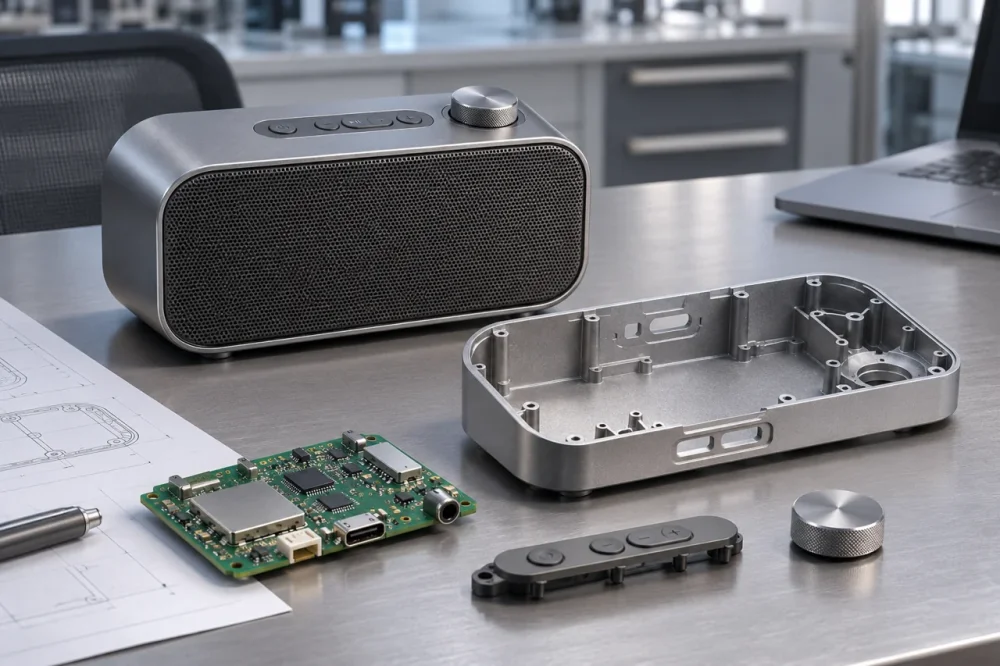
Zinc Components in Consumer Electronics OEM Programs
Coordinate device metalwork with board revisions, grounding, antennas and assembly. Plan representative samples, product testing and production release.
Discuss your requirements
Consumer electronics programs require the metalwork, electronics and assembly process to reach a compatible definition before production release. A zinc case can provide structure and appearance, but it also interacts with grounding, antennas, controls and thermal paths. The component specification should identify those interactions explicitly.
Gairun can review custom metal components within a defined device development project. Provide the current assembly and the requirements allocated to the metal part. This page concerns OEM coordination; product-specific designs are covered in the consumer component sector.
Resolve the next device-release decision
If the board layout is stable but the metalwork is changing, identify connector, antenna and control locations that must remain fixed.
If both are developing, name the revision used for each sample build. This prevents an apparently successful case trial from being approved against obsolete electronics.
Ask for the component proposal to identify its supplied condition and any requested assembly work.
Keep device-level electrical, radio and safety evaluation with the responsible product team. The useful output of the sourcing discussion is a metalwork scope linked to the current device configuration and next approval trial.
Align metalwork with the electronics release
The board outline, connector positions and component heights establish important constraints for the enclosure.
If these are still changing, identify the expected revision points before committing to tooling. A late connector move can require more than a small cosmetic change to the case.
Use consistent reference geometry across mechanical and electrical design files.
The case and board should not use conflicting assumptions about the same mounting interface. Include the relevant tolerances and clearances rather than relying on nominal model overlap alone.
Identify which dimensions are fixed by purchased components.
Displays, switches and connectors may have limited flexibility. The metalwork review should preserve those interfaces while evaluating changes to less constrained geometry.
The development schedule should show when the electronics and mechanical definitions are sufficiently stable for the next stage.
A prototype can support an early decision without justifying full production tooling. The sampling page explains how to match the sample to that decision.

Manage grounding and radio interfaces
A conductive body can participate in grounding or shielding, but the intended path needs a defined design.
Coatings, fasteners and seams can affect continuity. Identify the surfaces and assembly conditions that support the electrical function.
Wireless modules may require clearance from metal or a suitable nonmetallic window.
The electronics team should establish these constraints before the external shape is finalized. A case that looks complete in a mechanical rendering may still impair communication performance.
Do not assign electromagnetic performance to the casting alone.
The complete device, cable arrangement and internal layout influence the result. The product owner should define the applicable test and the configuration to be evaluated.
If a finish changes, review its electrical implications as well as its appearance.
A visually equivalent coating may behave differently at a contact surface. Keep those requirements visible in the drawing and manufacturing instructions.
Define assembly and repair access
The components must be installable in the intended order.
Check access for connectors, fasteners and wiring, including the space needed for tools. A final assembly can appear feasible in a model while being difficult to build without damaging parts.
Define whether the product is serviceable and which items may be replaced.
Battery covers, access panels and repeatedly used fasteners can require different interfaces from a permanently closed body. These decisions affect both tooling and the bill of materials.
Protect insulation and wiring from sharp or moving features.
Edge requirements should be placed where contact can occur, not applied only to the visible exterior. The assembled sample should be evaluated for routing and retention under normal use.
The assembly guidance helps allocate responsibility when several organizations supply components.
State whether Gairun provides a finished shell, a mechanical subassembly or another clearly defined unit.
Test drops, temperature and cosmetic wear
Mechanical handling tests should use the representative complete device where the internal assembly affects the result.
A metal case can survive an event while its electronics or connector supports fail. The acceptance criteria should reflect the product's actual requirements.
Thermal evaluation needs the intended power conditions, interfaces and surrounding environment.
The case material is one part of the heat path. A surface that feels substantial or cool before operation does not establish acceptable temperatures during use.
Cosmetic wear should be assessed separately from structural behavior.
Pocket abrasion, cleaning and repeated handling may affect the selected finish. The coating test guide explains why one test cannot stand in for all exposure conditions.
Regulatory and electrical assessment remains specific to the final product and market.
The component supplier should provide the agreed material and inspection evidence without implying complete-device approval. Keep claims tied to the actual test or conformity basis.
Transfer approved parts into production
Release a controlled set of mechanical drawings, electronics interfaces and assembly instructions.
Identify the approved sample and any accepted deviations. The production order should refer to the same configuration that was evaluated.
Pilot builds can reveal assembly variation, handling damage or inspection gaps.
Record those findings and close them before treating the route as stable. A visually acceptable first sample is not proof that every production handoff is already controlled.
Define the change process for purchased components and finishes.
A replacement connector, adhesive or coating can alter fit or performance. The program needs an owner who determines which checks must be repeated.
For service and repeat production, preserve the relationship between component revisions and the device versions they support.
The project process page describes how this can be managed through order and approval records.
Submit a device component launch brief
Provide the device assembly, metal-part drawings, critical interfaces and expected quantities.
Include grounding, radio, thermal and handling requirements allocated to the component. State the required inspection records and the organization responsible for complete-device qualification.
Identify open design decisions and the next approval milestone.
Send Gairun the electronics component brief so the proposed manufacturing route can be reviewed within the real development program rather than as an isolated enclosure purchase.