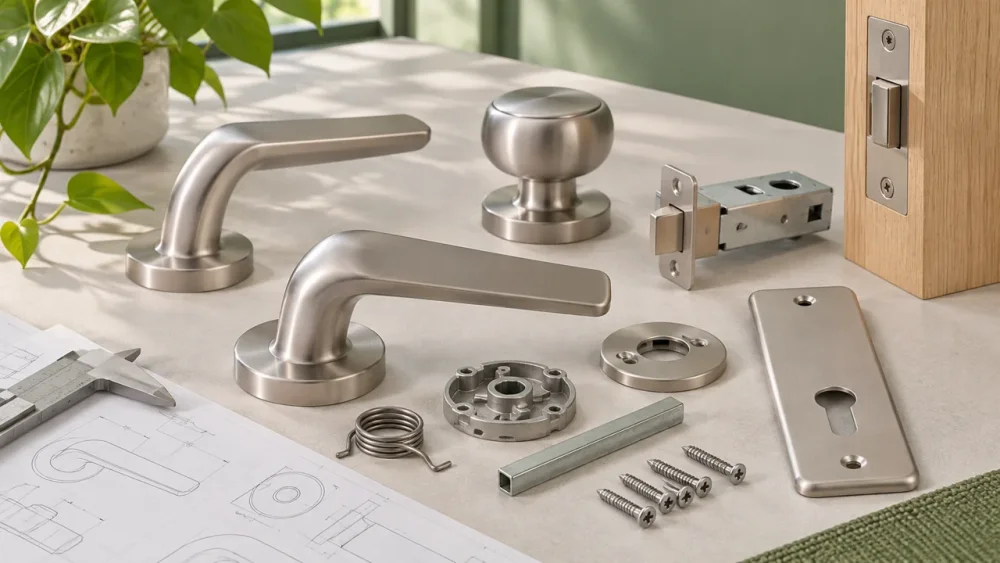
Custom Zamak Door Handles and Door Knob Components
Discuss custom zamak levers, knobs and handle components. Define the metal parts, spindle interfaces, finish and accessories included in your OEM enquiry.
Discuss your requirements
Discuss custom zamak door handles with Gairun for a defined hardware design: a cast lever, knob, rose or backplate. For a complete handle set, identify the spindle, return mechanism, fixings and assembly work separately. This establishes what you are asking the supplier to deliver before tooling or finish choices are priced.
Door hardware brands need both a consistent visible finish and a reliable installed interface. The review therefore starts with the handle design and its mating lock or latch. Zinc door levers and door knob castings require application-specific assessment; fire, security and accessibility claims depend on the relevant complete product.
Compare component supply with a complete handle set
Request separate scope lines for the metal components, purchased mechanisms, finishing and assembly.
A price for a plated lever cannot be compared directly with a price that includes the rose, spindle and fixings. State who supplies each mating part and who approves the assembled operation.
For a collection, identify shared parts across left/right or finish variants.
This makes it easier to discuss common tooling and separate finishing batches without assuming that every variant needs the same production route. Ask for unresolved interfaces to be listed before the quotation becomes an order.
Build around the door assembly
Provide the door thickness range, lock or latch interface and fixing arrangement.
Explain whether the handle is used on a residential, commercial or another door application. Applicable performance and installation requirements should come from the product specification.
Handing and orientation need explicit definition.
A lever that looks symmetrical in a front view may have different left and right assembly details. If a design is intended to be reversible, confirm how that function is achieved and checked.
The handle should be evaluated as part of the opening mechanism.
Operating effort and return behavior depend on springs, spindles and the connected lock or latch. A satisfactory cast shape does not by itself establish satisfactory door operation.

Spindles, roses and fastening
Define the spindle interface using the actual geometry and tolerances.
The fit must transfer the intended motion without unacceptable looseness or binding. Retaining screws, pins or other features also require an agreed location and engagement.
Roses and backplates should locate correctly on the door and provide the intended support.
Their fixing holes, cover arrangements and access for installation can constrain the casting. Review the order in which the installer assembles and tightens the components.
The installed load path matters. A decorative cover may not carry the same forces as the structural mounting element beneath it. Identify those roles so the inspection and material requirements are assigned to the correct components.
Grip geometry and cast sections
The grip should be assessed at its actual size and in normal use.
Clearance between the lever and door, transitions around the fingers and end geometry affect handling. Avoid allowing a visually sharp design detail to create an uncomfortable contact surface.
Section changes near the spindle or a narrow lever neck deserve engineering review.
These areas can see significant bending or torque. Increasing overall mass is not necessarily the best response; geometry and support should be considered first.
Tool parting and preparation marks should be placed with both appearance and touch in mind.
A witness acceptable on a hidden underside may be objectionable on the grip. The tooling review page explains how these requirements influence the die concept.
Finish the installed handle set
A handle set can include several shapes and substrates.
Approve color, gloss and texture on representative components assembled together. Similar finish names do not guarantee that a polished lever and a flat backplate will appear identical under the same light.
Frequent hand contact and cleaning exposure should inform the coating selection.
Identify the intended environment and cleaning instructions relevant to the product. A decorative metallic appearance should not be treated as a general corrosion or wear guarantee.
Protect critical interfaces from uncontrolled coating buildup.
Spindle sockets, threads and mounting faces may have different treatment needs from visible surfaces. Review surface finishing before final dimensions are released.
Cycle, torque and exposure checks
The responsible hardware engineer should define the operating, loading and environmental tests appropriate to the product.
The sample assembly should include the intended spindle, return parts, fixings and mounting conditions. Testing a lever alone cannot answer every installed-system question.
Record changes in movement, looseness, deformation and appearance against agreed criteria.
An initial operation check is useful but does not demonstrate long-term durability. Keep the test scope and the product claim aligned.
Door hardware with fire, security or accessibility requirements needs the relevant product and installation assessment.
Those claims should not be inferred from the casting material. The quality page explains how component evidence differs from product certification.
Prepare a door handle drawing
Provide the grip geometry, spindle details, roses or plates, fastening arrangement and finish reference.
Include left/right variants, order quantities and required validation documents. Identify which surfaces are appearance-critical and which dimensions control operation.
Discuss your door handle supply scope with drawings or a concept and the intended lock interface.
Start by identifying the metal parts and accessories you want included; the next decision is whether the proposed component package is ready for tooling review.