Custom Zinc Lock Housings and Cylinder Casings
Discuss custom zinc lock casings and smart lock covers. Separate housing supply from precision internals, electronics and complete lock qualification.
Discuss your requirements
A custom zinc lock housing enquiry concerns the casing, cover or mounting body around the mechanism. Send Gairun the housing drawing and internal assembly so that locating features, fasteners and finish can be reviewed together. For smart lock casings, include the electronics and service-access envelope.
The purchasing scope should distinguish the zinc cylinder housing from the precision plug, pins and other functional lock internals. These parts may use different materials and suppliers. Security or fire claims belong to the qualified lock system, not automatically to its cast outer body.
Separate the housing order from the lock mechanism
Identify whether the requested deliverable is a raw casting, a finished casing or a casing with selected inserts.
Include keys, cylinders, electronic modules or complete lock assembly only when they are explicitly part of the agreed supply proposal.
For an existing lock platform, mark interfaces that must remain interchangeable across revisions.
A cosmetic redesign may still change wall thickness, screw access or antenna clearance. Approve those effects before releasing a new exterior shape for tooling.
Separate housing from lock internals
Pins, springs, cams, keys and other working elements may need materials and processes different from the housing.
Their wear, accuracy and security functions should remain under the lock engineer's specification. A zinc exterior does not imply that the entire mechanism should be made from zinc.
For cylinder-related work, identify the exact component and its interfaces.
The term cylinder can refer to an assembly rather than a single cast part. Sectional drawings help show the bores, supports and retention features that the housing must provide.
Define the operating sequence and access needed for assembly.
A cavity that fits the final mechanism may still make installation difficult if parts cannot be inserted in the necessary order. Review assembly and service operations before the tool geometry is released.
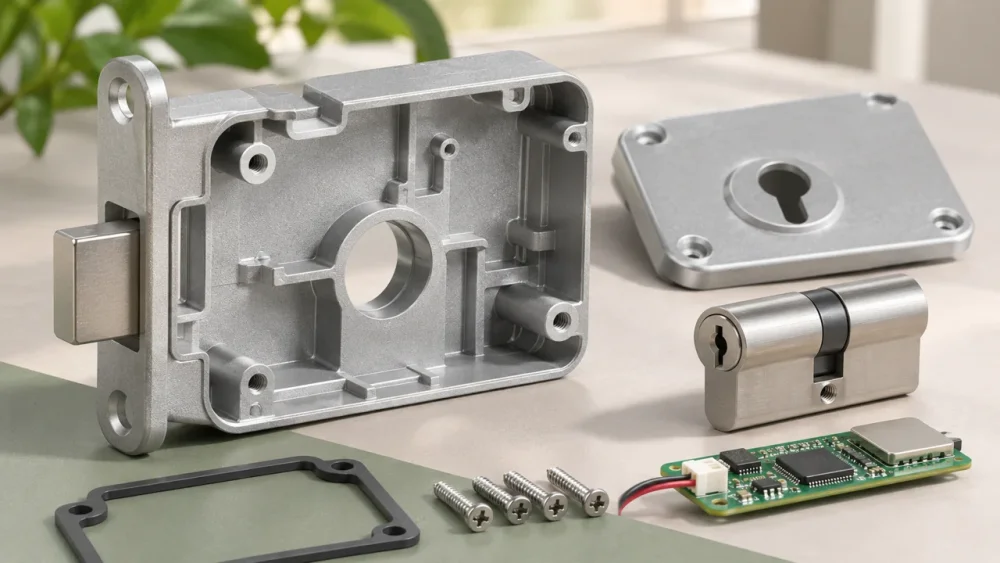
Locate the mechanism and fixings
Functional datums should reflect the way the housing locates the mechanism and mounts to the door or cabinet.
The relative position of bores, fixing holes and moving elements may matter more than the outer dimensions. Give those relationships a measurable definition.
Fastening can distort a housing or introduce local stress.
Specify the screws, engagement and supported surfaces, together with the intended installation conditions. A sample that operates freely before mounting should also be checked in the installed arrangement.
Features requiring machining should be identified early.
Critical bores or thread interfaces need an agreed fixture and inspection route. See secondary machining for the questions that connect the casting to its finished functional features.
Smart-lock electronics and access
Smart-lock housings may package a circuit board, battery compartment, display or wireless module in addition to mechanical elements.
Provide their envelopes and the required separation from moving parts. Electrical insulation and wiring paths need to survive both assembly and normal operation.
Metal near an antenna can affect wireless performance.
The product engineering team should define antenna placement, windows or other design constraints. A metal housing cannot be approved solely from a mechanical fit trial if communication performance depends on its geometry.
Service covers and battery access introduce additional joints and fastening cycles.
Define how often they are expected to be opened and which components provide retention. The intended finish should be evaluated around frequently handled edges and joints.
Wear surfaces and material boundaries
Identify surfaces that experience sliding, rotation or repeated contact.
A housing may need a separate bearing element, insert or different local construction where the service condition demands it. Do not assume that a decorative finish provides the required wear behavior.
Coating must be considered in the clearance calculation.
A dimension that works on an unfinished sample may bind after plating or coloring. Mark the finished condition and any masked or controlled surfaces on the drawing.
Different metals, lubricants and environmental exposure can also affect the assembly.
The material review should include the actual contact pair and use conditions. A generic alloy description is not a complete functional specification.
Housing inspection and full-lock testing
Component inspection should verify the dimensions and surface requirements allocated to the housing.
Functional trials should then evaluate the intended mechanism in that housing. These checks answer related but different questions.
Security, fire, durability and environmental claims belong to the applicable tested lock construction.
The presence of a suitable cast body does not confer those approvals. Identify any required standard and the organization responsible for evaluating the complete product.
If the housing changes after qualification, review whether the change affects alignment, access, strength or sealing.
The quality guidance helps define the evidence needed before accepting a revised part.
Define the lock housing enquiry
Provide the component and assembly drawings, mating parts, material requirements and finish references.
Include expected demand, critical characteristics and the required approval documents. State which design changes can be considered during manufacture review.
Request a lock housing manufacturing review with the component boundary and critical mating features marked.
Use the resulting scope discussion to establish the casing operations and the assembly checks needed for your lock platform.
