Custom Zinc Alloy Charms for Branded Collections
Discuss custom zinc alloy charms and logo pendants. Specify loose pieces or assembled attachments, then define detail, finish and collection variants.
Discuss your requirements
Custom zinc alloy charms can serve as bag ornaments, collectible attachments or branded metal pendants. Gairun can review the design with its actual hanging point and any requested ring or clasp. Specify whether you need a loose charm or an attached accessory so the proposal covers the intended item.
For small die cast logo charms, readable detail and a reliable eyelet matter as much as the outer silhouette. A jewelry use, a zipper attachment and a decorative gift can involve different contact and durability requirements. Identify the use before selecting the finish and test scope.
Order a charm series without mixing the assemblies
List each shape, finish and connector combination.
A shared logo can appear on several charms while the eyelet orientation or ring size changes. Keep those details in the variant record so assembly and packing do not rely on visual similarity.
If the charm attaches to a product supplied elsewhere, provide that mating component.
Request sample checks for both attachment and orientation. A correctly made charm can still hang backwards or interfere with a closure when its connection has not been reviewed.
Define where the charm will hang
The supporting object determines how the charm moves and what it contacts.
A bag charm may strike other hardware, while a garment charm may rub against fabric or skin. Those conditions should inform the shape and finish rather than being considered only after the artwork is approved.
Identify the intended user group and destination market.
A decorative accessory for adults and a component of a children's product may require different assessment. The description used in marketing does not alone determine the applicable safety obligations.
Consider whether the charm must remain in a particular orientation.
A single ring may allow it to turn, while another connection may hold the face more predictably. The artwork should remain useful in the way the item actually hangs.
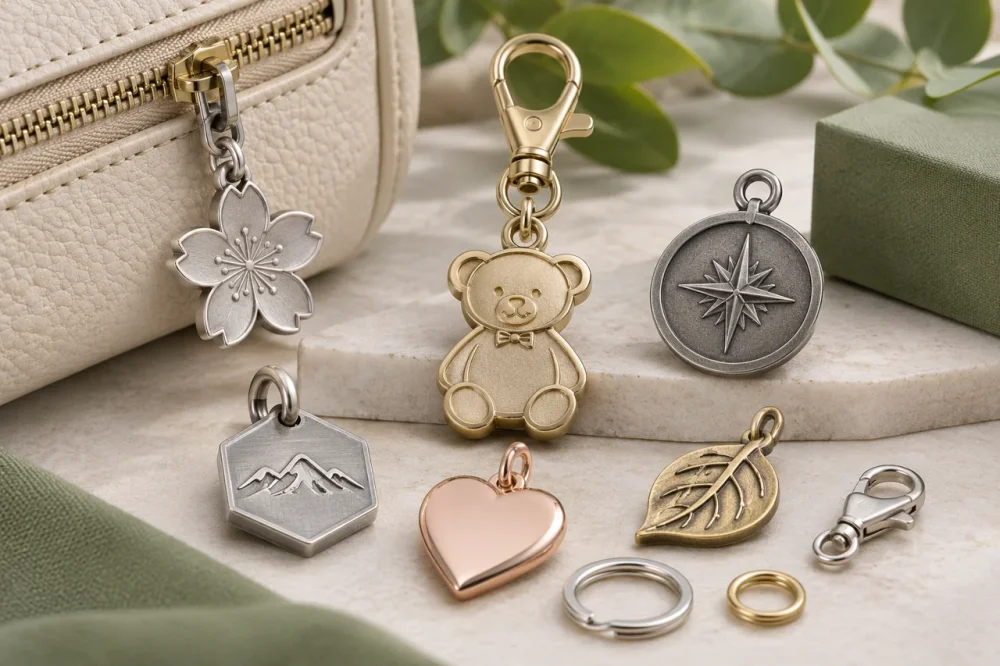
Small detail and readable identity
At a small scale, silhouette and a few well-chosen details often communicate more clearly than dense text.
Identify the essential brand or character features. Remove or adapt details that cannot be reproduced meaningfully at the intended size.
Raised and recessed surfaces can create contrast without adding many colors.
If color filling is required, the metal boundaries must provide practical separation. Printing may be more suitable for certain fine graphics, subject to the available surface.
For sculpted forms, review the complete geometry from several directions.
Deep undercuts or fine projections can make a one-piece casting impractical. The tooling guidance helps connect the visual concept with a feasible forming route.
Eyelets and connection geometry
The eyelet or attachment hole carries loads introduced by pulling and movement.
Its edge distance, surrounding section and orientation should suit the intended connection. A decorative outline should not leave the attachment supported by an unnecessarily narrow bridge.
Specify the ring, cord, chain or other mating element.
Hole size alone does not establish whether the assembly moves freely or remains secure. A split ring and a closed link can require different clearances and assembly methods.
Check edges where metal contacts soft materials.
Roughness or burrs can damage a cord or fabric over time. The final inspection should include these functional contact areas, even when they are small or partly hidden.
Contact materials and finish
Define likely exposure to skin, perspiration, cosmetics or cleaning products.
The coating and substrate need to be evaluated for the actual use. A common metallic color is not evidence that a finish is appropriate for every wearable application.
If testing is required, the sample should represent the complete material and finish system.
A report for uncoated metal may not address the finished charm. Likewise, a coating report from another product may not establish the current construction's compliance.
Appearance approval should cover color, gloss and the treatment of relief.
Small curved surfaces reflect light differently from flat swatches. Use representative samples to establish the intended result, as discussed in surface finishing.
Assembly and handling checks
Evaluate the charm with its actual attachment and supporting product.
Check retention, freedom of movement and contact with neighboring surfaces. A loose component inspection cannot reveal every issue that appears in the final accessory.
Where the design includes separate inserts, stones or other decorative pieces, define their retention and relevant tests.
Those additions change the bill of materials and potential failure modes. They should not be treated as incidental embellishment outside the approval scope.
Packing should keep small components identifiable and prevent abrasion.
Mixed designs or colors need a clear sorting and labeling method. If the customer will assemble them later, agree how the loose parts are protected and counted.
Order a controlled charm collection
Send the artwork or model, dimensions, attachment specification and intended use.
Include finish references, quantities by version, packaging and required test records. State which details may be adjusted during the manufacturing review.
Discuss your charm collection with sizes, artwork and the intended hanging arrangement.
Define whether the quote covers loose metal pieces or finished attachments, then approve the corresponding sample.
