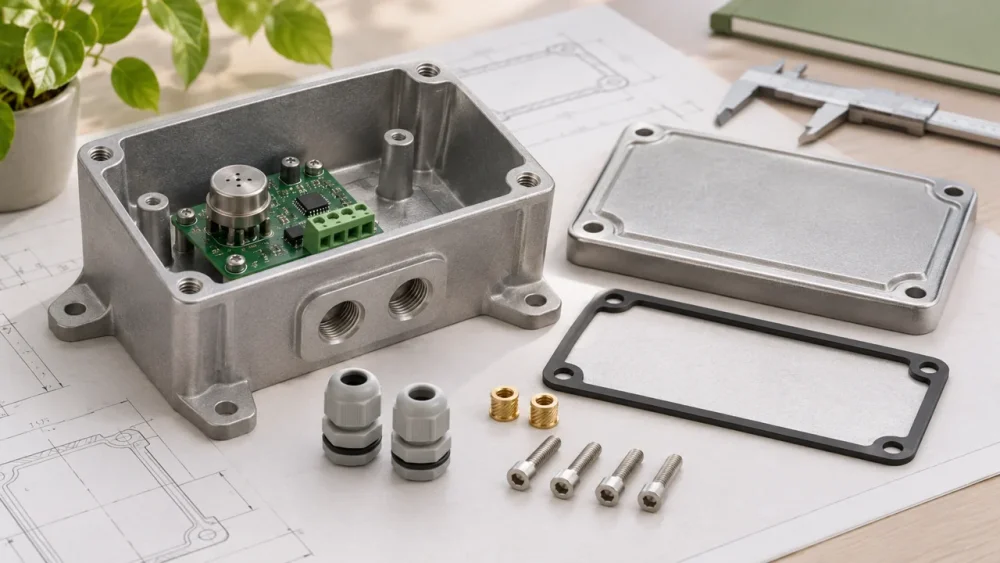
Custom Zinc Die Cast Housings and Instrument Enclosures
Discuss custom zinc die cast housings for sensors and instruments. Define bodies, covers, machining, finishes and the supplied assembly condition.
Discuss your requirements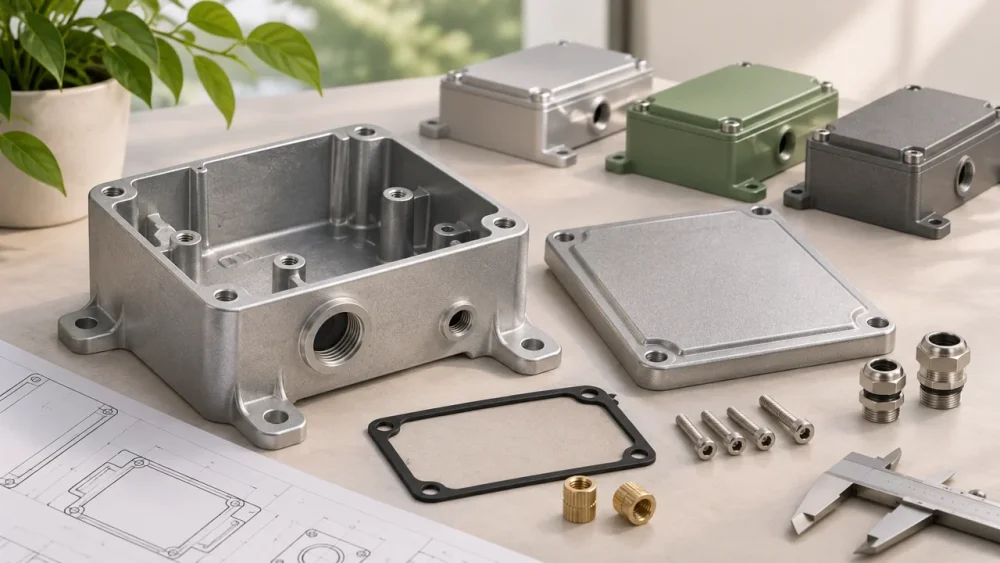
Discuss custom zinc die cast housings with Gairun for a defined sensor, instrument or electronic assembly. Identify the body, cover, mounting features and required supplied condition: casting only, finished metalwork or an agreed subassembly. This gives the quotation a clearer basis than an exterior model alone.
A zinc sensor housing or instrument enclosure must fit its internal components and provide the intended mounting, sealing and service access. Cast mounting bosses, threaded features and contact surfaces need to be reviewed with the complete assembly. Any environmental or electrical performance claim requires the relevant product evidence.
Specify what arrives at your assembly line
List the body and cover as separate parts where appropriate, then identify machining, coating, inserts and fasteners.
State whether gaskets come from your supplier or are requested within the quotation. A housing price is only comparable when those boundaries match.
For a replacement source, provide a controlled drawing and an approved sample, noting any differences between them.
Highlight the fit or cosmetic issues you want the new route to resolve rather than asking only for a copy of the outside shape.
Begin with the assembly envelope
Define the space available for the complete housing, including mounting screws, cable exits and service access.
The exterior dimensions alone do not show whether the internal assembly can be inserted or removed. An installation model can reveal interference that is difficult to identify from a single part drawing.
Inside the housing, locate the circuit board, sensor, optics or mechanism relative to meaningful reference surfaces.
Identify clearance zones and areas where contact is prohibited. Consider the final coating and the tolerance variation of both the casting and the installed components.
Decide whether the design requires one casting, a body and cover, or a cast section combined with another material.
A plastic window may be needed for a display or wireless function. A separate cover may improve access but introduces a joint that must be fastened and, where necessary, sealed.
Split lines and access
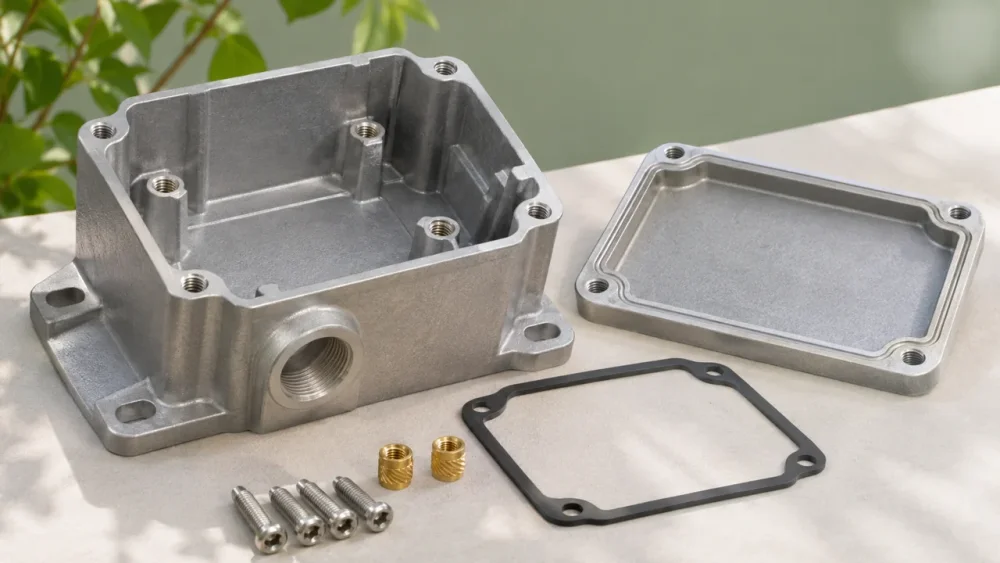
The parting line follows the way the tool opens.
Its location affects visible surfaces, trimming and the placement of features. Put cosmetic expectations on the drawing so the tool review can consider whether a line or witness mark is acceptable in the proposed location.
Internal undercuts and side openings may need moving cores or later machining.
Each option changes the tool, production route and inspection requirements. A small geometry change can sometimes remove a complicated feature without changing the function of the assembly.
Service access is a separate design question.
Screws should be reachable, connectors should be installable and the cover should open without damaging adjacent parts. Reviewing the intended assembly sequence before tooling helps avoid a housing that is manufacturable but inconvenient to use.
Fasteners, bosses and reference surfaces
Bosses need enough support for the selected fastening method.
Their position and surrounding wall transitions influence both casting behavior and the loads introduced during assembly. Avoid specifying an installation torque without considering the thread construction and engaged material.
Tapped holes, inserts and other fastening approaches have different tradeoffs.
An insert may improve serviceability in a repeatedly opened assembly, but it adds retention and assembly requirements. A directly formed or machined feature should be assessed against the actual fastening duty.
Choose datums that match the function of the housing.
If a sensor must align with an external opening, the drawing should relate those features directly. Measuring unrelated overall dimensions will not establish the alignment that matters in use.
Sealing is a system requirement
A sealed enclosure depends on the gasket, groove, mating surfaces, fastener spacing and assembly method.
The housing must support the intended seal compression without unacceptable distortion. Surface damage, coating buildup or a poorly controlled joint can compromise the assembled result.
State the environment and the required enclosure test.
Water exposure, dust exposure and immersion are different conditions. An ingress rating should be established for the final assembly under the applicable test, not assigned to an unfinished casting.
If the housing contains pressurized media, treat that as a separate engineering task.
Porosity, machining exposure, pressure cycling and fluid compatibility may become decisive. The industrial component overview distinguishes ordinary housings from pressure-containing bodies.
Electrical and thermal interfaces
A conductive metal enclosure may contribute to shielding or grounding, but continuity across joints and contact areas must be designed.
Coatings can interrupt a conductive path. Define any masked surfaces, contact points and assembly conditions needed for the electrical function.
Thermal interfaces need similar specificity.
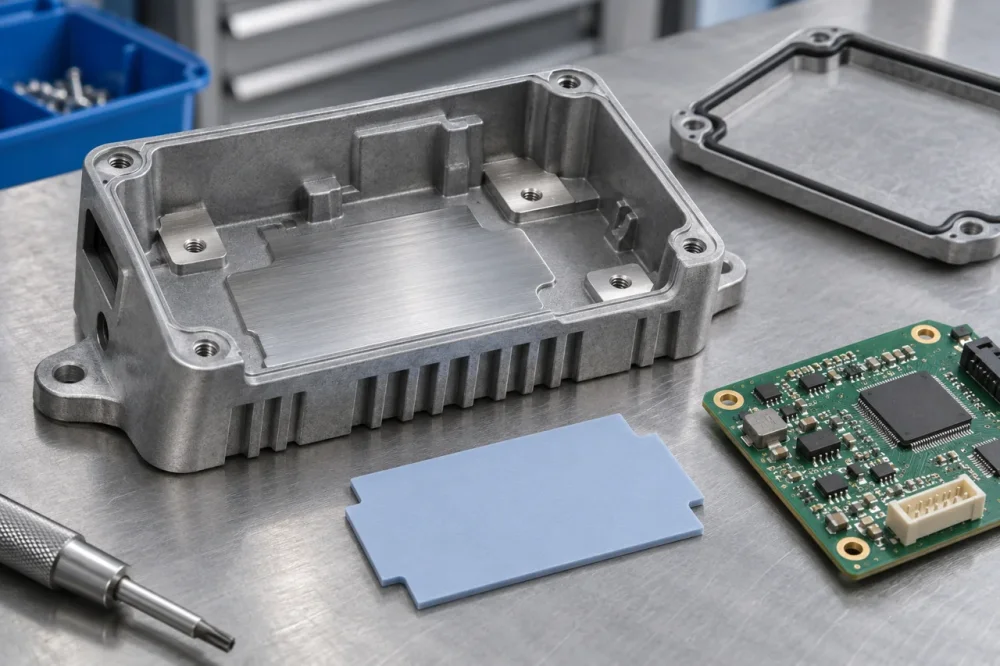
Identify heat sources, contact areas, interface materials and the allowable temperatures. A housing can participate in spreading heat without being an adequate heat sink for every operating condition.
Wireless devices may need an antenna arrangement that avoids unwanted attenuation by the metal body.
Review that issue with the electronics team before finalizing the outer form. Mechanical convenience should not prevent the complete product from meeting its communication requirements.
Finish without losing fit
Define which faces are visible after assembly and which must retain a controlled dimension.
Polishing and coating can affect edges, holes and mating surfaces. Critical fits should be evaluated in the condition in which the part will actually be assembled.
A finish reference should cover color, texture and acceptable surface indications.
It should also identify areas where a cosmetic requirement is unnecessary. This separation makes inspection more objective and avoids applying expensive appearance controls to hidden internal surfaces.
Review surface finishing early enough to account for masking, racking and handling.
Protective packing should prevent contact damage on the faces used for sealing, appearance or electrical connection.
Sample validation and drawing release
Use the first samples to verify the drawing and the assembly together.
Check critical dimensions, fit with mating parts, fastener behavior and any required sealing or thermal performance. Record the sample revision and finish so the result can be traced to a defined construction.
If a design changes after sampling, identify which checks must be repeated.
Moving a boss can affect alignment; changing a coating can affect fit; revising a gasket can change sealing behavior. Approval should apply to the actual released configuration.
Request a housing manufacturing proposal with the assembly envelope and supplied-condition requirements.
Ask the review to identify critical interfaces and the sample evidence needed before your line accepts the new housing.