
For real estate professionals, the most effective closing gifts are usually the ones clients actually keep and use. That is why key tags can be such a practical fit for the homeownership moment. A house-shaped key tag connects directly to the keys a buyer receives, adds a tangible reminder of the milestone, and gives agents a subtle way to stay memorable long after move-in day. From our manufacturing perspective, the strongest results usually come from designs that feel useful first and branded second, so the tag remains part of daily life instead of becoming another disposable promo item.
If your client gifting plan depends on everyday usefulness, durable finish choices, and easy customization, custom key tag manufacturing support can help you turn a simple house-shaped idea into a more polished closing tool. We typically help buyers compare materials, engraving or printing options, attachment hardware, packaging details, and variable data such as names or move-in dates so the final tag works for single-office gifting, team-wide branding, or larger real estate welcome programs.
What house-shaped key tags are and why they work in real estate marketing
House-shaped key tags are keychain tags cut in a recognizable home silhouette and customized with branding, personal details, or a short welcome message. In real estate marketing, that shape matters because it instantly matches the emotional context of the transaction. The client is not receiving a random branded object. They are receiving something visually tied to the purchase they just made.
That makes these tags more effective than many generic giveaways. A pen, mug, or notepad may still have value, but a house-shaped key tag feels more specific to the moment of ownership. It can be attached to front door keys, mailbox keys, garage remotes, or spare sets for family members. When the item enters everyday use, brand recall lasts longer.
For buyers comparing options, shape also creates a stronger design advantage. With custom shape branding options, agents can choose a classic roofline, a more modern house outline, or a simplified shape that leaves enough room for contact details without overcrowding the surface. In our production work, this balance between visual identity and readability is one of the main factors that separates a thoughtful gift from a novelty item.
Why key tags are especially meaningful at the homeownership milestone
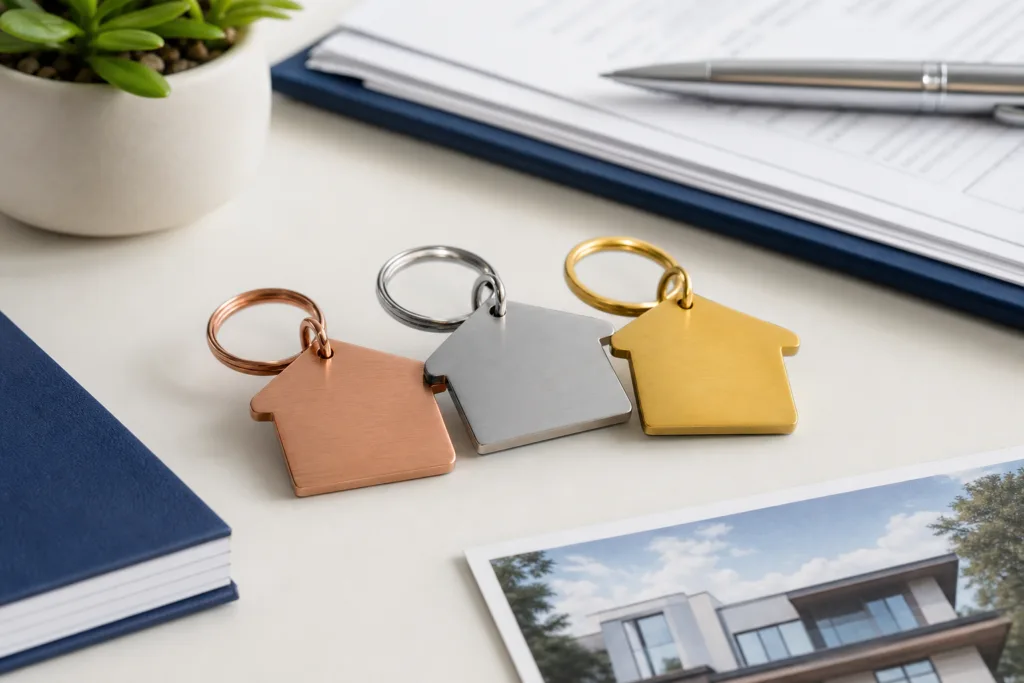
Homeownership is one of the few life events where a symbolic object can also be immediately practical. The handoff of keys is already part of the closing story. A key tag builds on that moment without feeling forced.
New homeowners are often juggling locks, garage access, mail access, utility setup, storage areas, and duplicate keys for partners or family members. A labeled or personalized tag helps organize that transition. If it includes the buyer name, move-in date, or a small neighborhood reference, it also becomes a keepsake tied to the first days in the new home.
For real estate teams, this is where emotional value and utility meet. The gift does not need to be expensive to feel intentional. It only needs to be well designed, durable enough for everyday carry, and packaged in a way that feels considered.
How personalized key tags improve the closing experience for new homeowners
Personalization changes the tag from branded merchandise into a client-specific gift. Even simple details can make a difference: first names, a closing date, a short “Welcome Home” line, or a development or neighborhood name. These touches signal that the gift was prepared for the recipient rather than pulled from a generic event box.
In practical terms, personalization can also improve usability. A family that receives multiple sets of keys may benefit from labels such as “Front Door,” “Garage,” or “Spare.” For clients with vacation homes, rental properties, or multi-unit purchases, custom identification becomes even more useful.
We often find that durable personalization methods matter more than buyers first expect. engraved key tag personalization is especially useful when the design needs to stay legible despite handling, pocket abrasion, and long-term use. Compared with purely surface-level decoration, an engraved approach usually gives buyers more confidence that names, dates, and contact details will remain readable over time.
Branding opportunities without making the gift feel like an ad
Many agents like the concept of branded key tags but worry about overbranding. That concern is justified. If the logo dominates the tag and the homeowner’s experience feels secondary, the item can lose its gift-like quality.
A better approach is to organize information by priority. The first priority is use. The second is personalization or message. The third is agent branding. On a small tag, that often means placing the house shape and welcome message on the front and reserving the back for a modest logo, brokerage name, website, or phone number.
Color also shapes perception. Real estate teams often default to loud brand colors, but many homeowner gifts work better with more restrained combinations: brushed silver and black, matte black and white, gold-tone brass with dark text, or anodized aluminum colors that support the brand without overpowering the design. The goal is recognizability, not visual noise.
Messaging should stay short. A line such as “Welcome Home,” “Home Sweet Home,” or “Keys to a New Beginning” is usually enough. If contact details are included, keep them clean and selective. A website or phone number may be sufficient; trying to fit every social handle on a small tag often hurts the design.
Design tips for a memorable and useful key tags campaign
When agents plan key tags for a closing program, we suggest starting with function before artwork. Ask what the client will do with the tag every day. Will it hold one house key, a full keyring, or a remote fob? Will the homeowner want a polished keepsake look or a more casual everyday accessory? Will the tag be part of a premium box, a simple welcome envelope, or an open-house handout?
Those answers influence material thickness, hole size, edge finish, attachment hardware, and marking method. They also help determine whether a campaign needs simple repeat branding or variable data for individual names and dates. At UC Tag, we see better long-term outcomes when design decisions are tied to real use rather than only to a digital mockup.
Here are a few practical design guidelines:
- Keep the outline simple. A clean house silhouette usually wears better than a highly detailed shape with thin corners.
- Protect readability. Leave enough flat area for names, dates, or contact information.
- Choose a comfortable size. Oversized tags can feel awkward on daily keyrings.
- Avoid overly sharp points. Rounded roof corners and smooth edges improve handling.
- Limit the message. One short phrase is usually more elegant than several lines of copy.
Material, finish, and durability considerations for everyday use
Because key tags spend time in pockets, bags, car consoles, and on countertops, durability deserves more attention than many promotional products receive. The right material depends on the look you want, the expected wear level, and the budget per gift.
| Material | Typical Advantage | Best Fit for Real Estate Use | Things to Watch |
|---|---|---|---|
| Aluminum | Lightweight and easy to color-finish | Modern branded gifts, larger team programs | Surface scratching depends on finish and marking method |
| Stainless steel | Strong, durable, premium feel | Higher-end closings, long-term daily use | Usually higher cost and heavier feel |
| Brass | Warm, classic appearance | Boutique agencies, heritage-style branding | Color tone may change naturally with handling unless protected |
| Acrylic or plastic-based options | Color flexibility and lower unit cost | Large-volume campaigns, open houses, community promotions | Need careful review for edge quality, impact resistance, and print durability |
For plastic or acrylic designs, it is smart to think beyond color and initial appearance. Buyers planning larger campaigns should ask about durable materials, impact resistance, and product quality, especially if the tag will be handed out broadly and used daily. ASTM maintains a broad framework around durable materials, impact resistance, and product quality that helps illustrate why material selection should not be treated as a purely cosmetic decision.
Metal options often create the best balance when the goal is a closing gift rather than a low-cost giveaway. Anodized aluminum can offer color variety with a lighter feel. Stainless steel gives a clean, durable look. Brass can create a more traditional, giftable appearance. Finish selection matters just as much as base material because edge smoothness, brushed texture, gloss level, and contrast all affect how premium the final tag feels in the hand.
Best shapes, sizes, and attachment options for homeowner key tags
The classic house silhouette remains the easiest choice because it is instantly understood and leaves room for branding. But even within that concept, agents can make smart adjustments.
Shape
A simple peaked-roof house shape works best for most campaigns. If you want to reference luxury homes, condos, or modern properties, a more minimal geometric outline may suit the brand better. Avoid shapes with narrow chimneys, tiny cutouts, or fragile corners that may bend or snag.
Size
For everyday use, the tag should be easy to hold without becoming bulky. A very small tag limits readability, while an oversized one can feel awkward on a keyring. Most clients prefer a middle-ground format that leaves space for a short message on one side and branding or personalization on the other.
Attachment method
The attachment choice changes the user experience more than many buyers expect. Split rings are common and familiar. Lobster clasps can feel a little more gift-oriented and make it easier to attach to bags or zipper pulls. If the key tag is paired with a welcome set, you can also consider a ring plus a short chain or decorative connector, but keep daily use in mind. Complicated hardware may look premium in a box yet become inconvenient later.
Hole placement is another practical detail. A centered top hole usually looks balanced on a house-shaped tag. Side holes or corner holes may work for creative designs, but they can make the tag hang unevenly. In production, this should be reviewed in sample form before approval.
How to balance branding with a premium, gift-like feel
A homeowner gift should feel like part of the closing experience, not like a giveaway that happened to be handed over at closing. The easiest way to preserve that feeling is to reduce visible sales language.

Instead of placing a slogan, full office address, multiple numbers, and social icons on the tag, think in layers:
- Front: house shape, short welcome phrase, or homeowner personalization
- Back: subtle logo and one clean contact point
- Packaging: thank-you card, care note, or referral reminder if appropriate
This structure keeps the object itself elegant while still giving the brand a place in the overall presentation. Packaging often does the heavy lifting. A small card or pouch can explain the sentiment, reinforce the relationship, and create room for a handwritten note without cluttering the tag.
Ideas for personalization that feel thoughtful instead of generic
The strongest personalization is usually simple and relevant. Real estate professionals do not need to create highly complex variable data programs to make the gift feel personal.
Useful personalization ideas include:
- Homeowner first names or family name
- Move-in or closing date
- Street name or neighborhood name
- Short welcome line
- Property nickname for vacation homes or rentals
- Separate tags for main key and spare key
When campaigns involve recurring office branding across many closings, personalization can still be controlled through a template. The key is to confirm data formatting early. For example, decide whether dates will be written numerically or in words, whether surnames include apostrophes, and whether neighborhood names will use abbreviations. These small file-prep decisions improve consistency during production.
How real estate agents can use key tags in closing gifts and welcome packages
House-shaped key tags work best when they are not isolated from the larger client experience. They fit naturally into a closing box, moving-day envelope, utility setup packet, or neighborhood welcome package. Because they are compact, they pair well with practical supporting items such as a handwritten note, local service recommendations, spare key envelopes, or a small home maintenance checklist.
For agents building a repeatable gifting system, it often helps to think in campaign terms rather than one-off orders. That is where custom metal tag solutions for campaigns become useful: one core design can be maintained across many closings while selected elements such as names, dates, or community names change from client to client. This approach supports consistency without making each gift feel identical.
There are also different use tiers. A solo agent may reserve personalized metal tags for signed buyers at closing. A larger brokerage may use premium versions for closings and simpler versions for open houses or relocation events. The shape remains recognizable, but materials and finishes can be adjusted by campaign level.
How key tags support referral generation and long-term client recall
Referral value rarely comes from the object alone. It comes from the relationship the object helps reinforce. A practical key tag can support that relationship because it stays visible in daily life and remains linked to a positive milestone. But it works best when paired with thoughtful communication after the sale.
That is why many agents include the key tag as one element in a broader client retention system. The National Association of Realtors has highlighted the importance of post-closing follow-up, repeat business, and referral generation, which aligns with what many buyers already know from experience: consistent, useful touchpoints are more memorable than one-time promotional gestures.
In practice, a key tag can support brand recall in three ways. First, it is tied to a daily-use object. Second, it marks an emotional event. Third, it can reopen conversation when friends or family notice it and ask about the move, the new home, or the agent behind the gift. None of this guarantees referrals, but it creates more natural memory triggers than many generic branded items.
Ways to use house-shaped key tags beyond closing day
Although closing gifts are the most obvious use case, house-shaped key tags can also support other parts of the client journey.
- Open houses: offer a limited, lower-cost version as a branded takeaway tied to a neighborhood launch.
- Buyer onboarding kits: include a welcome tag when a client signs an agreement, especially for premium service packages.
- Post-closing anniversaries: mail a replacement or upgraded tag on the first home anniversary.
- Referral thank-you gifts: send a refined version as part of a thank-you package after a successful referral.
- Team events or local partnerships: pair with mortgage, insurance, or home-service welcome materials when branding is coordinated carefully.
These secondary uses work best when visual consistency is maintained. The shape, color system, and message style should feel related even if the finish level changes by campaign type.
Common design mistakes that reduce usefulness or brand impact
Several common mistakes can make a good concept underperform:
- Overcrowded layouts: too much text reduces readability.
- Weak contrast: pale text on reflective surfaces often looks elegant in artwork but poor in real use.
- Sharp or fragile outlines: intricate shapes may catch on pockets or wear quickly.
- Brand-first hierarchy: oversized logos make the item feel promotional instead of personal.
- Ignoring hardware quality: a strong tag paired with a weak ring or clasp reduces the overall impression.
- Skipping sample review: digital proofs do not fully show edge finish, weight, or how the piece hangs on a ring.
Another frequent issue is designing without allowance for manufacturing tolerances. Text placed too close to the edge, very small fonts, or decorative details around the attachment hole may not reproduce as cleanly as expected. Early review of practical specs helps avoid those compromises.
How to source and order key tags in bulk for a consistent client experience
Bulk ordering is not only about price. For real estate gifting, consistency matters just as much. Buyers should evaluate whether the supplier can maintain shape accuracy, hole placement, finish consistency, and variable data quality across repeat runs.
Before placing a larger order, ask clear questions about material options, marking method, attachment hardware, packaging, MOQ, and replenishment capability. If names or dates are included, confirm how data files should be submitted and how variable content will be proofed. This becomes especially important when a team wants to reorder the same design throughout the year.
To reduce surprises, we usually recommend reviewing standard samples for review and approval before final production, especially when the buyer is choosing between engraved, printed, or mixed-finish approaches. Samples make it easier to judge real-world size, edge quality, weight, color contrast, and hardware feel in ways that flat artwork cannot.
Packaging should also be discussed upfront. A bulk-packed shipment may suit office inventory, while individually bagged or card-mounted tags may be better for organized closing kits. If private labeling or team packaging is part of the plan, that should be integrated before production rather than added later as an afterthought.
Checklist for planning a branded key tag campaign for new homeowners
For agents and brokerages building a repeatable homeowner gift program, this planning checklist can help:
- Define the main use case: closing gift, onboarding item, open-house giveaway, or referral thank-you
- Choose a house shape that supports both brand identity and readability
- Select a material based on budget, weight, and expected daily wear
- Decide on personalization level: none, names only, dates, or variable messages
- Keep the front message short and useful
- Limit back-side branding to essential details
- Review hole placement and attachment hardware carefully
- Request samples or sample-equivalent review before bulk production
- Plan packaging that supports a gift-like presentation
- Set a reorder process so the design remains consistent across future closings
Conclusion
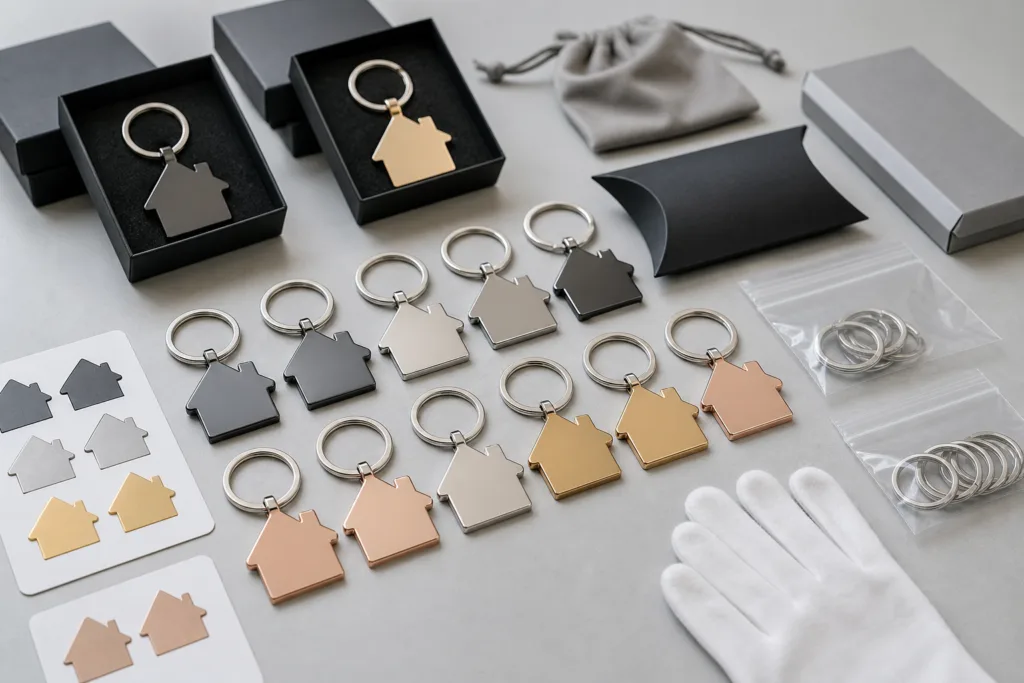
House-shaped key tags work well for real estate marketing because they sit at the intersection of practicality, symbolism, and brand memory. For the homeownership milestone, they feel relevant in a way many generic gifts do not. The best results come from keeping the design clean, the branding restrained, and the material and marking choices aligned with everyday use.
From our manufacturing perspective, key tags become more effective when buyers think beyond the artwork and plan the full experience: size, finish, readability, hardware, personalization, packaging, and repeat ordering. When those details are handled well, a simple house-shaped tag can support a more polished closing experience, stronger recall, and a client gift program that feels thoughtful rather than routine.
FAQs
Are house-shaped key tags a good closing gift for new homeowners?
Yes. They are useful, easy to personalize, and directly connected to the key handoff that defines the homeownership milestone. That relevance makes them feel more intentional than many generic branded gifts, especially when the design prioritizes usability and a modest amount of branding.
What information should real estate agents put on a branded key tag?
The most effective layouts keep information limited. A short welcome message, buyer name, or move-in date on one side and a small logo or one clean contact detail on the other usually works better than trying to include full marketing copy, multiple phone numbers, and social media handles.
Which material is best for everyday key tags?
The best material depends on the campaign goal. Metal options such as aluminum, stainless steel, or brass usually create a more premium and durable closing gift, while acrylic or plastic-based options may suit higher-volume promotions. The right choice should consider wear, weight, finish, readability, and the impression you want the homeowner to have.
Should key tags be engraved or printed?
Engraving is often the safer choice when names, dates, or contact details need to remain legible with regular handling. Printing can offer more color flexibility, but it should be evaluated carefully for contrast and wear. Many buyers compare both methods in sample form before deciding on the final campaign version.
How can agents keep branded key tags from looking too promotional?
Keep the branding secondary to the homeowner experience. Use a clean house shape, a short message, restrained colors, and subtle logo placement. If more brand storytelling is needed, place it in the packaging or insert card instead of crowding the tag surface itself.
What should buyers check before ordering key tags in bulk?
Review material, finish, thickness, edge quality, attachment hardware, variable data handling, packaging, MOQ, lead time, and sample approval steps. It is also important to confirm how repeat orders will be managed so future closings receive the same look and quality as the first batch.