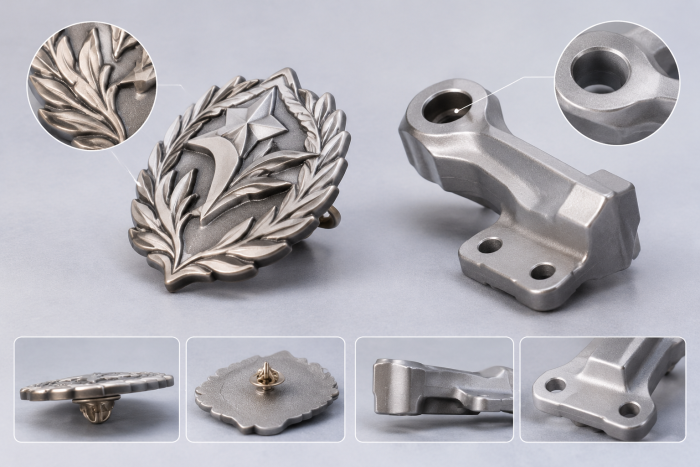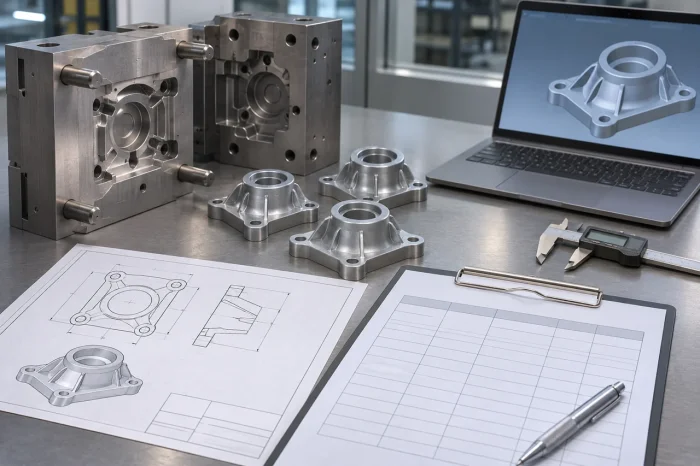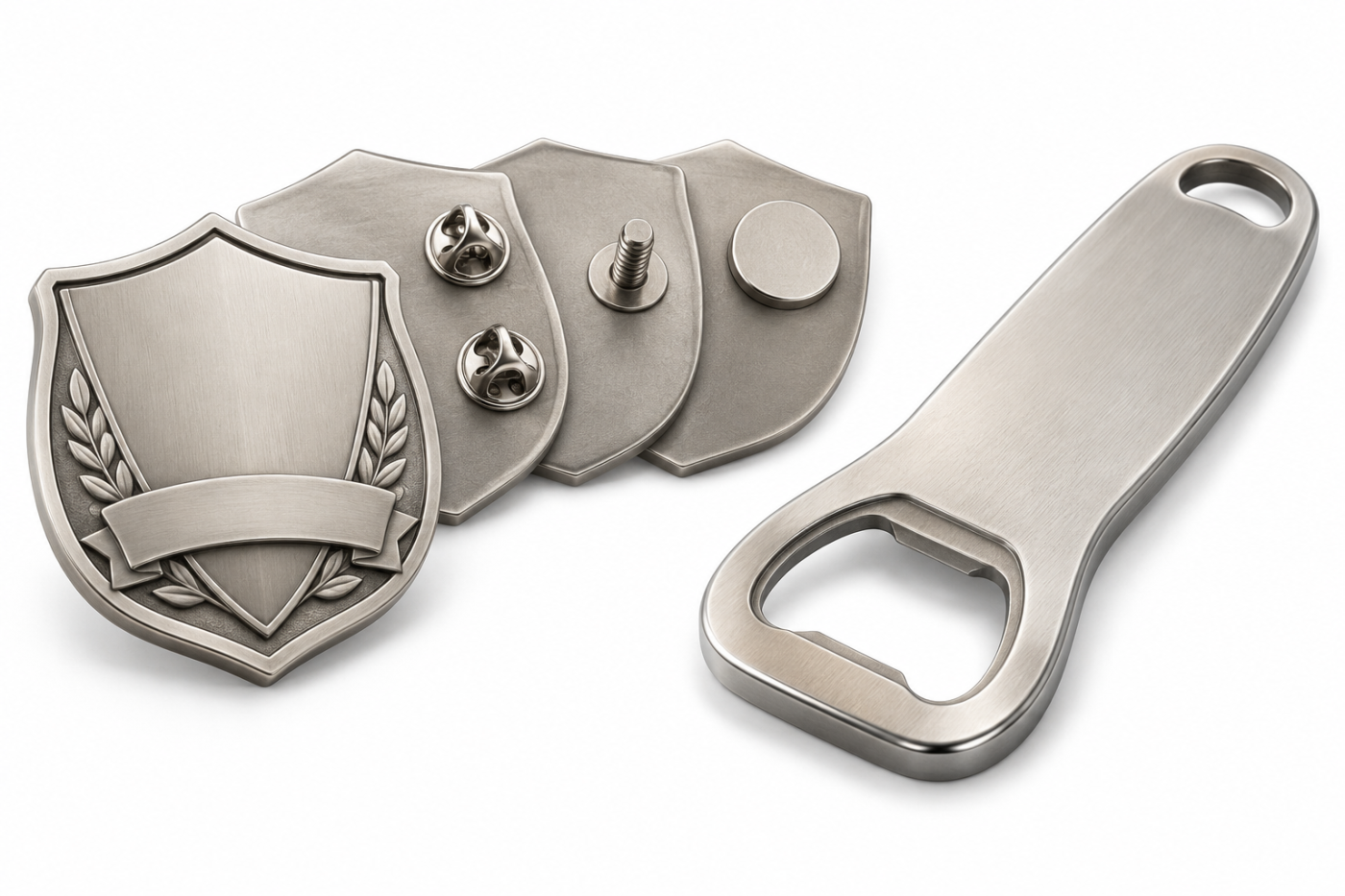
A promotional product supplier onboarding checklist should qualify a factory through separate evidence checkpoints, not one general impression. Begin by confirming product fit, artwork control, engineering communication, sample decisions, quality records, packaging, and export responsibilities. Then approve the supplier only for the product families and processes supported by current evidence. About Gairun and the Factory provides company context, but identity alone does not prove fit for a particular order. Every award, badge, opener, coin, or trophy still needs its own technical and commercial confirmation.
Use a Promotional Product Supplier Onboarding Checklist to Verify Product and Process Fit
Before requesting a quotation, record the product type, intended use, artwork complexity, material preference, finish, attachment, packaging, destination, and repeat-order needs. This first brief lets the supplier identify missing decisions. It also prevents a broad claim about custom metal production from replacing evidence for the actual format.
Assess the supplier against relevant product families, such as medals, challenge coins, lapel pins and badges, trophies and plaques, keychains, and bottle openers. Gairun is a Shenzhen-based OEM and ODM manufacturer focused on these custom metal awards and promotional products. Its listed base metals include zinc alloy, brass, iron, stainless steel, and aluminum. Buyers should still ask which material and forming route suit their geometry, relief, decoration, attachment, and intended use. The list is not a universal ranking of cost, strength, corrosion behavior, or sustainability.
Gairun's current first-party factory description identifies connected areas for tooling, stamping and hydraulic pressing, zinc-alloy die-casting, polishing, enamel and epoxy work, quality control, assembly, packing, and storage. During custom metal factory onboarding, confirm which operations apply to the order and whether any applicable work is subcontracted. A distributor can use the Factory Workflow and Supplier Review page as a starting point for those questions.
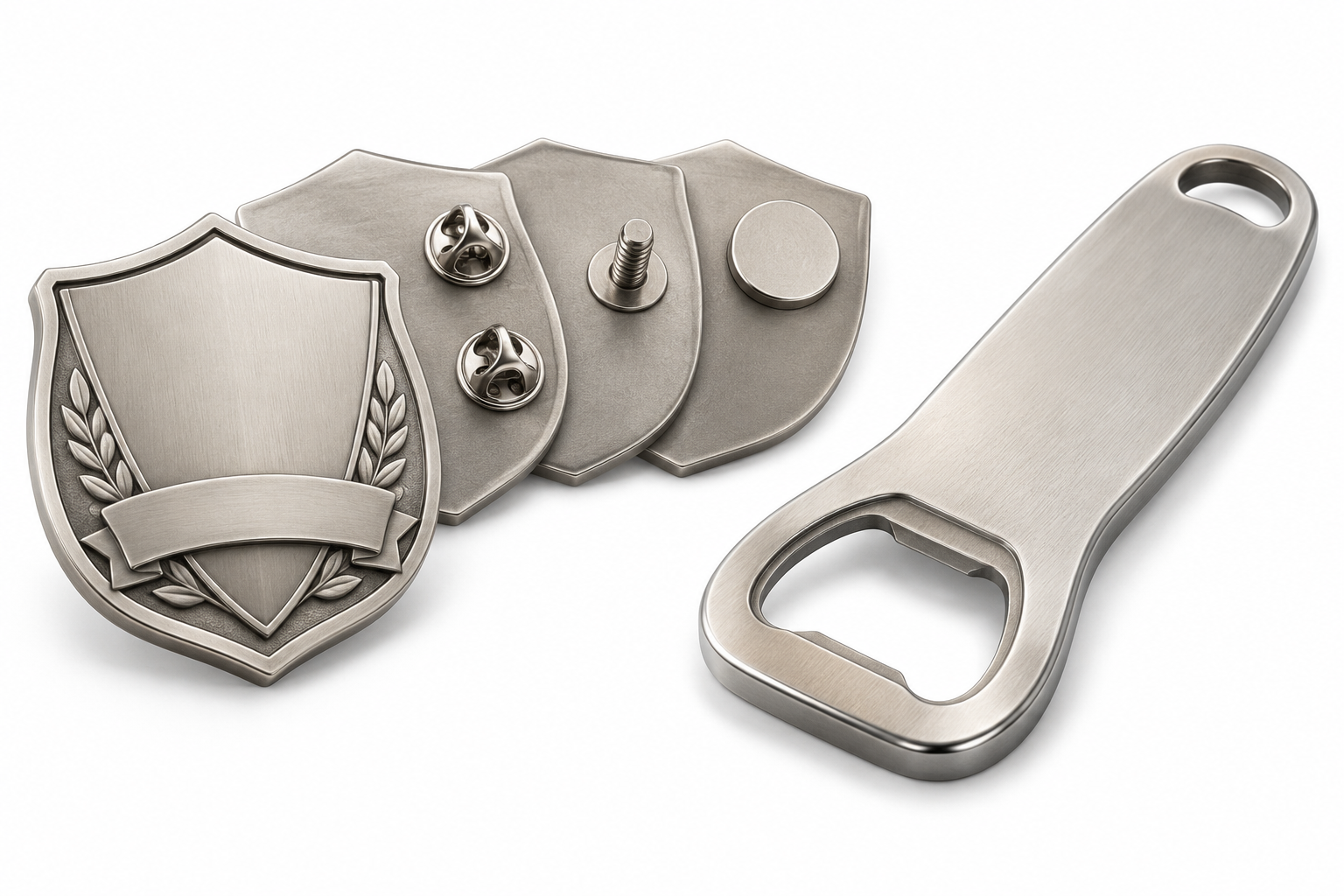
For a uniform badge requiring clear identification and long-term wear, contextual scenario guidance suggests 25–45 mm and a body thickness of 1.5–2.5 mm only when that specific scenario applies. An initial attachment choice might be dual pins, a screw post, or a magnetic back. Fabric thickness, badge weight, wearing direction, attachment, and surface treatment can change that decision. Wear stability, fabric pulling, and attachment retention also require validation for the actual construction.
For a handheld branded bottle opener, contextual guidance suggests 70–110 × 25–45 mm and a body thickness of 2–4.5 mm only for that scenario. The initial layout should keep the logo area away from the reinforced functional opening. Use frequency, cleaning environment, functional material, logo position, surface treatment, and required cycle or wear validation may change the construction. These scenario values are not universal specifications or confirmed manufacturing limits.
Review Artwork, Engineering, and File-Control Workflow
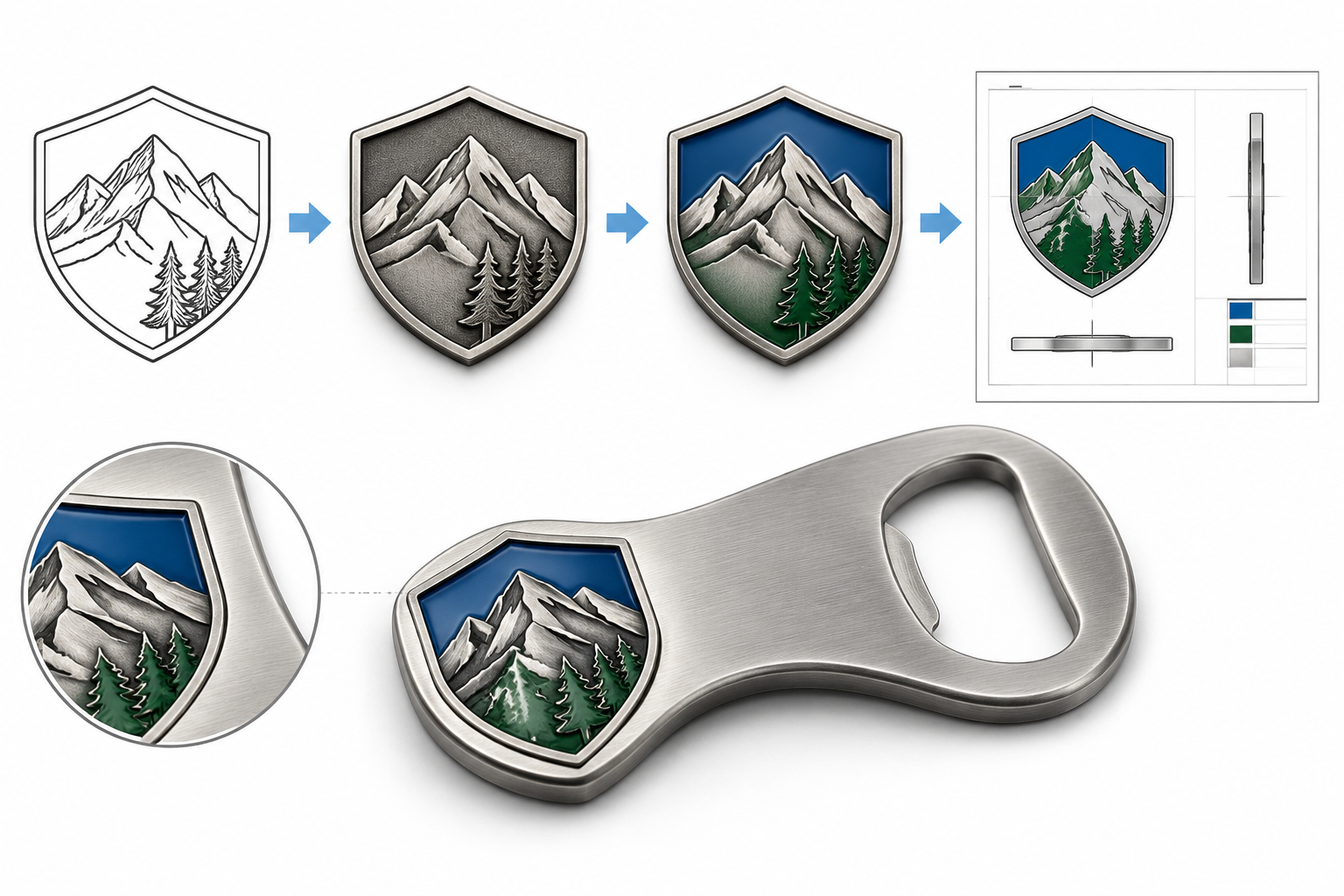
A supplier should be able to turn creative input into a controlled production reference. The minimum file pack should include vector artwork, a usable PDF, or a hand-drawn concept when necessary. Add dimensions, wording, color references, front and back instructions, attachments, product format, design variants, and intended use. Gairun can begin with these file types, but no submitted file is automatically production-ready.
The workflow should move from artwork intake to engineering review, clarification, and an accepted production reference. Gairun's pre-tooling review may address dimensions, thickness, relief, metal borders, color areas, attachments, component positions, and the proposed production method. The exact questions vary with artwork and structure. Tooling begins only after the relevant production artwork has been reviewed and accepted.
| Observable input | Likely concern | Initial supplier question | Variable requiring confirmation |
|---|---|---|---|
| Fine text or recessed detail | Legibility and separation may change after forming or decoration | Which production reference will define readable detail? | Character geometry, relief depth, finish, color placement, and viewing distance |
| Broad raised or relief areas | Surface shape can affect appearance and finishing access | How will the relief direction and transitions appear in the proof? | Overall dimensions, thickness, relief profile, border, and finish |
| Multiple components or moving structures | Positions, clearances, and assembly direction require control | Which drawing identifies every component and connection? | Movement, assembly method, attachment points, intended handling, and validation |
| Functional promotional parts | Brand decoration may interfere with the working structure | Which area must remain clear for the function? | Functional material, logo location, use frequency, cleaning conditions, and test method |
The badge artwork should show fine job information, wearing direction, and attachment zones. The opener artwork should distinguish the logo field from the reinforced opening and gripping area. In both cases, ask the supplier to mark proposed technical changes before tooling.
Visual artwork acceptance does not approve price, testing, packaging, shipping, or bulk production. Record the version name, revision date, approver, accepted changes, and events that require renewed approval. Gairun states that a 2D or 3D proof may be available within 24 hours when sufficient information is available. Current timing must be reconfirmed, and this proof timing is not production lead time.
Evaluate Samples, First Articles, and Approval Records
Award supplier qualification should distinguish three checkpoints. Artwork acceptance authorizes the relevant reference for tooling. A custom sample, when selected, supports a buyer-specific assessment of appearance and construction. First-article approval controls whether production may continue. None of these checkpoints should be treated as blanket authorization for later changes.
When assessing a sample or first article, check appearance, dimensions, relief, color placement, surface finish, component positions, attachments, packaging presentation, and any function tied to the application. The buyer's agreement should define applicable tolerances and acceptance criteria. Do not adopt an unsupported universal sampling threshold or tolerance.
A custom sample becomes more useful when uncertainty cannot be settled adequately on a drawing. Examples include a multi-component medal or trophy, a new private-label presentation format, or sensitive relationships between relief, metal borders, and color areas. A straightforward repeat order with a retained approved reference may follow a different path. Not every order requires a custom sample.
Gairun describes a service path from requirements intake through artwork and engineering review, sample planning when selected, production coordination, packaging, and shipment preparation. It defines a custom sample as a buyer-specific review of proposed appearance and construction. Sample approval and authorization for bulk production remain separate steps.
After tooling and trial forming, Gairun's stated process compares the first article with the approved 1:1 drawing for dimensions, thickness, and relief detail. Project tolerances must be specified separately. The approval record should identify the drawing and artwork version, the exact sample or first article, approved changes, approver, date, and remaining open items. A later change to relief, attachment, color, finish, packaging, or structure needs renewed assessment.
Distributors may also ask whether a trial quantity is appropriate. Gairun states that a 50-piece trial order may be supported for selected products, subject to design, process, and project review. This is not a universal MOQ or guaranteed option.
Check Quality Controls, Corrective Communication, and Compliance Responsibilities
A supplier quality checklist should make inspection evidence visible. Ask about incoming-material checks, first-article comparison, applicable in-process checks, final visual inspection, attachment checks, inspection records, defect photographs, disposition decisions, and corrective-action communication. For a formal audit, request the actual records rather than relying only on process descriptions.
Gairun states that incoming zinc alloy, brass, and iron materials are checked before production. Request supporting records and acceptance criteria during a formal audit; this statement does not establish third-party certification, batch traceability, or universal limits. Its stated in-process checks include burr inspection after forming and flatness checks after polishing, with acceptance criteria confirmed for the order.
For colored parts, Gairun describes checks for color overflow and areas with insufficient color. The approved artwork or proof should define where color belongs. Gairun also states that finished products receive a 100% visual inspection for surface scratches, subject to reconfirmation for the order. This process description is not a defect-free guarantee or laboratory test.
Attachment checks must match the actual configuration. Gairun states that relevant medal ribbons, butterfly clutches, magnets, and other used attachments are checked for secure fitting. Any pull-force value, attachment-life requirement, wear test, or functional rating needs a defined method and acceptance criterion.
When a nonconformance appears, identify the affected artwork version or lot, describe the deviation, and record whether the goods are held or may continue. Assign corrective action, name the decision owner, document authorization to proceed, and update the controlled reference when necessary. The buyer's quality agreement should define any formal corrective-action method or sampling plan.
Compliance needs current order-specific assessment. Product type, material, finish, intended use, attachments, packaging, and destination market can change the applicable requirements. Before production, the buyer should identify required standards, tests, certificates, labeling, packaging rules, attachment safety criteria, and market evidence. For government, military, public-safety, institutional, or official-recognition work, also identify who may provide controlled artwork and who gives final proof approval.
Confirm Packaging, Export Coordination, and Schedule Ownership
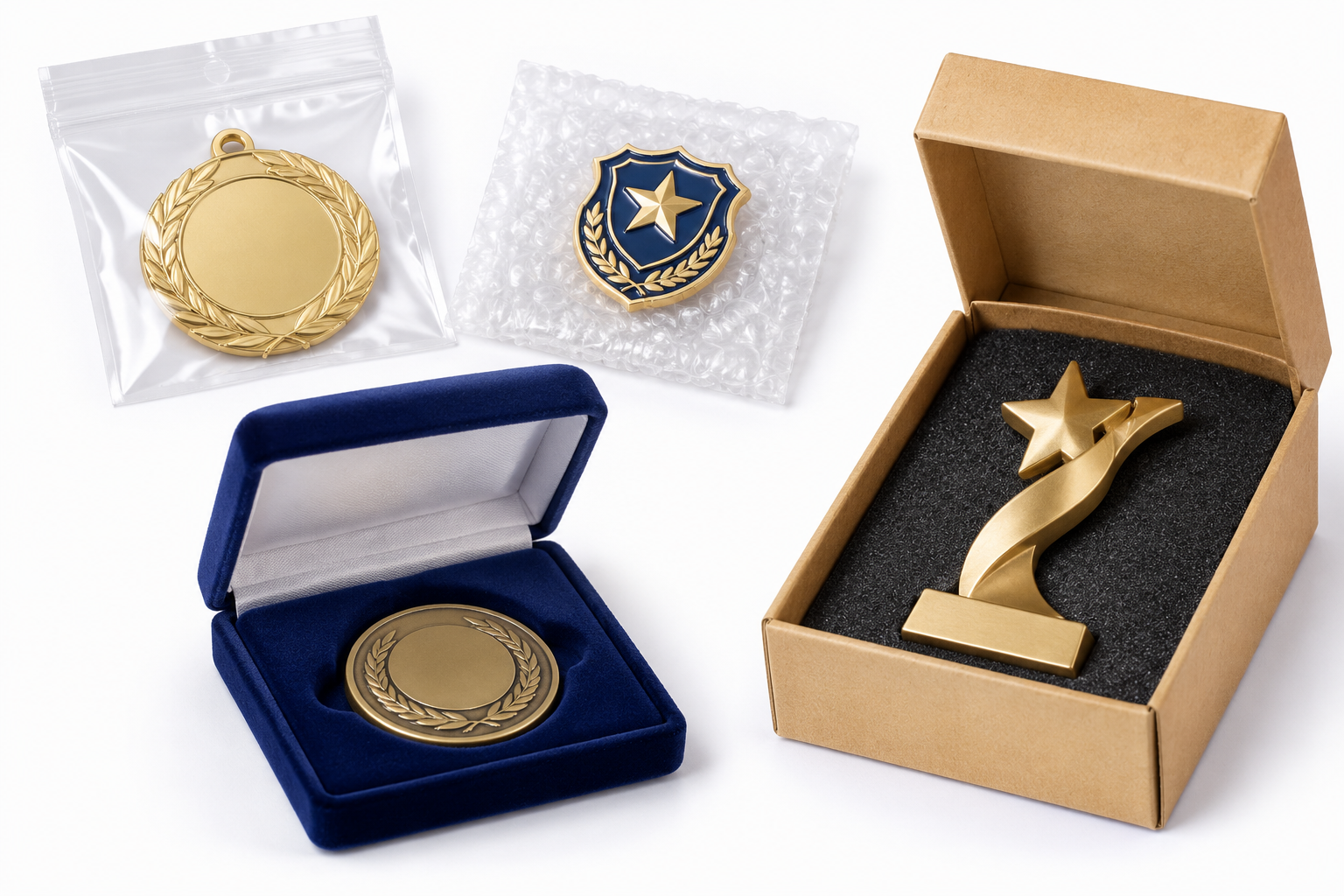
Packaging is both a protection decision and, for some programs, part of the presentation. Record individual protection, scratch prevention, presentation format, product dimensions, distribution channel, private-label requirements, carton information, destination, and the person approving packaging artwork. Do not assume a display box or private-label pack is included in base pricing.
Gairun lists standard anti-scratch packing, individual OPP bags, bubble protection, velvet boxes, paper display boxes, and plastic display boxes. Standard protection or individual bags may suit distribution handling. Bubble protection may help where surface exposure requires added separation. Display boxes may fit products sold or presented as formal awards. Suitability and pricing depend on dimensions, exposed surfaces, distribution, presentation, and shipping needs.
Build a written schedule that separates artwork approval, sample activity when selected, production, packaging preparation, shipping, customs arrangements, destination handling, and the required delivered date. Gairun states that standard bulk production normally takes 15–20 working days, but the actual design and schedule require confirmation. That period covers production, not a guaranteed delivered date. Approval timing, sampling, packaging, transport, customs, and destination handling may add time.
For an overseas supplier capability review, ask which party controls shipping terms, export and import documents, destination data, tracking, and damaged-packaging escalation. Record the point at which the supplier's responsibility ends. Current customs, labeling, import, and packaging rules should come from the applicable authority or the buyer's compliance program.
Move from evaluation to onboarding with a complete RFQ: product type, quantity, dimensions, artwork, variants, finish, colors, attachments, packaging, destination, and required schedule. Mark unresolved choices for technical discussion. Custom Gifts and Promotional Metalwork can help buyers organize product-format questions, while the RFQ remains the controlling project brief.
Convert the Review into a Distributor Vendor-Approval Scorecard
The distributor vendor-approval scorecard should cover product and process fit, artwork control, engineering response, sample or first-article control, inspection evidence, corrective communication, packaging, export coordination, schedule clarity, compliance documents, and repeat-order file control.
For every row, record the evidence received, unanswered question, responsible party, due date, approval status, and applicable project or product family. Avoid a generic pass mark that hides unresolved technical issues. Approve a supplier for a defined scope only when material open questions have owners and deadlines. Otherwise, retain conditional status.
Wholesale sourcing also requires controlled customer files, product versions, repeat-order references, and private-label packaging requirements. Preserve accepted drawings, artwork versions, approvals, and quotation assumptions so outdated logos, dates, or specifications do not enter a new RFQ. A retained reference improves control, but it does not guarantee repeat-order matching without current production confirmation.
Approve the Supplier by Scope and Record the Next Action
A sound onboarding decision connects product fit, controlled artwork, separate approvals, observable quality checks, packaging ownership, and export responsibilities. Approval should apply only to the documented product family or project scope. Issue the completed RFQ and approval record with technical, compliance, packaging, and schedule questions assigned. The next action may be technical review, a sample decision, or a written schedule. Gairun buyers can use Engineering and Purchasing Resources to prepare that project-specific submission.
Frequently Asked Questions
What should a promotional product supplier onboarding checklist include?
It should cover product and process fit, artwork control, engineering questions, sample and first-article decisions, quality evidence, corrective communication, compliance responsibilities, packaging, export coordination, scheduling, and repeat-order file control.
When should a distributor request a custom sample or first article?
Request a custom sample when buyer-specific appearance or construction needs physical assessment, especially for complex structures, sensitive relief and color relationships, or new presentation formats. Use first-article approval as a separate control before continued production.
How can buyers verify that artwork is ready for tooling?
Confirm that an identified production reference records dimensions, thickness, relief, borders, colors, attachments, component positions, and the proposed process. It should also show its version, date, approver, and resolved technical changes.
What quality records should an awards supplier provide during qualification?
Ask for applicable incoming, first-article, in-process, final visual, and attachment inspection records, plus defect photographs, disposition decisions, and corrective-action responses. Required records and acceptance criteria should follow the buyer's quality agreement.
How should packaging and export responsibilities be assigned between the buyer and supplier?
Use a written responsibility schedule covering packaging specifications and approval, shipping terms, documents, destination information, tracking, customs arrangements, damaged-packaging escalation, and the point where the supplier's responsibility ends.
Can a supplier be approved for one product family before being approved for all promotional products?
Yes. Scope-limited approval is appropriate when evidence supports one product family or process but not others. Record the approved scope, remaining questions, owners, deadlines, and any additional evaluation required before expanding approval.