Custom Metal Gifts and Die Cast Promotional Products
Compare medals, coins, pins, keychains and openers for custom programs. Plan artwork, attachments, finishes and packaging with Gairun's metalwork team.
Discuss your requirements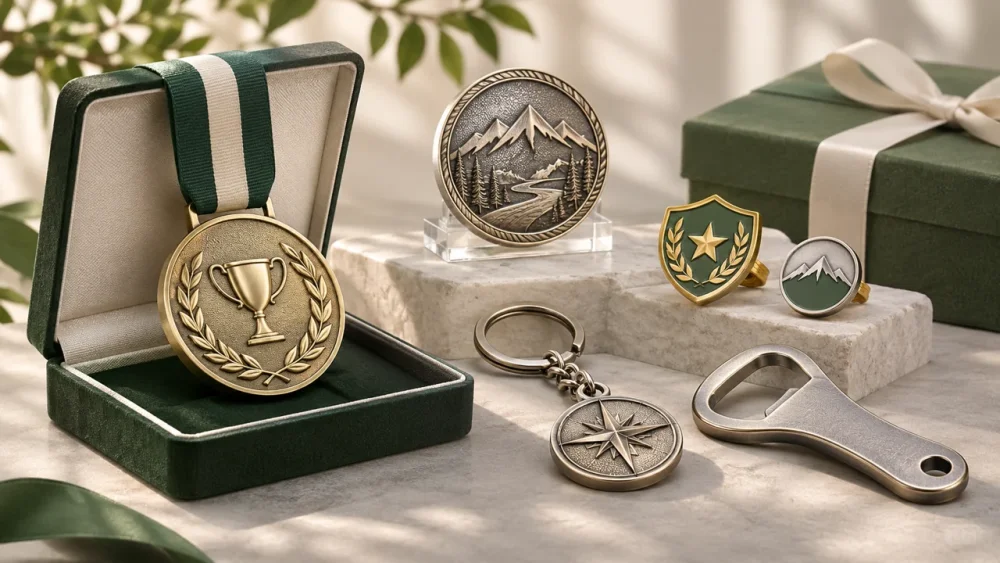
Custom metal gifts work best when their form supports the way they will be awarded, worn, carried or displayed. Gairun's custom metalwork experience includes medals, challenge coins, pins, badges, keychains and bottle openers. Each order begins with a design and purchasing brief that defines the product, decoration, attachments and presentation.
This product sector also provides a route for discussing related metal accessories and sculpted concepts. Manufacturing suitability is reviewed for the proposed construction. A product direction is a starting point for an enquiry, rather than a ready-stock item with a fixed specification.
Choose the format by how the recipient uses it
For an event, begin with the award or participation program and its distribution date.
For retail merchandise, consider the attachment, display card and individual protection. For a commemorative collection, prioritize the artwork, series identity and presentation. These purchasing situations lead to different specifications even when the same logo is used.
Gairun's custom metal gift work includes medals, coins, pins, keychains and bottle openers.
Additional formats require a defined construction and suitable supply route. A collection enquiry should list quantities by product and version, with any shared finish or packaging reference, so the proposal can distinguish common work from item-specific costs.
Product families and project requirements
| Product direction | Main purchasing decision |
|---|---|
| Custom Die Cast Belt Buckles | Strap retention and branded face geometry |
| Custom Metal Bookmarks | Page contact and route selection |
| Custom Metal Bottle Openers | Opening geometry, insert decisions and branding wear |
| Custom Challenge Coins | Two-sided relief, edge identity and collectible presentation |
| Custom Metal Charms | Attachment eyelets and small sculpted identity |
| Die Cast Figurines and Miniatures | Multi-part geometry and stable display |
| Custom Metal Keychains | Connection strength, daily abrasion and mixed-material assemblies |
| Custom Die Cast Medals | Award levels, ribbon geometry and event delivery planning |
| Custom Lapel Pins and Badges | Wearability, enamel route and attachment security |

Choose a product people can use or keep
Start with the recipient and the occasion.
A sports award needs a different format from a staff badge or a retail merchandise accessory. The same emblem can be adapted to several products, but it should not be transferred unchanged without considering scale, attachment and use.
Define whether the product's main purpose is recognition, identification, function or display.
This helps prioritize the features that deserve manufacturing attention. A functional opener requires a working geometry, while a commemorative coin may place more emphasis on relief and edge presentation.
Budget decisions should follow the complete construction.
A seemingly simple metal shape can become more involved when it includes several finishes, individual numbering, mixed materials or fitted packaging. Identify those requirements before comparing quotations.
Medals and challenge coins serve different programs
Medals are commonly designed around an award event and a wearable presentation.
Ribbon width, attachment position, award levels and distribution quantities are central to the brief. The metal design must hang and handle as intended, not merely look correct in a front-view image.
Challenge coins usually place more emphasis on the relationship between two faces and the edge.
They may commemorate membership, service or an anniversary, with relief, wording and display packaging supporting that purpose. Orientation and small-detail readability need explicit approval.
These are separate purchasing tasks even when both products use a similar forming route.
Review custom medals for ribbon and event planning, or custom challenge coins for two-sided design and collectible presentation.
For a coordinated program, maintain a common artwork identity while allowing each format to use the space effectively.
A medal can carry a prominent event mark, while a coin's reverse can hold additional wording. This creates a coherent collection without forcing every product into the same layout.
Pins and badges need an attachment plan
A lapel pin has a small viewing area and must remain practical to wear.
The design should account for its position on the garment, the weight of the body and the attachment arrangement. Front and reverse geometry should be approved together.
Soft enamel, imitation hard enamel, printing and clear coatings offer different visual results.
The appropriate route depends on line spacing, color areas, surface shape and the detail that must remain readable. A fine graphic may suit printing better than a set of tiny filled cells.
Attachment selection also affects the user experience.
Posts, clutches, safety-pin fittings and magnetic constructions have different assembly and use considerations. The pins and badges page explains how to connect the visual design with attachment and inspection requirements.
Openers and keychains combine identity with function
Bottle openers must be reviewed against the closure they are intended to remove.
Contact geometry, leverage and wear at the working edge matter. A decorative outline cannot substitute for a functional sample evaluation.
Keychains require a secure connection between the metal body, links and ring.
The assembly should move without damaging the decoration or creating uncomfortable edges. Weight and size need to suit routine carrying or the specific presentation program.
Some designs combine both functions.
In that case, the ring must not obstruct opening, and the opener must remain practical to carry. Review the complete object using the opener guidance and keychain guidance rather than approving its parts independently.

Belt buckles, bookmarks and charms
Belt buckles are a distinct accessory direction because they interface with a strap and a retention mechanism.
The brief should include strap width and thickness, attachment method and the part of the buckle that carries load. A decorative front plate and a working buckle frame require different checks.
Zinc casting can be considered for suitable shaped buckle elements, but the pin, bar or other loaded feature may need a different material or construction.
The complete assembly should be evaluated for repeated use and the intended user context. Artwork approval alone does not establish strap retention.
Bookmarks may favor thin sheet-based processes rather than die casting when flexibility or minimal thickness is important.
A cast decorative topper can be combined with a different main body, provided the joint and page-contact surfaces are appropriate. Avoid selecting zinc casting simply because the product is metal.
Charms require attention to the eyelet, connection and contact surfaces.
A small decorative piece may be attached to a bag, keychain, garment or jewelry item, and those uses have different exposure and compliance requirements. Specify the actual end use and intended user group before selecting the material and finish.
Sculpted figurines and miniature models
Three-dimensional figurines introduce geometry that a flat logo does not reveal.
Undercuts, deep recesses, unsupported projections and the tool opening direction can determine whether the object can be cast as one piece. A multi-piece construction may be needed to preserve the intended shape.
Start with a model or reference views that describe the complete object.
Identify the features that are essential to recognition and those that may be adapted for manufacture. A miniature also needs a stable base or attachment if it is intended for display.
Assembly joints should be planned with the visible finish.
A joint hidden in an uncoated model may become prominent after plating or polishing. The quotation should identify any separate components, joining operations and inspection requirements.
Clarify whether a miniature is an adult collectible, a decorative object or a toy.
Product classification depends on the actual design and intended use, not only on a marketing label. Applicable mechanical and substance requirements must be evaluated for the target market before production commitments are made.
Artwork, finishes and presentation
The production artwork should show dimensions, relief, color boundaries and the reverse-side details that matter.
If a design includes variable names or numbers, provide a controlled data list and identify the marking method. Those details may require operations beyond the main forming tool.
The surface finishing page helps compare polished, plated, colored and printed effects.
Choose a finish because it supports the product's visual and use requirements. More effects can introduce more variation and inspection work without improving the design.
Packaging protects the approved surface and supports the distribution method.
A presentation box, backing card or protective bag should fit the actual assembly. Rings, posts and projections need enough space to avoid damaging the product or neighboring items in transit.
Control variants through approval
Maintain a clear list of product versions, artwork revisions, quantities and packing arrangements.
Similar designs can differ in a small but important date, award level or attachment. Approval should identify the exact version that will be manufactured.
Use the quality guidance to define appearance and functional checks, and state any third-party testing required for the intended product and market.
Send Gairun your merchandise brief with the product purpose, artwork and distribution details to establish a suitable custom manufacturing route.
