Desktop phone stands look simple, but material choice changes how the product feels, performs, and sells. When buyers compare phone stands for office use, retail programs, branded merchandise, or private label desk accessories, the decision often comes down to aluminum or zinc. From our metal manufacturing perspective, these two materials solve different problems: aluminum is often chosen for lighter weight and clean modern styling, while zinc is often preferred for density, shape freedom, and a more substantial hand feel. The right answer depends on durability expectations, finish requirements, target price, packaging, and the kind of user experience you want the stand to deliver.
If your project sits within a broader custom metal products manufacturing overview, it helps to evaluate the phone stand not as a generic accessory but as a designed metal item with real production choices behind it. We typically help buyers compare material behavior, logo treatment, finish compatibility, mold or machining routes, sample approval priorities, and packaging needs before bulk production starts, which is especially useful when a desktop product must balance appearance, stability, cost, and brand presentation.
What a desktop phone stand is and why material choice matters
A desktop phone stand supports a mobile phone at a viewing angle for video calls, reading, charging, or hands-free use. Some are foldable and travel-friendly. Others are compact weighted desk stands designed to stay in one place. In both cases, the material affects more than appearance. It influences thickness, balance, base stability, scratch behavior, edge quality, finishing options, and even whether the product feels like a low-cost giveaway or a premium desk accessory.
For procurement teams and product developers, this is where comparison becomes practical. A stand made from aluminum may look refined and contemporary, but if the base is too light, the user may notice movement when tapping the screen. A zinc stand may feel solid and premium, but added mass changes shipping weight and can affect cost. In our production work, we encourage buyers to define the stand’s real job first: permanent desktop support, travel use, executive gifting, retail sale, or branded promotion.
Phone stands in aluminum vs. zinc at a glance
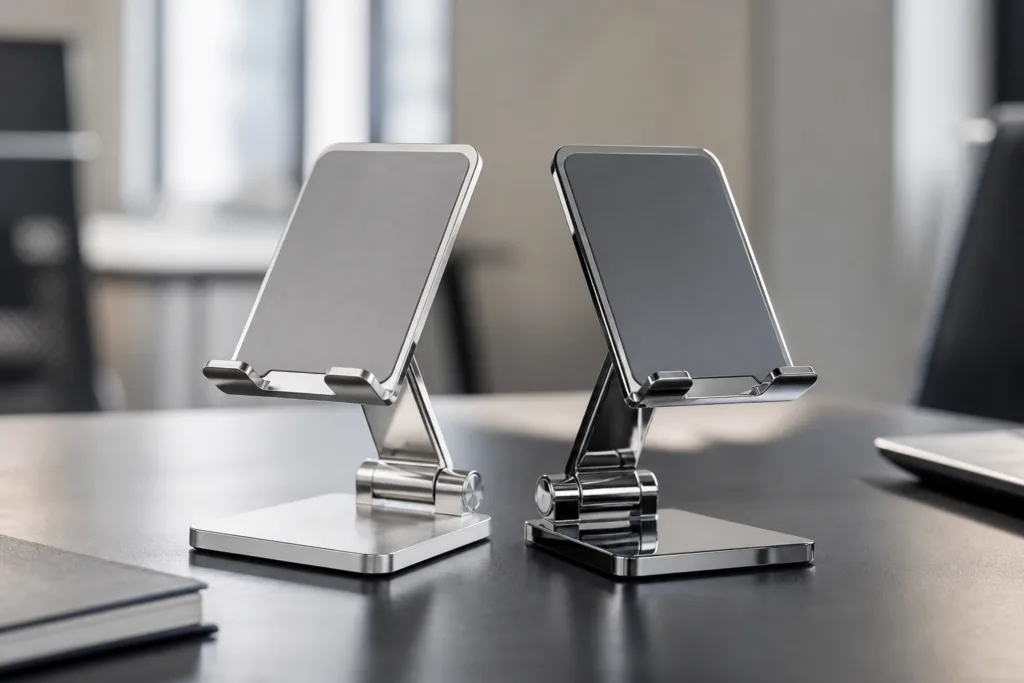
At a high level, aluminum and zinc differ in density, forming methods, finish behavior, and perceived value. Buyers who understand these differences early can avoid expensive redesigns later.
| Factor | Aluminum Phone Stand | Zinc Phone Stand |
|---|---|---|
| Weight | Lighter, easier to carry | Heavier, more stable on desk |
| Feel in hand | Clean, modern, technical | Dense, solid, premium |
| Common production route | Machining, extrusion, CNC finishing, some casting | Die casting with detailed shapes |
| Detail capability | Good for simple precision forms | Very good for complex shapes and crisp molded detail |
| Surface options | Anodized, painted, brushed, polished | Plated, painted, polished, antique and decorative finishes |
| Portability | Usually better | Usually lower |
| Desk stability | May need design compensation | Naturally stronger due to mass |
| Tooling logic | Can suit lower-volume machined designs | Often efficient for repeat die-cast production |
When buyers need a wider sourcing framework for evaluating process fit, decoration choices, and manufacturing consistency, our B2B metal manufacturing and sourcing guide is relevant because the material decision is rarely isolated from MOQ, tooling, inspection standards, and packaging planning.
Durability in everyday use: scratch resistance, strength, and long-term wear
Durability is one of the most misunderstood parts of material selection. Buyers often ask which metal is “stronger,” but in a phone stand, performance depends on structure, section thickness, joint design, surface treatment, and bottom protection as much as raw material type. A thin poorly designed stand in either material can fail faster than a well-designed one.
Aluminum performs well in everyday desktop use when the structure is properly engineered. It can offer a good balance of rigidity and lightness, especially in machined arms or folded forms. However, some aluminum finishes show wear differently. Brushed or anodized surfaces can look elegant, but visible edge rubbing or contact marks may appear over time if the stand is constantly folded, carried, or set against hard objects in a bag.
Zinc stands often give buyers confidence because they feel tougher and more substantial. In fixed desktop use, that weight can translate into a more reassuring user experience. For die-cast designs with broad bases and integrated support geometry, zinc can be very reliable for long-term desk placement. We often see zinc perform especially well when the product includes sculpted details, logo recesses, or a decorative premium body that would be harder or more costly to achieve in a comparable aluminum concept.
That said, scratch resistance is not purely a metal property. It is strongly influenced by finish choice. A polished plated zinc stand may show fingerprints differently than a matte anodized aluminum stand. Painted surfaces in either material can chip if edges are too sharp or if packaging protection is weak. In our sample reviews, we check not only the metal body but also silicone pads, anti-slip feet, hinge friction, and edge finishing, because these details define long-term satisfaction more than catalog-level material labels.
What buyers should inspect for durability
- Contact points where the phone rests
- Base pads and anti-slip materials
- Hinge life if the stand folds or adjusts
- Edge smoothness and burr control
- Finish adhesion on corners and high-touch zones
- Consistency of part thickness and assembly tolerance
Weight and stability: how each metal affects desk balance and portability
Weight is where aluminum and zinc separate most clearly in user experience. Aluminum is attractive when portability matters. A lighter stand is easier to move between home and office, easier to pack for travel, and often more comfortable in a slim foldable design. Broader materials research also supports the practical value of lightweight metals in product design, especially when everyday handling matters; this helps explain why lighter materials can improve everyday usability in accessories that are frequently carried or repositioned.
Zinc, by contrast, works in favor of stability. A heavier base can reduce sliding and tipping when a user taps the screen, uses facial recognition, or switches between portrait and landscape viewing. This is one reason many premium desktop stands use zinc or zinc-alloy structures: the stand feels planted. It can make even a compact design seem more expensive because the user immediately notices the weight.
From a manufacturer’s perspective, the better material depends on motion. If the stand is meant to stay on a conference table, reception desk, or executive workstation, zinc’s density can be a real advantage. If the product must fold into a laptop sleeve or be included in a travel kit, aluminum is often the better fit.
| Use Scenario | Better Fit | Why |
|---|---|---|
| Permanent office desk | Zinc | Higher mass improves stability |
| Home office with occasional movement | Either | Depends on style and base design |
| Travel or commuter use | Aluminum | Lower carrying weight |
| Gift set with premium feel | Zinc | Heavier hand feel adds perceived value |
| Minimalist tech accessory line | Aluminum | Light, precise, modern presentation |
Aesthetic appeal: surface feel, color options, plating, and premium appearance
Aesthetics are not only visual. They include temperature feel, edge softness, reflectivity, color depth, and how well the product matches a brand image. Aluminum usually gives a clean, modern, engineered look. It suits slim geometric stands, matte finishes, brushed textures, and understated branding. For technology brands, co-working spaces, and modern office environments, this can be a strong advantage.
Zinc is often selected when buyers want more decorative flexibility. Because zinc die casting supports crisp molded forms and works well with plating systems, it is easier to create shiny, satin, antique, gunmetal, or jewelry-like surface effects. In practical terms, this means a zinc stand can move beyond “tech accessory” and become a desk gift, award-adjacent item, or premium branded object.
Technical references on zinc die-casting alloys also help explain why zinc die-cast stands often feel denser and more premium, especially when a design depends on compact mass, fine contours, and decorative finishing. In our experience, zinc is especially useful when buyers want embossed logos, recessed branding, sculpted side profiles, or a small stand that still feels substantial.
For finish planning, buyers should compare not only color but maintenance. Mirror-like plated surfaces can look impressive but may highlight fingerprints. Matte textures are often easier to keep visually clean. Brushed aluminum can disguise some everyday handling marks, while very dark painted finishes may reveal edge wear more quickly if the product travels often.
Common finish directions for each material
- Aluminum: brushed, sandblasted, anodized, matte painted, polished edge accents
- Zinc: nickel plating, chrome-like finishes, black plating, antique effects, painted enamel accents, polished highlights
Manufacturing implications: die casting, machining, polishing, and finishing
Manufacturing route often decides whether a concept is commercially workable. Buyers sometimes choose a reference image first and only later discover that the shape favors one process over another. This is where engineering and supplier communication matter.
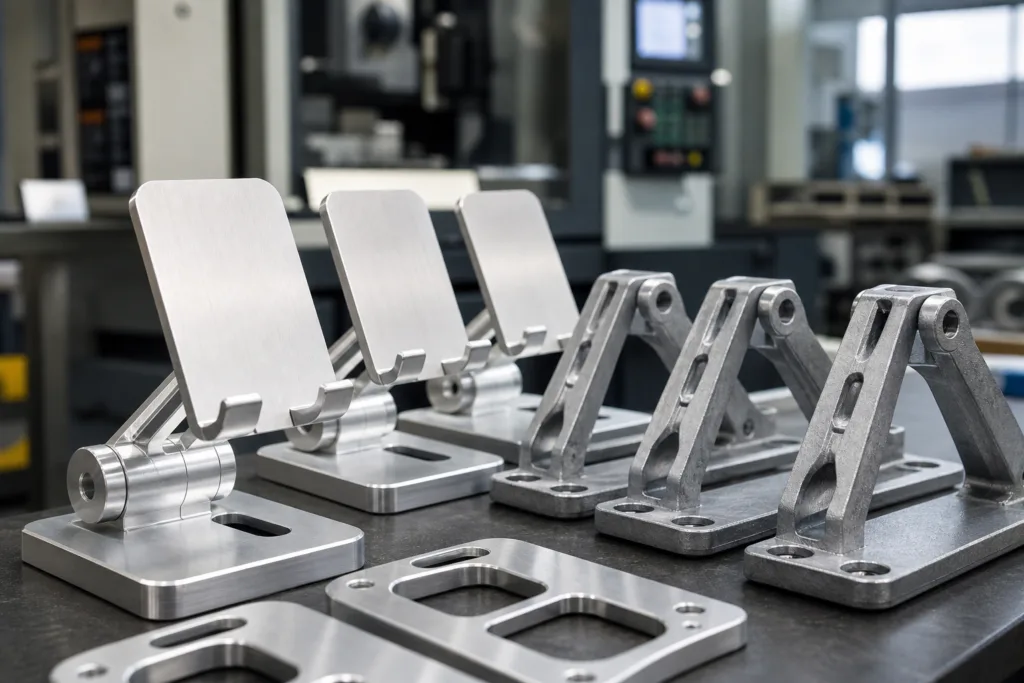
Aluminum phone stands are commonly produced through machining, extrusion-based fabrication, or combinations of CNC finishing and assembly. This route can work very well for minimalist designs with straight lines, hinge components, and controlled tolerances. It also suits lower to mid volumes when buyers want a refined form without building a heavily decorative die-cast tool. The trade-off is that complex sculptural shapes may become less efficient or more expensive.
Zinc phone stands are often suited to die casting. This process is attractive when a stand includes integrated contours, weighted bases, logo recesses, textured surfaces, or distinctive body shapes. Mold investment matters, but once the design is validated, die casting can support strong repeatability in shape and decorative detail. Buyers comparing material-process fit may benefit from our dedicated zinc alloy material performance guide, especially when evaluating detailed shapes, density, and finish compatibility.
At Gairun, we typically review several production questions before recommending a route: Is the stand foldable or fixed? Does the logo need engraving, casting relief, or color filling? Will the product be gift-boxed individually? Is anti-slip assembly manual or semi-automated? How much cosmetic variation is acceptable across bulk units? These factors affect not only cost but also what buyers should approve during sampling.
Sample approval points that matter
- Viewing angle comfort with a real phone
- Center of gravity under tapping use
- Finish consistency under indoor lighting
- Logo clarity and depth
- Pad adhesion and alignment
- Packaging protection against edge rubbing
Cost comparison: price points, tooling considerations, and value trade-offs
Cost should be evaluated across the whole project, not only raw unit price. Aluminum may appear attractive because it supports efficient minimalist forms and can avoid some decorative complexity. But if the design needs extra weight, hidden steel inserts, thicker sections, or additional machining, the cost equation changes. Zinc may involve mold investment, yet it can become cost-effective when the shape is complex and volumes are stable.
For private label and B2B buyers, the most important cost drivers usually include:
- Material weight per unit
- Process route: machining, assembly, or die casting
- Tooling and mold amortization
- Surface finishing steps
- Logo method: engraving, embossing, etching, printing, or filled color
- Protective pads, hinges, screws, or inserts
- Packaging type and drop protection
- Inspection level and rework tolerance
We usually advise buyers to compare value, not just price. A zinc stand may cost more to ship, but if it dramatically improves stability and premium perception, it may still offer better commercial performance in gifting or executive use. An aluminum stand may not feel as dense, but if the buyer needs portability, clean aesthetics, and a modern product image, it can deliver stronger value at the user level.
User preferences by scenario: office desks, home use, travel, gifting, and brand promotion
Different users notice different benefits. That is why material selection should follow the scenario, not the trend.
Office desks
For all-day desk use, stability is usually the priority. Zinc performs well here, especially when the stand is compact but must stay planted. Aluminum also works when the base geometry is wide enough or when anti-slip pads compensate for lower mass.
Home use
Home users often want a balance of appearance and convenience. If the stand matches laptops and modern home-office equipment, aluminum often feels right. If the user treats the stand as a permanent bedside or desktop object, zinc can be more satisfying.
Travel
Travel strongly favors aluminum. Lighter packed weight matters, and slim folding forms are easier to achieve in a polished, portable way.
Gifting and executive presentation
Zinc often has an advantage because weight influences perceived value the moment the box is opened. Buyers developing desk gift programs sometimes pair this with polished plating or antique finishes for a more formal presentation.
Brand promotion
For promotional campaigns, the right choice depends on brand identity. Tech-forward brands often prefer aluminum for a contemporary image. Heritage, luxury, or commemorative-style branding may align better with zinc. We are also seeing material stories matter more in desk accessories and branded merchandise, which is why our article on metal craft design and sustainability trends is useful for teams planning new product lines.
Sustainability considerations: recyclability, material efficiency, and production waste
Both aluminum and zinc are recyclable metals, which makes them appealing compared with low-value disposable materials in long-life desk accessories. But sustainability is not only about recyclability claims. Buyers should also look at product lifespan, repairability, packaging efficiency, and whether the stand is likely to remain in use for years rather than be discarded after a campaign.
From a manufacturing standpoint, material efficiency comes from smart design. Over-thick sections, unnecessary decorative mass, and fragile coatings all reduce the sustainability value of a product. A well-designed aluminum stand can use less material while staying functional. A well-designed zinc stand can justify its higher mass by offering longer desktop life and stronger perceived retention as a gift or branded item. Buyers exploring broader lifecycle thinking can review our perspective on eco-friendly metal material considerations when comparing long-term use value against disposable alternatives.
In real sourcing work, we encourage customers to ask a simple question: will the user keep this product? A durable, attractive stand that remains on a desk for years may create a better sustainability outcome than a cheaper item with weak retention value.
How to choose the right phone stand based on use case, budget, and brand image
If you are choosing between aluminum and zinc, start with these decision points:
| Question | If Yes | Material Lean |
|---|---|---|
| Will users carry it often? | Portability matters | Aluminum |
| Does the stand need strong desk stability? | It stays in one place | Zinc |
| Is a minimalist tech look important? | Clean modern styling | Aluminum |
| Do you want a dense premium gift feel? | Weight adds value | Zinc |
| Is the shape complex or decorative? | Molded detail matters | Zinc |
| Are shipping weight and portability key constraints? | Logistics matter | Aluminum |
We also recommend defining the branding method early. A laser-engraved aluminum surface creates a very different impression from a plated zinc stand with molded logo relief. Neither is universally better; they simply support different brand languages.
Common buyer mistakes when evaluating metal phone stands
- Judging quality only by weight, without checking finish durability and pad quality
- Choosing aluminum for portability but overlooking desk stability
- Choosing zinc for premium feel without accounting for shipping weight
- Approving a finish color without reviewing fingerprint visibility
- Ignoring packaging protection for polished or plated surfaces
- Testing only appearance and not real screen-tap stability
- Skipping sample evaluation with actual phone sizes and cases
- Assuming one material is always cheaper regardless of design complexity
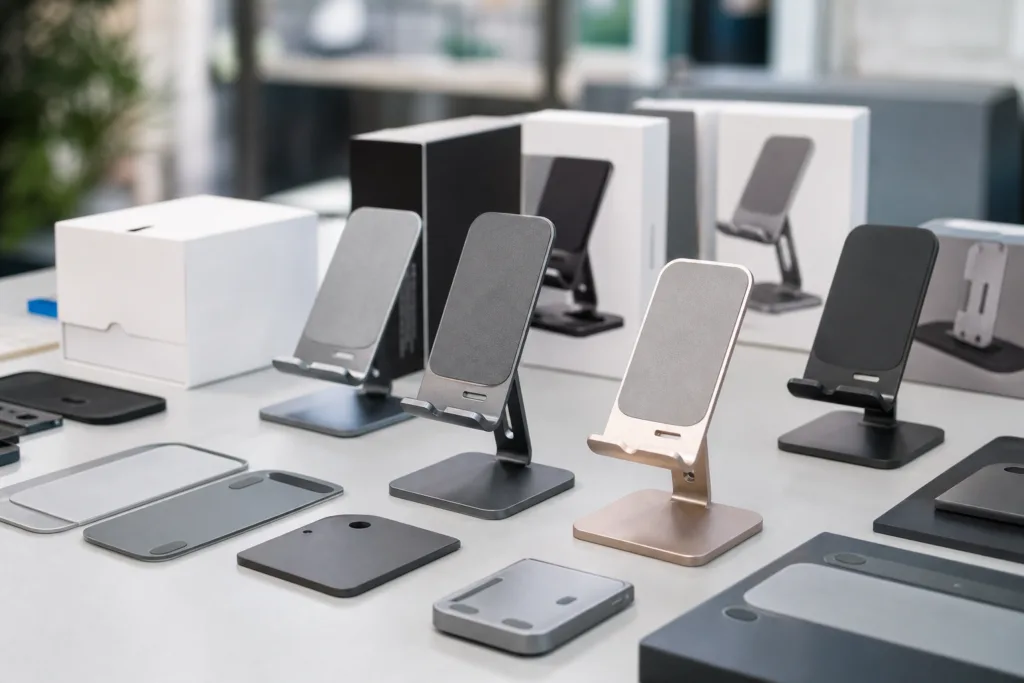
Most mistakes happen when buyers compare catalog descriptions instead of production realities. A stand should be assessed as a complete product system: metal body, finish, pads, hinges, logo treatment, packaging, and use environment.
Final decision checklist for selecting aluminum or zinc desktop phone stands
Choose aluminum when you want lighter weight, easier portability, a clean modern aesthetic, and a design language that fits technology-focused branding. Choose zinc when you want desktop stability, a denser premium feel, strong compatibility with decorative finishes, and shape flexibility through die casting. In both cases, durability and aesthetics depend heavily on engineering, finishing, and quality control rather than material labels alone.
For most buyers, the practical decision is simple: if the stand will travel, aluminum usually makes more sense; if it will live on a desk and must feel substantial, zinc is often the better choice. The best outcome comes from matching the metal to the use case, finish expectation, and target user experience from the start.
FAQs
Which material is better for premium desktop phone stands?
Zinc is often better for a premium desktop impression because its higher density creates a heavier, more substantial feel on the desk and in the hand. That said, aluminum can also feel premium when the design is precise, the finish is refined, and the product is positioned as a modern lightweight accessory rather than a dense executive object.
Are aluminum phone stands durable enough for daily office use?
Yes, aluminum phone stands can be very durable for daily office use when the structure is properly designed and the surface finish is appropriate for the environment. Buyers should still inspect edge treatment, hinge quality, anti-slip pads, and finish wear performance, because these details affect long-term satisfaction more than the material name alone.
Why do zinc phone stands usually feel more stable?
Zinc phone stands usually feel more stable because the material is denser, which helps create a heavier base in a compact form. That added mass reduces movement during screen tapping and can make the product feel more secure on smooth desk surfaces, especially when combined with well-placed anti-slip feet.
Is aluminum or zinc better for branded logo customization?
The better choice depends on the branding style. Aluminum works well for clean engraving, brushed finishes, and minimalist brand presentation, while zinc is often stronger for molded logo relief, decorative plating, and more sculpted product forms. The intended brand image should guide the material decision.
How should buyers compare cost between aluminum and zinc stands?
Buyers should compare total project cost rather than unit price alone. Material weight, tooling, production route, decorative finishing, packaging protection, and shipping all influence the final cost. A lighter aluminum stand may reduce logistics cost, while a zinc stand may offer stronger value if premium appearance and desktop stability are more important.
What should be checked before approving a production sample?
Before sample approval, buyers should test the stand with real phones and cases, check screen-tap stability, inspect edge smoothness, confirm logo clarity, review finish consistency under normal lighting, and verify that pads, hinges, and packaging protection are suitable for bulk shipment. These checks help prevent avoidable quality issues in mass production.