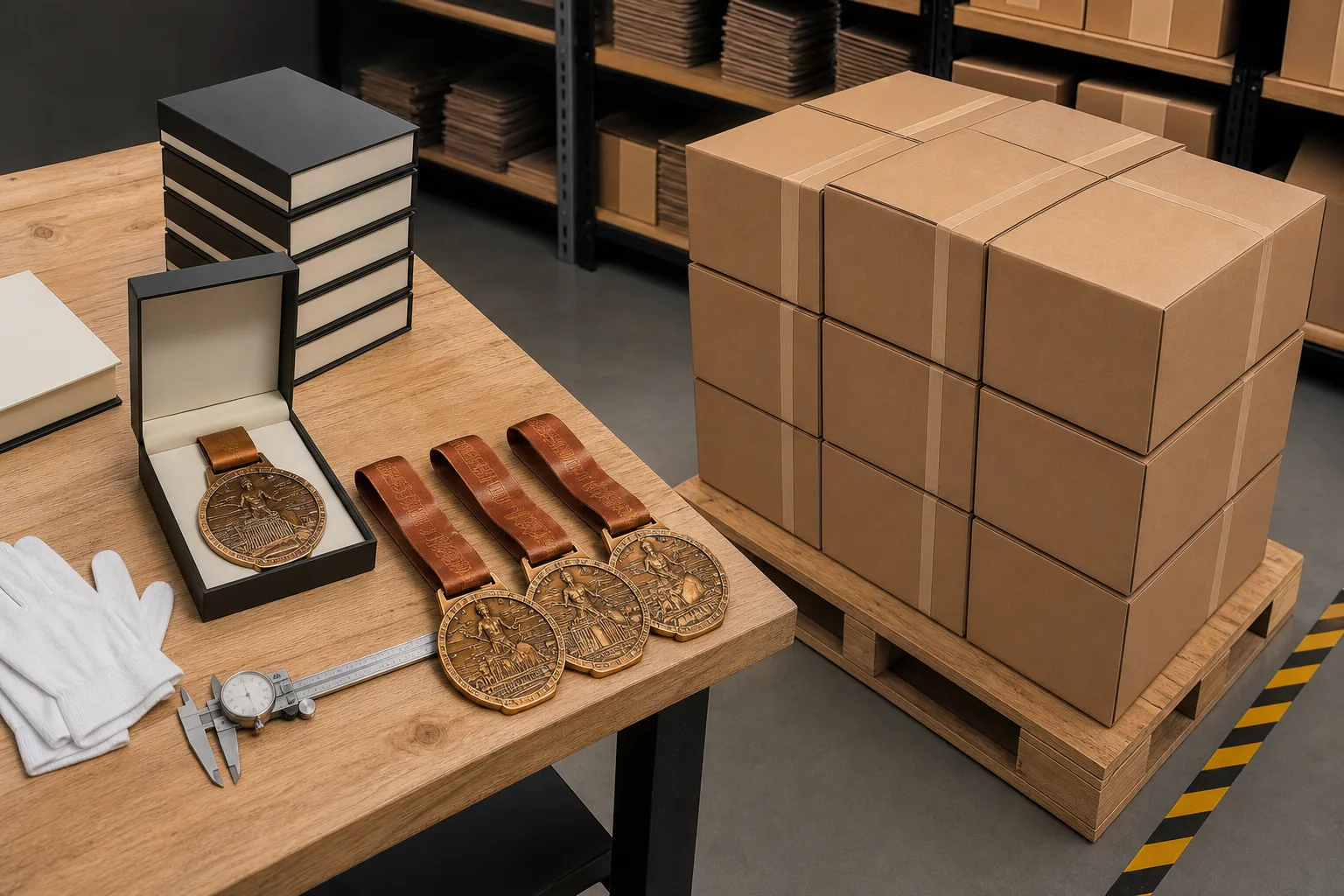
FACTORY-DIRECT OEM / ODM MANUFACTURING
Custom Awards for Marathons and Running Events
Gairun manufactures custom marathon medals and running event awards for race directors, timing companies and event agencies. We help connect the medal concept, finisher quantity, branded ribbon, approval schedule, packing plan and required arrival date in one clear project brief.
Our medal options include standard sports medals, 3D relief designs, and spinning or combination structures. Our 2D and 3D engineering team accepts vector artwork, PDFs and sketches and can provide a free artwork proof within 24 hours. To begin, send your event date, estimated quantity, artwork, medal specifications, packing needs and destination.
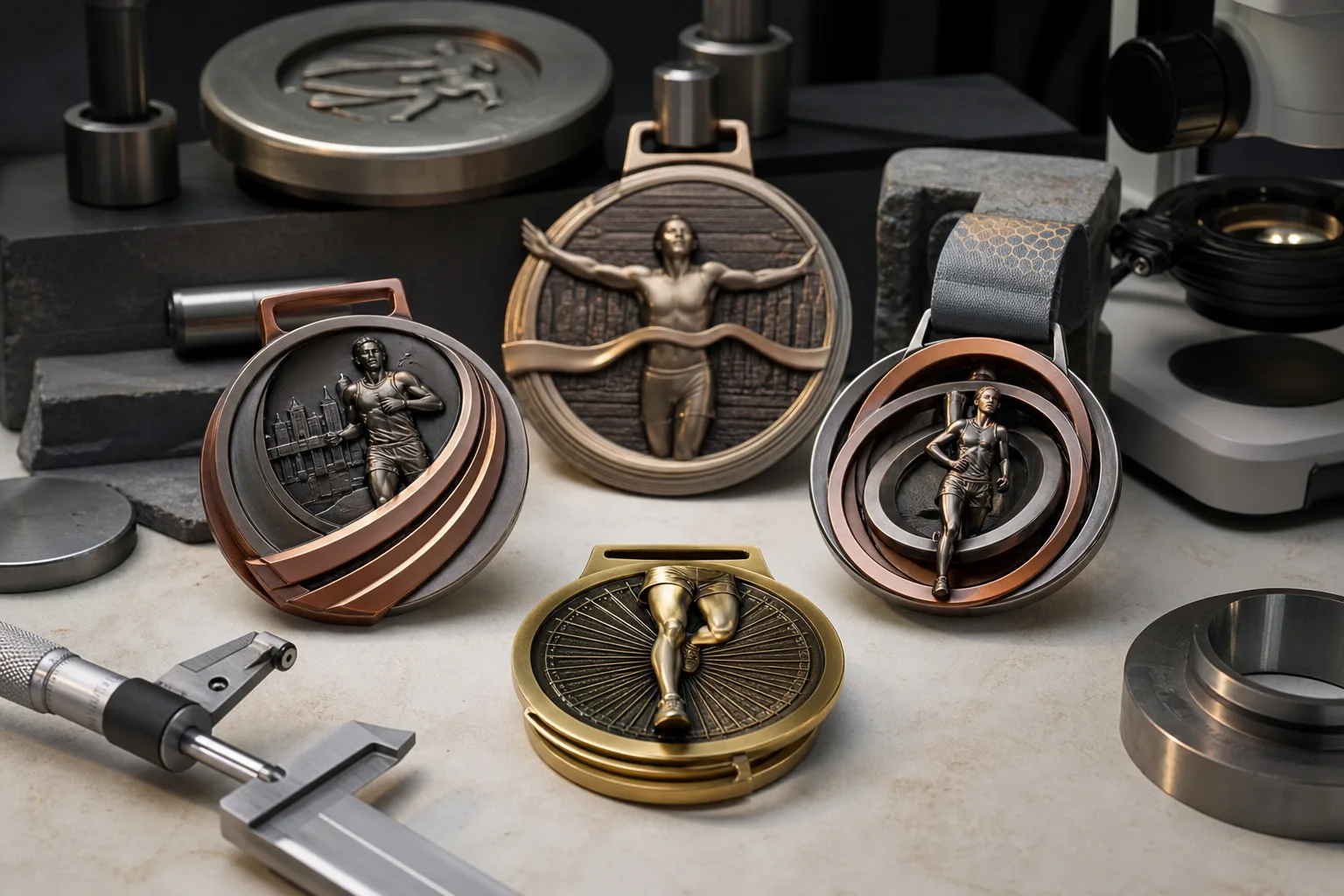
Define the Full Award Program Before Choosing a Medal
A running event medal program starts with the race plan, not the metal shape. The event name, date, distances and expected finisher groups determine how many medal versions are needed and what information must appear on each one.
Begin by deciding if all finishers will receive the same medal or if each race distance needs a separate version. A marathon, half-marathon and shorter run may share a common event identity while using different distance labels, colors or reverse-side wording. The ribbon can also remain consistent or change by distance.
Your planning brief should cover:
- Event name and race date
- Race distances and participant groups
- Estimated number of finishers for each distance
- Shared and distance-specific medal versions
- Ribbon branding and medal connection requirements
- Finish-line distribution method
- Delivery destination and required arrival date
These decisions create the working scope for the race medal supplier. They also reduce late artwork changes that may affect tooling, sampling or production.
Plan Finisher Quantities and Medal Versions
The order quantity should reflect more than current registrations. Race teams need to compare expected registrations, likely finisher numbers and any operational reserve they choose to hold. There is no single reserve percentage that fits every event, so the organizer should set this amount based on registration patterns and on-site distribution plans.
Count each design version separately. If only the distance wording changes, identify the quantity for each version and mark all common design elements. If the shape, relief, color layout or year changes, note those differences in the brief so we can review whether separate tooling or production steps are needed.
| Planning item | Organizer decision | Why it matters |
|---|---|---|
| Registration estimate | Expected entries by race distance | Creates the starting quantity for each medal version |
| Finisher estimate | Expected medals handed out | Connects the order to actual finish-line demand |
| Operational reserve | Extra quantity selected by the organizer | Covers the event’s chosen contingency without using an assumed percentage |
| Version map | Shared or separate designs by distance, year or group | Shows which artwork and production elements change |
Our standard MOQ is 100 pieces per design. A 50-piece trial order may be supported for selected products, depending on the design, process requirements and factory review. State the quantity for every version when requesting a project-specific quotation.
Match the Medal Structure to the Race Story
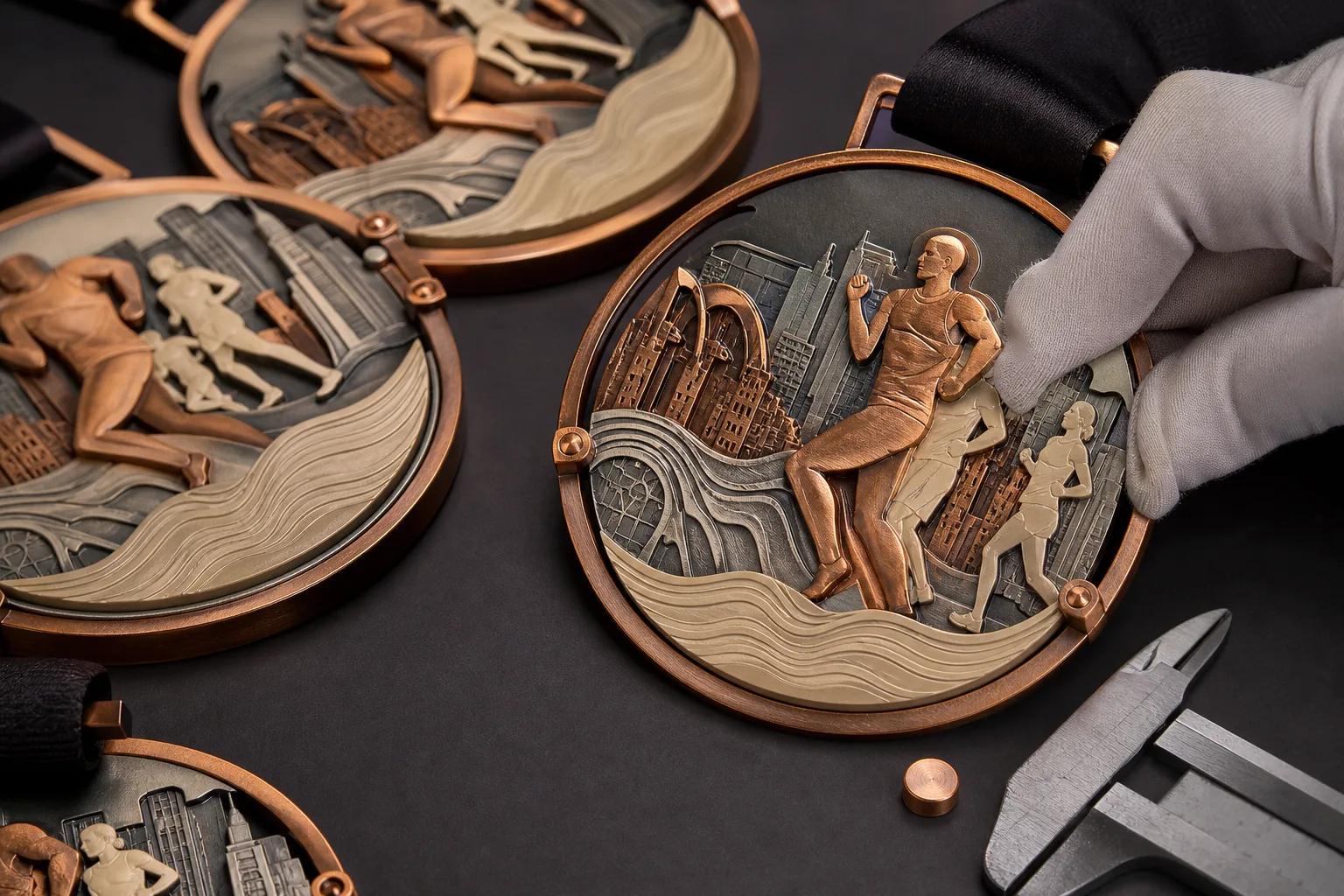
A useful medal concept gives runners a clear link to the event. The design may feature the race identity, a route theme, a local landmark, an anniversary or another part of the event story. The strongest concept is usually the one that remains clear after the artwork is translated into metal, relief and color.
Gairun produces standard marathon medals, 3D relief medals, and spinning or combination medals. A standard structure can carry the main race symbol, date and distance in a direct format. A 3D relief structure uses raised and recessed sculpted surfaces to create depth. A spinning or combination medal uses connected parts to create movement or a layered presentation.
Sculpted relief and moving components need added engineering review before mold work. The review considers how the artwork will be formed and how separate parts will connect. For detailed construction choices, review our custom marathon medals. You can also explore the broader custom metal product range if the event needs more than finisher medals.
Prepare Race Artwork and Wording for Proofing
Accurate race information is as important as the visual concept. Event names, dates, distances and sponsor marks should be checked before mold development because a small wording error can affect every finished medal.
We can begin with vector artwork, a PDF, a drawing or a sketch. Our engineering team can provide a free 2D or 3D artwork proof within 24 hours. Include the intended medal dimensions, front and back content, color references and attachment notes with the source file.
Check the proof for:
- Correct event name, year and date
- Correct distance wording for every version
- Logo and sponsor-mark placement
- Front and back design orientation
- Color location and visual separation
- Medal dimensions and relief direction
- Ribbon connection position
A digital proof records the agreed design direction, but it does not replace a physical custom sample when the project requires sample approval. For file preparation details, use our artwork and file preparation guide.
Treat the Branded Ribbon as Part of the Race System
The ribbon carries the event identity while runners wear the medal and while finish-line photos are taken. It should be planned with the medal rather than added after the medal artwork is complete.
Define the ribbon wording, logo order, colors and orientation. Also state whether the same ribbon will serve all distances or if each distance needs a separate version. The medal connection must be included in the project notes so the ribbon and medal can be reviewed as an assembled award.
A practical ribbon brief identifies:
- The exact text and logo sequence
- The intended color direction
- The viewing orientation when the medal is worn
- The connection point on the medal
- Version changes by distance or participant group
During final inspection, ribbon attachment security is checked as part of the assembled medal review. Ribbon widths, materials and decoration methods should be confirmed for the specific project rather than assumed at the concept stage.
Set Approval Gates Before Bulk Production
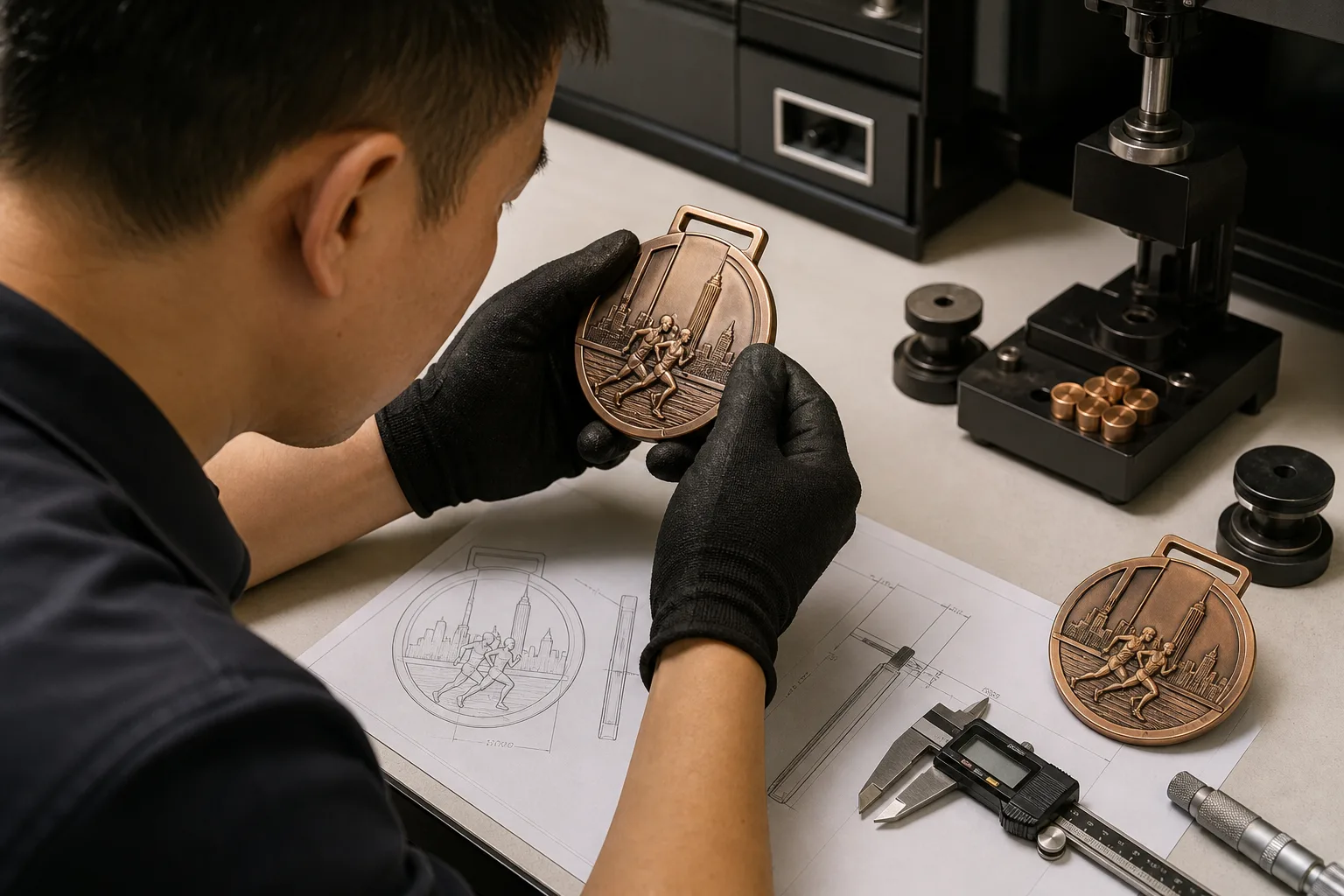
A controlled approval path keeps the race team, agency and factory aligned. The main gates are requirement confirmation, artwork proof, engineering review, custom sample review when required, bulk production authorization and final inspection.
After mold engraving and trial forming, the first article is compared with the agreed drawing for dimensions, thickness and relief detail. In-process checks cover burrs, flatness, plating and color. Finished medals receive a 100% visual inspection, including a check of ribbon attachment security.
Existing stock samples are free as products and can help a buyer review general workmanship. Delivery cost is confirmed separately. A stock sample is not a sample of your custom race design and does not replace project-specific approval.
01
Confirm the race requirements.
Record the quantities, versions, dimensions, artwork content, ribbon needs, packing plan and schedule.
02
Review the artwork proof.
Check all names, dates, distances, logos, colors and front-to-back details.
03
Complete engineering review.
Confirm how relief, moving parts, attachments and other structural features will be produced.
04
Assess the custom sample.
Custom sampling normally takes 7-10 working days. Review the physical result against the agreed design before authorizing bulk production.
05
Approve bulk production.
Record the accepted design and version quantities before the order moves forward.
06
Complete inspection.
Quality checks continue through forming, finishing, coloring, assembly and final visual inspection.
Choose Packing for Finish-Line Counting and Handout
Race medal packing should support the way the event team receives, counts, transports and stages the order. A medal that is easy to present in a gift box may take more space and handling time than one prepared for high-volume finish-line distribution.
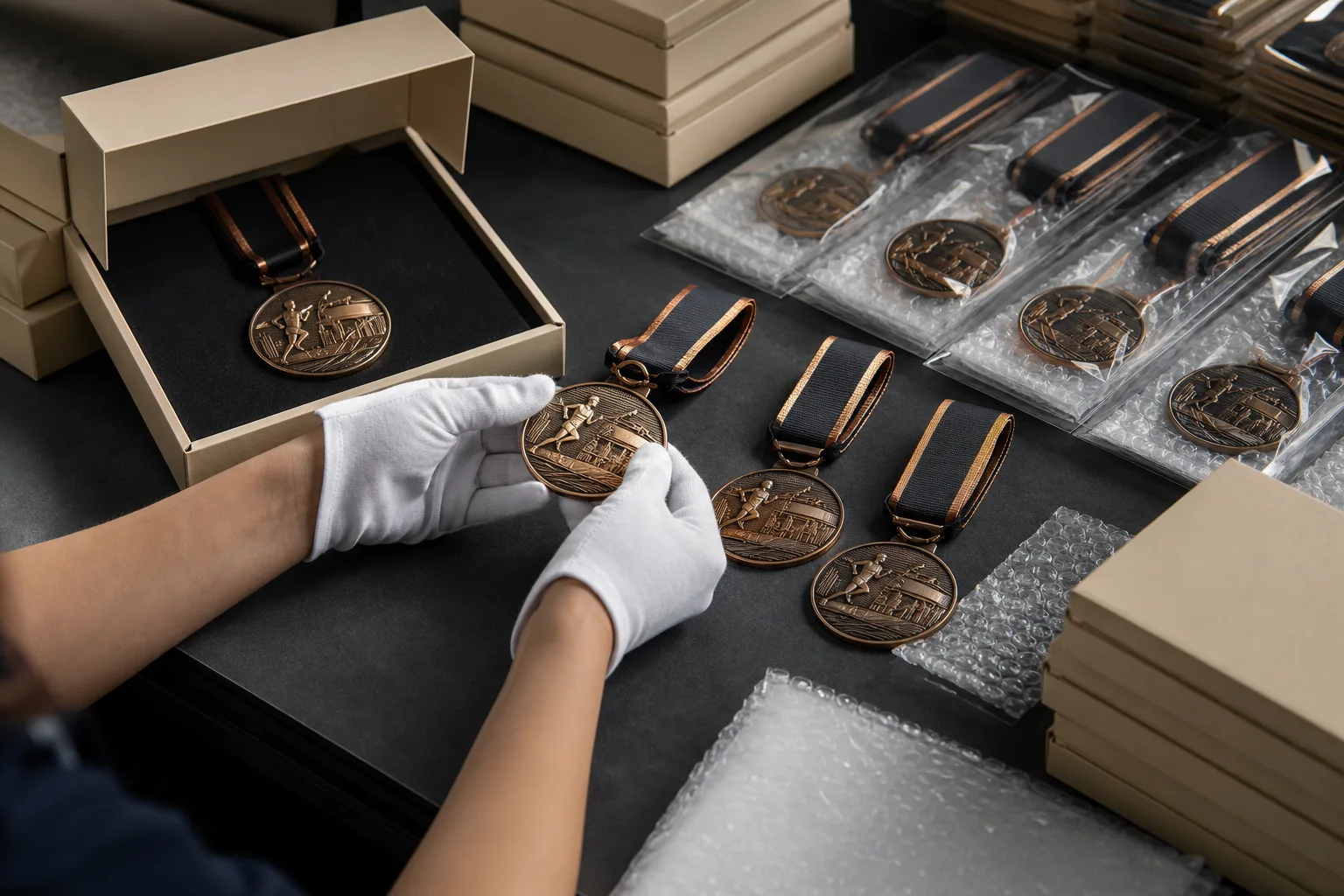
Gairun supports standard anti-scratch packing, individual OPP bags, bubble protection, velvet boxes, paper display boxes and plastic display boxes. For most finisher programs, the first question is how the medals will be protected and counted before race day. Presentation packaging is a separate decision.
- Standard anti-scratch packing: supports basic surface protection for bulk orders.
- Individual OPP bags: separate each medal for counting and handling.
- Bubble protection: adds protection where products need more separation during transport.
- Velvet boxes: suit selected presentation awards rather than routine finish-line handout.
- Paper display boxes: provide a defined presentation format.
- Plastic display boxes: keep the product visible while contained.
Tell us how the medals will be stored and distributed so the packing can be reviewed as part of the order rather than after production.
Work Backward from the Required Arrival Date
The race date is not the production deadline. Medals need to arrive early enough for receiving, quantity checks, local transport and finish-area setup. Build the schedule backward from the required arrival date, then allow time for artwork decisions and buyer approvals.
Key milestones include artwork approval, the custom sample decision, bulk production, inspection, packing, transport and local receiving. Standard bulk production takes 15-20 working days. This production period is not the full door-to-door delivery time. Expedited production is available only after project review.
International express, air, sea and rail transport are supported. Available trade terms include EXW, FOB, CIF, DDP and DAP. The suitable route depends on the destination, order details and required schedule. Shipping time and responsibility points should be confirmed separately for each project.