
When buyers compare die cast vs die struck medals, the most useful question is not which process is universally better. It is which process translates the specific artwork into a controllable metal form. For custom medals, that decision should consider the outer profile, relief hierarchy, side geometry, reverse design, attachment, material, and decoration—not just the front rendering.
Die Cast vs Die Struck Medals: The Short Answer for Artwork Selection
Die-casting is the stronger starting candidate when a fixed, one-piece medal depends on an irregular formed silhouette, integrated openings, visible thickness transitions, sculpted relief, or a noticeably dimensional body. Tooling can be reviewed around the complete medal geometry rather than only a conventional blank-like profile.
Die-struck forming is the stronger starting candidate when the design is primarily expressed through raised and recessed areas in a suitable metal blank. Exposed-metal detail, controlled borders, polishing, matte fields, and plating contrast can then carry much of the visual effect.
These are screening rules, not automatic production decisions. A process recommendation can change after reviewing the base metal, overall dimensions, specified thickness, edge profile, back design, holes, ribbon connection, color areas, and finish. A front-view image alone does not establish what happens at the side, whether a white area is a recess or a through-hole, or how the reverse must align with the front.
Neither route is inherently the higher-quality option. Quality depends on whether the forming process, tooling, approved artwork, decoration, assembly, and inspection criteria fit the intended product. Tooling expense, unit price, schedule, and quantity economics also remain quotation-specific.
How Die-Cast and Die-Struck Medal Manufacturing Processes Differ
For zinc-alloy die-cast medals, project-specific tooling defines the medal body, outline, openings, relief, and relevant thickness transitions. This makes zinc alloy die-casting a process to review when the outline and dimensional body are essential parts of the artwork. Actual feasibility still depends on dimensions, relief structure, walls, borders, recesses, side geometry, and the decoration plan.
Die-struck medals begin with stamping a suitable metal around raised and recessed design areas. Stamping creates the base form; it is not the final decoration method. Polishing, plating, color treatment, texture, printing, attachment assembly, inspection, and packing are separate or coordinated operations.
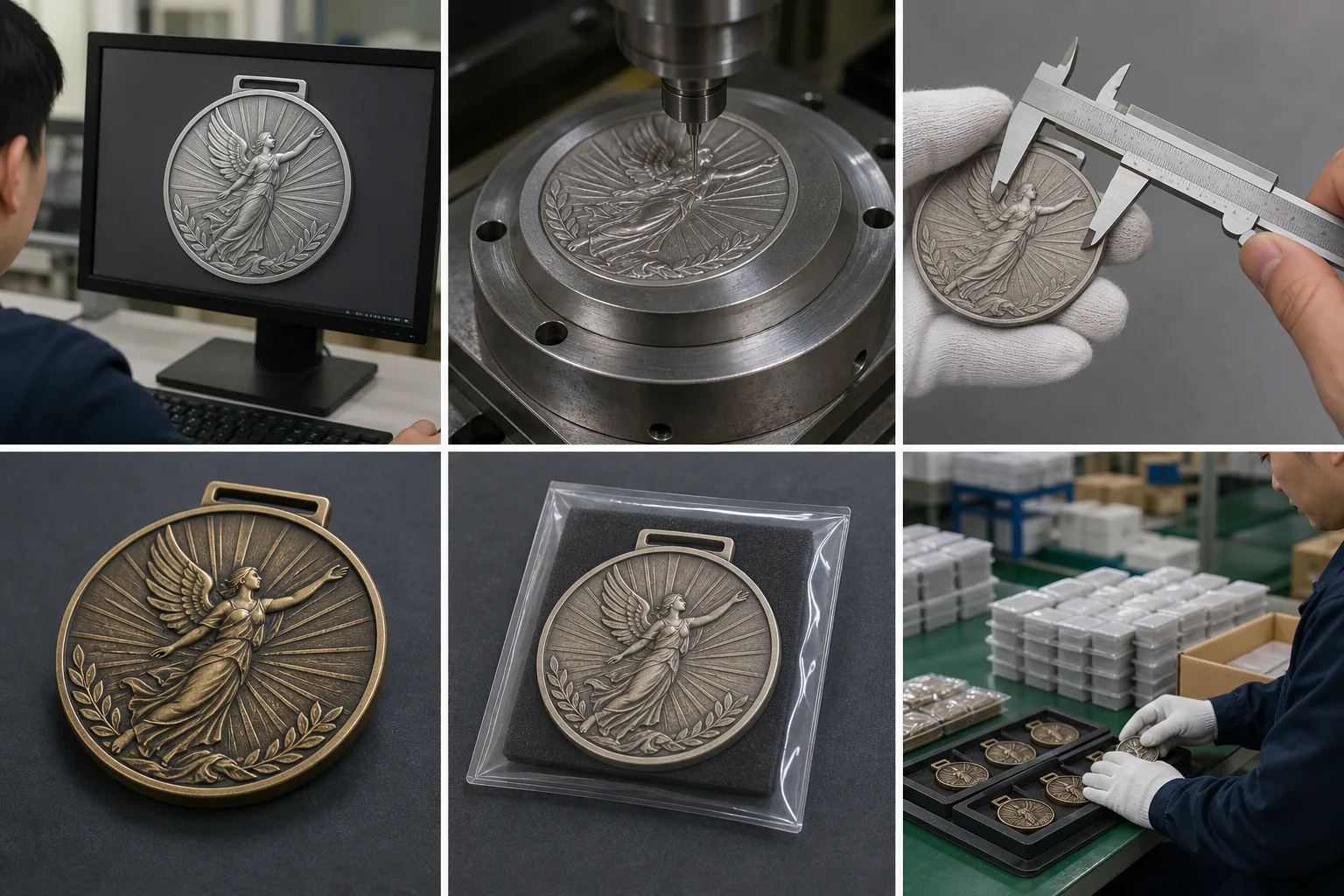
In either route, tooling converts approved artwork and relief instructions into production geometry. Gairun’s official manufacturing description includes mold making and CNC engraving for tooling that defines shape, dimensions, thickness, and relief. It also describes tooling, forming, polishing, enamel and epoxy work, quality control, assembly, and packing as connected production areas. This does not mean every operation is necessarily performed in-house for every order.
Base metal and forming route must be reviewed together. Gairun lists zinc alloy, brass, iron, stainless steel, and aluminum among the metals it can process, but the list does not make every metal compatible with both routes or every medal design.
If unusually high relief cannot be resolved within the proposed casting or striking plan, metal stamping and hydraulic relief forming may be reviewed as a separate direction. Photo etching may also be relevant to certain artwork structures. An alternative should be selected only after project-specific engineering review.
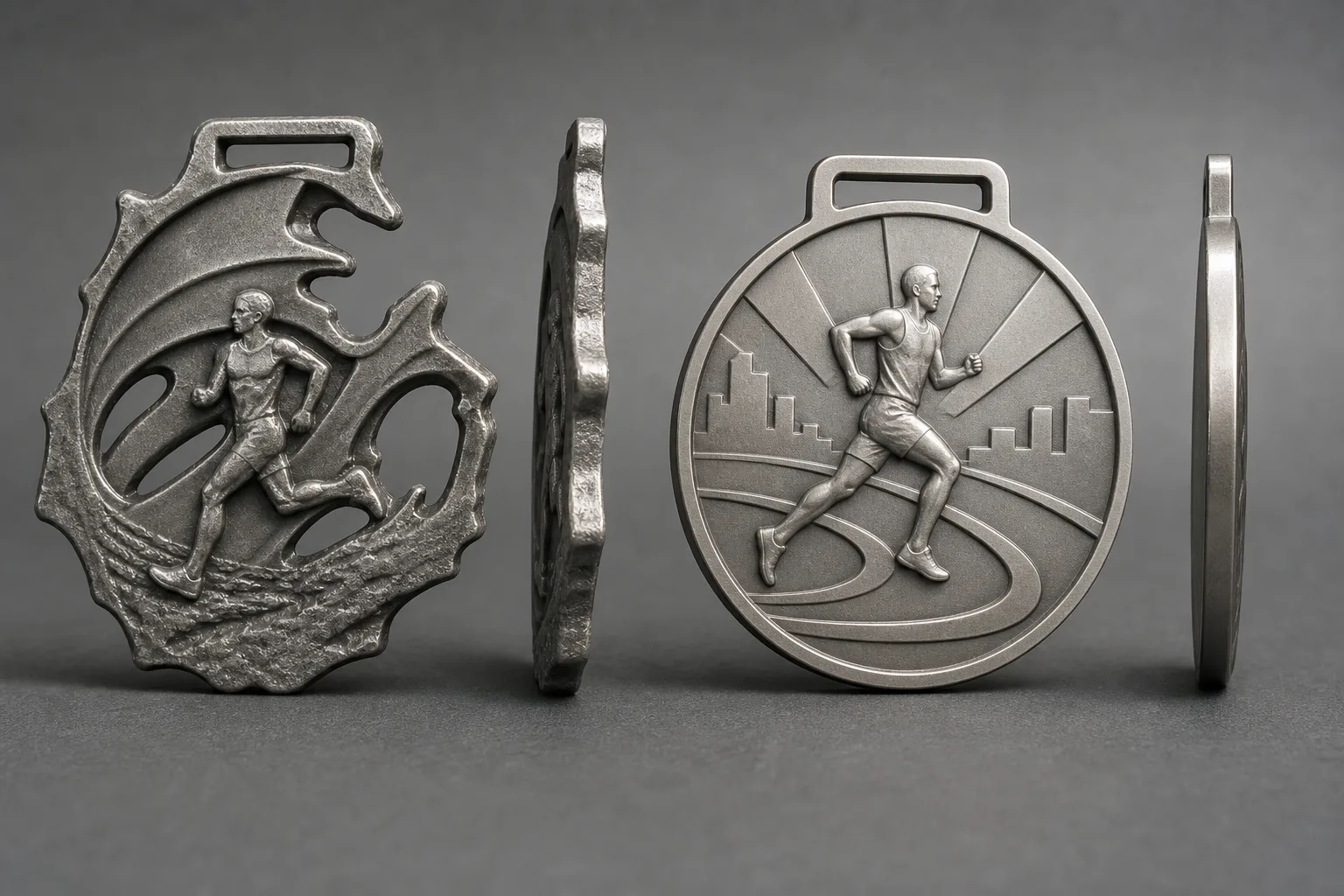
How Shape, Relief, Edges, and the Reverse Side Affect Process Choice
Breaking artwork into geometric features is more reliable than classifying the whole design as simply “2D” or “3D.” Review these areas separately:
- Outer profile: Determine whether the medal uses a conventional blank-like perimeter or an irregular silhouette integral to the subject. A shaped outline alone does not settle the process, but an extensively formed body points more strongly toward die-casting review.
- Relief hierarchy: Separate simple raised and recessed levels from sculpted forms. For a 3D relief medal, identify the foreground, middle layer, background, and visually dominant subject. Do not describe every element as equally raised.
- Edge and side geometry: Show whether the perimeter is standard, contoured, stepped, or variable in thickness. Side transitions that are invisible in the front artwork can affect tooling and finishing.
- Negative space: Mark every intended through-hole or cutout. White, transparent, or uncolored artwork does not automatically mean that metal should be removed; it may represent a recess, a color-free field, or an open area.
- Reverse side: Supply the complete back design, including text, logos, textures, recessed fields, attachment positions, and required orientation relative to the front.
- Attachment area: Define the ribbon loop or other connection, its position, and how it meets the medal body. The connection can affect visible geometry, tooling, assembly, and pull-test planning.
Small lettering, narrow lines, portraits, seals, tight borders, and subtle tonal transitions need review at the final medal scale. They should not be assumed to transfer unchanged into formed metal. Subjective instructions such as “deep relief,” “soft matte,” or “highly dimensional” are clearer when accompanied by an approved rendering, reference sample, relief map, or cross-section.
This comparison is clearest for a fixed one-piece medal. Spinning and combination medals have moving or connected components, so alignment, movement, connection points, and visible clearances must be reviewed as an assembled system before the design is considered production-ready.
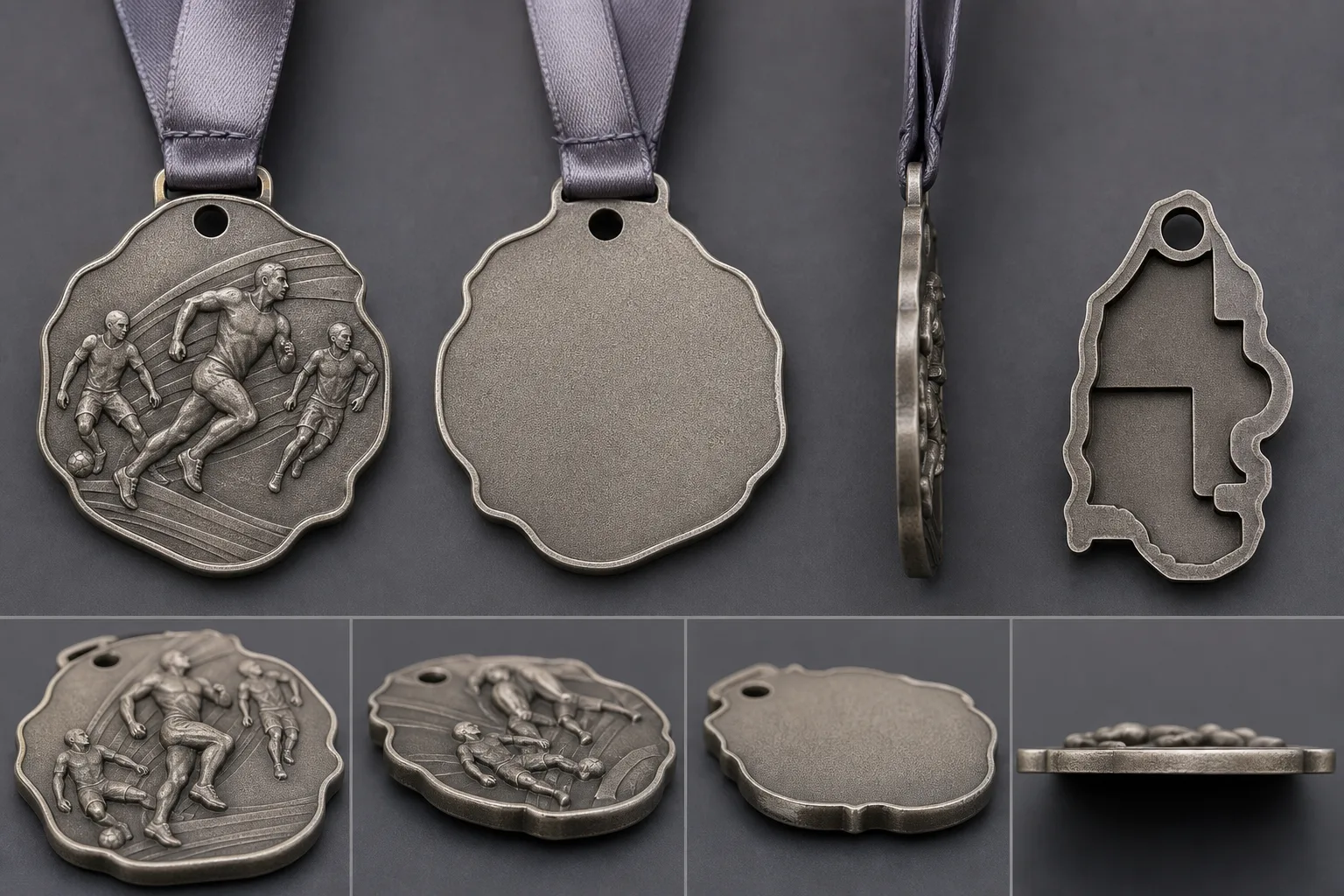
Artwork Indicators That Point Toward Die Casting or Die Striking
Artwork for die-cast medals should be reviewed first for casting when it contains several of the following indicators:
- An irregular formed outline or dimensional body
- Integrated openings or complex negative space
- Sculpted relief with distinct foreground and background forms
- Substantial contour or thickness changes
- Geometry that cannot be explained adequately as flat raised and recessed levels
Artwork for die-struck medals should be reviewed first for striking when it uses a suitable metal blank and is driven by clearly separated raised and recessed areas, controlled borders, exposed-metal details, and finish contrast.
For straightforward profiles and moderate relief, either route may remain a candidate. Material preference, thickness, decoration, quantity, tooling approach, and quotation can then decide the direction.
Editable vector files are useful for outlines, borders, and graphic elements, but they may not communicate sculpted form. Add annotated elevations, relief maps, cross-sections, renderings, or reference models where available. Identify the dominant subject so engineering adaptation preserves the intended visual hierarchy rather than treating every element equally.
Gradients, photographs, and multiple tonal values may indicate a printing requirement rather than formed relief. Narrow color cells, fine marks, small text, and tight metal borders must be checked at final size. For branded, institutional, government, military, or public-safety artwork, the buying team should also document who is authorized to provide controlled artwork and who gives final proof approval.
How Material, Plating, Color, and Texture Interact with the Forming Route
A medal should be planned as a coordinated system: base metal, formed geometry, exposed metal, raised and recessed areas, plating direction, color treatment, texture, printing, and attachment. Forming approval and decoration approval should remain separate because an acceptable base shape does not automatically approve tone, gloss, texture, or color.
Gairun lists gold, silver, nickel, black nickel, antique bronze, and antique silver as plating directions. Final tone and feasibility must be coordinated with the base metal, relief, recessed fields, exposed-metal boundaries, and approved artwork. These names do not establish precious-metal purity, coating thickness, or corrosion performance.
Polished, matte, sandblasted, and antique-style contrast can reinforce the relief hierarchy. Sandblasting and matte finishing can reduce shine or distinguish recessed fields, but suitability depends on the artwork, forming route, base metal, and width of the treated areas. Exact texture or gloss requires an approved sample, master reference, or measurable finish specification.
Color treatment may need containing metal borders. Those borders must remain practical after the design is scaled to the final dimensions. Gairun also offers UV printing for printed details or multiple tones, with fine marks, gradients, and color layout subject to project review. Photographic fidelity, outdoor life, and colorfastness should not be assumed without supporting order-specific evidence.
Use a metal materials comparison to identify preferences, but confirm the actual material-to-process combination for the project.
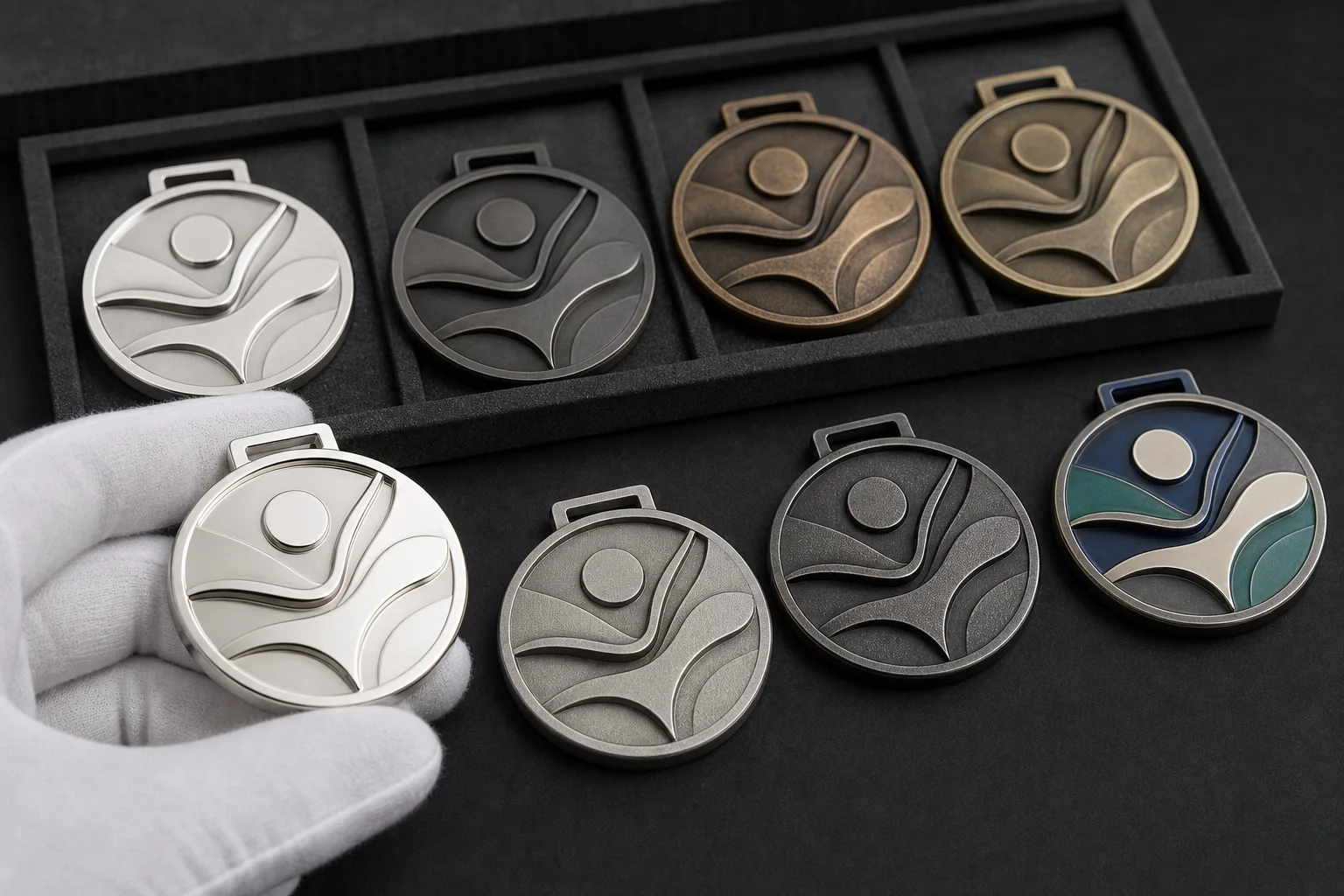
Die-Cast vs Die-Struck Medal Decision Matrix
The following matrix supports a preliminary custom medal process selection. It is not a substitute for tooling review or a supplier quotation.
| Decision factor | Die-cast starting position | Die-struck starting position |
|---|---|---|
| Outer profile | Stronger candidate for an irregular formed body | Potentially suitable for a controlled blank-like profile |
| Relief structure | Stronger candidate for sculpted, dimensional hierarchy | Stronger candidate for defined raised and recessed levels |
| Side geometry | Review when contours or thickness transitions are visually important | Review when the intended form is mainly face-driven |
| Holes and cutouts | Stronger starting candidate for integrated openings, subject to tooling review | Potentially suitable, but each opening requires feasibility review |
| Exposed-metal detail | Potentially suitable with coordinated finishing | Strong candidate when stamped levels and finish contrast define the appearance |
| Base metal | Confirm zinc-alloy specification and geometry | Confirm the suitable metal and stamping plan |
| Reverse design | Review complete front-to-back geometry | Review raised and recessed back artwork and orientation |
| Color and printing | Coordinate after or with base-form review | Coordinate after or with base-form review |
| Attachment | Review integration with the formed body | Review loop geometry and connection to the struck body |
| Moving components | Separate assembled-system review required | |
Leave the decision unresolved if material, thickness, relief direction, reverse geometry, color layout, attachment, or product construction is missing. Do not fill gaps with assumed specifications.
A useful decision sequence is: preserve the essential artwork hierarchy, confirm the material and complete geometry, coordinate decoration, and then compare tooling, price, schedule, and quantity implications through project-specific quotations. Neither process has an automatic quality, cost, speed, durability, or sustainability advantage.
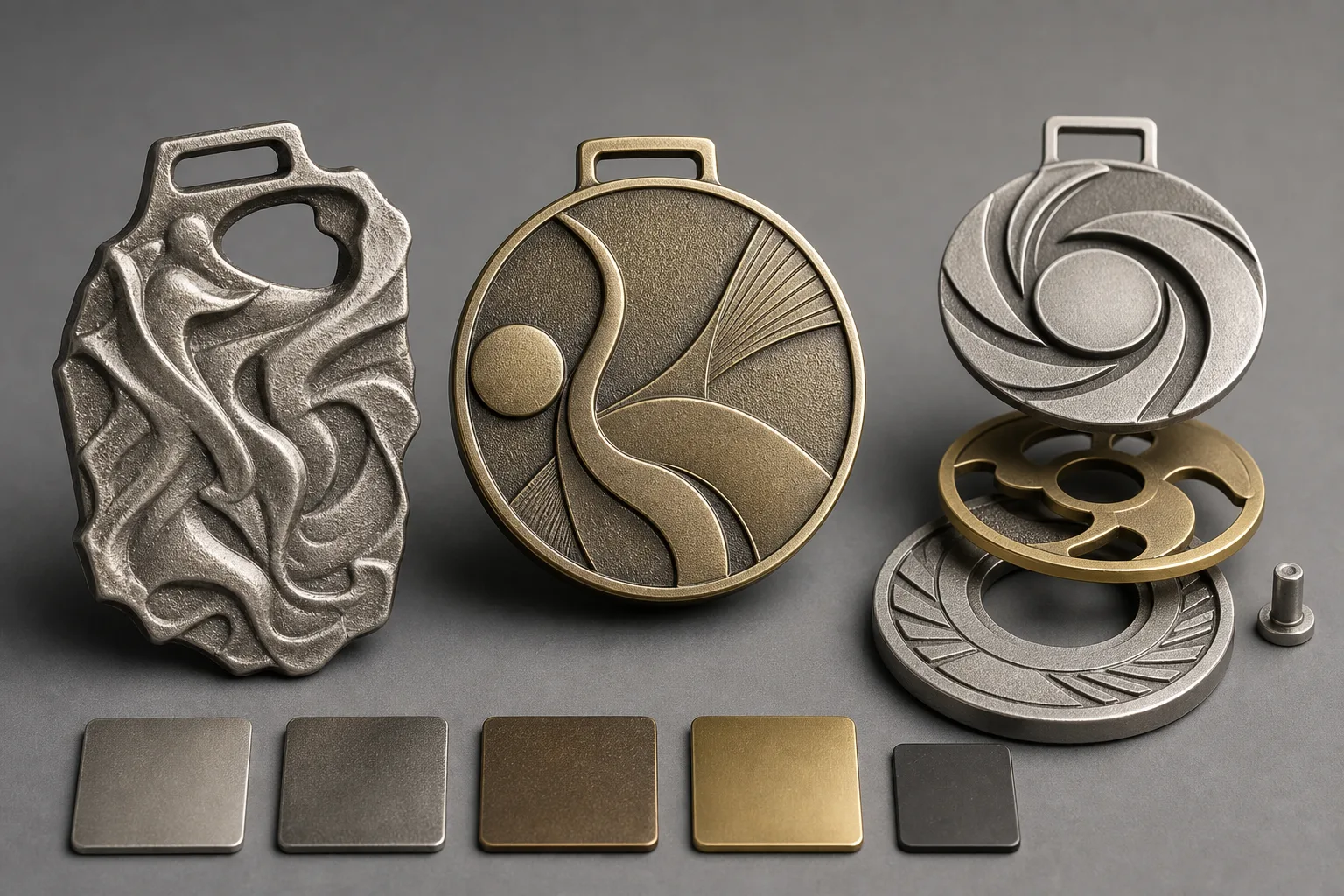
Buyer-Ready Artwork and Medal Specification Checklist
A complete RFQ makes the process recommendation more efficient while keeping unresolved technical items visible for engineering review.
- Product structure: Fixed one-piece medal, spinning medal, combination structure, or another defined construction.
- Commercial inputs: Quantity, design variants, destination, required schedule, and known shipping or trade-term preferences.
- Dimensions: Overall width and height or diameter, specified thickness, critical dimensions, edge profile, openings, cutouts, and side transitions.
- Artwork: Editable front and back files, outlined text or font information, color references, and any protected-artwork authorization.
- Relief: Raised and recessed directions, dominant subject, hierarchy of forms, annotated renderings, and cross-sections where useful.
- Negative space: A clear distinction between recessed fields, uncolored metal, through-holes, and cutouts.
- Material and forming: Known preferences or a request for an engineering recommendation between zinc-alloy die-casting and die-struck forming.
- Finish and decoration: Plating direction, exposed-metal boundaries, polished or matte areas, sandblasted or antique treatment, color method, and printed regions.
- Attachment and assembly: Loop position, ribbon specification, connecting parts, component alignment, movement, and clearances where applicable.
- Packaging: Individual protection, abrasion concerns, presentation, labeling, and distribution requirements.
- Inspection and testing: Required dimensions, tolerances, sampling, methods, limits, duration, and acceptance criteria.
Artwork, sample, testing, packaging, commercial, and shipment approvals are separate control points. An incomplete RFQ is not final production approval. If RoHS or REACH documentation is required, Gairun states a general compliance position, but the buyer should request current order-specific confirmation based on destination, product category, materials, finishes, use, substance criteria, and required documents.
From Process Recommendation to Tooling and Production Approval
- Requirement intake: Confirm artwork, quantity, dimensions, structure, material preference, decoration, attachment, packaging, destination, and schedule.
- Pre-tooling review: Evaluate thickness, relief, metal borders, color areas, openings, attachment geometry, component positions, and the proposed forming route. The exact checklist depends on the medal structure.
- Artwork approval: Establish the accepted production reference before tooling begins. Artwork approval does not approve pricing, testing, packaging, shipping, or other commercial terms.
- Tooling and trial forming: Develop tooling against the approved reference and assess the initial formed geometry.
- First-article inspection: Gairun’s stated process compares the first article with the approved 1:1 drawing for dimensions, thickness, and relief detail. Project tolerances and measurement methods must be specified separately.
- Operation-specific controls: Checks may include burr inspection after forming and flatness review after polishing where applicable. Acceptance criteria must be confirmed for the order.
- Custom sample when selected: A buyer-specific sample can be used to review appearance and construction. Sample approval and authorization for bulk production remain separate, and approval does not cover later unapproved changes.
- Production, packing, and shipment preparation: Coordinate continued production against the approved references and maintain packaging and shipment approvals as separate controls.
Gairun lists cross-hatch tape testing for plating adhesion, salt-spray testing for oxidation and corrosion resistance, and pull testing for medal ribbon connections as available tests. Test methods, limits, duration, sampling, and acceptance criteria require project confirmation; no result or pass status should be assumed without an order-specific report.
For a process recommendation, buyers can upload your artwork and specifications with unknown technical choices clearly marked for review. The objective is not to force every design into casting or striking, but to select a medal manufacturing process that supports the artwork’s essential geometry, material, decoration, and approval requirements.
Frequently Asked Questions
Are die-cast medals better than die-struck medals for 3D relief artwork?
Not automatically. Die-casting is a stronger starting candidate when sculpted dimensional relief and a formed body are central to the design. Defined raised and recessed levels may still suit die-struck forming. Unusually high relief may require review of another forming route.
Can the same medal artwork be quoted in both die-cast and die-struck versions?
Yes, when both routes appear feasible. Each version may require different engineering adaptation, tooling geometry, material assumptions, and decoration planning. The quotations should be compared against clearly identified specifications rather than treated as identical products.
Which process is the stronger starting choice for irregular medal shapes, holes, or cutouts?
Die-casting is generally the stronger starting candidate when an irregular formed body or integrated openings are essential. However, every outline, opening, border, side transition, and attachment still requires project-specific feasibility review.
Can die-cast and die-struck medals both use plating, enamel, matte textures, or printed details?
Both routes may be coordinated with these decoration directions, subject to the base metal, formed geometry, border widths, recessed areas, and intended finish. Decoration feasibility and approval should remain separate from approval of the base form.
What artwork files and specifications are needed before selecting the medal manufacturing process?
Provide editable front and back artwork, final dimensions, thickness requirements, relief direction, marked holes and cutouts, edge and side details, attachment position, material preferences, finish, color treatment, packaging, quantity, destination, and required schedule. Mark unknown technical items for engineering recommendation.
Should a custom sample be approved before bulk production of die-cast or die-struck medals?
A custom sample can be useful when appearance, relief, construction, attachment, or finish needs physical review, but it is not mandatory for every order. When sampling is selected, sample approval and authorization for bulk production should remain separate steps.