
To specify custom medals without guessing, make the decisions in this order: define how the medal will be worn and distributed, choose its finished face dimensions, set a provisional nominal body thickness, calculate a theoretical solid-blank mass, and then define the target assembled weight. Finally, verify the construction, attachments, packaging, and shipment assumptions. Diameter alone cannot predict weight, and a calculated metal-body mass is not the same as the weight of a finished medal with its ribbon and fittings.
The numerical bands below are starting guidance for named applications. They are not universal industry standards, production limits, tolerances, or final specifications. Gairun checks the selected dimensions together with artwork, relief, material, edge geometry, attachments, and intended use before tooling.
Medal Size Guide: Choose Diameter, Thickness and Weight in the Right Order
For a circular medal, specify the finished main-body diameter. For an irregular medal, state the maximum finished width and height from identified points on a revision-controlled 1:1 drawing. Do not convert an irregular outline into an “equivalent diameter,” because that hides projections, openings, and hanging-area geometry.
| Event or use inputs | Finished diameter or maximum dimensions | Nominal body thickness | Material context | Visual or wearability implication | Initial decision | Still to confirm |
|---|---|---|---|---|---|---|
| School sports; student wear; award-level differentiation; limited small components | 45–60 mm | 1.8–2.8 mm | Primary: iron. Alternatives: zinc alloy or aluminum. | Compact face and controlled wearable weight; rounded or chamfered edges deserve attention. | Start near the middle only after checking text and emblem space. | Age group, quantity, edge profile, artwork, assembled weight, and 20–25 mm ribbon. |
| 5K/10K road race; wearable finish-line award; volume distribution | 55–65 mm | 2.5–3 mm | Primary: zinc alloy. Alternatives: iron or aluminum. | More identity space while retaining a wearable event format. | Choose dimensions around the required logo, date, and race imagery. | Relief, cutouts, weight target, connector, and 25–30 mm ribbon. |
| Half-marathon; city identity; commemorative presence balanced with weight | 65–75 mm | 2.8–3.5 mm | Primary: zinc alloy. Alternative: aluminum. | Larger face supports layered imagery, but construction has a growing effect on mass. | Approximately 70 mm can be explored; 3.5 mm is the upper end of this scenario. | Relief levels, rear geometry, finished weight, and attachment arrangement. |
| Full marathon; strong event identity; long-term keepsake | 70–85 mm | 3–4 mm | Primary: zinc alloy. Alternative: brass. | Strong visual presence with greater material and packaging implications. | For concepts above 80 mm, consider openings, rear recesses, or local thinning. | Final geometry, material grade, weight, ribbon, protection, and distribution plan. |
| Ultra-marathon or 100 km; collector-oriented concept; limited wear duration | 80–100 mm | 4–6 mm | Primary: zinc alloy. Alternatives: brass or combined materials. | High commemorative presence, but a fully solid block would conflict with weight planning. | Build weight reduction into the concept from the beginning. | Component mass, movement, clearances, attachment validation, and 30–38 mm ribbon. |
Other published medal size charts can provide comparison points, but the selected band still needs to remain tied to the actual event and artwork. Running programs should also define race identity, design versions, ribbon branding, event date, sorting, shipping, and finish-line distribution.
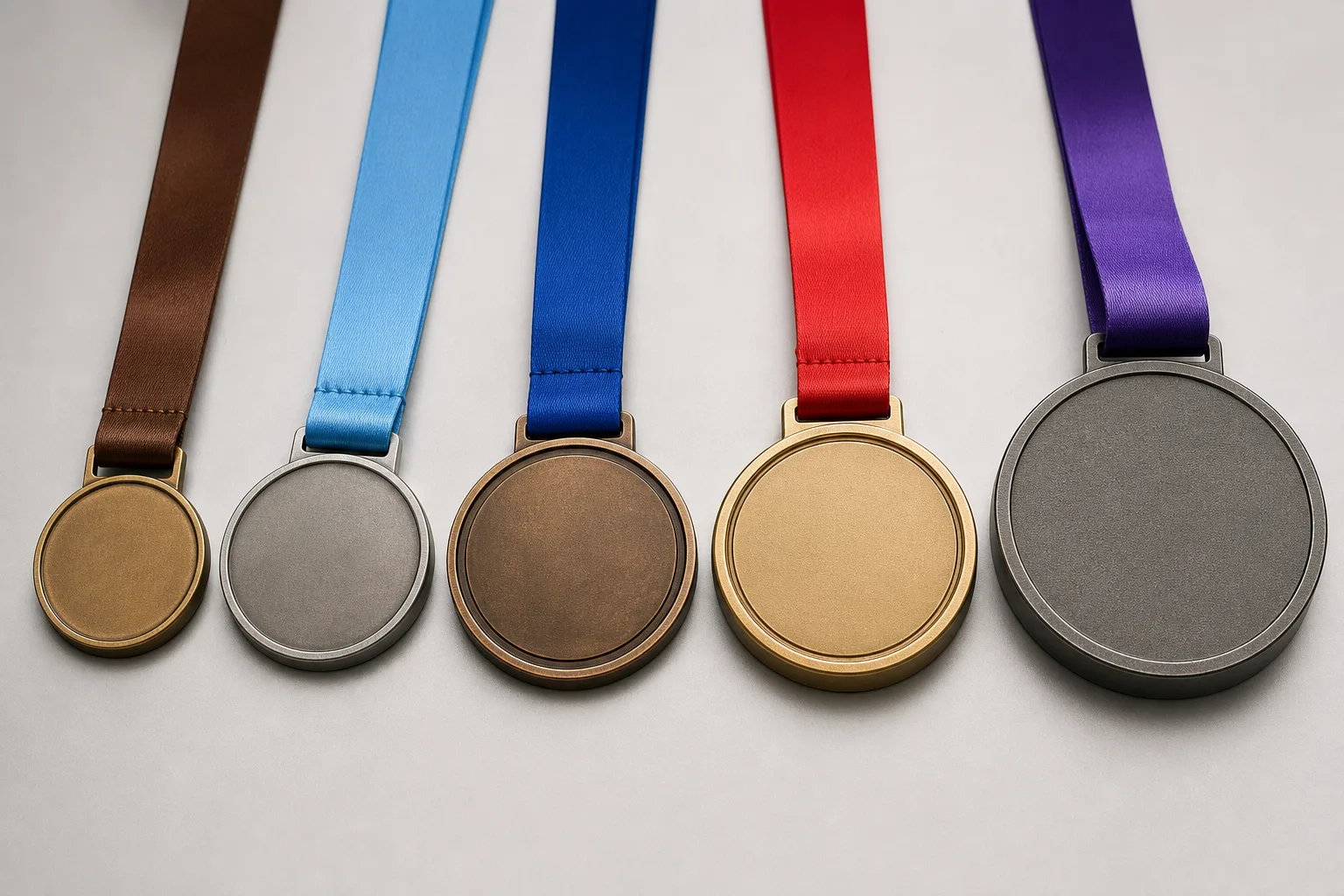
How Medal Diameter and Custom Medal Thickness Work Together
Diameter controls the available face area. Increasing it creates more room for logos, dates, text, borders, and imagery. If material and thickness stay unchanged, it also increases nominal material volume according to the square of the diameter.
Custom medal thickness needs a precise definition. “Nominal body thickness” should exclude raised relief, recessed fields, chamfers, rear cavities, hanging fittings, magnets, connected layers, and moving parts. If those features matter to packaging or presentation, specify total assembled thickness separately.
There is no universal diameter-to-thickness ratio. A 70 mm medal, for example, may begin within the 65–75 mm half-marathon guidance at 2.8–3.5 mm. Approximately 3.5 mm can be reasonable where stronger edge presence or deeper sculpted imagery is intended. It is not the default thickness for every 70 mm design.
Reducing thickness alone can alter the visible edge, relief hierarchy, openings, hanging area, narrow projections, and component connection zones. Gairun’s engineering review before tooling may therefore cover dimensions, relief, metal borders, color areas, attachments, component positions, and the proposed forming route. The exact checks depend on the artwork.
A 3D relief medal uses sculpted levels to separate dominant forms from supporting recessed details. The artwork should identify which subjects sit forward. Fine lines cannot be assumed to transfer unchanged. Pointed outlines, gear-like edges, narrow extensions, and products intended for students also need explicit edge treatment.
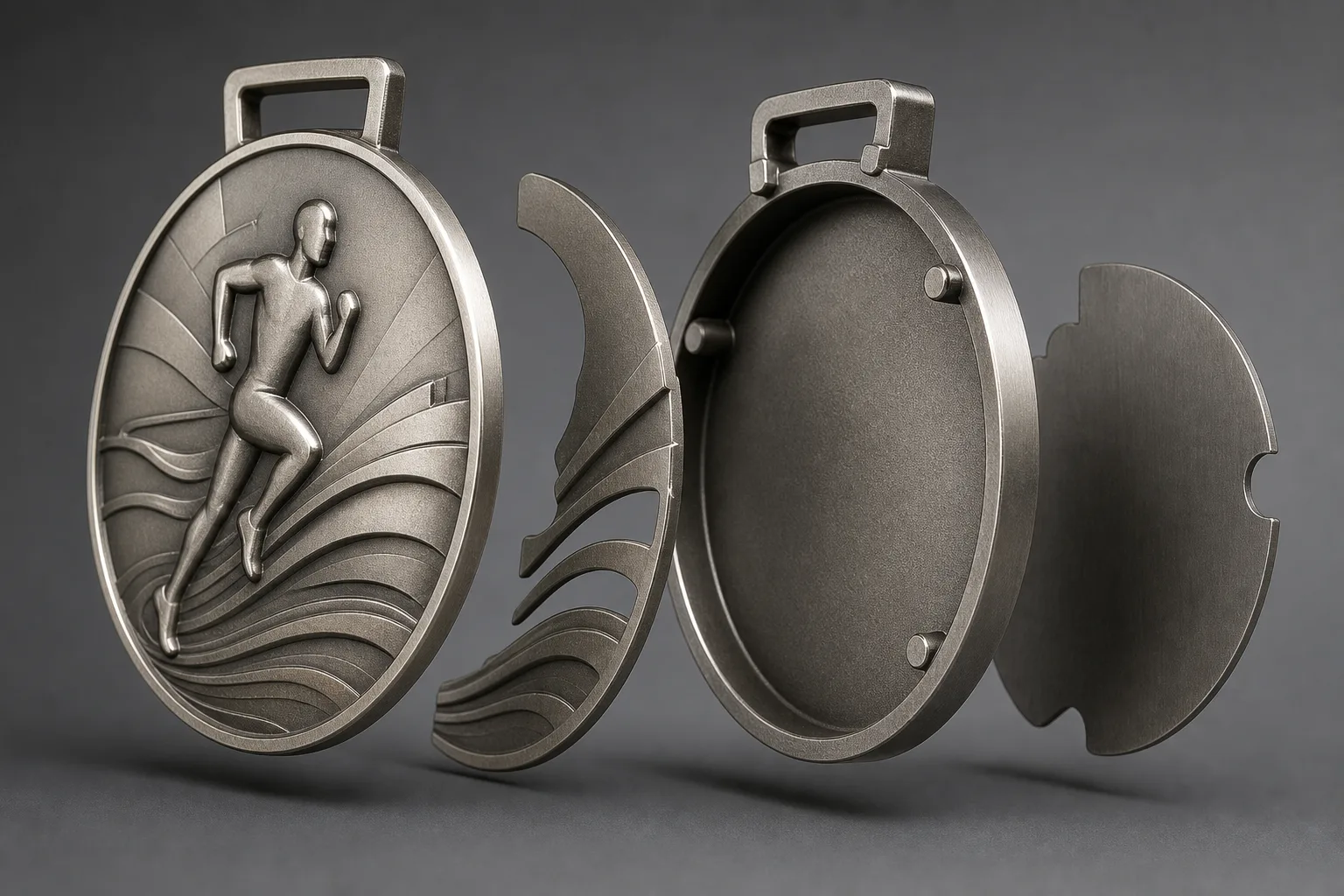
How to Calculate Custom Medal Weight Before Requesting a Quote
For a theoretical solid circular blank with uniform thickness, use:
mass_g = PI × (diameter_mm / 2)^2 × thickness_mm × density_g_per_cm3 / 1000
Diameter and thickness are entered in millimeters. Density is in grams per cubic centimeter. Dividing by 1000 converts cubic millimeters to cubic centimeters. The method is also illustrated by this external medal technical specification calculator.
The examples use identified calculation materials: ASTM A848 Grade 1 commercially pure iron at 7.87 g/cm3 and Zamak 3 zinc alloy at 6.60 g/cm3. These values must be checked against the current grade-specific supplier datasheet or material record used for the order. Do not apply either density to all iron or zinc alloys.
| Scenario example | Diameter × nominal thickness | Material and density | Formula substitution | Nominal solid-disc mass | Excluded features | Required confirmation |
|---|---|---|---|---|---|---|
| School sports | 50 mm × 1.8 mm | ASTM A848 Grade 1 iron; 7.87 g/cm3 | PI × 25² × 1.8 × 7.87 / 1000 | 27.8 g | Relief, holes, finish, ring, ribbon, and packaging | Actual material grade and measured assembled weight |
| 5K/10K road race | 60 mm × 2.5 mm | Zamak 3; 6.60 g/cm3 | PI × 30² × 2.5 × 6.60 / 1000 | 46.7 g | Relief, recesses, cutouts, decoration, connector, and ribbon | CAD geometry or production-representative weighing |
| Half-marathon | 70 mm × 3.5 mm | Zamak 3; 6.60 g/cm3 | PI × 35² × 3.5 × 6.60 / 1000 | 88.9 g | Relief, cavities, holes, plating, enamel, fittings, and ribbon | Measured complete weight against the agreed definition |
Results are rounded to the nearest 0.1 g. They are nominal solid-disc estimates, not promised finished weights. The 70 mm × 3.5 mm example uses the upper end of the half-marathon scenario; it does not establish a standard 70 mm medal thickness.
Material should not be chosen by density alone. Geometry, forming route, relief, decoration, and intended use also matter. Gairun states that incoming zinc alloy, brass, and iron are checked before production. Buyers needing formal evidence should request the applicable records rather than infer certification, batch traceability, or universal acceptance limits.
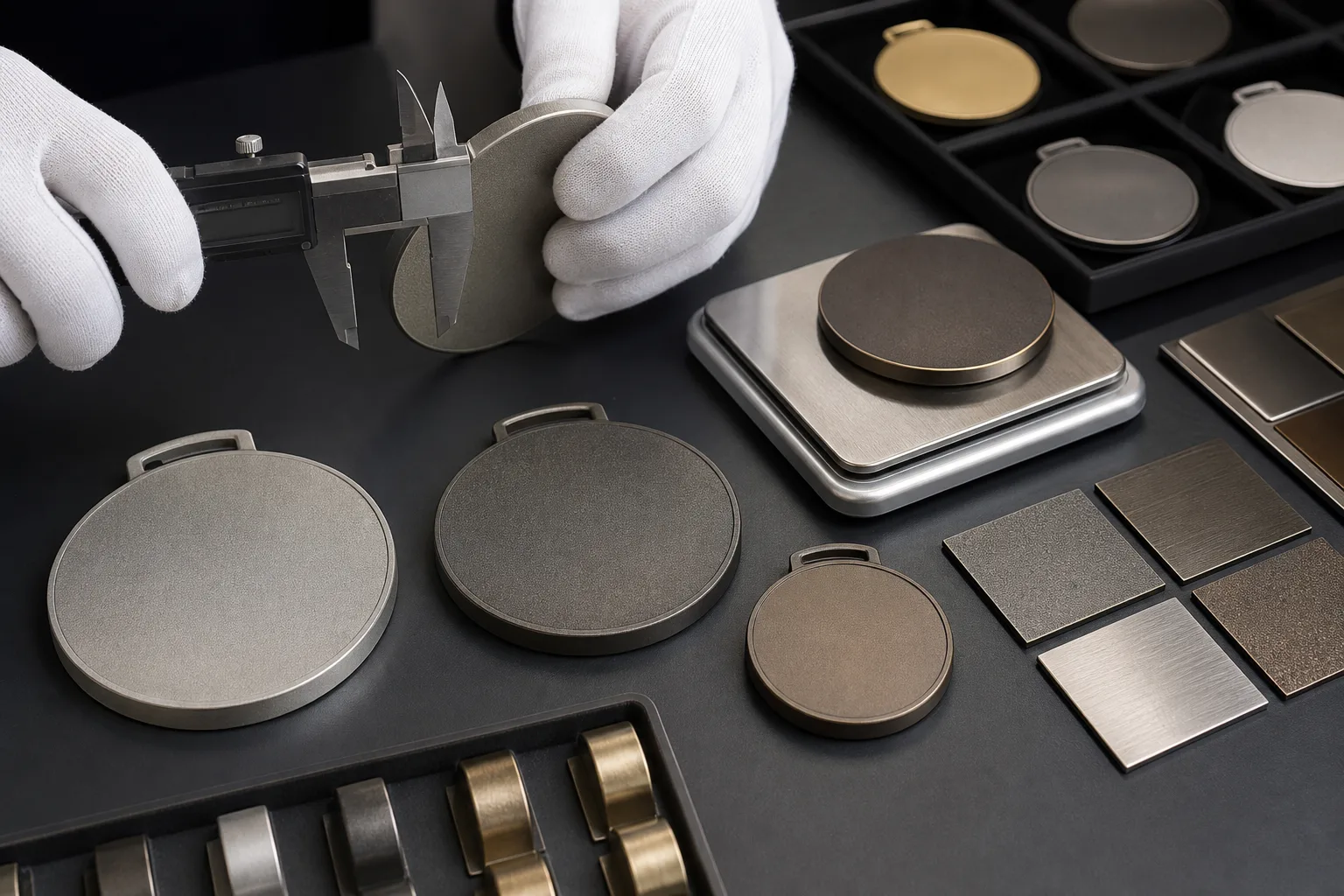
Why Relief, Cutouts, Materials and Multi-Part Construction Change Finished Weight
Two RFQs can list the same diameter and nominal body thickness yet produce different weights. Raised and recessed forms redistribute volume. An opening removes material, while a layered feature adds it. Rear cavities and local thinning may reduce mass, but the effect must come from final CAD volume or physical measurement, not a generic percentage.
Example 1: A wearable school-sports medal
A buyer starts with a 50 mm circular iron body at 1.8 mm nominal thickness, simple two-level artwork, rounded edges, and no moving parts. This fits the 45–60 mm and 1.8–2.8 mm school-sports guidance. Deeper relief, an irregular outline, added components, or a lower assembled-weight target could change the initial material and thickness decision.
Example 2: A sculpted half-marathon medal
A buyer starts with a 70 mm Zamak 3 body at 3.5 mm nominal thickness and sculpted city imagery. This sits at the upper end of the 65–75 mm half-marathon guidance. A lower weight target could lead to shallower rear geometry, openings, a rear recess, an alternative material, or a different construction.
An 80–100 mm, 4–6 mm ultra-marathon concept needs another approach. Weight reduction is required, and a fully solid body should be avoided. Open fields, rear cavities, locally thinned zones, or divided components may help, subject to the final geometry and connection requirements.
Spinning, magnetic, detachable, and layered medals are assembled systems. Their specification must define each component’s weight, total thickness, movement, alignment, connection points, and visible clearances. A one-piece medal merely identifies one fixed main body; it does not prove that the quotation will be simpler or less expensive.
Zinc alloy, iron, brass, stainless steel, and aluminum are among the metals Gairun lists for custom products. They should not receive universal rankings for price, strength, corrosion behavior, or sustainability. Compare an identified grade, geometry, finish, and use through a suitable metal materials comparison.
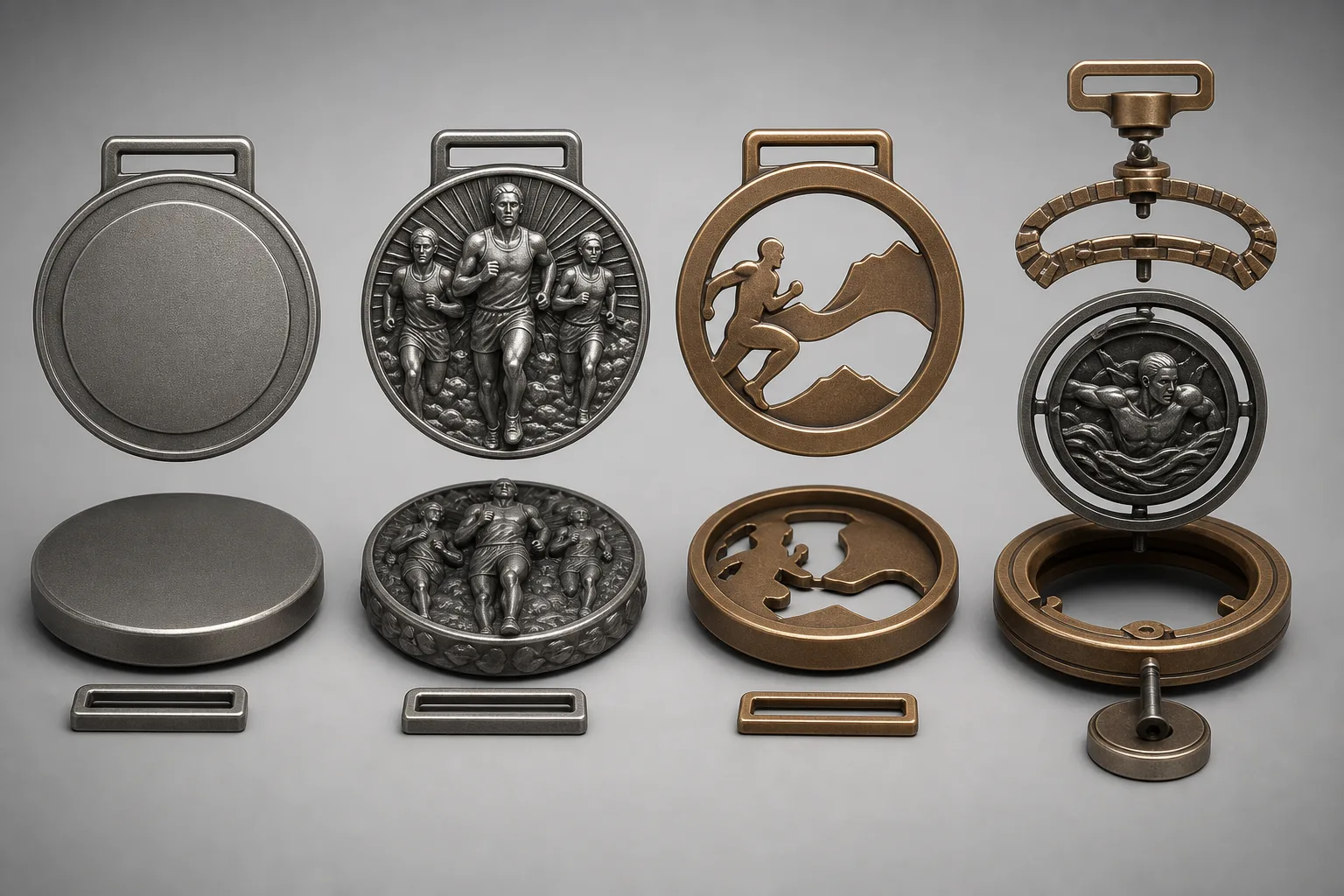
Check Wearability, Attachments, Packaging and Freight Weight
The weight line in an RFQ should say either “metal body only” or “complete assembly.” For complete assembly, list every included item: hanging ring, connector, ribbon, spinner, magnet, detachable piece, or additional layer. Ribbon and hanging configuration should follow assembled geometry and weight rather than diameter alone.
- School-sports programs may begin with a 20–25 mm ribbon.
- 5K/10K, half-marathon, and full-marathon programs may begin with a 25–30 mm ribbon.
- Ultra-marathon or 100 km collector-oriented programs may begin with a 30–38 mm ribbon.
These are scenario starting points. Confirm the hanging-hole position, ribbon orientation, connector alignment, and estimated assembled weight. Moving parts require buyer-defined anti-loosening criteria without assuming an unstated load limit. Participant age and intended use may also affect edge, finish, attachment, and small-component requirements.
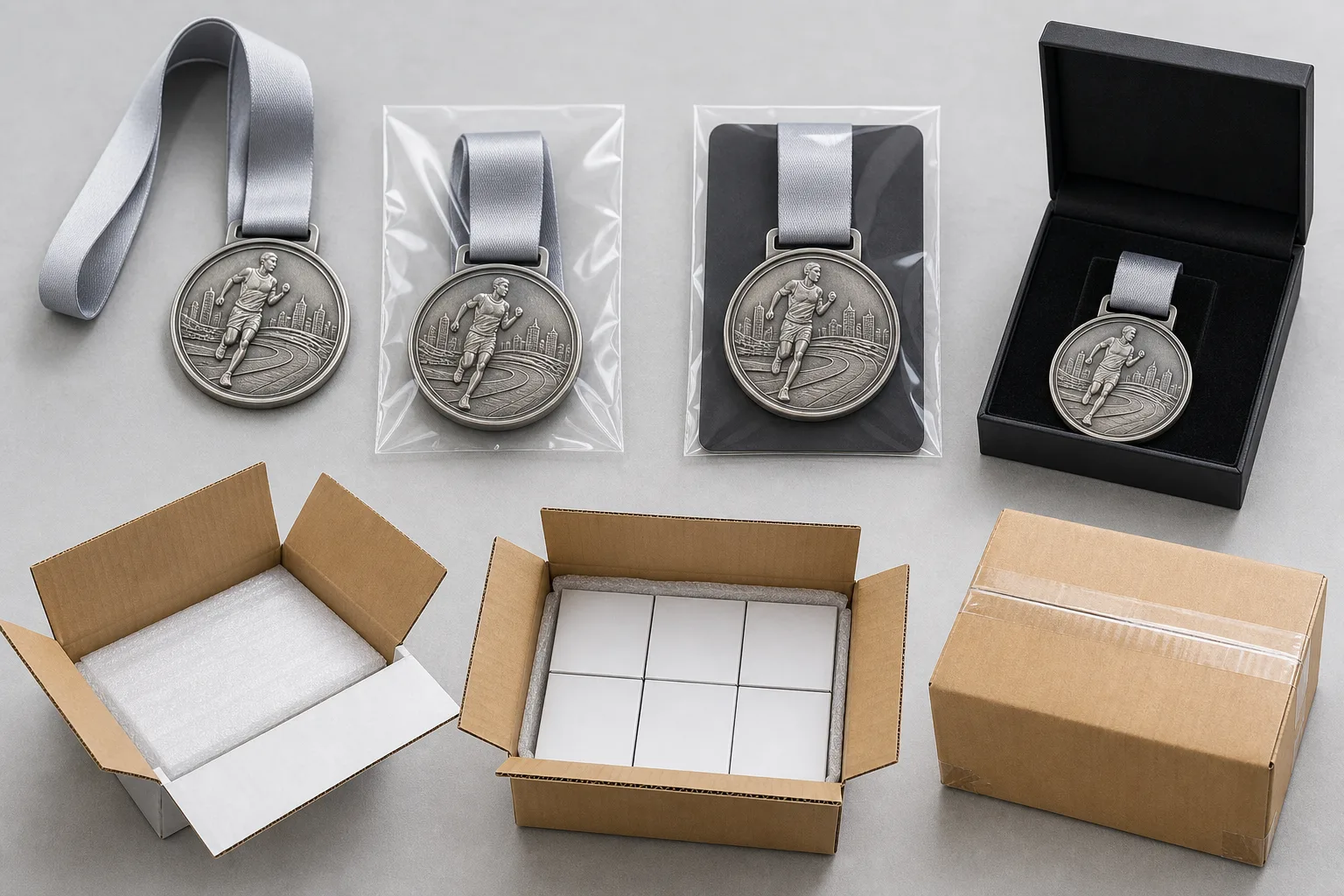
Protective packing and presentation packaging serve different functions. An individual bag or card-backed bag may support sorting and finish-line distribution. A selected collector program may use a gift or wooden box, but presentation packaging should not automatically be treated as sufficient transit protection. Use a custom packaging guide to separate these requirements.
Calculate packed shipment weight from measured or supplier-confirmed values: medal bodies, ribbons, connectors, unit protection, presentation boxes, carton tare, and order quantity. Reconcile the estimate against packed-carton data before shipment. Do not infer freight weight from medal diameter.
Validate Diameter, Thickness and Weight Before Tooling and Production
Use a controlled 1:1 proof with a revision identifier. It should show circular diameter or irregular maximum width and height, nominal body thickness, relief direction, openings, edge profile, hanging position, ribbon orientation, and front-to-back alignment.
- Separate nominal body thickness, local relief height, and total assembled thickness.
- Separate calculated solid-blank mass from target finished assembled weight.
- Define included components, measurement method, scale resolution, sampling basis, and buyer-required tolerance.
- Check text, borders, color areas, recessed details, and relief hierarchy at actual size.
- For connected designs, define movement, alignment, clearances, and anti-loosening criteria.
Tooling begins only after the relevant production artwork has been accepted. Artwork approval does not approve every commercial, testing, packaging, or shipment term. A buyer-specific custom sample may be selected where appearance, construction, or weight risk justifies it. Sample approval and authorization for bulk production remain separate steps.
Gairun describes first-article comparison against the approved 1:1 drawing for dimensions, thickness, and relief detail. Actual body thickness, assembled weight, attachment function, and packaging fit should be checked against written requirements. Tolerances and measurement methods must be agreed separately rather than inferred.
Copy-and-Use Medal Specification Block for Your RFQ
Use the following block so competing quotations address the same assumptions. Mark unresolved technical choices for assessment rather than filling them with guesses.
Event or award use:
Participant context and age group:
Quantity and design variants:
Circular finished diameter, or maximum width × height:
Nominal main-body thickness:
Local relief treatment or height:
Total assembled thickness, if relevant:
Preferred material and identified grade:
Acceptable material alternatives:
Construction: fixed / spinning / layered / magnetic / detachable / other:
Front and back artwork files and revision:
Openings, rear recesses, cutouts, and edge treatment:
Finish, color treatment, and text:
Nominal calculated solid-blank mass:
Target or maximum finished assembled weight:
Components included in weight definition:
Measurement method, sampling basis, and tolerance:
Custom-sample or first-article weight check required:
Ribbon width and branding:
Hanging hole, ring, connector, and orientation:
Movement, clearance, and anti-loosening requirements:
Protective packing:
Presentation packaging:
Sorting, labeling, and carton requirements:
Destination, distribution method, and required schedule:
Under Gairun’s OEM model, production follows buyer-supplied artwork or specifications, while technical assessment and buyer approval remain necessary. A useful RFQ includes quantity, dimensions, variants, finish, colors, attachments, packaging, destination, and schedule. Current material, construction, sampling, commercial, delivery, and compliance terms should come from the actual quotation. Buyers can request a project-specific quotation after completing the block.
Frequently Asked Questions
What custom medal thickness is appropriate for a 70 mm medal?
For the named half-marathon scenario, 70 mm falls within the 65–75 mm diameter and 2.8–3.5 mm body-thickness guidance. Approximately 3.5 mm is reasonable as an upper-end starting point when the artwork needs greater edge presence or sculpted depth. It is not a universal default.
How do I calculate custom medal weight?
Use mass_g = PI × (diameter_mm / 2)^2 × thickness_mm × density_g_per_cm3 / 1000 for a uniform solid circular blank. Use a verified grade-specific density and treat the result only as an initial body-mass estimate.
Why can equal-diameter medals have different finished weights?
Relief, recesses, openings, rear cavities, edge geometry, decoration, material grade, hanging fittings, and connected components change material volume or assembled mass.
Should I specify body-only or assembled weight?
Ideally, state both. Define body-only weight separately, then list every ribbon, ring, connector, spinner, magnet, or detachable component included in the assembled-weight target.
How should irregular or multi-part medal dimensions be specified?
State maximum finished width and height from defined points on an approved 1:1 drawing. Also specify nominal body thickness, total assembled thickness, component positions, movement, and visible clearances where applicable.
How does packaging affect freight weight?
Unit protection, presentation boxes, labels, inserts, carton tare, and carton configuration all add weight. Build the shipment estimate from measured component values and reconcile it against final packed cartons.