
When specifying Custom Medals, choose the relief style according to the feature that must remain recognizable at finished size. Use 2D or controlled multi-level relief when the design depends on crisp logos, lettering, maps, route lines, or color boundaries. Consider sculpted 3D relief when recognition depends on rounded volume, facial planes, anatomy, terrain, fabric folds, or curved architecture.
3D is not automatically clearer or more detailed. A disciplined 2D layout often protects graphic information better, while sculpted relief can make naturally rounded subjects more convincing. The production artwork must establish a visual hierarchy before tooling begins: identify the dominant subject, decide what projects forward, and keep supporting information recessed, flat, or visually quieter.
2D vs 3D Medals: A Quick Artwork Decision Framework
The practical distinction is between discrete graphic levels and continuously modeled surfaces. Supplier terminology varies, but this explanation of how 2D raised-and-recessed levels differ from sculpted 3D relief provides useful technical context. The label alone does not determine the material, forming method, or achievable detail.
| Observable artwork input | Practical production implication | Initial relief decision | What still requires confirmation |
|---|---|---|---|
| Bold event logo, date, distance, and surrounding text | Recognition relies on stable outlines and ordered information | 2D or controlled multi-level relief | Finished size, smallest essential lettering, borders, and color areas |
| Line-art emblem with narrow internal spaces | Lines must become defined metal features or separated decoration areas | 2D relief, possibly simplified | Feature widths, spacing, material, and finish |
| Architectural facade with windows, arches, and rooflines | Orderly planes can separate facade layers without distorting geometry | Multi-level relief | Whether domes, statues, or columns need curved modeling |
| Portrait or animal mascot | Facial planes and anatomy rely on gradual slopes and transitions | Sculpted 3D relief | Reference views, finished dimensions, likeness cues, and local relief |
| Mountain or trail scene | Terrain needs depth, but route graphics and wording need stable fields | Mixed stepped and sculpted relief | Terrain prominence, contour simplification, openings, and weight |
| Composition recognized mainly by color | Physical depth may contribute less than clean color boundaries | 2D or shallow multi-level relief | Color method, metal borders, finish, and color references |
| Central figure with event text and sponsor marks | The focal subject needs volume while commercial information needs flat geometry | Combined 2D and sculpted 3D | Separation between slopes, lettering, color, and exposed metal |
This table gives an initial artwork direction. Final feasibility also depends on dimensions, body thickness, material, local relief, forming route, edge geometry, openings, finish, attachment position, and the smallest features that must survive production.
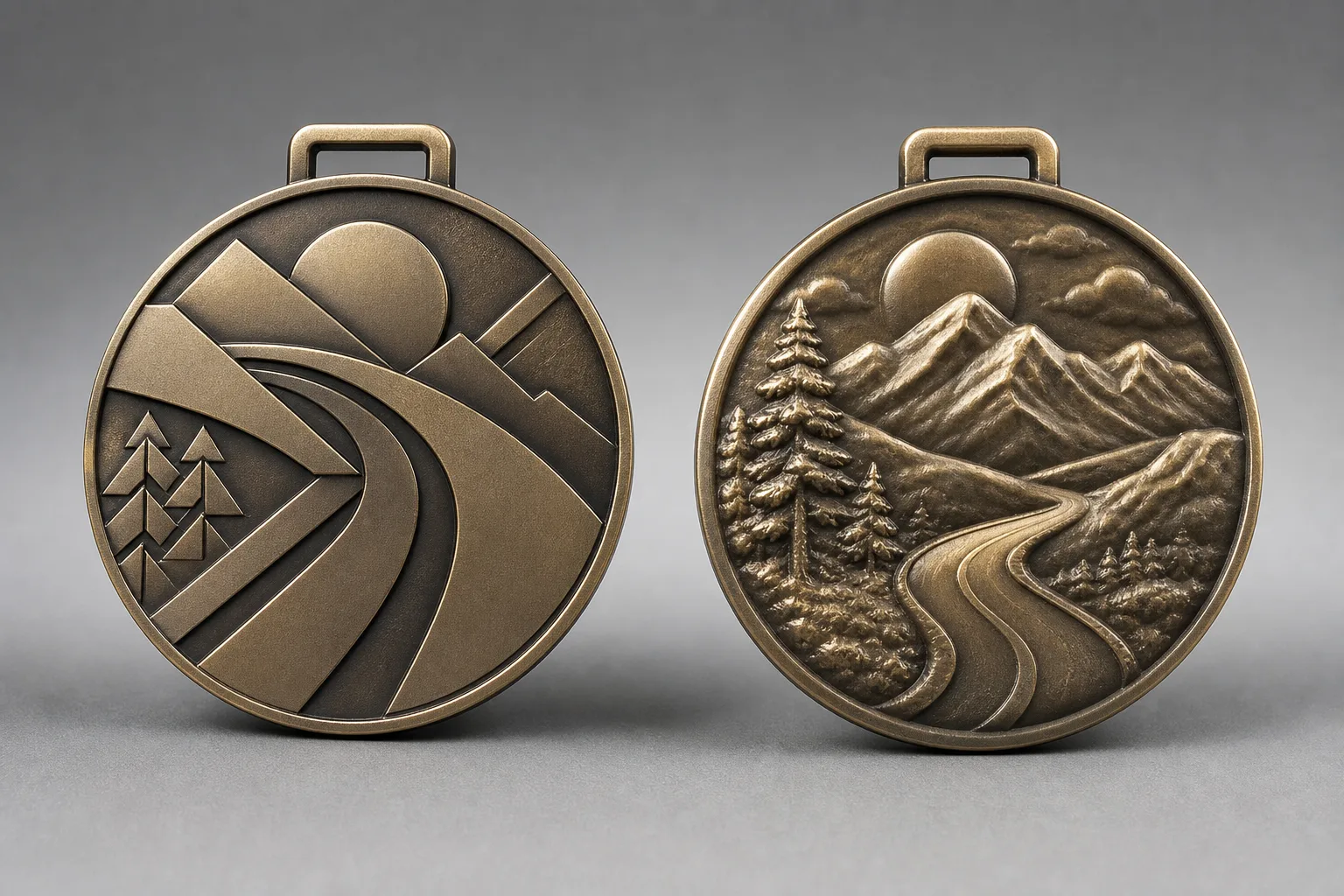
What 2D, Multi-Level, and Sculpted Medal Relief Actually Mean
2D medal artwork is organized through outlines and distinct raised or recessed areas. A letter, border, background, and emblem may occupy separate planes, but each plane remains largely controlled and graphic.
Multi-level relief adds intentional foreground, middle-ground, and background planes. It can create substantial depth while retaining firm boundaries. It is useful when overlapping subjects need separation but do not require continuously rounded modeling.
Sculpted medal relief uses gradual slopes and transitions to produce volume. A cheek, ball, animal body, mountain ridge, or dome changes height across its surface. Light and shadow therefore shift as the medal moves. Gairun describes its 3D Relief Medals as using sculpted levels to establish a hierarchy of raised and recessed forms.
Printed gradients, illustrated shadows, transparent color, and plating contrast are surface cues, not physical medal relief levels. They may support depth visually, but they do not create geometry. One medal can also combine methods: a sculpted portrait can sit within flat lettering, dates, borders, sponsor marks, and color fields.
A production proof should distinguish raised and recessed areas, flat fields, sculpted transitions, textures, engraved details, borders, openings, and decorated areas. Even a fixed one-piece medal needs front and back layouts, maximum dimensions, relief direction, body thickness, and attachment details. Fine illustration cannot be assumed to transfer unchanged or achieve a chosen depth without an accepted proof.
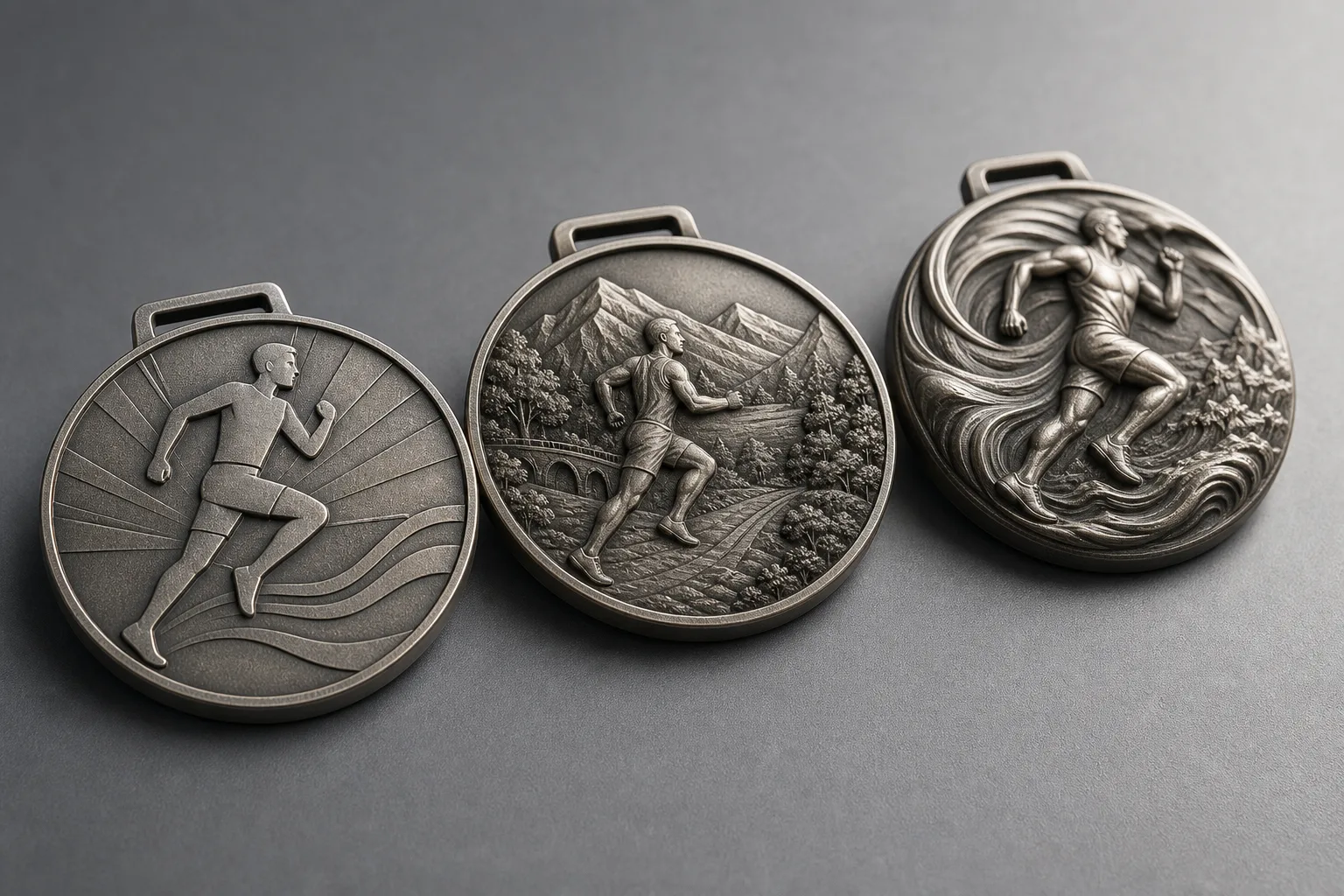
Which Artwork Subjects Reproduce More Clearly in 2D or 3D Relief?
Example 1: Running-event information. A hypothetical medal contains a race logo, route line, date, distance, and sponsor names. The initial choice would be 2D or controlled multi-level relief because recognition depends on crisp boundaries and information order. A central city landmark could change the direction if its curved form is essential.
Race identity, distance versions, event date, and ribbon branding should be treated as protected graphic information. Terrain, decorative foliage, and background texture should not compete with them. Event organizers should also confirm that they are authorized to provide sponsor marks and other controlled artwork.
Example 2: Portrait or animal mascot. A front-facing portrait with visible cheekbones, brow shape, muzzle, or rounded anatomy initially favors sculpted 3D relief. The decision could change if the approved identity is intentionally flat, the medal is too small for the essential planes, or color carries most of the recognition.
Useful approval criteria are specific cues, such as the silhouette, eye placement, jawline, ear shape, or characteristic pose. “Make it more 3D” is not a measurable direction. Portrait likeness and small anatomical details should be judged against accepted references and, where appropriate, a physical sample.
Example 3: Architecture and terrain. A facade with repeated windows, arches, and rooflines often suits multi-level relief. Domes, curved columns, statues, and irregular stone surfaces may benefit from selective sculpting. A mountain scene can use modeled ridges while keeping contour lines, route graphics, dates, and event wording on stable planes.
Example 4: Ball-sports medal. A ball or athlete can receive sculpted volume while the crest, season, ranking, and event name remain flat. The observable input is a mixed composition with both rounded and graphic recognition cues. The missing variables are finished size, body thickness, material direction, and the space reserved for text.
Selective simplification is usually more useful than uniform detail. Individual hair strands, fine fur, foliage, masonry, and crowded textures can merge visually or weaken the main subject. Preserve the face, emblem, landmark, route, or event name first.
How 2D Medal Artwork Changes for Sculpted 3D Production
Flat source artwork is not yet a production relief map. For 2D construction, convert important elements into closed areas. Assign raised and recessed metal, borders, text treatment, color boundaries, textures, and front-versus-back content. Resolve open paths and ambiguous overlaps before they reach tooling.
For multi-level artwork, assign foreground, middle-ground, and background planes. If an illustration shows one object crossing another, specify which object remains forward at the intersection. Avoid asking the toolmaker to infer physical order from shadows alone.
For sculpted 3D production, provide reference views that explain the intended form. Front, side, or angled images may be useful for a portrait, mascot, landmark, terrain feature, or fabric fold. Photographic highlights, perspective, gradients, and background blur are reference cues. They do not automatically become metal geometry.
Keep logos and text on controlled graphic fields where practical. Placing lettering across a steep sculpted slope can change letter shape and readability. Common candidates for simplification include thin strokes, small letter counters, individual hairs, fur, brick patterns, foliage, contour lines, and dense background textures.
Gairun can begin artwork assessment from vector artwork, a usable PDF, or a hand-drawn concept when supporting information is available. Under an OEM route, the buyer supplies defined artwork and specifications. ODM support can begin with a sketch, reference, or broader idea. Neither route removes engineering assessment or buyer approval.
- Source artwork or concept and exact wording
- Approved reference views for sculpted subjects
- Maximum dimensions and body thickness direction
- Front and back layout
- Dominant feature and intended relief hierarchy
- Color areas, color references, and finish direction
- Openings, cutouts, ribbon, and attachment position
- Design variants and quantity for each version
A pre-tooling Engineering Review and Design for Manufacturing may cover dimensions, thickness, relief, metal borders, color areas, attachments, component positions, and the proposed method. The exact checklist changes with the artwork and structure.
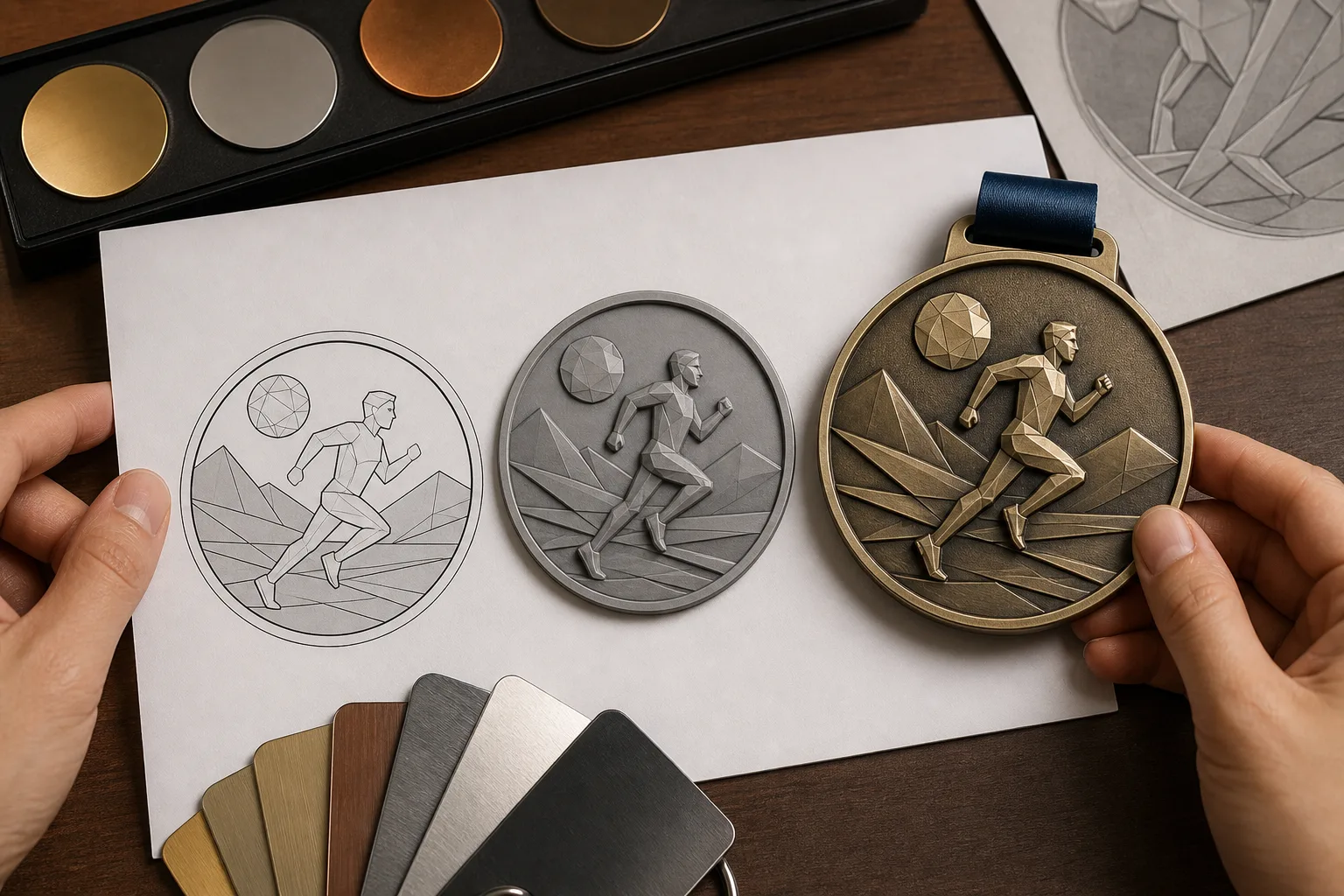
How Relief Choice Affects Tooling, Forming, and Medal Construction
The controlled sequence is straightforward: accepted production artwork establishes the reference, tooling defines the intended geometry, and trial forming shows how that hierarchy transfers to the physical part. Two-dimensional and multi-level designs need clear boundaries and plane assignments. Sculpted designs also need slope, transition, volume, and focal-prominence information.
According to Gairun’s official manufacturing information, its Mold Making and CNC Engraving workshop develops tooling that defines shape, dimensions, thickness, and relief. This statement does not establish an unspecified tolerance, machine quantity, or guaranteed relief capability.
Gairun lists zinc-alloy die-casting, stamping or die-struck forming, photo etching, and hydraulic high-relief forming. These routes are not interchangeable. Selection depends on material, part shape, relief structure, body thickness, edge geometry, openings, and the decoration plan—not simply whether the buyer calls the medal 2D or 3D.
A large rendering may show transitions that become crowded at physical size. The production version may need wider separation, simplified textures, stronger plane changes, or a revised hierarchy. Evaluate the proof at 1:1 scale before accepting it.
Relief and medal structure are separate decisions. A fixed one-piece medal has one main body. A spinning or combination medal introduces alignment, connection points, movement, retention, and visible clearances. It must be assessed as an assembled system rather than treated as a normal medal with an added 3D label.
As contextual planning guidance, a zinc-alloy half-marathon medal may be considered at 65–75 mm and 2.8–3.5 mm. A full-marathon concept may use 70–85 mm and 3–4 mm with high relief, cutouts, two-tone plating, or two-sided artwork. These are scenario references, not universal specifications. Final artwork, local relief, estimated weight, edge treatment, openings, and ribbon connection still need confirmation. Designs above 80 mm may prioritize cutouts, rear recessing, or local thinning to manage weight, subject to final engineering assessment.
Using Finish, Texture, and Color to Preserve Relief Clarity
Finish can strengthen or weaken an established relief hierarchy. Polished highlights beside recessed matte or textured fields can separate adjacent areas without adding another physical level. Antique-style directions can visually emphasize recesses and modeled texture, while highly reflective surfaces may change perceived detail under different lighting.
Gairun lists gold, silver, nickel, black nickel, antique bronze, and antique silver as plating directions. Final tone and feasibility must be coordinated with the artwork, base metal, relief, and exposed metal areas. These names do not imply precious-metal purity, plating thickness, or a particular corrosion result.
Color fills, printed gradients, and transparent effects need deliberate boundaries. They do not substitute for sculpted shading. A practical mixed design might use a sculpted central figure, a matte background, polished high points, and flat color fields for an event emblem. The separation must remain clear at finished size.
Texture should not interfere with essential lettering, facial cues, route lines, or emblem details. Sandblasting and matte finishing can reduce shine or create contrast, but suitability depends on treated-area width, position, base metal, forming route, and surrounding relief. Exact texture or gloss requires a written specification or approved sample.
Clear epoxy can be requested as a transparent layer over decorated areas. It changes the surface presentation and should not be assumed. Its use alone does not support claims that a medal is scratch-proof, UV-proof, or chemically resistant.
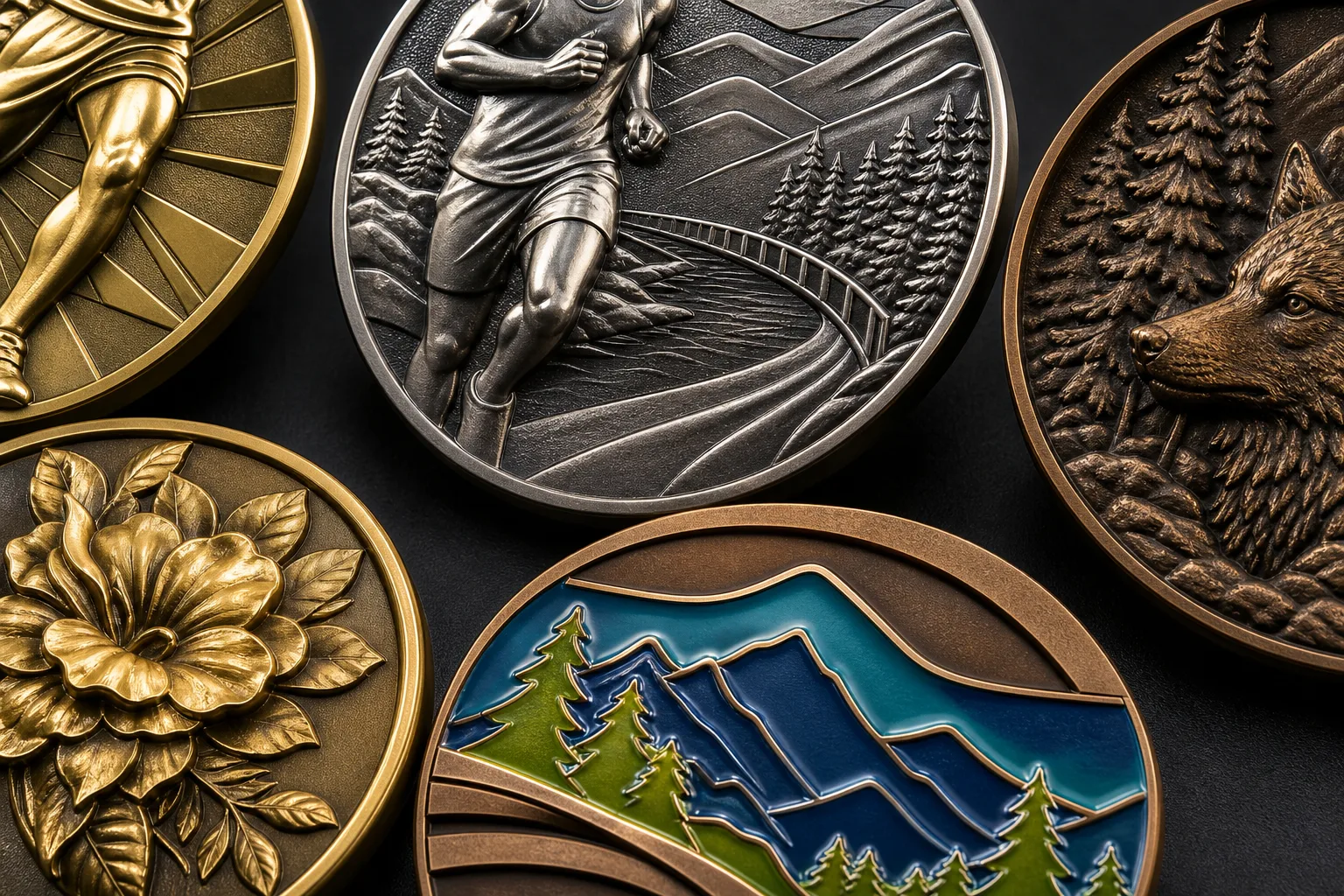
Final Proof Checklist Before Approving 2D or 3D Relief
Tooling should begin only after the relevant production artwork has been examined and accepted. Artwork acceptance controls the tooling reference; it does not approve commercial terms, testing requirements, packaging, or shipment arrangements.
- View the proof at intended physical size, not only as an enlarged screen image.
- Identify the dominant subject and foreground-to-background order.
- Confirm every raised, recessed, flat, textured, and continuously sculpted area.
- Check exact wording, dates, logos, borders, color fields, and front and back content.
- Compare portraits, mascots, landmarks, and terrain with approved reference views.
- Verify dimensions, body thickness, intended local relief, material direction, and proposed forming route.
- Confirm finish, color treatment, openings, edge treatment, and estimated weight where relevant.
- Define ribbon width, connection structure, and attachment position.
- For moving parts, define alignment, clearance, retention, and expected assembled behavior.
After tooling and trial forming, Gairun’s stated process compares the first article with the approved 1:1 drawing for dimensions, thickness, and relief detail. Tolerances and acceptance criteria must be documented separately. In-process checks such as burr inspection or flatness checks apply according to the work performed and are not a universal test plan.
A custom sample can help evaluate buyer-specific appearance and construction, especially for portraits, complex terrain, mixed finishes, or connected structures. Sample approval and bulk-production authorization remain separate steps, and not every order requires a custom sample.
For an RFQ, provide product format, quantity, dimensions, artwork, variants, finish, color treatment, attachments, packaging, destination, and required schedule. Unresolved technical choices can be marked for discussion rather than invented. More preparation guidance is available in Gairun’s Design and Artwork resources.
Frequently Asked Questions
Are 3D relief medals always more detailed or clearer than 2D medals?
No. 2D relief often preserves lettering, logos, maps, and boundaries more clearly. Sculpted 3D relief is more suitable when rounded form is an essential recognition cue.
Can one medal combine 2D lettering and color fields with a sculpted 3D central subject?
Yes. This is often an effective hierarchy. The central subject can use modeled volume while text, dates, borders, and color fields remain on stable graphic planes.
What reference images are needed for a portrait, mascot, landmark, or terrain scene?
Provide clear approved views that explain shape, depth, and essential recognition cues. Front, side, and angled references may be useful, depending on the subject and intended relief.
How many medal relief levels should be identified on production artwork?
Identify every level needed to remove ambiguity. A simple design may need raised and recessed assignments. A complex design may need several planes plus continuously sculpted areas. There is no universal ideal number.
When is a physical sample advisable for a 3D relief medal project?
Consider one when likeness, complex terrain, local depth, mixed finishes, weight, attachments, or moving components are important acceptance points. Sampling remains separate from authorization for bulk production.