
For most buyers, the practical choice is not “which process is better?” It is “which process fits the coin structure I am trying to build?” A regular circular coin with controlled raised and recessed artwork may start with a die-struck evaluation, especially with a brass-oriented material direction. An irregular, sculpted, cutout, layered, rotating, magnetic, or removable design may start with zinc-alloy die-casting. Explore Custom Challenge Coins as a reference point, then submit the complete construction brief before approving tooling.
This initial direction is not a final feasibility decision. Dimensions, thickness, relief, edge form, material, decoration, quantity, packaging, tolerances, and acceptance requirements can change the recommended route. At Gairun, the coin edge, border, thickness, front face, and reverse face are treated as one connected structure rather than as separate artwork features.
Choose Die-Struck or Die-Cast Challenge Coins by Design Intent
Begin with the design intent, not with the name of the manufacturing process. Identify the intended material, body outline, relief hierarchy, edge treatment, decoration plan, and whether the coin is a fixed one-piece body or a multi-component construction.
A regular circle or simple geometric body often supports a die-struck starting point. This is especially true when the artwork uses controlled raised and recessed fields, a clear border, and a brass-oriented material direction. Official, association, corporate, and recognition coins commonly begin with this type of assessment.
A zinc-alloy die-cast route may be the stronger starting direction when the subject is sculpted or strongly dimensional. It can also be considered for irregular silhouettes, local cutouts, layered structures, rotating elements, magnetic elements, or removable components. Fine artwork details still need a forming assessment; they should not be assumed to transfer unchanged.
Plan both faces together. A front emblem may look suitable for one route, while reverse-face text, border continuity, edge orientation, or component clearance changes the construction. The first route is only an engineering direction. It does not confirm feasibility, tooling scope, price, quantity, schedule, finish performance, or production authorization.
How the Coin Forming Process Differs: Die-Struck vs Die-Cast
In die-struck forming, metal is stamped around raised and recessed design areas. The result is organized around the shape of a prepared blank and the relief defined by the forming tools. Polishing, plating, color application, printing, engraving, or assembly may follow as separate operations when the artwork requires them.
Zinc-alloy die-casting forms the body through a moldable alloy route. This can support an irregular outline or a more sculptural body concept, but the actual result depends on geometry, wall sections, relief, connections, and the decoration plan. A rendered 3D image is useful for communication, but it is not a substitute for production artwork and structural checks.
The distinction matters because forming is only one part of challenge coin manufacturing. A coin can be formed, polished, plated, colored, printed, engraved, assembled, inspected, packed, and prepared for shipment in a connected sequence. The order and combination depend on the design.
Gairun lists zinc alloy, brass, iron, stainless steel, and aluminum among its possible base-metal directions for custom products. That list does not mean every metal suits every forming route. Material should be considered with the outline, relief, decoration, intended use, and acceptance standard.
For this reason, avoid universal claims that one route is always stronger, more durable, more economical, faster, or more premium. The relevant comparison is the quoted construction: its material, tooling, labor, finish, quantity, packaging, and inspection requirements.
Die-Struck vs Die-Cast Challenge Coins: Buyer Decision Table
The table below gives an initial direction from observable design signals. The last column identifies the information that must be settled before the route becomes a controlled production plan.
| Observable input | Practical implication for construction | Initial forming direction | What still requires confirmation |
|---|---|---|---|
| Regular circular body | Consistent perimeter and two defined faces support a conventional coin structure. | Assess die-struck first, particularly with brass-oriented material. | Body thickness, relief height, edge style, and reverse-face alignment. |
| Irregular outline | Tips, narrow bridges, and shaped perimeter areas affect connection strength and edge treatment. | Assess zinc-alloy die-casting first when the silhouette is central. | Rounded tips, minimum connection areas, thickness transitions, and burr control. |
| Raised and recessed 2D relief | Artwork can be organized into primary subjects and supporting fields. | Assess die-struck forming first for a regular body. | Text scale, relief hierarchy, face alignment, and surface finish. |
| Sculpted or strongly dimensional subject | High points, sloping forms, and depth changes become part of the body structure. | Assess zinc-alloy die-casting first. | Feature transfer, high-point protection, assembled thickness, and visual acceptance. |
| Continuous rope or shaped edge | Edge geometry must remain continuous around the full perimeter. | Either route may be considered. | Edge orientation, corner transitions, tactile finish, and tool feasibility. |
| Local cutouts | Open areas require adequate bridges and protection against weak connecting sections. | Assess die-cast construction first when cutouts dominate. | Connection strength, deburring, clearance, and transport protection. |
| Front-to-back orientation | Text, emblems, and edge patterns must read correctly when the coin is turned. | Either route may be considered. | Face alignment, flip direction, border continuity, and drawing convention. |
| Color fields and exposed metal | Decoration and polished areas depend on relief boundaries and accessible surfaces. | Choose the base-form route first. | Plating tone, color system, treated-area width, and appearance standard. |
| Flat personalization zone | Names, dates, or sequential numbers need a stable, sufficiently flat area. | Either route may be considered. | Data format, numbering rules, placement, font, and uniqueness checks. |
| Multi-layer or moving elements | Assembly clearances and retention become as important as the coin body. | Assess zinc-alloy die-casting plus assembly options first. | Component tolerances, retention, drop performance, magnets, and packaging. |
As scenario planning guidance, an official or association coin may use a 38–50 mm diameter and 3–4 mm body thickness. A complex sports scenario may use 40–50 mm diameter and 3–4 mm body thickness. These are not factory standards or engineering limits. The final values must match the buyer’s artwork and construction.
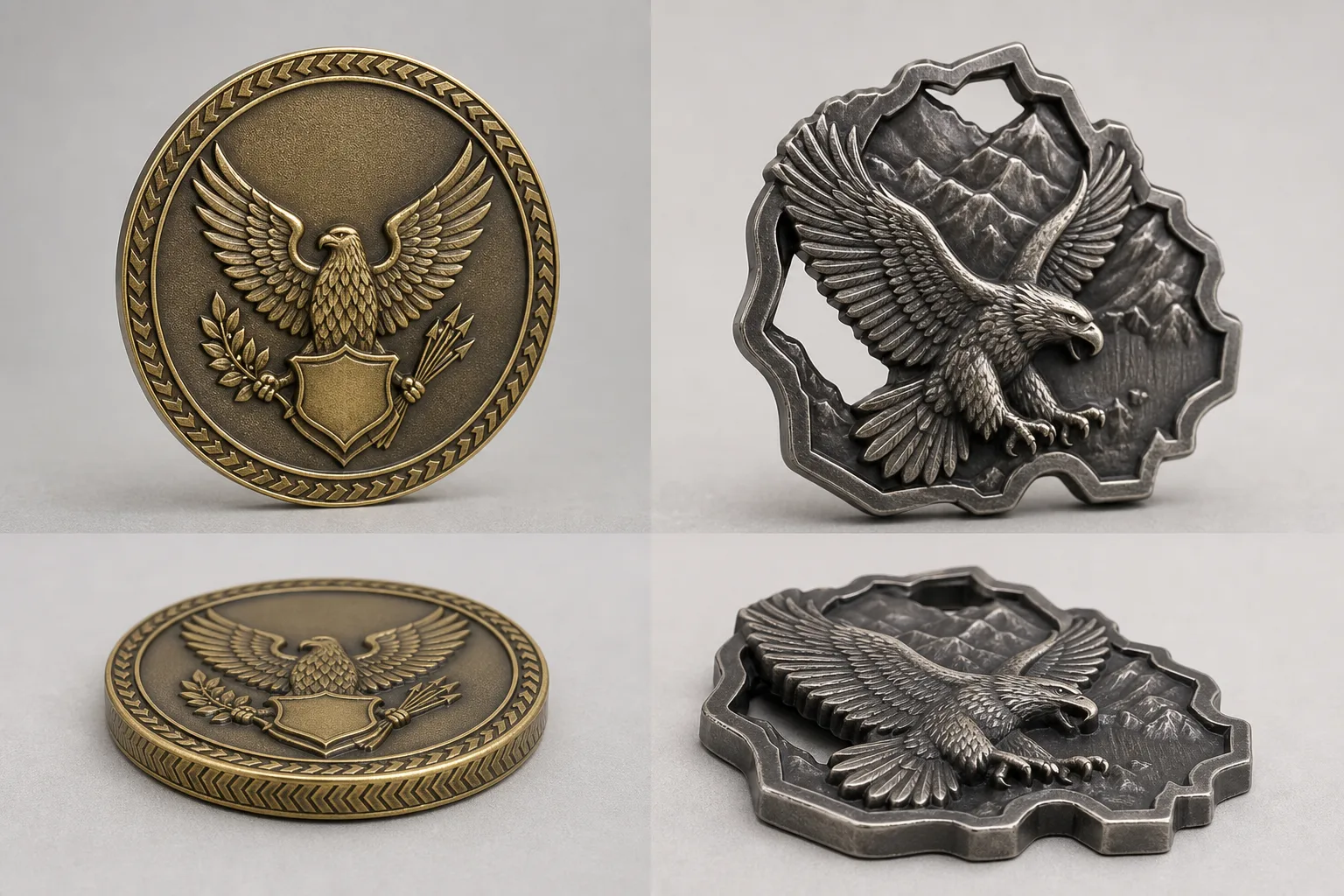
Match Geometry, Relief, Edge Design, and Components to the Forming Route
Geometry should be discussed as a complete object. For a circular coin, confirm whether the border is continuous, whether the edge is plain or patterned, and whether both faces share the same orientation. For an irregular coin, identify narrow tips, deep notches, local cutouts, and the areas that connect the main body.
Relief also needs a hierarchy. Mark the dominant subject, supporting fields, recessed background, and any layered or sculpted elements. Challenge-coin relief may be raised, recessed, layered, or sculpted. Without a clear hierarchy, a detailed illustration can become difficult to form, finish, and inspect consistently.
Possible edge directions include plain, rope, diagonal, fine-tooth, custom-text, and shaped treatments. An edge treatment is not confirmed simply because it appears in a rendering. Its continuity, orientation, tactile condition, and compatibility with the selected forming route must be established in the production drawing.
Ask how burrs will be controlled after forming, especially on toothed edges and local cutouts. Irregular tips may need rounded treatment. Connecting sections around openings need enough strength for the intended handling conditions. Gairun’s stated in-process checks include burr inspection after forming and flatness checks after polishing; the acceptance criteria should still be written for the order.
Rotating, magnetic, removable, or layered elements raise the validation level. The brief should address assembly clearance, retention, drop handling, and transport packaging. Small magnets and moving parts can detach and are unsuitable for young children. If the destination market or intended users introduce safety requirements, those requirements should be identified before production.
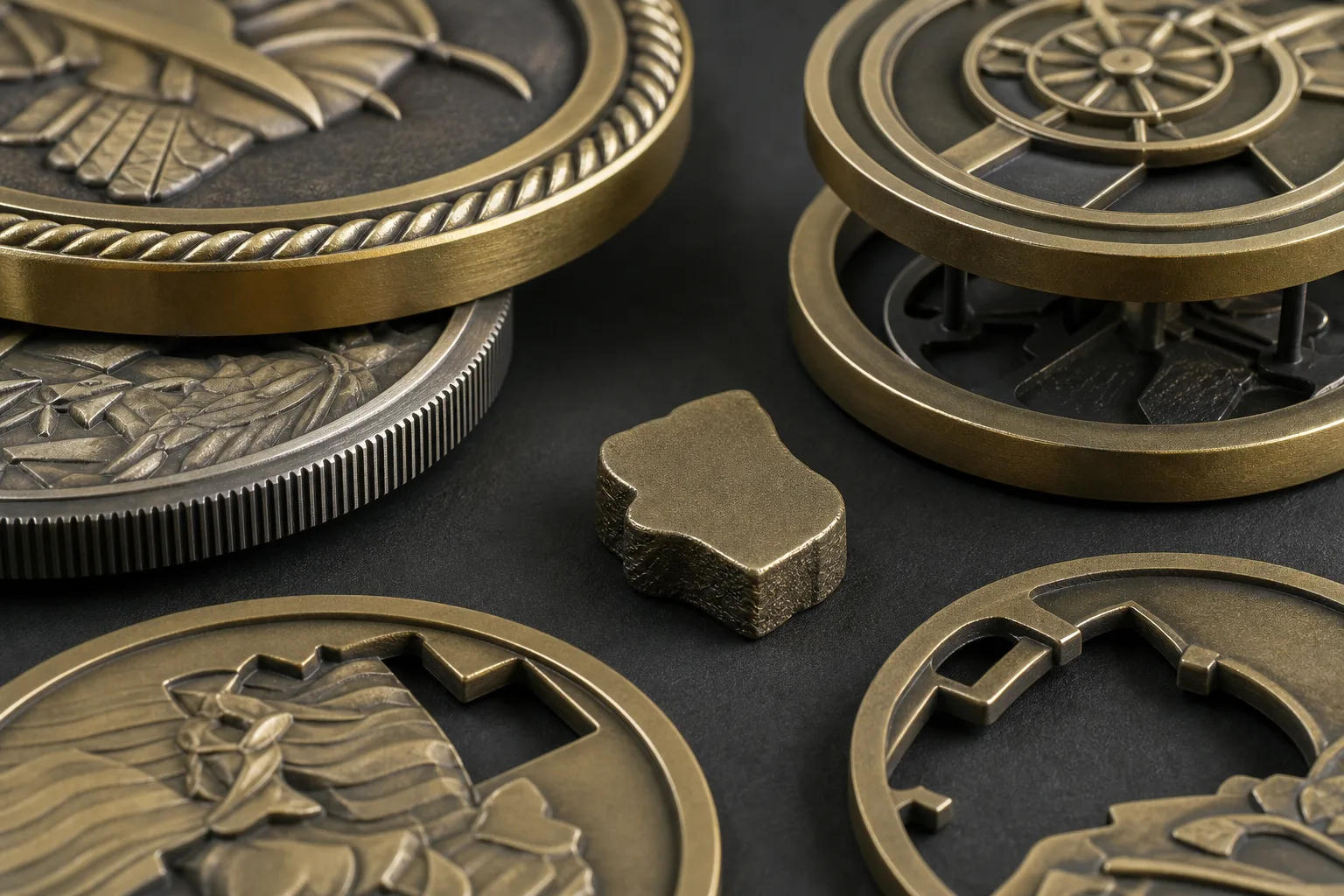
Coordinate Material, Artwork, Finish, and Personalization After the Base-Form Decision
Once the initial forming route is selected, prepare a specification package that shows the front and reverse faces, maximum dimensions, body thickness, edge direction, relief hierarchy, text orientation, color areas, exposed-metal fields, surface direction, and personalization zones.
Plating, color, printing, and engraving follow the base-metal and forming decision. They do not independently determine whether a coin should be die struck or die cast. Gairun lists gold, silver, nickel, black nickel, antique bronze, and antique silver as plating directions. The final tone must be coordinated with the base metal, relief, artwork, and exposed-metal layout.
Sandblasted or matte areas can reduce shine or create contrast with polished fields. Their suitability depends on the artwork, material, forming route, and width of the treated areas. If surface appearance is critical, provide a finish reference, an approved sample when selected, or a written acceptance standard.
Personalization requires early space planning. Reserve a sufficiently flat area for names, dates, or sequential numbering. Then provide the data list, file format, font, uniqueness rules, placement, and visual acceptance criteria. For recognition programs, different levels may be separated by surface color, edge treatment, or reverse-face text without changing the main mold, but that choice must be confirmed against the artwork.
Tooling begins only after the relevant production artwork has been reviewed and accepted. This approval controls the artwork reference for tooling and sampling; it does not approve commercial terms, packaging, testing, or shipment conditions. Buyers can Upload Artwork and Specifications with unresolved material or process choices clearly marked for engineering input.
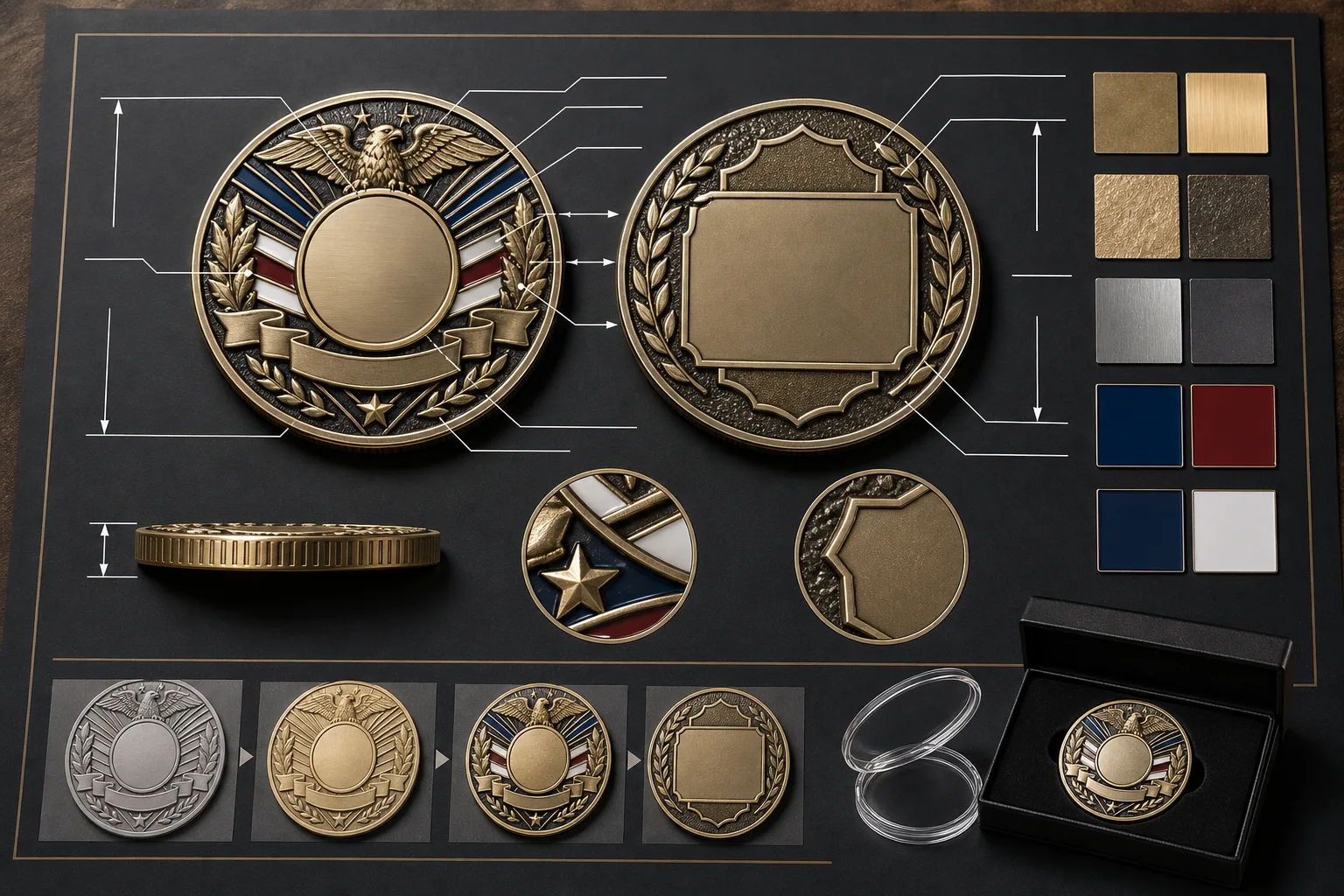
Two Hypothetical Artwork Patterns That Change the Initial Process Choice
Example 1: Regular commemorative coin
Imagine a circular recognition coin with an emblem on the front, a motto and date on the reverse, a continuous rope edge, and controlled raised and recessed relief. The initial direction is to assess die-struck construction first, particularly with a brass-oriented material direction. The regular body and organized relief fields fit that starting logic.
That direction could change if the central emblem becomes a strongly sculpted subject, the outline gains a major cutout, or the design adds a second assembled layer. Those features may shift the engineering assessment toward zinc-alloy die-casting. The missing variable is not the brand name or finish; it is the final body structure.
Example 2: Sports or cultural collector coin
Now consider an irregular mascot or landmark silhouette with pronounced 3D elements, local cutouts, and a shaped perimeter. The initial direction is to assess zinc-alloy die-casting first because the dimensional subject and irregular body dominate the construction.
If the buyer simplifies the silhouette into a regular outline and converts the artwork into controlled raised and recessed fields, a die-struck evaluation may become reasonable. The decision can therefore move when the geometry changes, even if the theme, colors, and wording remain the same.
For a complex collector structure, size and thickness should be treated as scenario guidance, not limits. One scenario may use 45–60 mm, 4–6 mm base thickness, and 5–9 mm assembled thickness. Layered or moving construction can make assembled thickness exceed the base body. Weight, high-point protection, inserts, and the presentation box must be planned together.
Approve the Forming Route with an Engineering and RFQ Checklist
A useful RFQ should give the manufacturer enough information to compare construction routes rather than quote from a partial illustration. Include:
- Program purpose, quantity, variants, and intended recipient or use context.
- Front and reverse artwork, brand or emblem authorization, text direction, and language.
- Material direction, regular or irregular outline, maximum dimensions, and target body thickness.
- Relief hierarchy, edge style, cutouts, layers, moving parts, magnets, and component positions.
- Color treatment, plating direction, exposed-metal areas, matte or sandblasted fields, printing, and engraving.
- Personalization data, numbering sequence, font, uniqueness rules, and flat-area requirements.
- Packaging, destination, shipping requirements, and the schedule needed for approval and delivery.
Ask route-specific questions. Can the proposed die-struck or zinc-alloy die-cast route achieve the outline, relief, cutouts, edge, and reverse-face orientation? Which features need simplification, reinforcement, or relocation? What will the accepted 1:1 production drawing define, and which tolerances will be written separately?
Gairun’s pre-tooling engineering service may cover dimensions, thickness, relief, metal borders, color areas, attachments, component positions, and the proposed production method. The exact checklist changes with the structure and artwork. For a formal sourcing package, buyers may use Engineering Review and Design for Manufacturing to organize these questions before tooling.
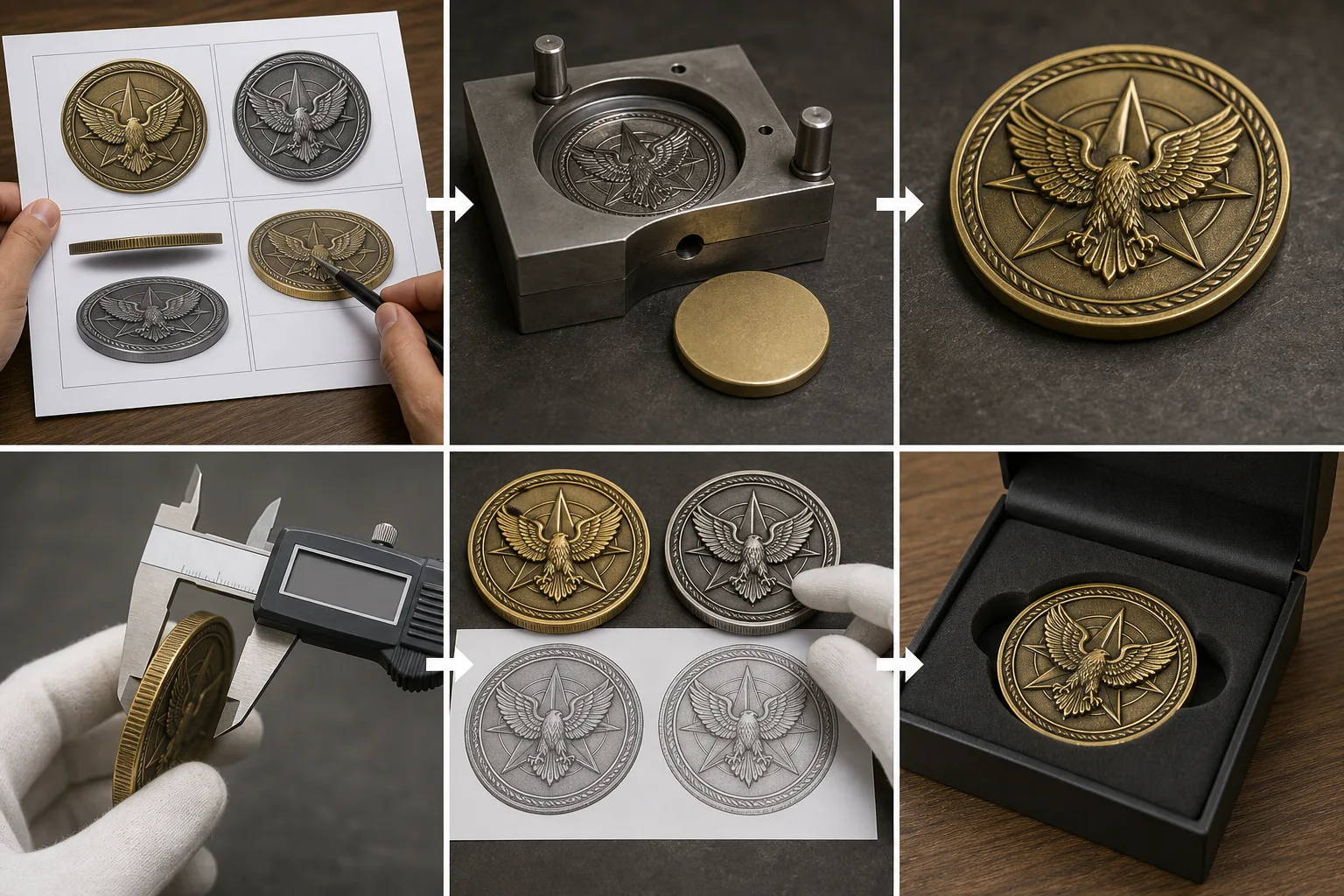
A controlled sequence normally separates requirement intake, artwork and engineering assessment, accepted production artwork, tooling, trial forming, first-article comparison, and production authorization. After tooling and trial forming, Gairun states that the first article is compared with the approved 1:1 drawing for dimensions, thickness, and relief detail. Define tolerances and visual acceptance criteria in the project documents.
Packaging should protect the selected construction. A simple recognition coin may use an individual bag or pouch. A formal or collector program may need a coin case, fitted insert, display solution, or protective box that prevents surface friction and pressure on relief high points. Packaging is part of the RFQ because it can affect the condition in which the buyer receives the finished coins.
Before requesting a final quotation, separate known requirements from open decisions. A complete brief helps Gairun compare the forming route, tooling scope, finishing sequence, assembly needs, packaging, and acceptance checkpoints without treating an incomplete RFQ as production approval. Buyers can also Book a Project Consultation when the artwork is ready but the construction route remains open.
FAQ
What is the main difference between a die-struck coin and a die-cast challenge coin?
A die-struck coin is formed by stamping metal around raised and recessed design areas, usually around a regular blank. A die-cast challenge coin is formed through a zinc-alloy casting route that may suit irregular bodies or more dimensional structures. Both still require separate decisions for finish, color, engraving, assembly, and packaging.
When should a regular round challenge coin start with a die-struck evaluation?
Start there when the body is circular or simply geometric, the material direction is brass-oriented, and the artwork uses controlled raised and recessed fields. Reverse-face details, edge treatment, thickness, and relief must still be checked together.
Can an irregular-shaped challenge coin be die struck?
It may be possible in some designs, but the outline, narrow sections, cutouts, relief, and material must support the forming route. If the irregular silhouette or dimensional subject dominates, zinc-alloy die-casting is often the more useful initial direction to assess.
Which route should be assessed first for 3D relief, cutouts, or layered structures?
Assess zinc-alloy die-casting first when pronounced 3D relief, local cutouts, layered construction, rotating parts, magnetic elements, or removable components drive the concept. The final route depends on connections, clearances, retention, thickness, and decoration.
Do plating, enamel, printing, and laser numbering determine the forming method?
No. These are post-forming or coordinated decoration decisions. Select the base-form direction from the material, geometry, relief, edge, and component structure, then confirm how the chosen finish and personalization will be applied.
What should be approved before challenge coin tooling begins?
Approve the production artwork for both faces, dimensions, thickness, relief hierarchy, edge direction, text orientation, colors, exposed-metal areas, personalization rules, attachments, packaging, tolerances, and visual acceptance criteria. Tooling should begin only after the relevant production artwork is accepted.
For a broader comparison of available metals, see Metal Materials Comparison. The most reliable forming decision comes from a complete drawing and a written construction brief, not from the front artwork alone.