
A custom medal ribbon should be specified as part of the assembled award, not purchased as an isolated branded strip. Start with the medal body, expected finished weight, ribbon dimensions, artwork orientation, connector, and presentation method in one controlled brief. Buyers still defining the metal component can use Gairun’s Custom Medals resource before finalizing the ribbon.
Build One Specification for the Medal, Ribbon, and Connection
The quote-ready specification should cover the whole path from the wearer’s neck to the medal body. This prevents a ribbon that looks correct in a flat proof but hangs backward, twists at the connector, or conflicts with the medal opening.
Core specification block: medal structure; maximum body dimensions; thickness; expected finished weight; ribbon width; finished ribbon length, loop length, or wearing drop; measurement endpoints; ribbon construction; decoration route; artwork placement; attachment; assembled orientation; packaging; quantities by version; and required approvals.
| Observable input | Practical implication | Initial specification decision | What still requires confirmation |
|---|---|---|---|
| Fixed one-piece body | No moving or connected main-body components | Define front, back, relief direction, opening, and ribbon connection | Dimensions, weight, production method, connector clearance, and quotation |
| Sculpted 3D relief | Raised and recessed forms affect thickness, balance, and visual hierarchy | Mark which forms project forward and which remain recessed | Reproducible detail, relief profile, finished weight, and hanging behavior |
| Spinning or combination structure | Moving parts introduce alignment and clearance requirements | Define movement, component positions, connection points, and intended front | Assembly feasibility, visible gaps, resistance to loosening, and movement after assembly |
| Asymmetrical or heavily cutout body | The geometric center may not be the hanging balance point | Show the opening and medal centerline in an assembled view | Tilt, twist, connector direction, and outward-facing ribbon legs |
Gairun’s pre-tooling engineering assessment may include dimensions, thickness, relief, metal borders, color areas, attachments, component positions, and the proposed production method. The actual checks depend on the artwork and structure. A fixed medal should not be assumed cheaper than a multi-component design without a current quotation.
Keep buyer control points separate: artwork approval, attachment or construction approval, sample approval when selected, packaging approval, and bulk-production authorization. Artwork approval creates a controlled production reference; it does not approve testing, prices, packaging, or shipment terms.
Choose Ribbon Width and Construction by Medal Scenario
The following ranges are contextual planning guidance. They are not universal standards, engineering limits, capability promises, or final specifications. The approved drawing and quotation control the actual ribbon width.
| Award scenario | Medal body guidance | Thickness guidance | Initial ribbon-width band |
|---|---|---|---|
| School sports or children’s events | 45–58 mm | 2–3 mm | 20–25 mm |
| 5K/10K road running | 55–65 mm | 2.5–3 mm | 25–30 mm |
| Half-marathon | 65–75 mm | 2.8–3.5 mm | 25–30 mm |
| Full marathon | 70–85 mm | 3–4 mm | 25–30 mm |
| Cycling | 65–80 mm | 2.5–4 mm | 25–30 mm |
| Water sports | 55–70 mm | 2–3.5 mm | 25–30 mm |
| Ball-sports leagues | 55–70 mm | 2–3.5 mm | 25–30 mm |
| Trail running | 75–95 mm | 3.5–5 mm | 30–38 mm |
| Ultramarathon | 80–100 mm | 4–6 mm | 30–38 mm |
| Triathlon | 70–90 mm | 3.5–5 mm | 30–38 mm |
Select the nearest scenario, then consider expected finished weight, maximum body dimension, solid or cutout construction, branding area, attachment geometry, wearer comfort, and presentation format. Size and thickness alone cannot establish weight when the design includes recesses, holes, relief, or multiple components. For further body planning, see How to Specify Medal Diameter, Thickness and Weight Without Guessing.
Example 1—compact school athletics medal: A 50 mm body with a simple event mark could begin in the 20–25 mm ribbon band. Multiple sponsor marks may require more branding width. A wide fold or different opening geometry could also change the choice. Wearer age, edge shape, finished weight, and loose-part risks must be assessed for the intended market.
Example 2—collectible ultramarathon medal: An 85 mm medal with deep relief could begin in the 30–38 mm band. Cutouts, a recessed back, or localized thinning may be considered to manage weight. The initial choice can change after checking the connector, balance, neck presentation, and sponsor layout.
Width does not determine length. State a finished ribbon length, loop length, or wearing drop in millimeters, with exact measurement endpoints. Also identify fold or overlap allowance, seam location, connector allowance, and join position. Do not rely on an unstated “standard length.” Event organizers can consult Marathons and Running Events for related race-planning considerations.
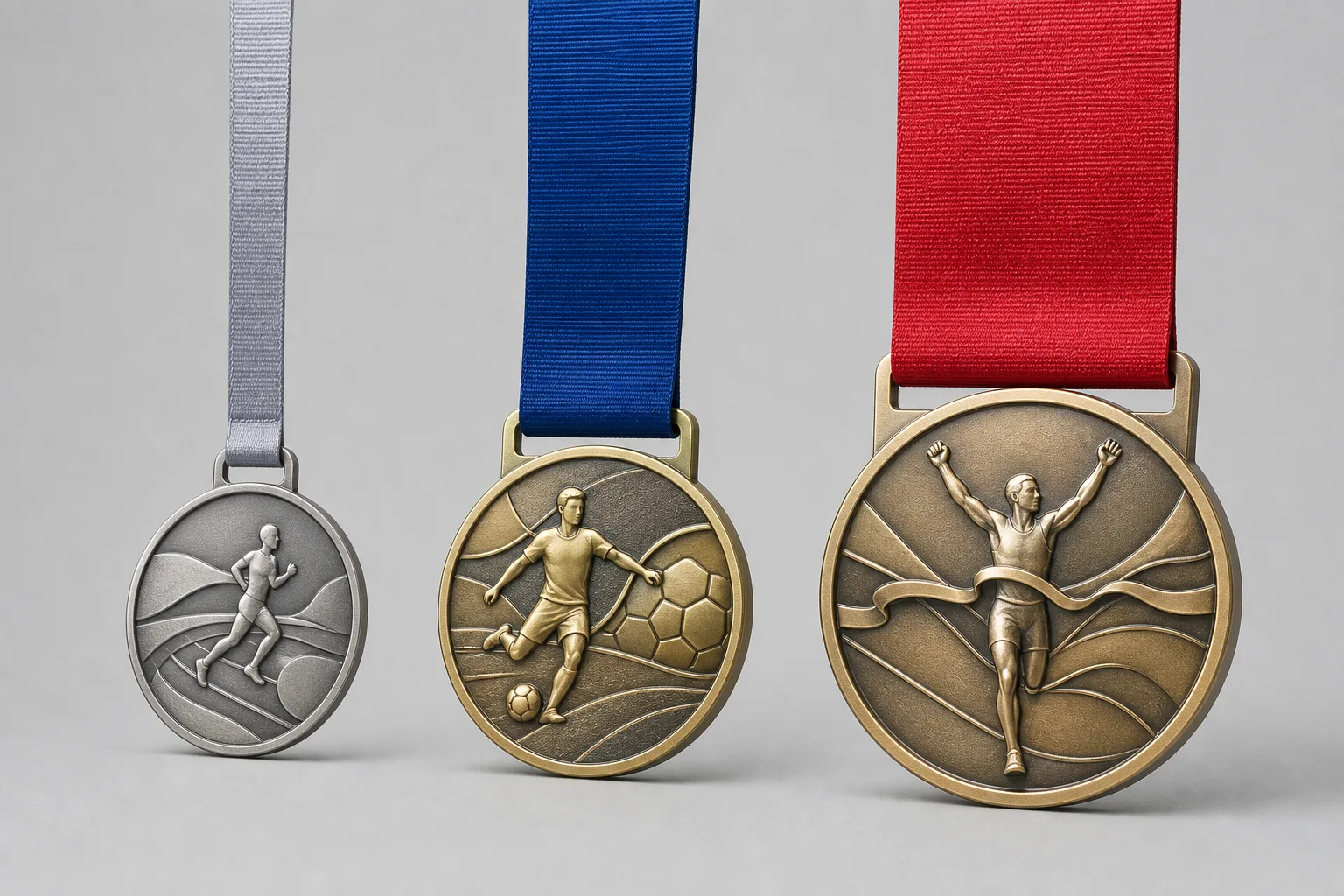
Prepare Ribbon Artwork, Orientation, and Sponsor Hierarchy
First define the artwork arrangement: repeating pattern, alternating logo sequence, continuous graphic, one-time neck placement, or a combined layout. Identify the intended ribbon construction and decoration route for supplier confirmation. Practical guidance on ribbon fabric, print-process, and hardware choices also illustrates why these decisions belong in the initial brief.
A controlled 1:1 layout should show the front-facing side, reading direction on each ribbon leg, top and bottom of each mark, medal centerline, neck position, seam, and join. Copying the same unrotated logo onto both legs can make one side appear upside down when worn. Approve an assembled wearing view, not only a flat strip.
Set a content hierarchy before reducing artwork to the actual width:
- Event identity or award category
- Race distance, placement level, or season
- Title sponsor
- Secondary sponsors
- Date or short supporting message
Supply vector artwork or a usable PDF where available. Include exact wording, color references, logo order, dimensions, and front-versus-back instructions. Gairun can begin an assessment from a hand-drawn concept when supporting instructions are supplied, but a sketch is not automatically production-ready. The Artwork and File Preparation Guide explains how to organize source files.
Use a version matrix for different distances, award levels, dates, seasons, sponsor sets, and quantities. Do not place unresolved alternatives in one artwork file. The buyer should also obtain authorization for third-party marks; visual approval does not establish legal permission.
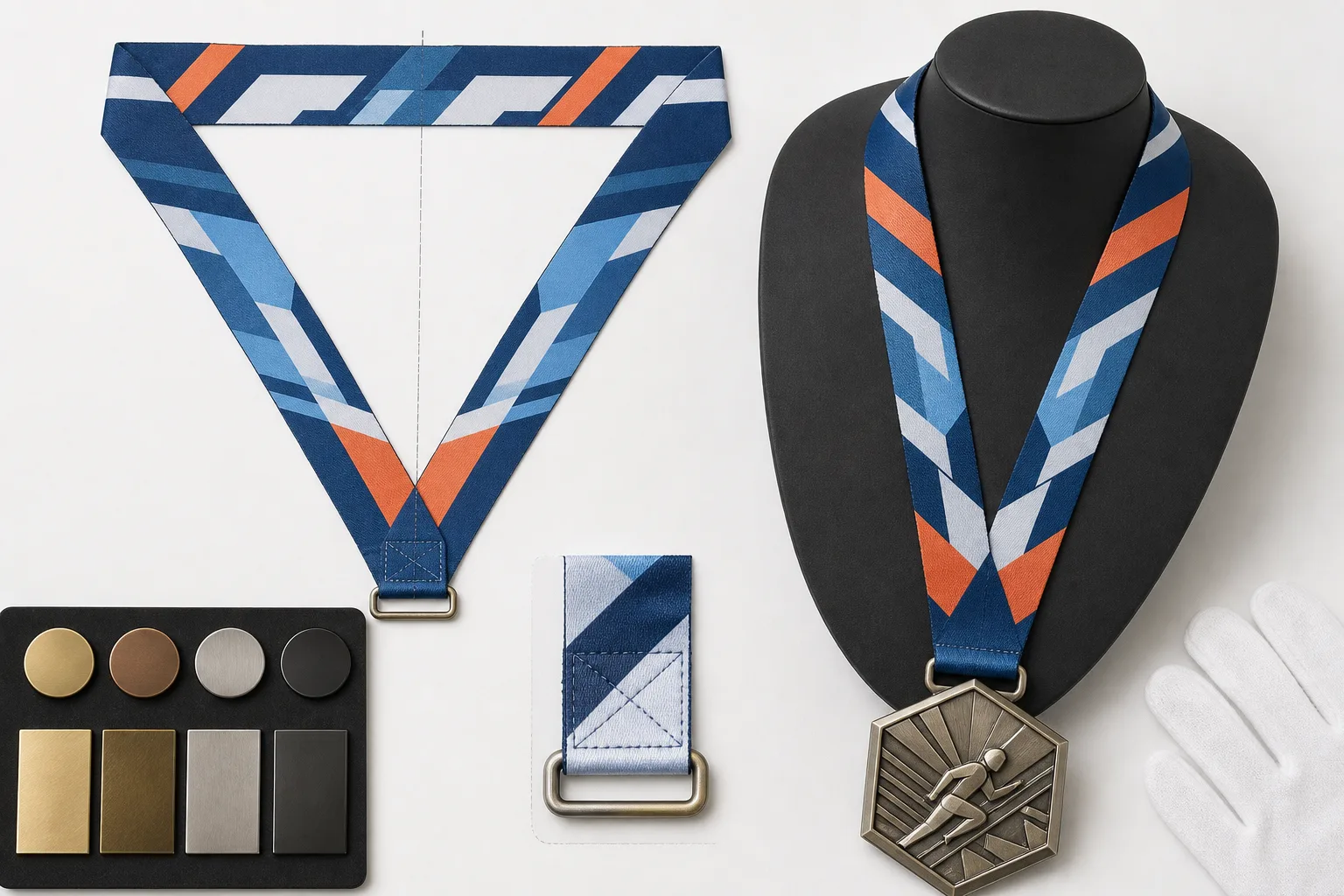
Coordinate the Medal Ribbon Attachment and Assembled Orientation
Define the complete medal ribbon attachment path: ribbon end treatment, fold or loop, connector, medal opening, and any moving or decorative component. Generic descriptions such as “ring” or “clip” are insufficient. A dimensioned drawing should show opening position, connector direction, fold construction, clearances, body thickness, and medal centerline.
Ribbon width, opening, and connector must be selected together. The connection also needs to account for expected finished weight, relief, cutouts, balance point, and intended hanging direction. For an asymmetrical medal, request a hanging view to check tilt, logo alignment, and whether the intended front remains forward.
Spinning, detachable, magnetic, layered, and combination structures need assessment as complete assemblies. Movement, component alignment, visible clearances, and resistance to unintended loosening cannot be established from separate component drawings. Industry guidance on choosing a medal-ribbon attachment that suits the finished award assembly reinforces the need to coordinate hardware with the complete medal.
For attachments used in the actual product, Gairun states that secure fitting is checked during final inspection; the applicable check depends on the configuration. Pull testing may be available, but the fixture, loading direction, force, duration, sampling plan, and acceptance criteria must be agreed for the order. No force value or pass result should be assumed.

Approve Flat Artwork and Complete Assembled Proofs
The proofing package should connect ribbon artwork to medal construction. Request these controlled views:
- Flat 1:1 ribbon layout: actual width, length convention, repeat pitch, logo dimensions, margins, colors, reading directions, front-facing side, and join position.
- Medal front and back: maximum dimensions, thickness, relief direction, opening, finish or color placement, and attachment callouts.
- Assembled front and back: connector direction, outward-facing ribbon legs, medal centerline, and visible connection points.
- Hanging view: intended front, balance, tilt, logo orientation, and neck placement.
Reconcile all views against the version matrix. Each medal design, ribbon version, race distance, award level, date, sponsor combination, and quantity should have one unambiguous identifier.
Before signing, check wording, spelling, dates, sponsor order, color references, dimensions, ribbon width, finished length convention, repeats, orientation, attachment, front and back views, quantities, and packaging. Record the authorized approver and approval date.
A visual proof is a decision point, not evidence that every fine detail is reproducible or that every color will match without acceptance criteria. Gairun states that 2D or 3D proofs may be provided when sufficient information is available; current service timing should be reconfirmed. Tooling begins only after the relevant production artwork has been accepted.
After tooling and trial forming, Gairun’s stated process compares the first article with the approved 1:1 drawing for dimensions, thickness, and relief detail. Tolerances must be defined separately rather than inferred from the visual proof.
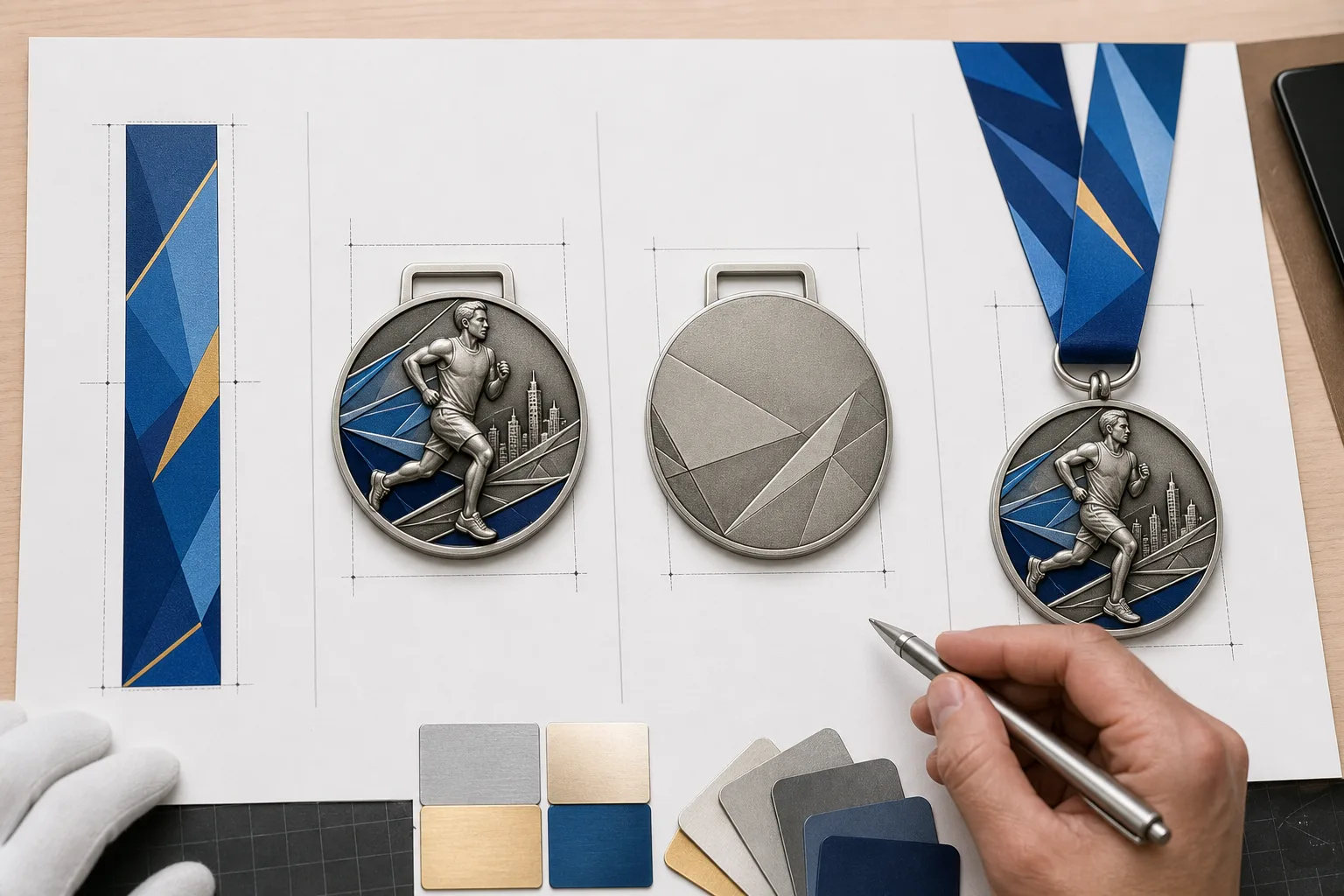
Validate the Sample, Connection, and Award Presentation
When a custom sample is selected, inspect it at actual scale. Check text readability, sponsor sequence, repeat placement, edges, color under the agreed viewing conditions, and which side faces outward. Then hang or wear the assembly to observe twist, tilt, ribbon bunching, balance, connector movement, and neck presentation.
Verify secure fitting using the actual ribbon, connector, and medal opening. Apply pull or anti-loosening testing only under an agreed method and acceptance plan. For moving medals, cycle the intended movement and inspect alignment and visible clearances without assuming an unsupported life-cycle rating.
Sample approval and bulk-production authorization remain separate. Any later change to artwork, dimensions, construction, attachment, or packaging requires renewed assessment of the affected items.
Protective packing and presentation packaging serve different purposes. Individual protective bags or card-backed bags may assist separation and finish-line handling. Selected premium or collectible programs may consider gift boxes or wooden boxes. The pack-out must still account for shipment protection, sorting, version identification, and tangle prevention.
Gairun states that finished products receive 100% visual inspection for surface scratches as part of its current process, subject to order confirmation. This describes a visual control step, not a defect-free or laboratory-testing guarantee.
Send a Quote-Ready Custom Medal Ribbon Specification
A complete RFQ makes unresolved decisions visible and allows the medal, ribbon, and connector to be quoted as one configuration. Include:
- Event data: event name, date, market, participant quantity, quantities by version, award category, destination, and distribution method.
- Medal body: fixed, sculpted, spinning, detachable, or combination structure; material under consideration; maximum dimensions; thickness; expected weight; front and back artwork; relief; finish; openings; and moving parts.
- Ribbon dimensions: width, finished length, loop length, or wearing drop in millimeters; measurement endpoints; fold or overlap allowance; seam; join position; and quantities by version.
- Construction: requested base textile, edge treatment, proposed decoration method, one-sided or two-sided appearance, background treatment, and tactile or presentation requirement, subject to confirmation.
- Ribbon artwork: editable or usable files, exact wording, logo order, color references, repeat dimensions, reading directions, outward-facing side, sponsor hierarchy, and version matrix.
- Attachment: ribbon end treatment, connector type, opening dimensions and position, assembly direction, clearances, expected load context, and any required test method.
- Approvals: required proof views, dimensional and color criteria, sample decision, named approver, packaging specification, and separate bulk-production authorization.
OEM is appropriate when artwork, dimensions, and construction are already defined. ODM support can help develop a sketch or sourcing concept, but neither route removes engineering assessment or buyer approval. Gairun’s How to Order Custom Metal Products resource provides a broader requirement-to-order workflow.
Obtain a current quotation for the approved assembly rather than comparing cost from ribbon width or medal structure alone. If timing is critical, use a written schedule covering artwork acceptance, tooling, sampling when selected, production, packaging, and shipment preparation.
Frequently Asked Questions
What belongs in a complete custom medal ribbon specification?
Include medal dimensions, structure and expected weight; ribbon width and measured length; construction and decoration; artwork orientation; attachment details; quantities by version; packaging; and separate approval requirements.
How should I choose ribbon width?
Use the closest event scenario as a starting band, then check medal size, weight, branding area, attachment geometry, comfort, and presentation. The approved drawing controls the final width.
How should logos be oriented on both ribbon legs?
Mark reading direction, logo top and bottom, outward-facing side, neck position, join, and medal centerline. Approve a wearing view because identical unrotated artwork can appear upside down on one leg.
Which attachment details must be confirmed?
Confirm the end treatment, fold, connector, opening dimensions and position, assembly direction, clearances, balance point, expected load context, and any agreed functional test.
Should I approve a physical sample?
A sample is useful when appearance, balance, movement, attachment, or packaging requires physical validation. Its approval remains separate from authorization for bulk production.
How should branded medal ribbons be packed?
Choose protective packing for separation and transit, then add presentation packaging only when the award program requires it. Plan sorting, variant identification, tangle prevention, and handout method together.