
Choosing challenge coin edge options is a construction decision, not simply a decorative one. The right edge depends on whether the coin must carry text, how densely the front and reverse are designed, how often it will be handled, and whether the intended presentation is formal, promotional, or collectible. Buyers can begin with Custom Challenge Coins, then define the edge, border, thickness, relief, and finish as one coordinated specification.
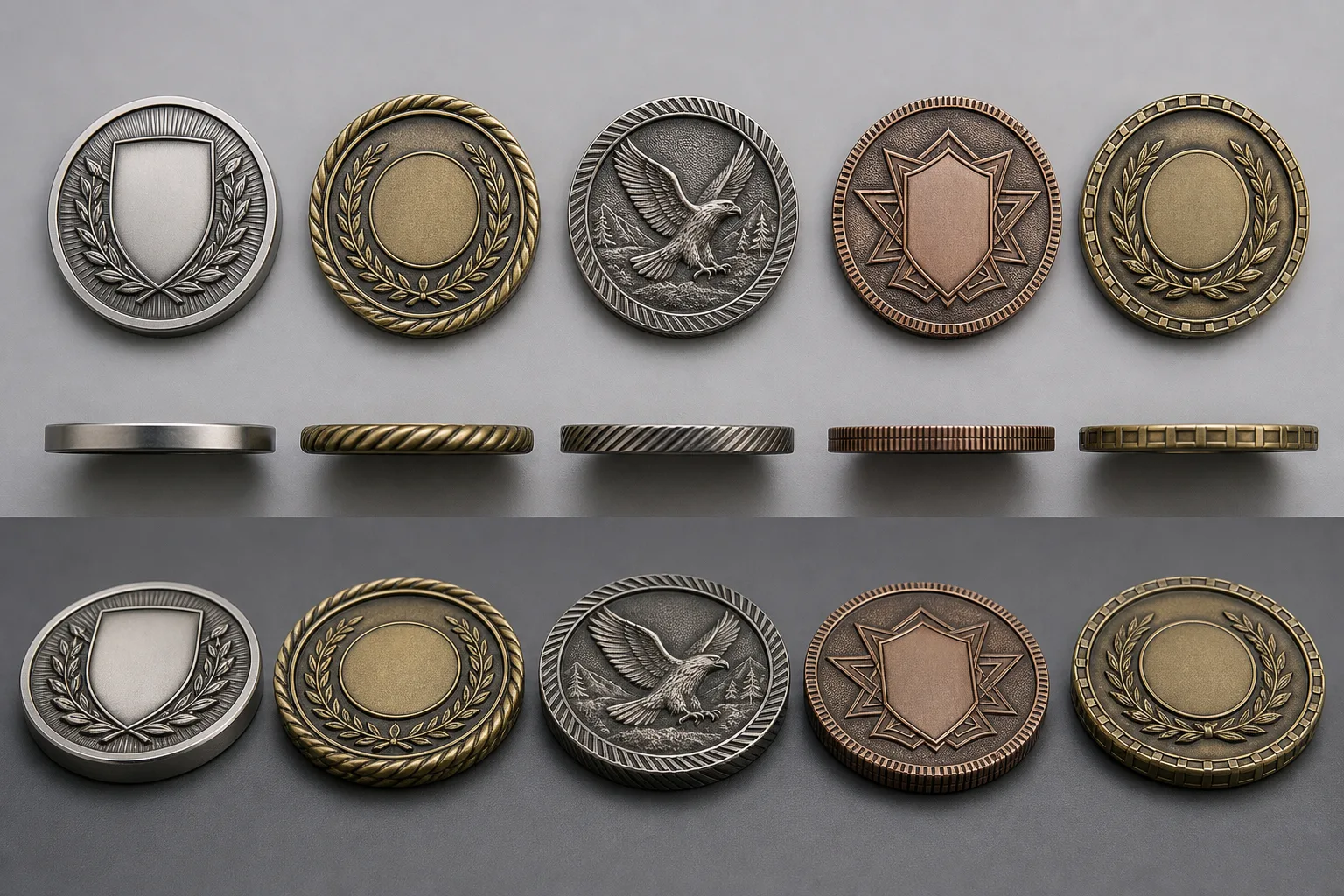
As a practical starting point, use a simpler smooth or lightly textured edge when the coin edge must carry information. Choose rope, diagonal, fine-toothed, faceted, or custom lettered treatments when the face already communicates the main message and the edge is intended to add framing or collectibility. The final choice still depends on the approved artwork and forming route.
Choose the Edge Treatment by Message, Readability, and Handling
Start with four observable inputs: the amount of information, expected handling, artwork density, and presentation purpose. These inputs help narrow the challenge coin edge design before a supplier prepares tooling or a detailed proof.
- Information priority: If the edge carries a motto, date, serial number, or variable text, reserve an uninterrupted band.
- Handling priority: Coins carried frequently need controlled transitions and edges that do not create an uncomfortable sharp-feeling contact point.
- Artwork density: A high-relief face with many color fields usually benefits from a restrained edge.
- Presentation priority: Formal commemorative designs may need orderly framing, while collector pieces may justify more visual complexity.
A custom coin border should frame the face without competing with the dominant emblem, portrait, date, or color areas. The edge, border, thickness, front face, and reverse face should therefore be planned as one structure. Gairun’s pre-tooling engineering work may cover dimensions, thickness, relief, metal borders, color areas, component positions, and the proposed production method. The exact points depend on the design.
| Observable input | Practical implication | Initial decision | What still requires confirmation |
|---|---|---|---|
| Long motto, multilingual copy, or serial numbers | More circumference is occupied by characters, separators, and spacing. | Begin with a smooth or consistently textured edge. | Final diameter, exact copy, character layout, orientation, and numbering position. |
| Large emblem with deep relief | A complex edge may compete with the face hierarchy. | Use a restrained rope, diagonal, or fine-textured edge. | Relief structure, border width, exposed metal, and forming route. |
| Corporate logo and anniversary year | The front already carries the primary recognition message. | Use a smooth or lightly textured edge with a defined border. | Brand color boundaries, finish contrast, and reverse artwork density. |
| Limited collector design with presentation packaging | The edge can contribute to exclusivity, but high points and box clearance become important. | Consider a faceted, diagonal, or custom text edge. | Touch safety, total thickness, inner-box fit, and sample appearance. |
| Frequently distributed promotional coin | Small details may be difficult to read and can overcrowd the design. | Keep the edge simple and move detailed information to the packaging card. | Size, information hierarchy, quantity, and packaging format. |
Example 1: official commemorative coin. Imagine double emblems on the faces, a formal motto, and a serial number. A restrained rope or fine-textured edge is an appropriate starting direction. Edge text should be added only if the circumference and letter scale remain readable. The recommendation could change with the final diameter, text length, and required numbering position.
Example 2: corporate anniversary coin. Suppose the front has a large logo and anniversary year, while the reverse carries a milestone statement. A smooth or lightly textured edge with a defined border keeps the brand message dominant. The choice could change if the brand system requires a contrasting two-tone border or the reverse already fills the available area.
Example 3: limited collector coin. A deep-relief subject, contrasting plating, and presentation-box packaging may support a diagonal, diamond-cut, or custom text edge. The direction remains conditional on touch safety, box clearance, and the selected forming method.
Separate the Coin Edge, Face Border, and Artwork Relief
Many RFQs become unclear because “border,” “edge,” and “relief” are used as if they describe the same area. They do not. Clear labels make artwork discussion faster and reduce the risk of approving a visual effect that does not match the intended physical structure.
- Outer coin edge: The physical side surface around the circumference. This is where rope, diagonal, fine-toothed, faceted, or coin edge text may appear.
- Face border: A ring or boundary visible from the front or reverse. It may be smooth, patterned, separately plated, or used to contain enamel and metal fields.
- Face relief: Raised, recessed, layered, or sculpted forms that create hierarchy inside the face.
- Recessed field: A lower area around or between raised features. It may receive color, matte treatment, or an antique contrast.
A custom coin border is viewed front-on. Challenge coin edge engraving or formed edge text is read around the circumference, so its orientation and spacing require a different callout. A border can also act as a visual boundary around soft enamel, imitation hard enamel, printed areas, or exposed metal. Soft enamel leaves color below the surrounding raised metal borders, while imitation hard enamel brings color and metal areas closer to one level.
Relief should establish visual priority. The artwork needs to identify which emblem, portrait, building, mascot, or symbol is dominant and which details remain recessed. Gairun’s challenge-coin guidance treats raised, recessed, layered, and sculpted forms as tools for separating primary subjects from supporting fields. Do not assume relief depth or portrait fidelity before the artwork and sample direction are accepted.
For artwork preparation, create separate layers or callouts for the front face, reverse face, outer edge, face border, edge text, numbering, finish areas, and orientation arrows. A single flattened image may show the concept but cannot always communicate the required forming structure.
For additional preparation guidance, buyers can consult Design and Artwork before submitting the coin brief.
When Edge Text Is Legible: Specify the Message Before the Decoration
Coin edge text should be specified before selecting a decorative texture. Every character uses part of the available circumference, leaving less room for separators, margins, numbering, and pattern continuity. Long mottos and multilingual wording can change the recommended edge treatment entirely.
Supply the exact copy in a separate text file and in the artwork. Include the language, capitalization, punctuation, reading direction, start point, stop point, and whether the message repeats around the coin. State whether the letters should be engraved, recessed, raised, or formed. These terms should not be treated as interchangeable outcomes.
When text is the priority, reserve a smooth or consistently textured band. Avoid placing lettering across abrupt grooves, deep transitions, interrupted cuts, or changing surface levels without engineering input. The final result depends on diameter, edge width, letter arrangement, relief, and the forming route, so a visual mockup alone may not settle the question.
Use extra care with serial numbers, dates, names, and variable personalization. Character counts can differ from one recipient or edition to another. For employee recognition coins, a flat rear area may be a better location for names or dates, leaving the edge simple. This supports variable data without forcing every character around a curved surface.
For official or association coins, list edge-text readability, front-to-back direction, numbering position, and edge-pattern continuity as separate approval points. Artwork approval establishes the controlled reference for tooling, but it does not approve unrelated packaging, commercial, testing, or shipment terms.
Compare Smooth, Textured, Cut, and Custom Lettered Edges
The following comparison turns a decorative list into a selection tool. It describes design tendencies rather than universal rankings for cost, durability, safety, or production difficulty.
| Edge option | Observable result | Best-fit artwork condition | Main trade-off and confirmation |
|---|---|---|---|
| Smooth edge | Clean, uninterrupted side band with limited visual noise. | Corporate recognition, employee coins, promotional designs, or edge text. | Less decorative contrast. Confirm border width, text layout, and finish transition. |
| Rope or corded edge | Formal repeating texture that frames the coin. | Official, association, cultural, or commemorative artwork with a strong central emblem. | Pattern may compete with small text. Confirm repeat continuity and touch quality. |
| Diagonal or slanted edge | Directional texture with a more active visual rhythm. | Corporate, collector, or modern commemorative designs. | Reading and orientation can become less obvious. Confirm start point and face direction. |
| Fine-toothed edge | Small repeated teeth or ridges around the circumference. | Formal or recognition coins with limited edge information. | Small lettering may lose contrast. Confirm deburring and edge-text clearance. |
| Diamond-cut or faceted edge | Angular highlights and a more distinctive metallic presentation. | Limited collector coins with controlled plating and presentation packaging. | Transitions can feel sharp and may affect box clearance. Confirm touch safety and inner-box fit. |
| Custom text edge | Information is integrated directly into the circumference. | Numbered editions, mottos, dates, or designs where the edge carries a message. | Uses available circumference and requires exact orientation, spacing, and forming-route confirmation. |
| Irregular or open edge | Non-round outline, openings, steps, or sculpted perimeter. | Complex 3D, sports, mascot, or highly shaped designs. | Structural connections, points, and packaging clearance become central. Confirm the complete construction. |
Finish can reinforce the edge decision. Gairun lists gold, silver, nickel, black nickel, antique bronze, and antique silver plating directions. Final tone and feasibility depend on the base metal, relief, artwork, forming route, and exposed metal areas. Sandblasting or matte finishing can reduce shine and create contrast, but the treated width and location should be specified.
Dual plating can separate selected areas, including a face border or edge-related metal region, when the artwork provides clear boundaries. It should not be assumed suitable for every relief or geometry. The Metal Finish Selection Guide can help organize the finish discussion before quotation.
As a scenario direction, official and cultural coins may suit rope or textured edges when the face is formal. Corporate and recognition coins often benefit from smooth or restrained textures. Collector coins may justify more complex treatments when the structure, handling, and packaging have enough room for them.

Align Edge Treatment with Front and Reverse Artwork
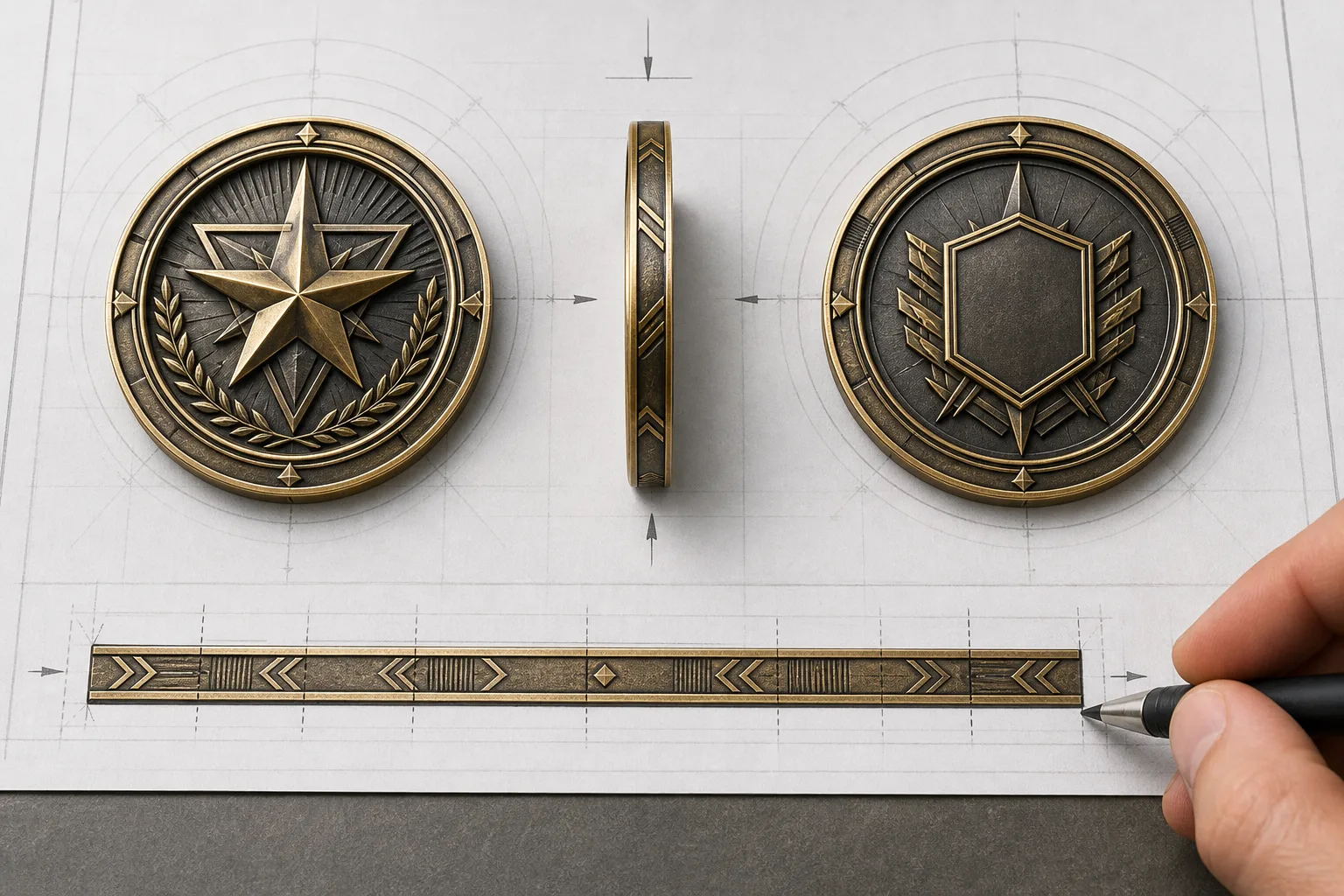
Do not approve the front and reverse as isolated illustrations. Request a complete front view, reverse view, side profile, and edge-development view. Together, these views show whether the coin edge supports the face hierarchy and whether the design reads correctly in both orientations.
Check the direction of edge text while the front face is upright. Then check how the reverse face is oriented when the coin is turned. Mark the edge start point, reading direction, repeat interval, border boundary, plating boundary, and no-text zones. This is especially important for mottos, dates, official insignia, and sequential numbering.
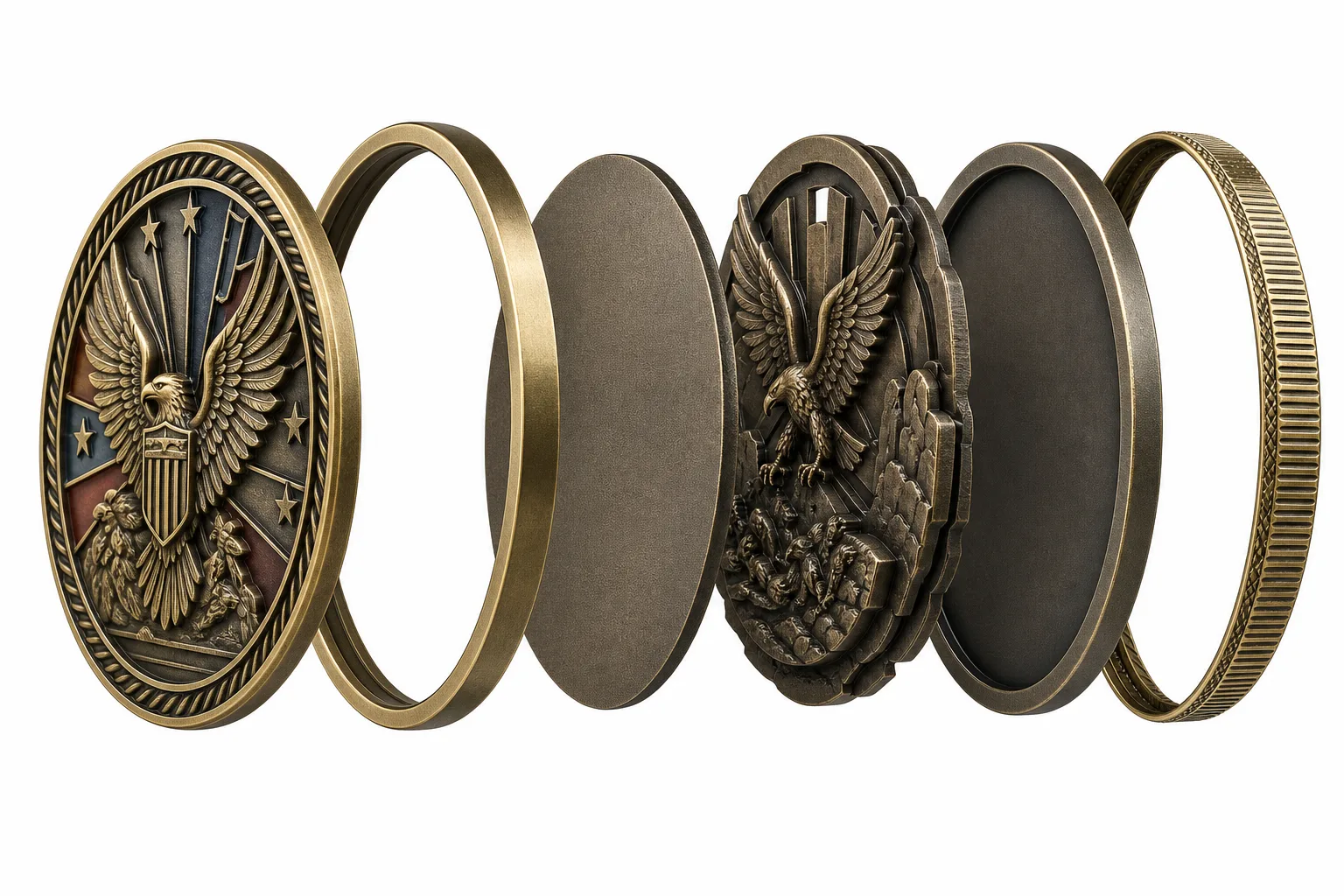
Also check the relationship between border width, relief levels, color fields, and exposed metal. Deep relief may need more visual separation from the border. Edge text may conflict with a thick rim, openings, multi-layer steps, or an irregular outline. For complex coins, total assembled thickness and packaging clearance are structural questions, not merely edge-decoration choices.
Gairun lists zinc-alloy die-casting, stamping or die-struck forming, photo etching, and hydraulic high-relief forming. The appropriate route depends on material, shape, relief structure, and decoration plan. This is why an attractive edge treatment should not be presented as confirmed before the forming route and approved artwork are assessed.
Complex multi-layer or active structures require additional attention to assembly tolerances, anti-loosening measures, drop performance, and transport protection when those features are included. If a design contains moving parts, magnets, openings, or multiple bodies, show both the basic thickness and the assembled thickness in the brief.
For examples of more involved construction and surface separation, see High-Relief and Dual-Plated Coins.
Build a Scenario-Linked Specification Block for the Edge and Border
Scenario guidance helps buyers prepare a useful starting brief. It is not a universal standard, engineering limit, or final specification. The following examples keep dimensions and materials tied to their intended product context.
| Scenario | Starting specification direction | Edge and border focus | Key confirmation points |
|---|---|---|---|
| Official commemorative coin | 38–50 mm diameter; 3–4 mm base thickness; brass as the primary material. | Rope, diagonal, or fine-toothed edge; formal border; optional numbering. | Emblem authorization, front-to-back direction, edge continuity, number position, and deburring. |
| Corporate anniversary coin | 40–50 mm diameter; 3–4 mm base thickness; brass as the primary material. | Smooth, diagonal, or rope edge; defined border; limited edge text. | Brand rules, year placement, variable names or dates, finish contrast, and protective packaging. |
| Collector coin | 45–60 mm diameter; 4–5.5 mm base thickness; brass as the primary material. | Rope, diamond-cut, diagonal, or custom text edge. | High points, touch safety, weight, presentation-box clearance, continuous numbering, and sample appearance. |
Zinc alloy may suit complex sculpted or irregular forms in some scenarios, while brass, iron, stainless steel, aluminum, or other listed metals may be considered for different structures. Material selection must be coordinated with geometry, forming method, relief, decoration, and intended use. Do not transfer one scenario’s dimensions to another product without a fresh assessment.
For any design involving plating, matte areas, enamel, or epoxy, specify the intended appearance and boundaries. A clear epoxy coating changes the surface presentation and should be requested explicitly rather than assumed.
At minimum, the buyer’s specification should identify the product scenario, diameter or maximum dimension, base and total thickness where applicable, material preference, forming route if known, edge pattern, edge text, border treatment, front and reverse artwork, finish, numbering, packaging, destination, and schedule.
Request Proof Views and Submit a Complete Edge Specification
Ask for a 2D proof that shows the front, reverse, side profile, edge development, text direction, border boundaries, relief hierarchy, and finish callouts. A 3D proof can add useful context for sculpted relief or unusual construction when enough information is available. Gairun states that its design team can provide a free 2D or 3D artwork proof within 24 hours when sufficient project information is available; current timing should be reconfirmed, and this is not production lead time.
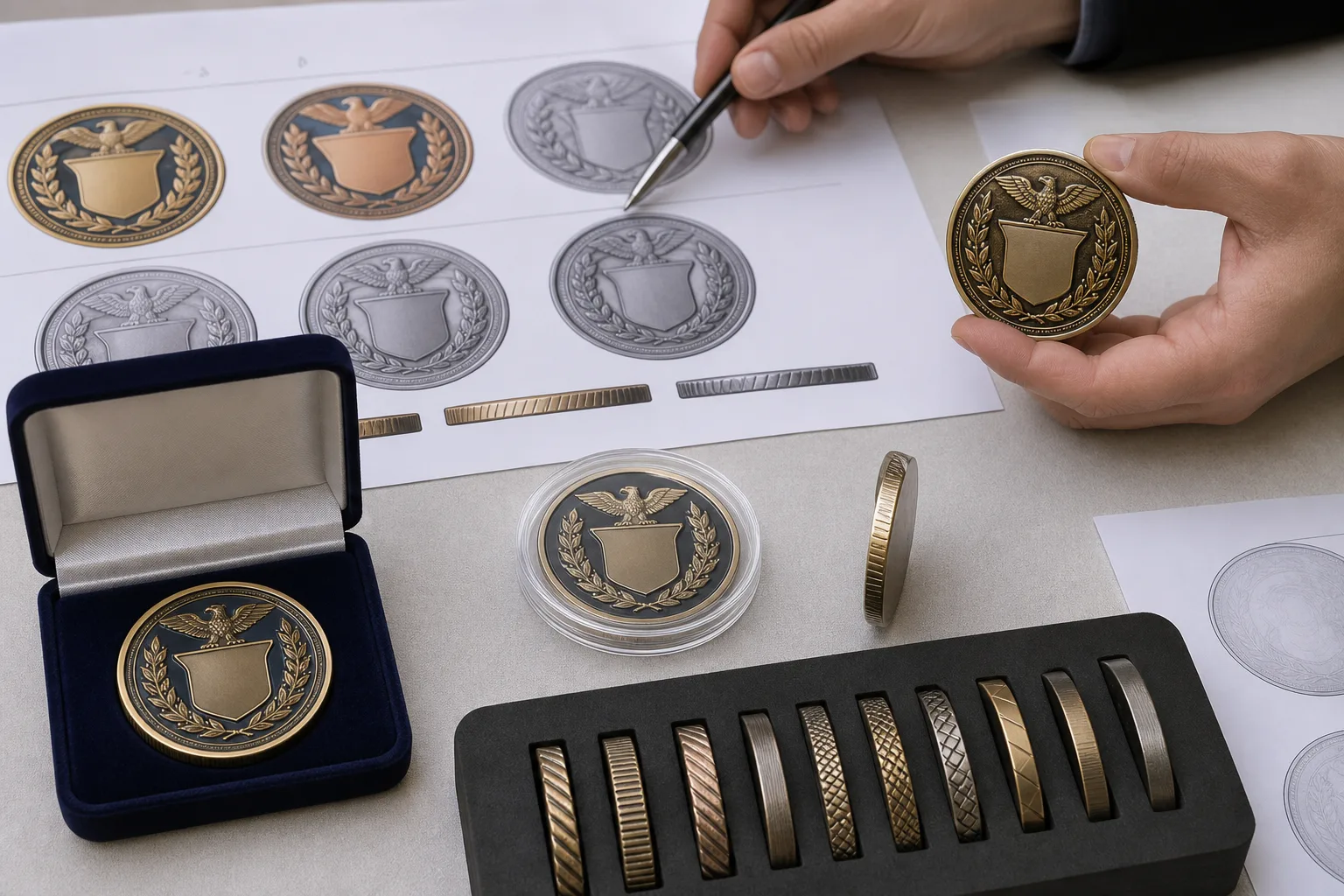
Consider a custom sample when edge treatment, coin edge text, relief, dual plating, unusual cuts, or packaging clearance is central to the buying decision. A custom sample uses buyer-specific artwork to assess the proposed appearance and construction. Sample approval and bulk-production authorization remain separate steps.
Stock samples have a narrower purpose. They can demonstrate general workmanship, finishes, construction, or packaging, but they cannot prove the buyer’s custom edge design. Availability and delivery cost should be confirmed separately.
Gairun’s service path moves from requirements intake through artwork and engineering discussion, sample planning when selected, production coordination, packaging, and shipment preparation. Keep artwork approval, sample approval, bulk-production authorization, and commercial or shipment terms as separate control points. Mark unresolved technical choices as questions for engineering instead of treating an incomplete RFQ as production approval.
Challenge Coin Edge RFQ Checklist
- Product scenario and intended use
- Quantity and design variants
- Diameter or maximum dimension
- Base thickness and total assembled thickness where applicable
- Material preference and known forming route
- Front and reverse artwork
- Edge pattern or cut direction
- Exact edge text, language, orientation, and numbering data
- Face-border width, finish, plating, and color treatment
- Relief hierarchy and any sculpted, layered, open, or moving areas
- Deburring and touch-safety expectations
- Packaging format, destination, required schedule, and requested Incoterm with named place
For a project-specific assessment, send the artwork, exact edge copy, dimensions, scenario, finish preference, quantity, packaging needs, destination, and required schedule. That information gives the supplier a controlled basis for deciding whether the preferred challenge coin edge options can be developed as drawn or need adjustment.
Frequently Asked Questions
Which challenge coin edge option is best for edge text?
A smooth or consistently textured edge is usually the best starting direction because it provides a more continuous band. The final choice depends on diameter, copy length, character arrangement, orientation, and the selected forming route.
How should coin edge text be oriented and supplied in the artwork?
Provide the exact wording separately and mark the start point, reading direction, capitalization, punctuation, repeat pattern, and relationship to the upright front face. Include the reverse orientation as a separate callout.
What is the difference between a custom coin border and challenge coin edge engraving?
A custom coin border is a ring or boundary visible on the front or reverse face. Challenge coin edge engraving refers to text or marks placed around the physical circumference. They require separate artwork layers and separate orientation checks.
Can a challenge coin combine a textured edge with dual plating or high relief?
It may be possible in some structures, but the combination requires clear plating boundaries and coordination between the relief, base metal, edge geometry, and forming route. A proof or sample may be appropriate when appearance is critical.
Should I request a custom sample before approving a challenge coin edge design?
Request one when text legibility, unusual cuts, high relief, dual plating, touch feel, or presentation-box clearance could affect acceptance. A stock sample can show general workmanship but cannot prove the buyer’s custom edge.
What information should be included in an RFQ for a challenge coin with a custom edge?
Include the scenario, quantity, dimensions, thickness, material, front and reverse artwork, edge pattern, exact edge text, orientation, border treatment, finish, numbering, packaging, destination, and required schedule. List unresolved choices as questions for technical assessment.