
For buyers comparing Custom Lapel Pins and Badges, the short answer is straightforward: printing usually preserves gradients, continuous tones, small graphic details, and complex illustrations more directly than enamel. Enamel is usually the better starting point when the artwork can be divided into clear color cells separated by visible metal borders.
That decision is only a first direction. The finished result also depends on the pin size, base construction, thickness, relief, metal borders, surface finish, attachment, and approved artwork proof. Gairun manufactures enamel pins and printed metal badges, but these routes are not interchangeable. A suitable decoration method must be considered together with the part itself.
Use UV printed pins when multiple tones, fine marks, or gradients are central to the design. Consider screen printed badges when defined graphic details should remain printed on a prepared metal surface. Choose soft enamel or imitation hard enamel when the design benefits from bounded color areas, visible metal separation, and a formed badge-like surface.
Enamel vs Printed Pins: Which Method Preserves Detailed Artwork?
Printing generally preserves detailed artwork with fewer structural changes because the graphic remains an applied image or defined printed detail. Enamel requires the artwork to be translated into recessed or level color areas. Each area needs a controlled boundary, and the surrounding metal becomes part of the design.
Soft enamel leaves colored areas recessed below raised metal borders. This creates a tactile contrast and works well for bold logos, symbols, and illustrations with distinct color regions. Imitation hard enamel creates a smoother face, with color and metal areas brought closer to one level, but it still needs controlled color areas and metal borders. It should not be treated as vitreous hard enamel.
For detailed artwork, start with the dominant visual requirement:
- Gradients, photographic-style graphics, and many tonal transitions: start with UV printing or another specified printing route.
- Defined graphic details on a prepared metal surface: consider screen printing when the artwork should remain printed.
- Flat colors, bold outlines, and visible metal separation: start with soft enamel or imitation hard enamel.
- Dimensional or irregular bodies: assess the forming method and decoration together rather than selecting enamel or printing in isolation.
The initial choice is not a final engineering specification. Gairun’s pre-tooling engineering review may consider dimensions, thickness, relief, metal borders, color areas, attachments, component positions, and the proposed production method.
How Enamel and Printing Reproduce Color and Detail
Enamel and printing create detail through different physical structures. Enamel color is placed into defined areas of the metal form. The boundaries are not merely graphic lines; they are part of the manufactured surface. This is why a detailed illustration may need simplification before it can become an enamel design.
Soft enamel keeps the color below the surrounding raised metal. The result is a visible border and a recessed touch. Imitation hard enamel produces a smoother appearance, but the design still depends on metal borders and separated color fields. A smooth face does not remove the need for manufacturable boundaries.
Printing applies graphic detail to a prepared surface. Gairun offers UV printing for artwork requiring printed detail or multiple tones. Fine marks, gradients, and color layout still need practical assessment at the intended finished size. UV printing should not be treated as an automatic guarantee of photographic reproduction, colorfastness, or any particular resolution.
Gairun also offers screen printing for defined graphic details applied to a prepared metal surface. Screen printing may suit artwork with selected lines, text, or graphic areas that should remain printed. The ink system, color count, resolution, and abrasion expectations must be specified for the order rather than assumed.
Color control also depends on the selected route. Gairun describes automatic color-dispensing equipment alongside manual coloring capability in its enamel workshop. That information does not establish color tolerances, production throughput, or full automation. For enamel work, coloring checks include looking for overflow and areas with insufficient color against the approved artwork.
For a broader process explanation, see Enamel, Printing and Epoxy Finishing. The useful question is not simply which method is more detailed. Ask which method preserves the important details without forcing the base construction, borders, or surface treatment into an unsuitable form.
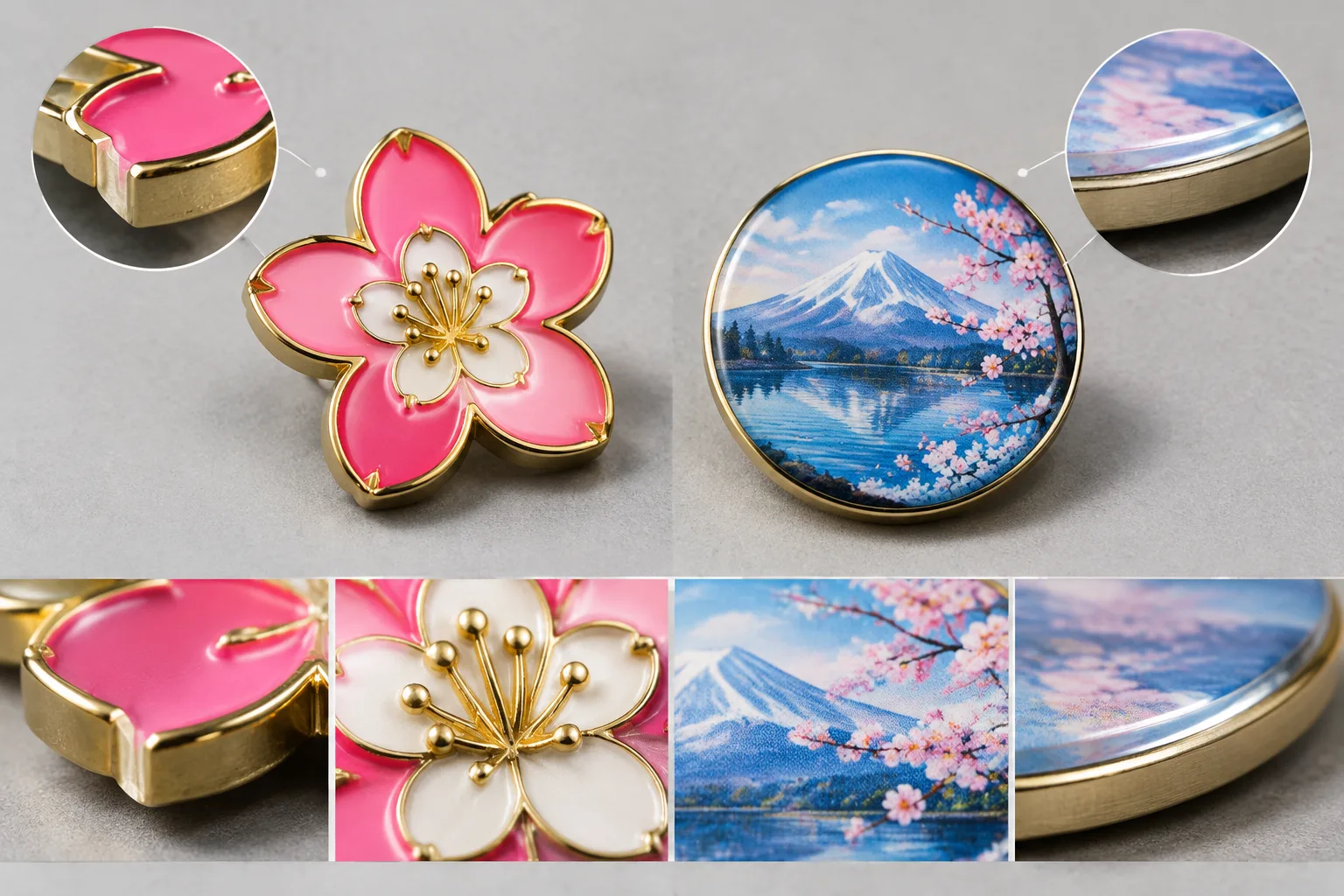
Borders, Gradients, Small Text, and Fine Lines
Artwork features provide a practical starting point for method selection. A smooth gradient can remain continuous in a printed graphic. In enamel, the same gradient would need to become several distinct color areas, each separated by a boundary. That change may alter the visual character of the original artwork.
Small text and narrow lines should be judged at the intended finished size, not only on a large computer screen. Enamel may require clearer borders, heavier lettering, or simplified wording. Printed detail can preserve more of the original graphic, but legibility still depends on the actual badge size, surface, contrast, and artwork arrangement.
Metal borders can make enamel color separation clear and attractive. However, crowded boundaries can reduce the open space available for lettering and small graphic elements. Raised or recessed relief may establish visual hierarchy, but it does not guarantee that every fine feature will transfer unchanged into a formed part.
Gairun lists stamping, die-casting, photo etching, and hydraulic high-relief forming among its available forming methods. Suitability depends on the material, shape, relief, and decoration plan. A complex dimensional body can require a different construction assessment from a flat printed badge.
Example 1: A corporate logo has two flat colors, bold outlines, and short text. Soft enamel or imitation hard enamel is an appropriate initial direction because the artwork can be divided into bounded cells and the metal border supports recognition. If the finished size becomes smaller, or if a gradient is added to the logo, printing may become more suitable.
Example 2: An event illustration contains a sky gradient, several tonal transitions, fine character details, and small captions. UV printed pins are an appropriate initial direction because the graphic can remain printed. If the buyer simplifies the illustration into a few bold color fields and removes the small captions, enamel may become practical.
For souvenir, fashion, or brand pins, artwork may combine an irregular outline with multiple decoration effects. In those cases, a die-cast base can be considered for formed outlines or dimensional relief, but the geometry, rear attachment area, and decoration plan must be defined before tooling.
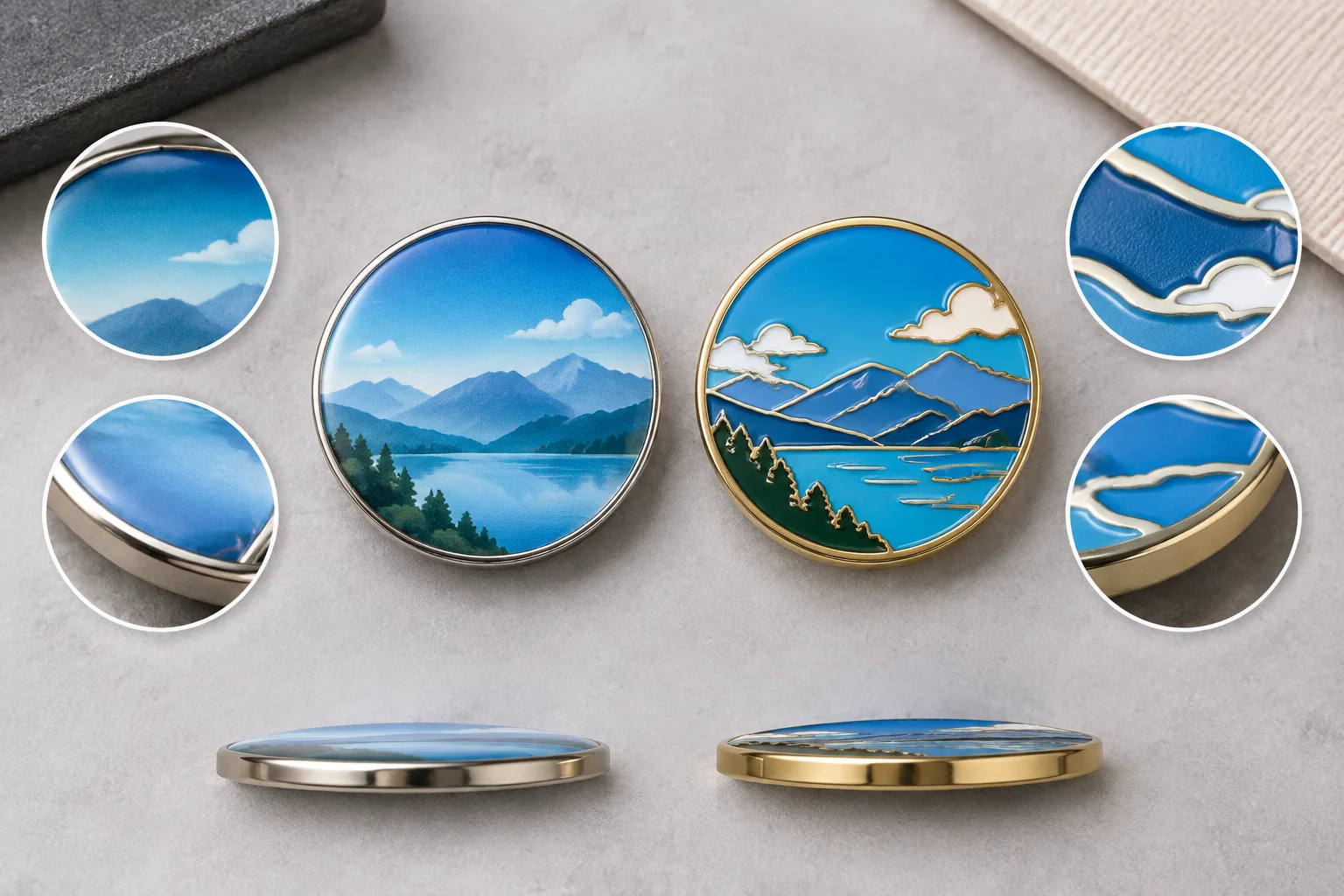
Surface Feel, Relief, and the Clear Epoxy Option
Artwork detail is only one part of the decision. Buyers should also decide whether the pin should feel recessed and tactile, appear smooth, retain exposed metal, or present a printed surface with an added coating.
Soft enamel creates recessed colored areas and visible raised metal borders. That tactile contrast can suit badge-like designs and strong graphic shapes. Imitation hard enamel creates a smoother face, but it should not be described as automatically more durable. The choice is primarily about surface appearance, color structure, and design intent unless separate performance evidence is available.
A clear epoxy coating can be applied as a transparent layer over a decorated surface when requested. It changes the surface presentation and may be considered over printed or enamel decoration, but it does not solve every artwork limitation. It should not be described as scratch-proof, UV-proof, or chemically resistant without supporting evidence.
Gairun lists matte and sandblasted finishes as options for reducing shine or creating contrast. The exact texture or gloss level should be defined through a specification or approved sample. Plating direction, exposed metal areas, relief, and the base construction should be coordinated with the artwork.
When a smoother printed presentation is important, see Printed and Epoxy-Coated Badges. When the design is built around a smooth enamel face and defined color cells, see Imitation Hard Enamel Pins.
Artwork Preparation and Proof Approval for Each Route
A reliable quote begins with a complete buyer brief. Submit the original artwork together with the intended product type, quantity, dimensions, thickness, finish, color treatment, attachment, design variants, packaging requirement, destination, and required schedule when known.
For enamel, identify the metal borders, separate color cells, relief hierarchy, plating areas, and text or linework that may need simplification. The artwork should show which areas remain exposed metal and which areas receive color.
For printing, state whether the intended route is UV printing or screen printing. Preserve the required graphic layers and provide color references without assuming a particular ink system or color count. If the artwork includes gradients, tiny type, or fine lines, show the intended finished size alongside the original file.
Use the artwork proof to check the finished-size appearance, color placement, borders, text, relief relationship, plating, and attachment position. A visual proof does not replace confirmation of dimensions, construction, finish, packaging, or commercial terms.
Gairun states that tooling begins only after the relevant production artwork has been reviewed and accepted. Its pre-tooling engineering review may cover the part dimensions, thickness, relief, color areas, attachment, component positions, and production method. Gairun also states that a 2D or 3D artwork proof may be provided within 24 hours when sufficient project information is available; that timing should be reconfirmed and is not a production lead-time promise.
A custom sample, when selected, is used to assess proposed appearance and construction. Artwork approval, sample approval, and authorization for bulk production are separate control points. A sample approval also does not authorize later unapproved changes.
For soft enamel-specific preparation, see Soft Enamel Pins. Keep the approved artwork and any approved sample together as the acceptance reference for later production discussions.
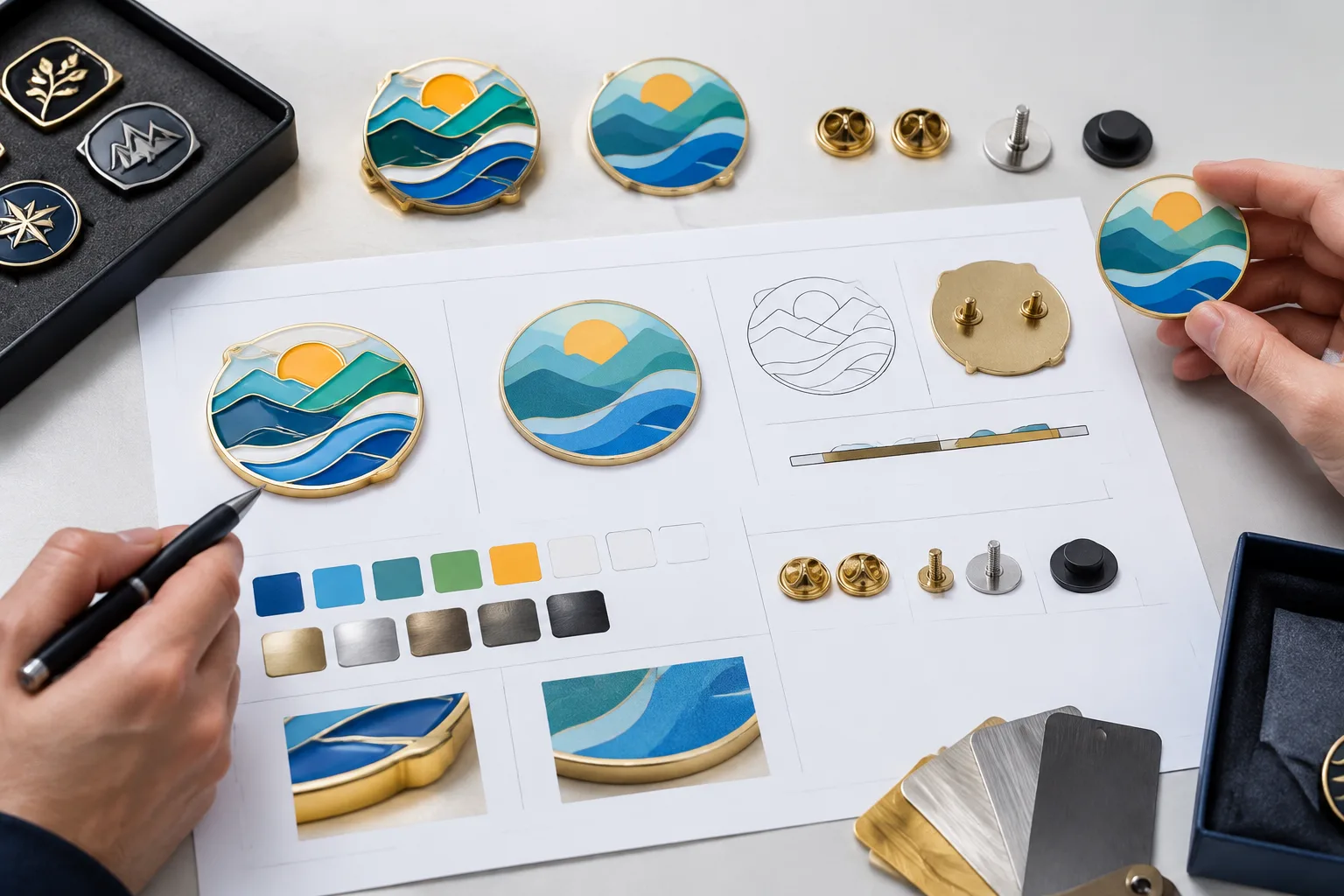
Side-by-Side Decision Table for Detailed Pin Artwork
The table below is an initial selection aid. It is not a universal engineering limit or a replacement for the approved proof. The same artwork can lead to a different route when its size, base shape, relief, attachment, or surface specification changes.
| Observable artwork or product input | Practical implication | Initial decision | What still requires confirmation |
|---|---|---|---|
| Gradient or several continuous tones | Separating the image into enamel cells may interrupt the tonal transition. | Start with UV printed pins. | Finished-size color appearance, surface preparation, and the selected printing specification. |
| Small text or tightly spaced lettering | Enamel may need clearer borders or simplified type; print still needs a legibility check. | Compare printing with simplified enamel artwork. | Actual text size, contrast, spacing, and proof at finished dimensions. |
| Fine lines and many small marks | Relief and metal boundaries can compete with the graphic details. | Start with UV printing or screen printing. | Line visibility on the selected base, surface finish, and attachment position. |
| Two or three bold, bounded colors | Clear cells can use the metal structure as part of the visual design. | Start with soft enamel or imitation hard enamel. | Border layout, plating tone, relief, and the desired face texture. |
| Strong visible metal borders | Metal separation supports enamel color placement and visual hierarchy. | Favor enamel when the borders are intentional. | Border width, crowded areas, exposed metal finish, and proof appearance. |
| Preference for tactile recessed color | Recessed fields and raised metal create a physical contrast. | Consider soft enamel. | Color overflow checks, relief relationship, and final surface treatment. |
| Preference for a smoother face | Color and metal areas should appear closer to one level. | Consider imitation hard enamel or printed decoration. | Exact gloss, texture, color appearance, and any added coating. |
| Dimensional or irregular body | The base forming method can affect available graphic areas and detail hierarchy. | Decide construction before final decoration. | Material, shape, thickness, relief, rear attachment area, and tooling drawing. |
| Protective clear epoxy requested | A transparent layer changes the surface presentation but does not replace artwork decisions. | Add epoxy only as a specified option. | Compatibility with the decoration, gloss, thickness, and approved surface reference. |
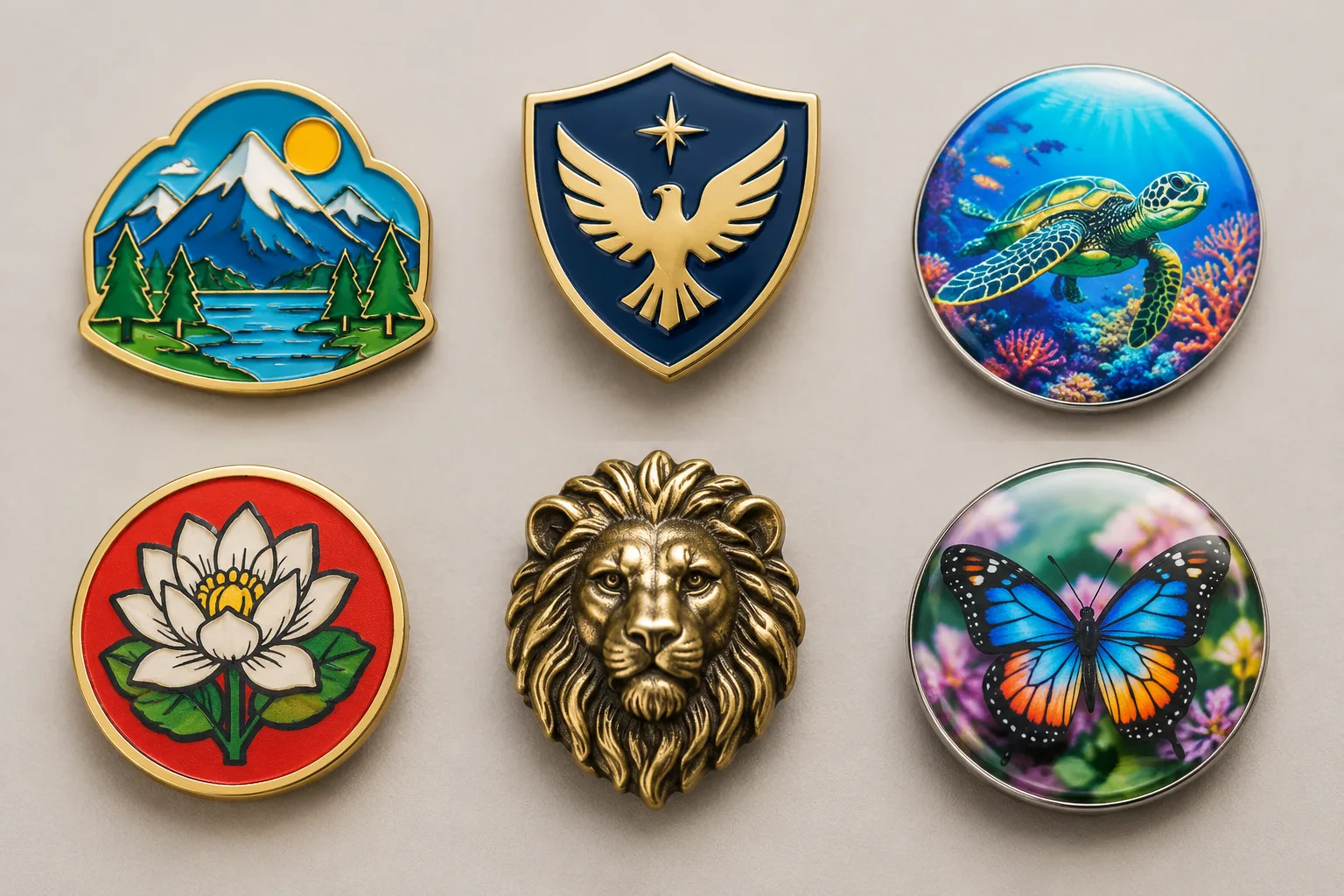
What to Confirm Before Requesting a Quote
Mark the preferred route as an initial choice: soft enamel, imitation hard enamel, UV printing, or screen printing. If the artwork contains competing requirements, identify the unresolved choice so the engineering discussion can address it directly.
- Provide the product type, quantity, dimensions, artwork, design variants, finish, color treatment, attachments, packaging, destination, and required schedule.
- Show the artwork at the intended finished size, especially when it includes gradients, small text, fine lines, or crowded borders.
- Ask how exposed plating, metal borders, relief, and any clear epoxy layer will appear on the selected construction.
- Confirm the attachment, orientation, expected weight, and whether anti-rotation features are needed. A fastening method should not be chosen from artwork alone.
- Separate artwork approval, sample approval when selected, bulk-production authorization, packaging, and shipment terms into distinct decisions.
- Use a written specification for the final decoration, surface, construction, attachment, and acceptance reference.
For wearable badges, the attachment affects the practical result. A corporate logo lapel badge may use a compact construction and a conventional back fitting, while a larger or unbalanced design may need a different attachment position. Scenario guidance such as size, thickness, material, and fastening options must remain tied to the exact product and use case, then confirmed for the buyer’s design.
Gairun’s RFQ guidance calls for product type, quantity, dimensions, artwork, design variants, finish, color treatment, attachments, packaging, destination, and required schedule. Its OEM model follows a buyer-supplied design or specification, but that does not remove engineering review or buyer approval. The service path can move from requirements and artwork review through optional sampling, production coordination, packaging, and shipment preparation.
Frequently Asked Questions
Are printed pins better than enamel pins for gradients and complex artwork?
Usually, printing is the better initial route because gradients and continuous tonal changes can remain part of the graphic. Enamel may work if the buyer simplifies the image into clearly bounded color cells.
Can UV printing preserve small text and fine lines better than enamel?
UV printing can be considered for printed detail, fine marks, multiple tones, and gradients. The finished-size proof still determines whether the text and lines are sufficiently clear for the actual badge.
When should I choose screen printed badges instead of UV printed pins?
Consider screen printing when defined graphic details should remain printed on a prepared metal surface. The ink system, color count, resolution, and abrasion expectations should be specified for the project.
Does soft enamel or imitation hard enamel show more artwork detail?
Neither method automatically preserves every detail. Soft enamel emphasizes recessed color and raised borders. Imitation hard enamel presents a smoother face, but both require controlled color areas and metal boundaries.
Can clear epoxy be added over a printed or enamel pin?
Yes, clear epoxy can be requested as a transparent layer over a decorated surface. It changes the surface presentation and should be specified with the decoration, finish, and approved appearance.
What artwork and specifications should I include when requesting a quote for detailed pins?
Include the product type, quantity, dimensions, thickness, artwork, variants, finish, color treatment, attachment, packaging, destination, and required schedule. Also identify gradients, small text, fine lines, relief, exposed metal, and the preferred decoration route.