
To decide how many race medals to order, calculate the quantity for each approved medal design rather than applying one percentage to the whole event. Start with eligible participants, add supported late or on-site entries, include approved complimentary or operational units, then add a documented contingency based on the event’s actual uncertainty. For running-event planning, define participant quantity, race identity, distance or design versions, ribbon branding, event date, and finish-line distribution. Gairun’s guidance for Marathons and Running Events follows this same design-by-design logic.
The result is a planning estimate first and a purchase quantity later. A 5K medal, half-marathon medal, and full-marathon medal are separate controlled items when their artwork, ribbon, finish, or packaging differs. Extra units of one version cannot automatically solve a shortage of another.
How Many Race Medals to Order: A Design-by-Design Forecast
A practical race medal quantity model is:
Order quantity by design = eligible baseline + supported additions + approved operational units + documented contingency
The eligible baseline comes from the latest registration and award records. Supported additions may include expected late entries or on-site registrations that are not already included. Operational units can cover approved staff, invited participants, replacement medals, or controlled distribution needs. The contingency is the remaining uncertainty, not an unexplained standard percentage.
For example, this hypothetical calculation demonstrates the method only. It is not an industry benchmark:
- Eligible participants for one approved 10K design: 1,120
- Supported late-entry estimate: 35
- Approved operational units: 10
- Documented contingency for the event’s registration and replacement risks: 25
- Planning quantity: 1,190 medals
The same event might need a different quantity for its half-marathon design because the participant data, award rules, ribbon, or distribution process differs. Record the assumptions beside each number, including the registration snapshot date and who approved the working case.
Before requesting production quantities, connect each number to the physical version being made. The brief should identify the event, distance, visible variations, ribbon branding, required arrival date, and finish-line distribution method. That information helps prevent a single event-wide total from hiding an omitted design or an incorrect version.
Start with Registration, Race Category, and Finish Eligibility Data
A finisher medal forecast should begin with the latest usable registration export, not a rounded estimate. Create a baseline for every distance and award category. Then determine whether the event awards medals to all finishers, selected categories, teams, or another defined group.
Reconcile the records before choosing quantities. Check paid registrations, complimentary entries, transfers, duplicates, deferred entries, cancellations, and participants who are not eligible for a particular medal. A registered participant is not automatically part of every medal quantity.
Record two dates: the data snapshot date and the expected registration-closing date. This makes later changes visible. It also prevents a late update from being hidden inside an unexplained buffer.
Build an award matrix before totaling the order. Useful columns include distance, category, eligibility rule, medal design, ribbon version, language, sponsor treatment, and expected distribution point. A tournament-style matrix can also distinguish winners, divisions, age groups, teams, or individual achievements where those distinctions actually exist.
| Registration input | Quantity implication | Buyer action |
|---|---|---|
| Confirmed eligible registrations | Forms the baseline for the matching design | Attach the export date and eligibility rule |
| Transfers or deferred entries | May move a participant between event versions or dates | Remove duplicates and confirm the final event assignment |
| Separate distances or categories | May require separate medal and ribbon quantities | Map each group to an approved design |
| Cancelled or non-eligible registrations | Should not automatically remain in the finisher quantity | Document the treatment in the worksheet |
Do not infer finish rates or category participation from a generic assumption. Use the organizer’s own historical records when available. If those records do not support a conclusion, show the uncertainty as a scenario rather than presenting it as a fact.
Separate Paid, Complimentary, and On-Site Entries Before Adding a Buffer
Different types of uncertainty should appear on separate worksheet lines. At minimum, distinguish confirmed paid registrations, complimentary or invited participants, staff or VIP allocations, expected on-site entries, replacements, and any other approved operational quantity.
First determine whether late entries are already included in the registration total. If they are not, define the registration cutoff and the evidence supporting the expected addition. On-site quantities should be based on event-specific records or an internal planning decision, not a universal relationship between on-site entries and finishers.
Also decide how the event will handle DNS participants, transfers, duplicate registrations, damaged medals, and finish-line replacements. Include only quantities that have an owner and an operational reason. An open-ended line called “extra medals” is difficult to approve and difficult for a supplier to interpret.
Use low, working, and high cases when the final count is unsettled. The working case becomes the proposed order quantity. The low and high cases show what would change if registrations, category assignments, or distribution needs move before the order is released.
- Low case: confirmed eligible participants with no unapproved additions.
- Working case: confirmed participants plus supported additions and approved operational units.
- High-risk case: the working case adjusted for a documented uncertainty that cannot be resolved before production.
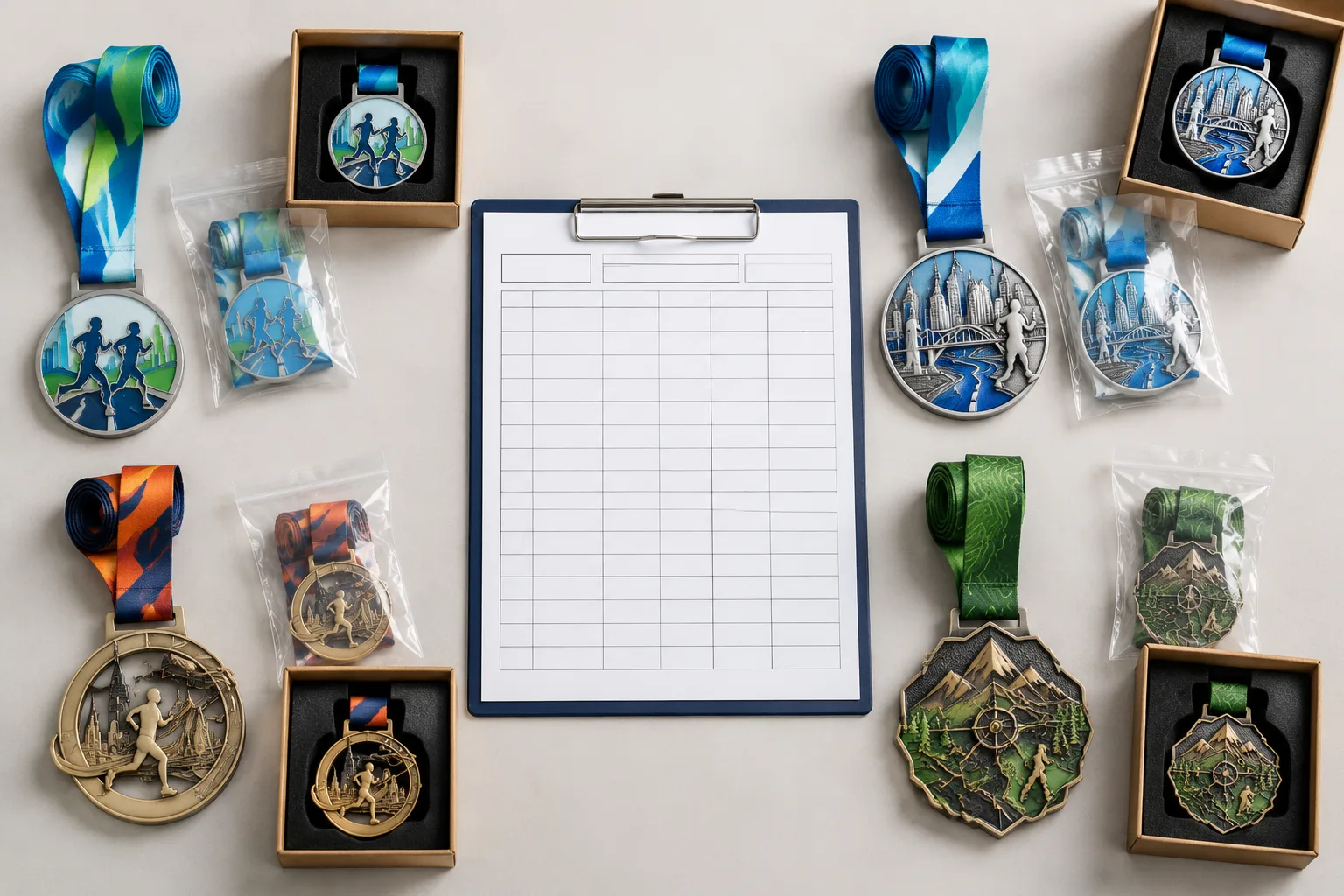
Sorting and handout procedures matter as much as the total. Medals may arrive separated by distance, design, ribbon, or presentation format. Packaging should support that process, especially when several versions are shipped together. Gairun lists options such as standard anti-scratch packing, individual OPP bags, bubble protection, velvet boxes, paper display boxes, and plastic display boxes. Suitability and commercial inclusion depend on the product and order.
Map Medal Versions, Shared Components, and Specification Choices
After the award matrix is complete, create one quantity line for every visible version. Include distance, category, event year, language, sponsor treatment, ribbon, attachment, and packaging differences. Similar shapes or shared artwork do not make separately approved designs interchangeable.
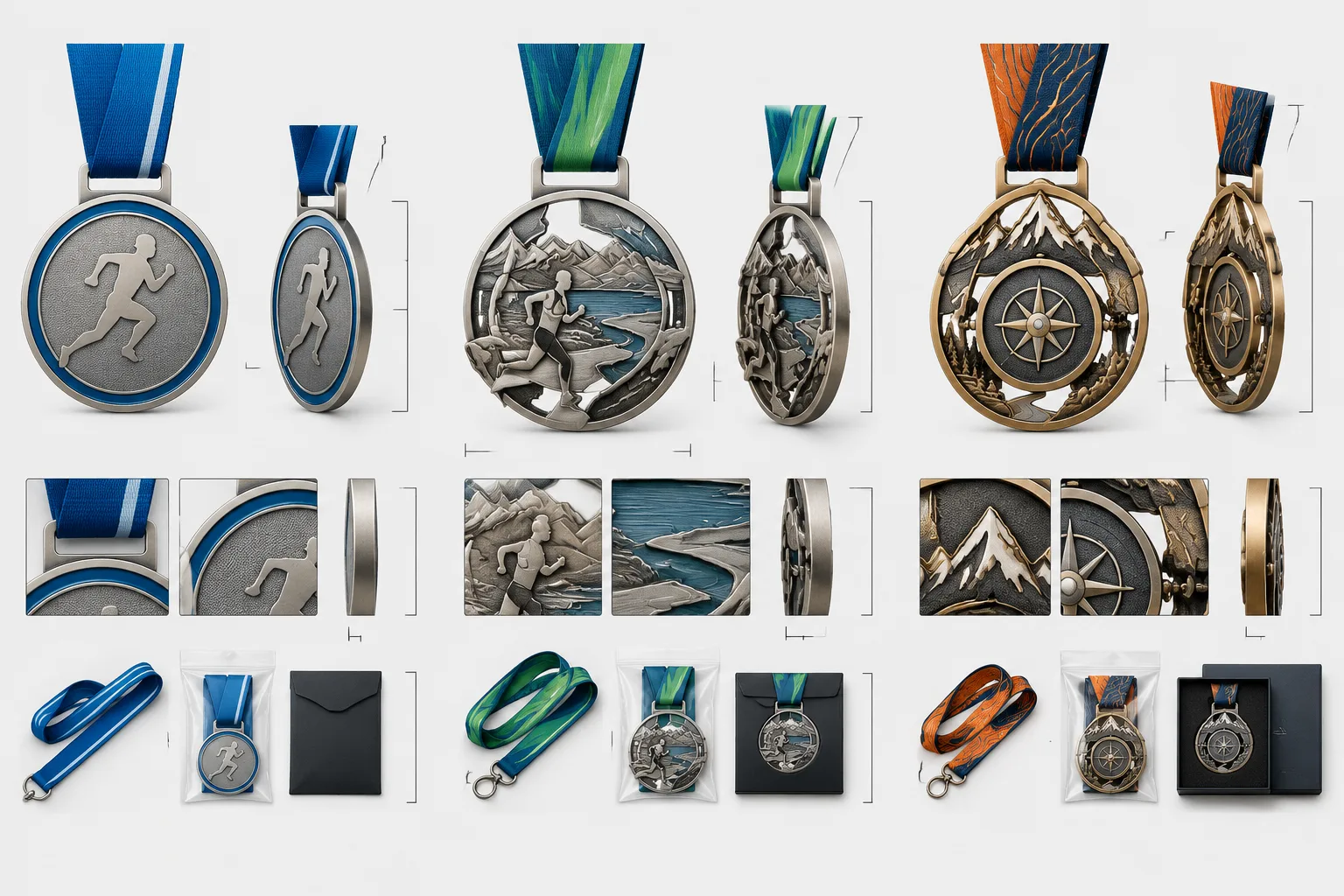
Construction choices can affect weight, sorting, attachment, handling, and the need for additional engineering input. Gairun manufactures fixed sports medals, sculpted 3D relief medals, and spinning or combined structures. The suitable format depends on the design, not simply on the event name.
| Observable input | Practical implication | Initial decision | Still to confirm |
|---|---|---|---|
| One fixed body with no moving feature | One main body and a simpler sorting identity | Consider a one-piece medal | Front and back artwork, dimensions, relief, openings, and attachment |
| Raised subject with recessed background | Artwork needs a clear relief hierarchy | Consider sculpted 3D relief | Which forms sit forward and whether fine details reproduce clearly |
| Spinning, layered, or connected parts | Alignment, clearances, connections, and assembly affect handling | Consider a moving or combination structure | Movement, connection points, component positions, and assembled weight |
| Individual presentation at the finish line | Protection and sorting take more handling time | Consider separate protective packing | Surface exposure, package size, handout method, and shipping arrangement |
Example 1: 5K or 10K. A simple circular design with no connected parts may initially fit a fixed construction. Scenario guidance for this running format uses a 55–65 mm maximum dimension, 2.5–3 mm body thickness, a 25–30 mm ribbon, and an individual protective bag or card bag. These values are contextual, not universal specifications. Artwork, expected weight, attachment, and distribution can change the initial choice.
Example 2: full marathon. A large city-themed medal with deep relief and a maximum dimension between 70–85 mm may initially be considered for a more dimensional construction. Scenario guidance uses 3–4 mm body thickness and notes that designs above 80 mm may benefit from openings, a recessed back, or local reduction to control weight. The final artwork, material, relief, expected weight, ribbon connection, and packaging must determine whether that direction is suitable.
Example 3: ultra-marathon. An 80 mm-plus concept with layered or moving elements may need weight reduction, assembly planning, and upgraded packaging. Scenario guidance for a super-marathon or 100 km event uses 80–100 mm and 4–6 mm as a contextual range, with the condition that a large solid piece should be avoided. A moving design must be considered as an assembled system rather than approved from a flat image alone.
For every design, retain a specification block covering final artwork, maximum dimension, body thickness, local relief height, expected weight, ribbon and connection structure, surface treatment, and packaging method. A one-piece medal uses one fixed main body. A 3D relief design separates raised and recessed forms. A spinning or combination medal requires component alignment and connection details. Tooling begins only after the relevant production artwork has been accepted, but artwork acceptance does not approve every commercial or shipping term.
Model Uncertainty Without Inventing a Universal Marathon Medal Buffer
There is no defensible universal marathon medal buffer percentage that applies to every event and design. The right contingency depends on registration quality, entry timing, category uncertainty, replacement policy, distribution risk, and the possibility of replenishment before the event.
Assess at least three cases for each design. Then identify the driver behind the additional units. Examples include a registration file that is still changing, a defined on-site allocation, an uncertain category split, a known replacement policy, or a design with no practical replenishment window.
Keep the contingency at design level. Separate designs may use different tooling and setup. A fixed medal, a sculpted 3D medal, and a moving medal may follow different production paths. A unique ribbon or special package can also make one design operationally distinct.
Do not transfer unused 5K medals to the full-marathon allocation unless the physical product, ribbon, branding, and approved use are genuinely interchangeable. In most event programs, they are not.
Record three approval details: who selected the working case, which evidence supported it, and what trigger would cause a reforecast. This turns a buffer from a vague percentage into a controlled procurement assumption.
Freeze the Quantity Through Clear Approval Gates
Quantity approval should be separated from artwork, engineering, packaging, and schedule approval. A practical sequence is:
- Registration snapshot: approve the source date and treatment of transfers, cancellations, and eligibility.
- Award matrix: approve every distance, category, and medal version.
- Quantity by design: approve the baseline, additions, operational units, contingency, and owner.
- Artwork and engineering: confirm dimensions, thickness, relief, structure, attachments, finish, and color treatment.
- Packaging and logistics: confirm packing format, destination, transport assumptions, and required arrival date.
A supplier-ready RFQ should include product type, quantity by design, dimensions, artwork, design variants, finish, color treatment, attachments, packaging, destination, and required schedule. Unresolved technical choices can be marked for discussion, but an incomplete RFQ should not be treated as final production approval.
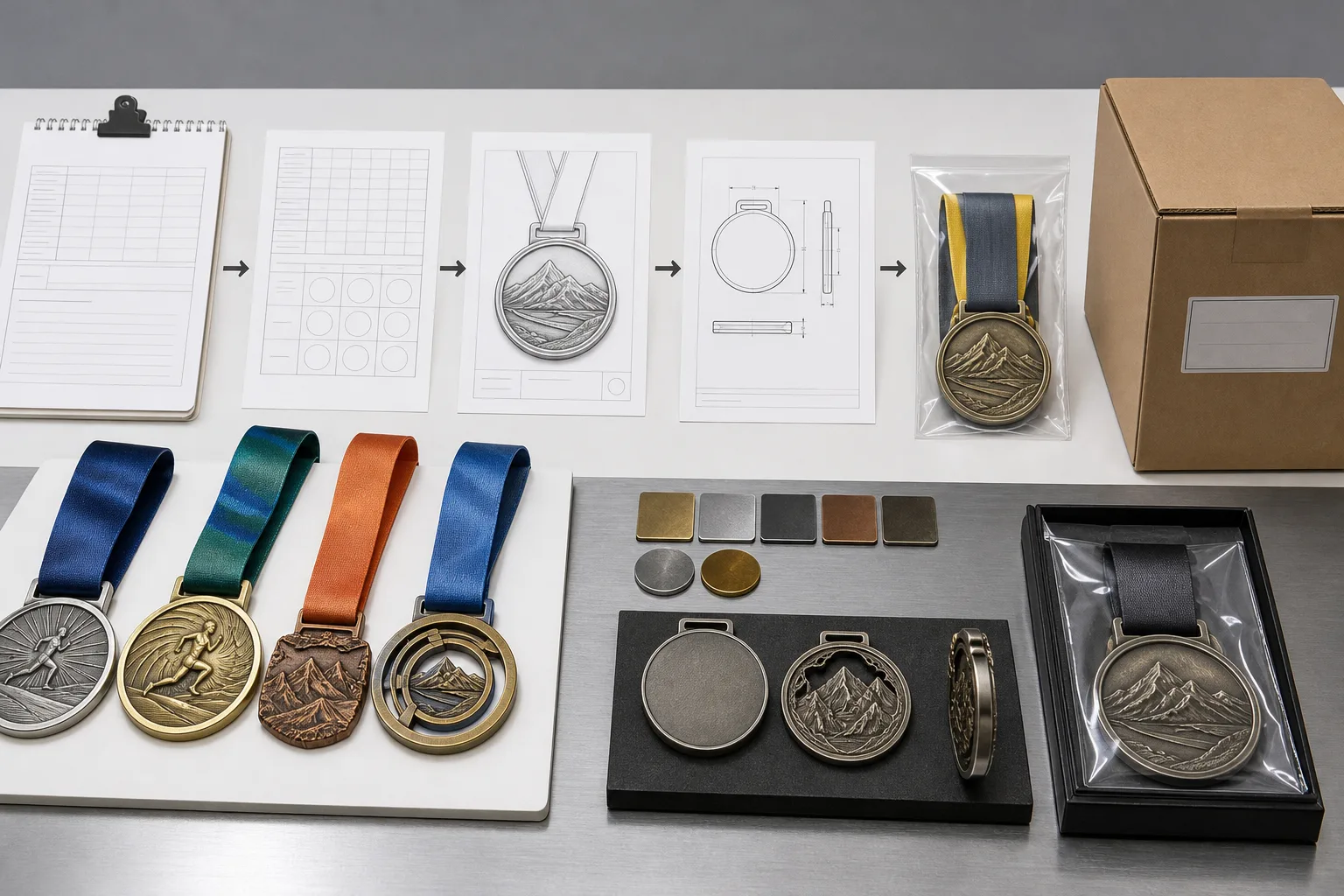
Gairun’s service path separates requirement intake, artwork and engineering review, sample planning when selected, production coordination, packaging, and shipment preparation. A 2D or 3D artwork proof may be available within 24 hours when sufficient project information is supplied, subject to current confirmation. The proof is a visual control point, not a replacement for final specification approval.
Ask for current written confirmation of commercial terms. Gairun states that its standard minimum order quantity is 100 pieces per design, with reconfirmation required for the product and process. A 50-piece trial order may be supported for selected products after design, process, and project review. Neither figure should be used to justify an event quantity without confirmation.
Separate production time from shipping time. Destination, transport mode, customs arrangements, packaging, and approval timing affect the delivered date. Expedited production support may be available subject to project review and the current production schedule; it is not a substitute for a written schedule.
Use a Design-Specific Quantity Worksheet Before Placing the Order
The worksheet should contain one row per medal design. Keep the quantity fields and specification fields together so a correct total cannot be attached to the wrong version.
| Worksheet field | What to enter |
|---|---|
| Design identity | Design name, distance or category, event year, language, and approved file name |
| Quantity basis | Eligible baseline, confirmed registrations, expected additions, complimentary or operational units, and approved contingency |
| Order result | Total order quantity and approval owner |
| Visible components | Ribbon version, attachment, finish, color treatment, and sponsor treatment |
| Physical specification | Maximum dimension, body thickness, relief direction, expected weight, and construction |
| Fulfillment | Packaging format, destination, required arrival date, and shipping assumptions |
Before release, reconcile the worksheet total against the supplier quotation and purchase order. Check that no design is omitted or duplicated. Then compare dates, sponsor or organization marks, distance names, ribbons, quantities, packaging, destination, and required arrival date against the current approved files.
For wholesalers, distributors, and repeat buyers, consistent file naming and approval records reduce the risk of mixing outdated event dates, logos, or specifications. Any compliance, testing, safety, or market-entry requirement should be checked against current order documentation because requirements can change with the product, finish, attachments, packaging, and destination market.
Use the completed worksheet as the basis for a Gairun RFQ or final quantity confirmation. Keep unresolved structure, packaging, and buyer requirements visible until the responsible party closes them.
FAQ
Is there a standard percentage buffer for marathon or race medals?
No universal percentage should be assumed. Select the contingency by design from documented registration volatility, late-entry expectations, category uncertainty, replacement policy, distribution risk, and supplier schedule.
Should I order medals for registered participants or only for expected finishers?
Start with the event’s eligibility rule and award policy. Reconcile registrations, cancellations, transfers, and non-eligible participants, then add supported late entries and approved operational units.
How should medal quantities be handled when a race has separate 5K, half-marathon, and full-marathon designs?
Forecast each design separately. Keep its registrations, ribbon, artwork, packaging, contingency, and approval owner on its own worksheet line before calculating the event-wide total.
Can extra medals for one race category be used for another category?
Only when the physical medal, ribbon, branding, and approved use are genuinely interchangeable. Different artwork, distance names, finishes, or packaging normally make the units separate inventory.
What information should be included when requesting a quote for race medals?
Include product type, quantity by design, dimensions, artwork, variants, finish, color treatment, attachments, packaging, destination, and required schedule. Add material or forming preferences when known, and identify unresolved choices for discussion.
When should the final medal quantity be frozen before artwork approval and production?
Freeze it after the registration snapshot, award matrix, and design-version list are approved, but before tooling and production are released. Reforecast only through an identified approval gate when new data changes the assumptions.