
For a fixed race date, start with the date the medals must be venue-ready, not with a factory lead-time number. The practical Marathons and Running Events schedule works backward through approvals, engineering, tooling, optional sampling, production, packaging, transport, and destination handling. This is consistent with established backward-planning practice in project management, where milestones and dependencies are scheduled from a required finish date (backward scheduling guidance).
In other words, the race medal production timeline is a chain of decisions, not one promise. Gairun normally states 15–20 working days for standard bulk production, but that figure excludes approvals, sampling, packaging, freight, customs, and local delivery. The actual schedule must match the design, quantity, destination, transport mode, trade term, and approval status.
Start with the Required Arrival Date, Not a Factory Lead-Time Number
Separate four dates before requesting a quotation:
- Event date: when the race takes place.
- Medal distribution date: when finishers receive their awards.
- Venue-ready date: when the medals must be at the event location.
- Receiving and sorting date: when your team needs the shipment for counting, variant separation, or ribbon preparation.
Use the earliest operational requirement as the starting point. Then subtract confirmed destination handling and transport time, packaging and shipment preparation, bulk production, optional sampling, tooling, engineering, artwork approval, and buyer decision time. The remaining date is the latest practical point for submitting a complete RFQ and entering controlled production planning.
Gairun treats requirements, artwork and engineering, sample planning when selected, production coordination, packaging, and shipment preparation as separate control points. A project manager may coordinate proof approval, sampling, production progress, and shipment follow-up when available, but the communication plan should be confirmed for the order.
Ask for a written schedule that identifies dependencies. A production estimate is not a delivered-date commitment. If artwork changes after tooling, if a sample is added, or if customs information is incomplete, the arrival date can move even when the factory production line remains on its normal schedule.
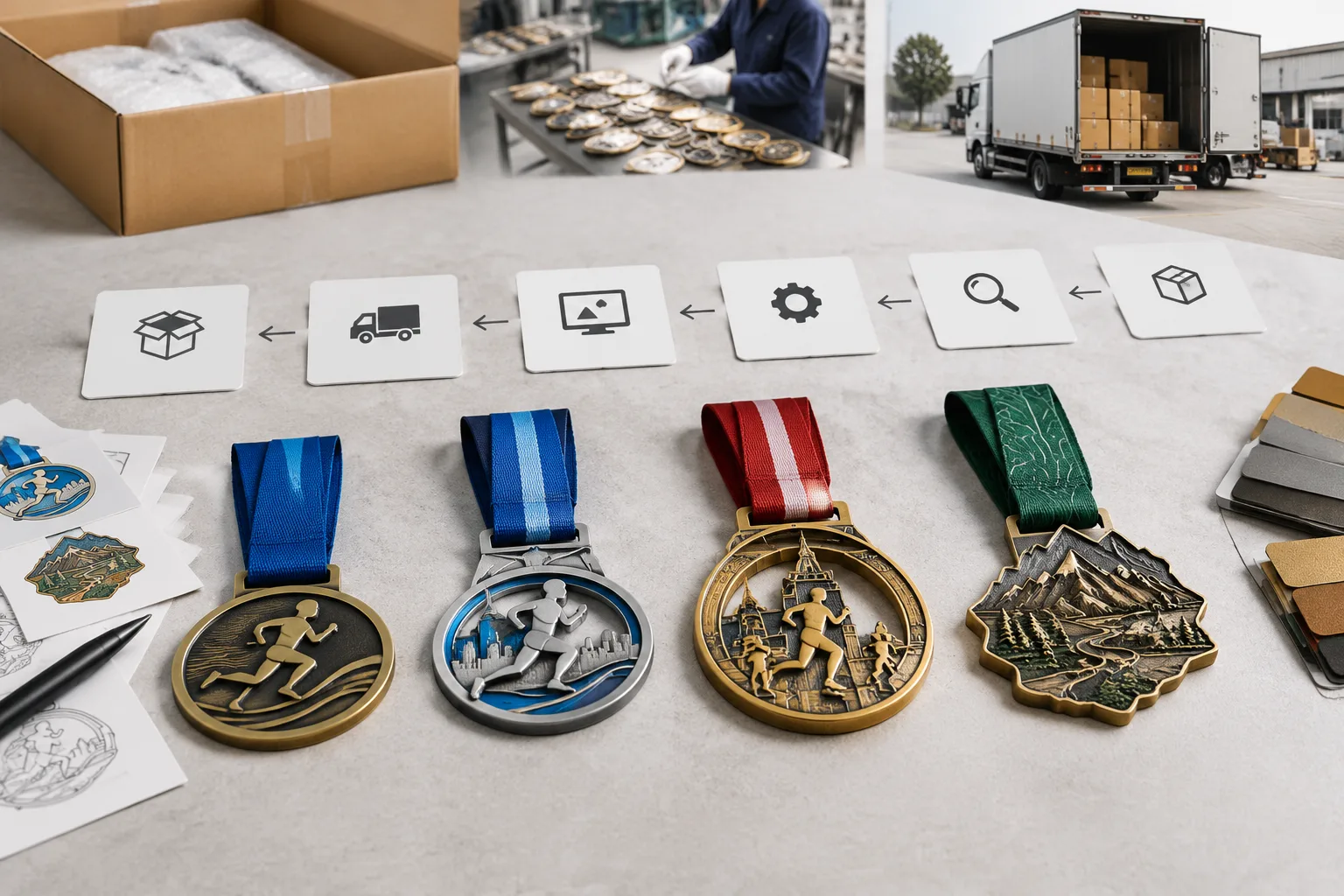
Lock the Event, Quantity, and Medal Specification Before Scheduling
A nominal lead time cannot be applied reliably to an undefined medal. The initial brief should state participant quantity, race identity, distance or design versions, ribbon branding, event date, finish-line distribution, destination, packaging method, and any award matrix for different categories.
For the medal itself, provide front and reverse artwork, maximum dimensions, body thickness, relief direction, openings, attachment details, finish, color treatment, expected weight, and packaging expectations. If a specification is still open, label it as an item for engineering rather than silently leaving it out of the schedule.
Scenario guidance can help create an initial brief, but it is not a universal standard. A hypothetical 5K or 10K road-race medal may begin at 55–65 mm with a 2.5–3 mm body thickness. A hypothetical half-marathon medal may begin at 65–75 mm with a 2.8–3.5 mm body thickness. The final dimensions, relief, attachment, and weight still need confirmation against the artwork.
| Observable inputs | Practical implications | Initial decision | What still requires confirmation |
|---|---|---|---|
| Fixed body, round outline, front and reverse graphics, no moving parts | A single main body can keep the structure controlled, but wording and attachment details still affect tooling | Start with a one-piece medal route | Final thickness, relief, weight, finish, and ribbon connection |
| Sculpted skyline, raised and recessed forms, openings, or two-tone plating | Depth, borders, open areas, and weight may require more engineering decisions | Start with a sculpted or open-structure assessment | Relief hierarchy, metal thickness, plating boundaries, and forming method |
| Smaller standard running format with simple text and limited decoration | Individual protection and efficient sorting may matter more than presentation packaging | Consider a standard medal and protective bag or card bag | Quantity, expected weight, ribbon handling, and packing sequence |
| Larger collectible format with complex relief or multiple components | Weight, component assembly, finish protection, and presentation can add decision gates | Assess sampling and upgraded packaging early | Final construction, attachment security, box scope, and shipment preparation |
Example 1: A fixed one-piece 5K medal has a round body, race identity, distance text, and a standard hanging ribbon. The initial decision is a fixed-body approach because no movement or connected feature appears in the artwork. The missing variable that could change the route is the final weight or attachment design.
Example 2: A full-marathon medal shows a city skyline in high relief, several openings, and two-tone plating. A larger running-event scenario may begin around 70–85 mm and 3–4 mm, with weight-management features considered for larger formats. The initial decision is to involve engineering early. Final geometry, relief height, and the connection structure could change the recommendation.
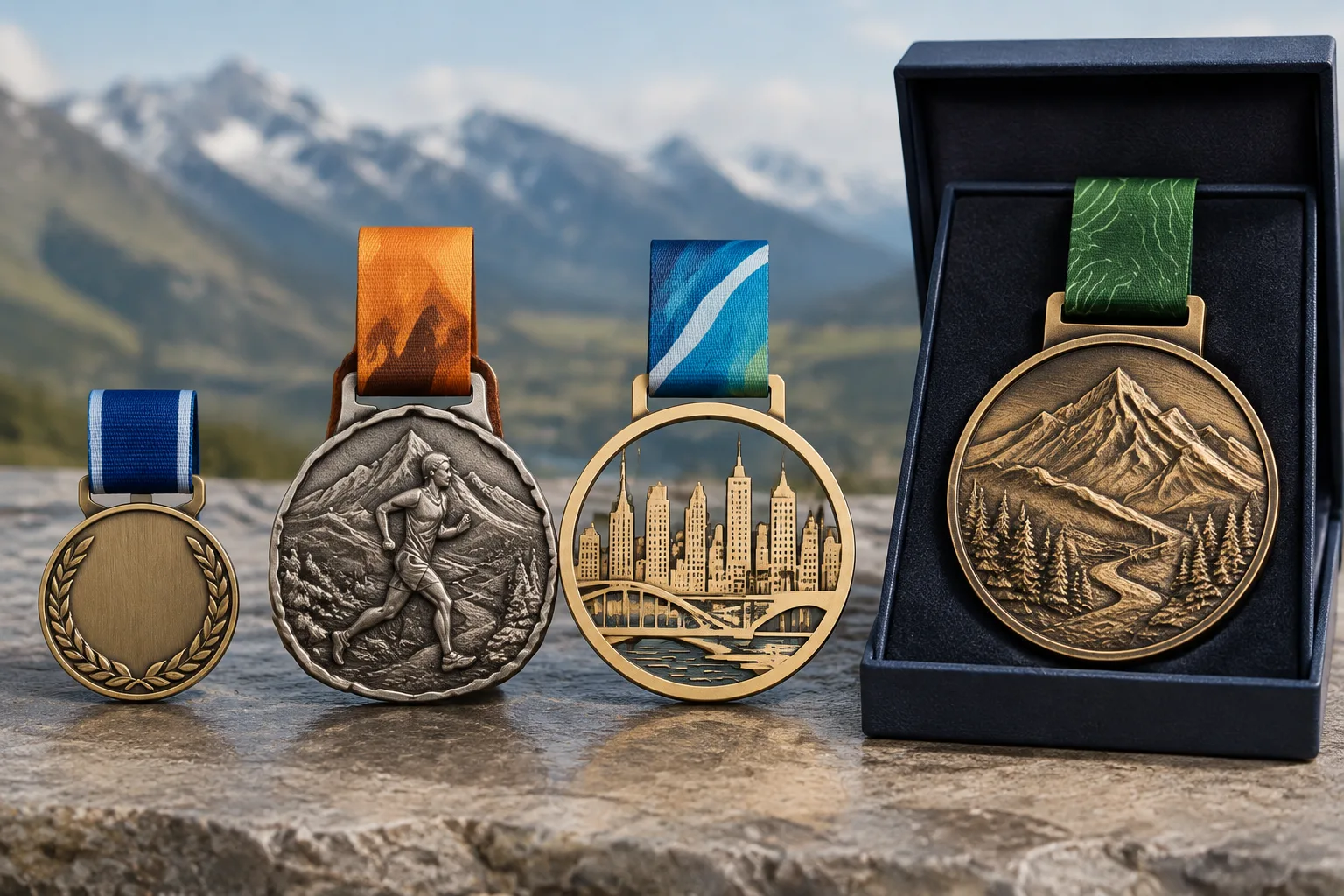
Move from Artwork Review to Engineering Approval and Tooling
Visual artwork approval and manufacturing approval are different milestones. A buyer may accept the look of the front and reverse artwork without approving packaging, shipment terms, or the authorization to begin bulk production.
Before tooling, the working file should identify dimensions, thickness, relief, metal borders, color areas, attachments, component positions, and the proposed production method. For a 3D relief medal, mark which forms are raised and which remain recessed. For a spinning or combined medal, show movement, alignment, connection points, and clearances as an assembled system.
Gairun states that tooling begins only after the relevant production artwork has been reviewed and accepted. A 2D or 3D proof may support visual decisions, and the design team may provide one within 24 hours when sufficient information is available. That timing is a visual proof reference, not a production lead time.
Late changes to race wording, distance labels, sponsor areas, ribbon branding, component positions, or recipient data can create rework. Keep version numbers on files and record written approval. The buyer’s approval should state whether it covers artwork only or also authorizes the next manufacturing step.
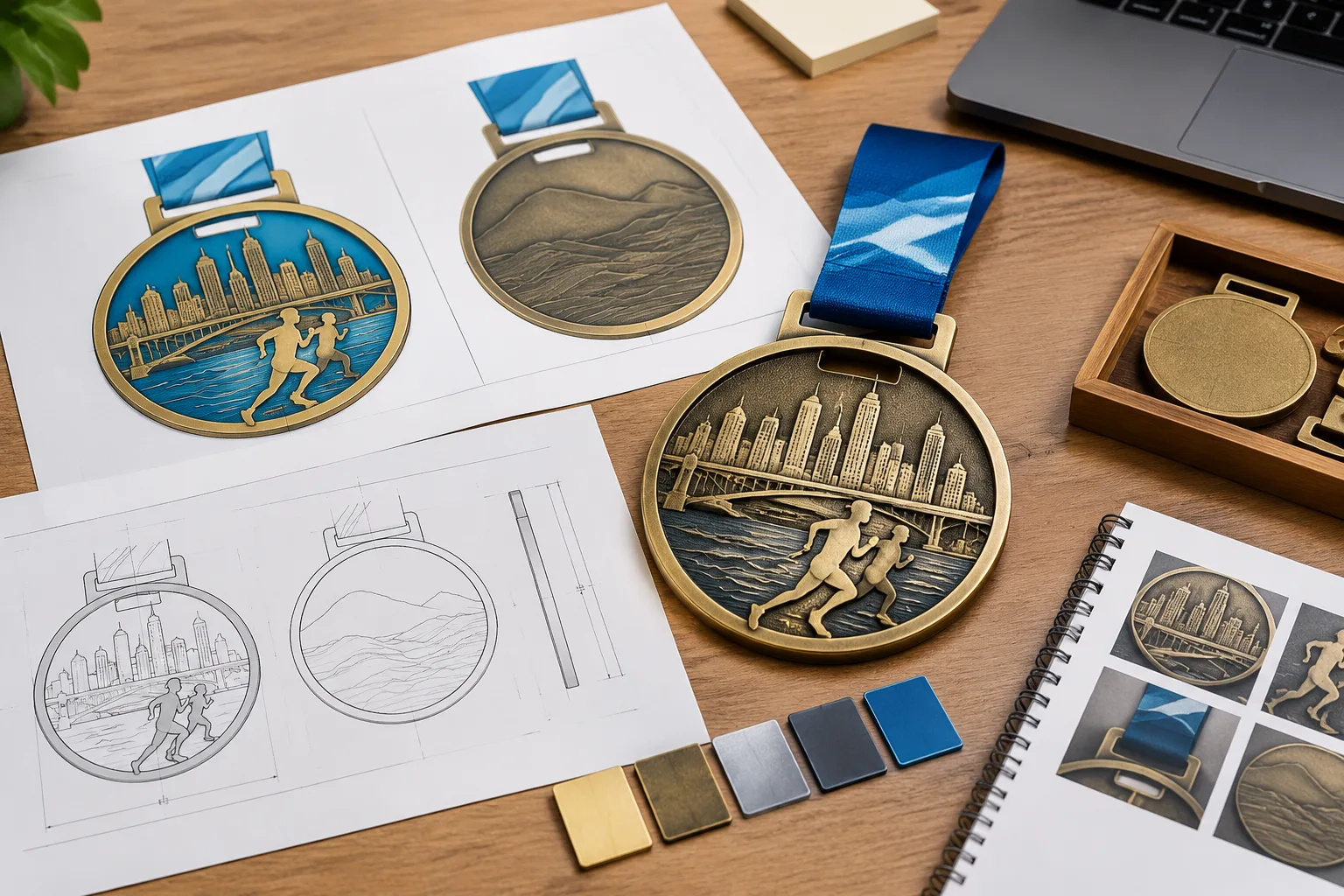
Decide Whether a Custom Sample Belongs in the Critical Path
A physical custom sample is useful when the cost of discovering a problem during bulk production is greater than the time added by sampling. It can be especially valuable for unusual relief, a large or heavy medal, openwork, connected parts, moving components, tight color and finish relationships, or a high-visibility collectible award.
Sampling may be unnecessary for a controlled fixed-body design with clear artwork and an agreed construction, subject to the buyer and supplier decision. Gairun does not imply that every order requires a custom sample.
A custom sample uses the buyer’s artwork to assess proposed appearance and construction. Sample approval remains separate from authorization for bulk production. Gairun normally quotes 7–10 working days for custom sampling, subject to design complexity, artwork status, tooling, shipment, and other project conditions. It is not a guaranteed delivered date.
Example 1: A standard fixed 5K medal has no openings, moving feature, or unusual surface relationship. Proceeding from accepted artwork to bulk production may be reasonable if the construction is clear. The final weight and hanging connection remain the variables to settle.
Example 2: A full-marathon medal combines high relief, open areas, and a moving center element. A physical sample is initially more valuable because appearance and assembly interact. Final component geometry, attachment design, and weight could determine whether the sample remains necessary.
Put the decision in writing: sample included or not included, what the sample represents, how it will be shipped, who approves it, and the deadline for that approval.
Separate Bulk Production, Packaging, and Transport from the Arrival Promise
Place the normal bulk-production reference of 15–20 working days on its own schedule line. Keep artwork approval, sampling, packaging, transport, customs, and destination handling outside that line. This separation prevents a factory estimate from being mistaken for a delivered date.
Packaging should match the distribution workflow. Individual protective bags or card bags may suit a standard running event where medals must be counted, sorted, and handed out quickly. A higher-value collectible program may consider upgraded boxes where presentation and finish protection justify the added preparation. The quotation should state the actual packaging scope.
Transport options can include express courier, air, sea, or rail. The appropriate choice depends on destination, shipment size, required schedule, and import arrangements. No route, transit time, or customs result should be promised without a shipment quotation and destination information.
Request the Incoterm and named place in writing. Gairun lists EXW, FOB, CIF, DDP, and DAP as terms to review. The selected term changes cost, handoff, and transport responsibilities, and it must match the destination and quotation scope. Customs clearance, local delivery, and destination handling remain schedule variables unless expressly covered.
For international orders, ask the carrier, broker, or logistics provider to identify the transport window, import steps, document responsibilities, and local handoff. These details belong in the arrival plan, not in a footnote after production has started.
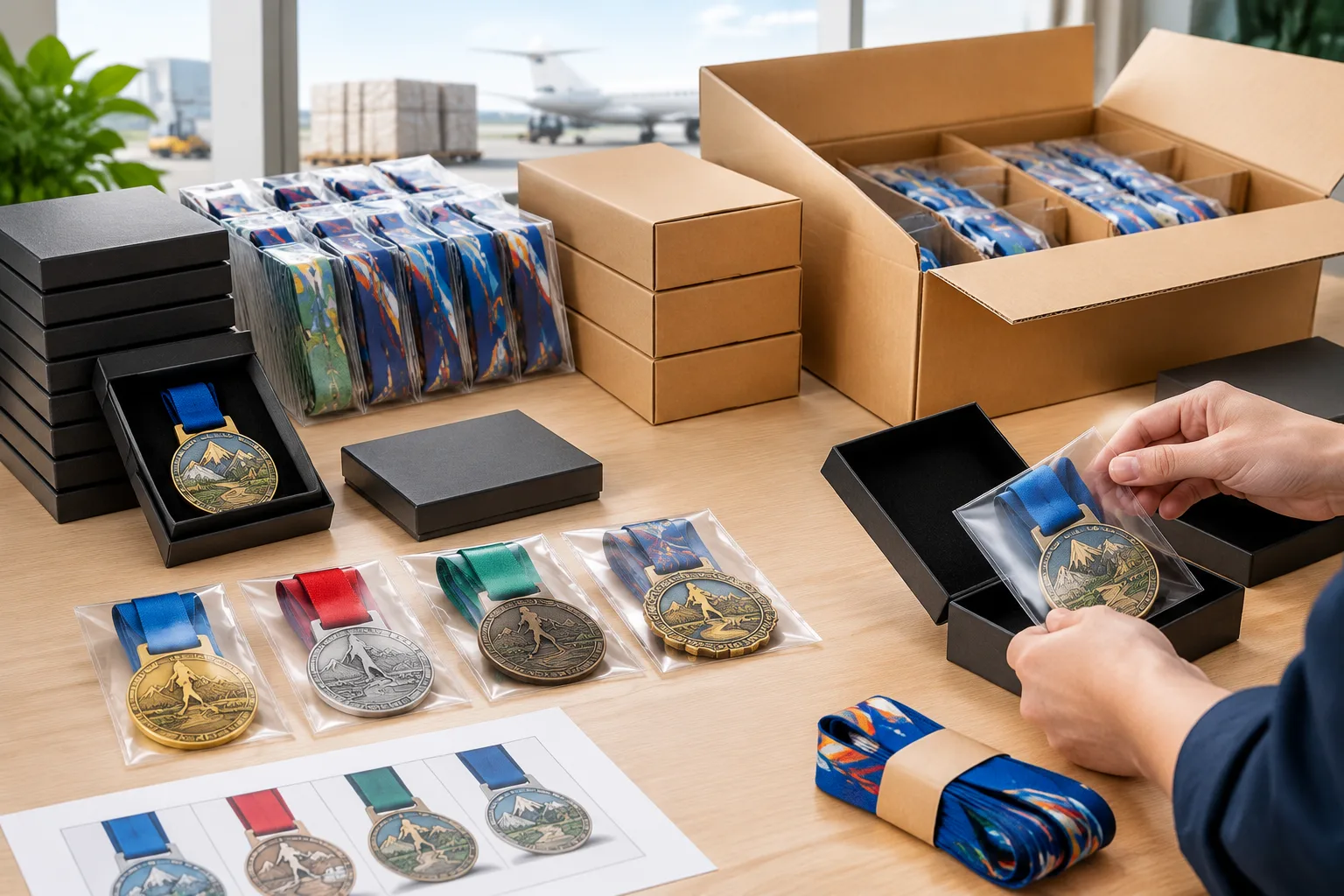
Build Contingency Around Decisions, Revisions, and Risk Controls
Contingency should respond to known risks rather than use an unsupported universal number of days. Common risks include incomplete artwork, late sponsor wording, unresolved design variants, delayed approval, a changed ribbon or attachment, added sampling, tooling rework, packaging changes, and transport or customs disruption.
Place contingency before the venue-ready date. Its size should reflect the number of open decisions, design complexity, sampling choice, destination, and transport plan. A simple fixed medal with approved artwork has a different risk profile from a large moving medal with several finish areas.
- Buyer: owns brief completeness, artwork versions, quantity, and written approvals.
- Supplier: confirms engineering, tooling, production, packaging, and shipment-preparation milestones.
- Logistics parties: confirm transport, import requirements, destination handling, and handoff timing.
Expedited production support may be available after project review and subject to the current production schedule. It does not remove the need to settle artwork, process, packaging, and shipping decisions. The written schedule, including assumptions and exclusions, should control over informal timing references.
When available, project coordination can help consolidate progress updates. Confirm the update method and frequency instead of assuming real-time factory access or a fixed reporting cadence.
Use a Backward-Planning Template Before Requesting a Quote
Use this sequence to turn the event date into an RFQ and a supplier-confirmable critical path:
- Required venue-ready date
- Receiving, counting, and sorting date
- Transport and destination-handling estimate
- Packaging and shipment-preparation milestone
- Bulk-production window
- Sample decision and sample-approval deadline, if applicable
- Tooling and engineering milestone
- Artwork approval deadline
- Final RFQ submission and buyer decision date
A useful RFQ should include product type, quantity, dimensions, artwork, design variants, finish, color treatment, attachments, packaging, destination, and required schedule. Add material and forming preferences when known, plus the requested Incoterm and named place. The How to Order Custom Metal Products guide and Buyer Resources can help organize the information.
Mark each technical choice as fixed or open. Pay particular attention to dimensions, thickness, relief, openings, expected weight, attachment structure, finish, packaging, and moving or connected parts. A one-piece fixed sports medal, a sculpted 3D medal, and a spinning or combined medal may follow different approval paths.
Before release, confirm the front and reverse artwork, variant matrix, sample gate, engineering questions, written bulk-production authorization, packaging method, transport mode, trade term, named place, and arrival responsibility. For broader planning context, see Event and Recognition Planning. If the date is tight, Book a Project Consultation with the complete brief rather than only the event date.
FAQ
When should I order marathon medals for a fixed race date?
Start from the venue-ready date and work backward through transport, packaging, production, sampling if needed, tooling, engineering, artwork approval, and buyer decisions. Request a written schedule before approving tooling.
Does the race medal production timeline include shipping and customs?
Not automatically. Gairun separates production time from shipping time. Transport, customs, local delivery, destination handling, packaging, and approvals must be added and confirmed for the destination.
How long does custom medal sampling take, and do I always need a sample?
Gairun normally quotes 7–10 working days for custom sampling, subject to the design and project conditions. A sample is a risk decision, not a mandatory step for every controlled fixed-body medal.
What approvals must be completed before medal tooling begins?
The relevant production artwork must be reviewed and accepted. Dimensions, structure, relief, attachments, finishes, and the proposed manufacturing route should also be settled before tooling proceeds.
Can expedited medal production support a short event schedule?
Expedited support may be available after project review and subject to the current production schedule. It does not eliminate artwork, engineering, packaging, transport, or import decisions.
Which transport mode and Incoterm should be included in the medal schedule?
Review express courier, air, sea, or rail against destination, shipment size, schedule, and import arrangements. State the requested EXW, FOB, CIF, DDP, or DAP term and named place in the quotation.