
Rubber Clutch vs Butterfly Clutch: The Quick Selection Framework
For Custom Lapel Pins and Badges, begin with a rubber clutch when soft contact, casual wear, collectible presentation, or simple spare-back distribution matters most. Begin with a butterfly clutch when the buyer prefers a metal fastener and a traditional lapel-pin presentation. This rubber clutch vs butterfly clutch decision is only a starting point. Pin weight, balance, post position, garment thickness, wearer profile, and packaging can change the recommendation.
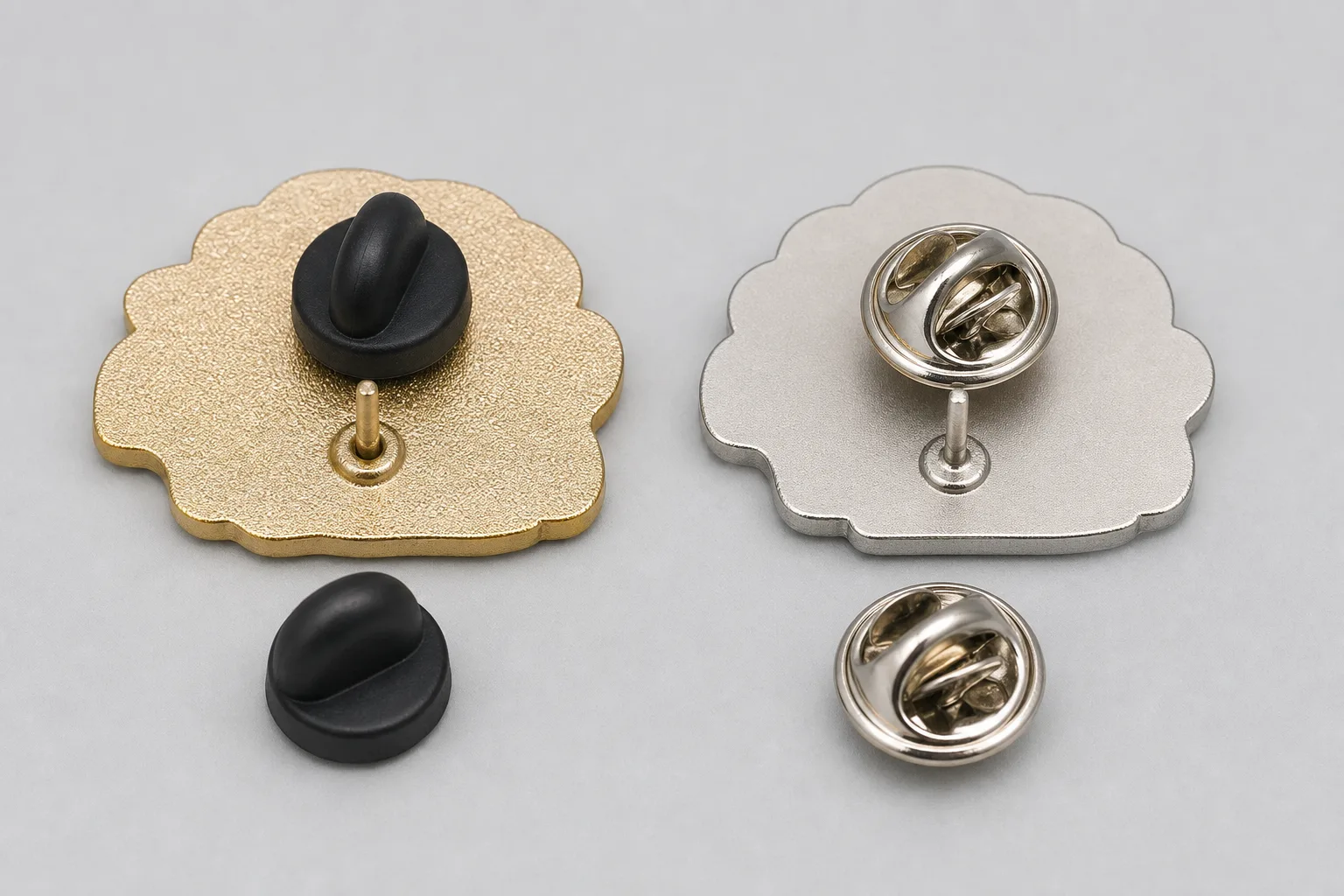
A rubber clutch is a soft push-on backing. A butterfly clutch is a metal mechanism with a spring-operated grip around the post. Neither type should be described as universally more secure without defining the post, clutch, pin body, garment, and test method.
Use this decision order:
- Identify the intended garment, wearer, and frequency of use.
- Define the pin body, weight distribution, wearing direction, and rear attachment area.
- Choose the post count and positions before comparing clutch comfort and handling.
- Plan spare-backing distribution, packaging, and presentation.
- Approve the rear layout and validate the actual configuration.
The attachment belongs in the product brief with dimensions, finish, color treatment, packaging, quantity, and destination. It should not be added after the artwork is finalized. Enamel pins, die-struck badges, die-cast pins, photo-etched designs, and printed metal badges use different constructions, so their attachment layouts are not automatically interchangeable.
Rubber Clutch and Butterfly Clutch Comparison Table
The most useful pin back comparison starts with observable conditions rather than a general preference. The following table gives an initial direction and identifies the information still needed before production.
| Observable buyer input | Practical implication | Initial backing decision | What still requires confirmation |
|---|---|---|---|
| Backing may contact skin or a thin garment | A softer contact surface may improve the wearing experience | Start with a rubber clutch | Post length, garment layers, pin weight, and wearer feedback |
| Formal metal presentation is important | The rear fastener is part of the intended visual and handling format | Start with a butterfly clutch | Metal finish, clutch dimensions, gift packaging, and post compatibility |
| Recipients remove and refit pins frequently | Grip method and finger handling become important | Compare physical samples of both | Repeated-use criteria and the intended user group |
| Many spare backs will be distributed | Replacement sorting, packing, and compatibility must be controlled | Rubber may provide a practical starting point | Spare quantity, color, pack-out method, and repeat-order consistency |
| Collector pin will be sold on a back card | Rear projection, card holes, and unboxing appearance affect the pack | Often begin with rubber | Card thickness, number of posts, protective bag, and display orientation |
| Badge is worn daily on a uniform | Stability, fabric loading, and repeated handling may outweigh appearance | Test the complete attachment system | Fabric thickness, badge weight, wearing rules, and retention criteria |
| Pin is wide, heavy, elongated, or off-center | A single post may allow rotation regardless of clutch type | Assess dual posts or another anti-rotation approach | Center of gravity, usable rear area, post spacing, and garment behavior |
| Product is intended for children | A sharp post and detachable clutch create risks that require assessment | Do not default to either clutch | Age group, supervision, warnings, attachment alternatives, and destination rules |
Buyers should specify the complete lapel pin attachment, not simply request an “enamel pin clutch.” If retention force, repeated-use performance, or attachment life is important, define a test method and acceptance criteria. Gairun states that attachments used on the actual product are checked for secure fitting during final inspection, but this is not a pull-force rating or service-life guarantee.
Choose by Garment, Wearer, and Distribution Context
Example 1: Small corporate logo badge. Consider a compact, balanced logo intended for a suit lapel. A butterfly clutch may be the first choice when a traditional metal fastening format supports the formal presentation. A rubber clutch may be preferred when softer rear contact matters more. The decision could change after checking suit fabric, daily wearing frequency, post length, badge weight, and gift-box requirements.
For corporate logo badges, scenario guidance commonly places the badge within 18–30 mm and 1.2–2 mm thick, with brass as one possible primary material and iron or zinc alloy as alternatives. Those values are not a universal standard. The logo source file, minimum line width, color references, construction route, attachment, and packaging still require confirmation.
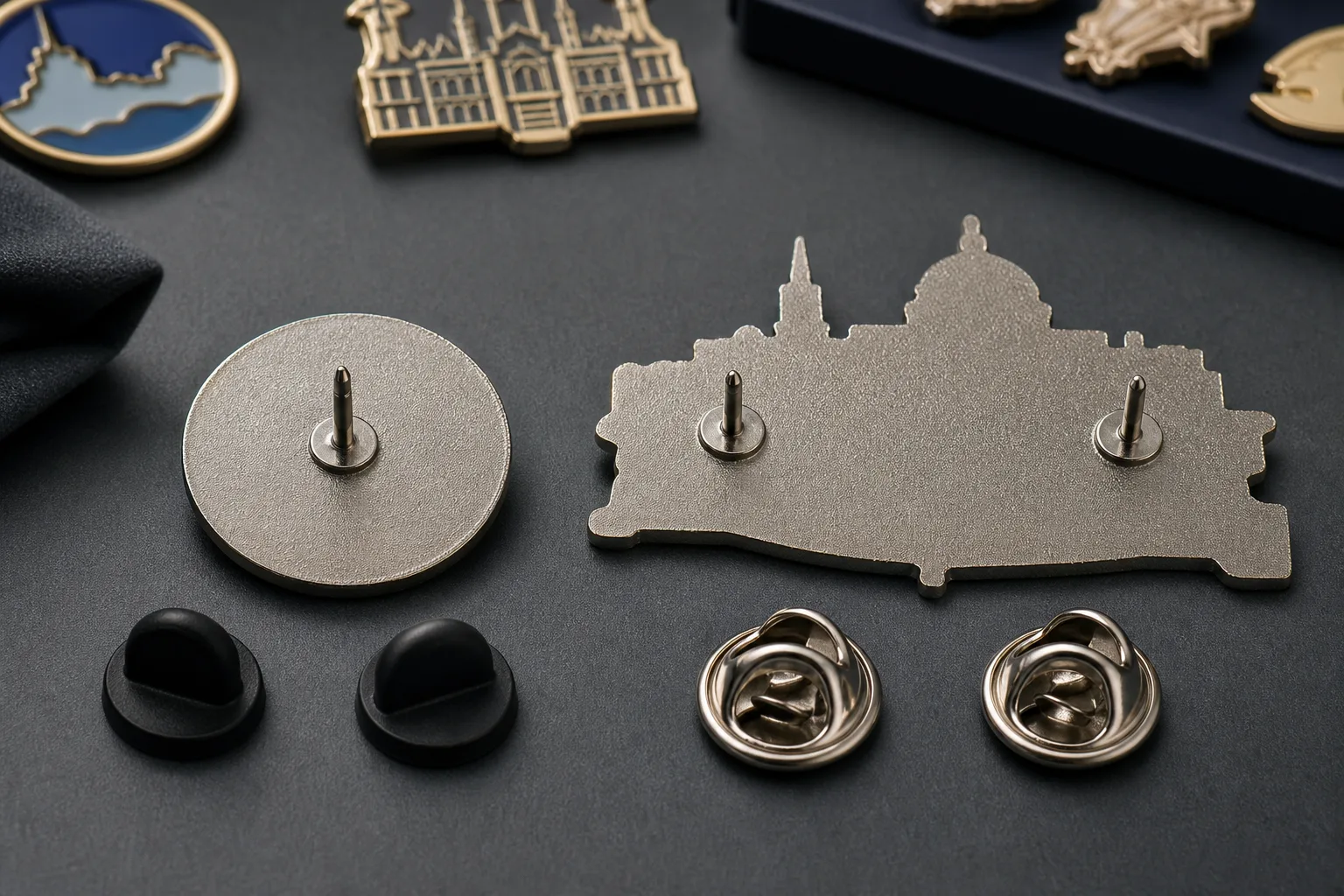
Example 2: Asymmetric collectible enamel pin. Consider an irregular, full-color landmark design on a branded back card. Rubber clutches provide a practical initial direction for soft backing contact and replacement handling. However, a wide top section or offset center of gravity may cause a single-post pin to rotate. Two posts with matching clutches may be more appropriate, subject to rear-space and garment checks.
For fashion, art, animation, or brand enamel pins, dual posts are often considered when a design is above approximately 35–40 mm or has an offset center of gravity. This is scenario guidance, not an engineering rule. Final placement depends on weight, geometry, rear decoration, card design, and the material on which the pin will be worn.
Uniform and institutional badges need a different evaluation. A heavier or frequently worn badge may call for dual-pin butterfly clutches, screw posts, or magnetic attachments according to fabric thickness, badge weight, and wearing rules. A wear trial can reveal rotation, fabric pulling, difficult handling, or unwanted rear contact before bulk production.
For school or child-oriented distribution, neither small detachable clutch is a default solution. The buyer must assess age, detachable-part risk, sharp-pin risk, adult supervision, warnings, and current destination-market requirements. A locking pin or sew-on structure may be more appropriate. Large event button badges are also a separate product format and commonly use safety-pin or clip-and-pin configurations.
Pin Construction, Post Placement, and Anti-Rotation Decisions
The pin body, rear attachment area, post location, post quantity, and wearing direction should be designed as one system. Changing the clutch cannot correct a post placed too close to the center of an unbalanced design.
A compact round logo with balanced mass may begin with one centered post and either clutch type. A wide asymmetric landmark may begin with two separated posts to resist rotation. The second layout needs enough flat rear area for attachment, suitable spacing for the wearer, and clearance from recessed decoration or back text. Weight and garment behavior can still change the outcome.
Construction route also affects the available rear surface. Die-struck badges are formed by stamping metal around raised and recessed design areas. Color, plating, or printing can then be considered after selecting the base form. Buyers can learn more about the forming context through Metal Stamping and Hydraulic Relief.
Zinc-alloy die-casting can be considered for formed outlines, irregular bodies, or more dimensional relief. Geometry, thickness, rear attachment area, and decoration should be defined before tooling. These production routes should not be treated as interchangeable.
During pre-tooling engineering work, Gairun may assess dimensions, thickness, relief, metal borders, color areas, attachments, component positions, and the proposed production method. The exact checks depend on the artwork and structure. Rear post positions must avoid conflicts with recessed details, serial information, back text, or a requested flat presentation area.
The relevant production artwork must be accepted before tooling begins. That approval creates a controlled reference for tooling and sampling. It does not approve unspecified tests, packaging, commercial terms, or shipment arrangements.
Replacement Handling, Packaging, and Presentation Trade-Offs
Replacement planning affects purchasing long after the initial pin back comparison. Decide whether recipients receive spare clutches, whether replacements travel with each pin, and whether one backing type must remain consistent across variants or repeat orders. Spare backs should be identified by compatible post configuration rather than appearance alone.
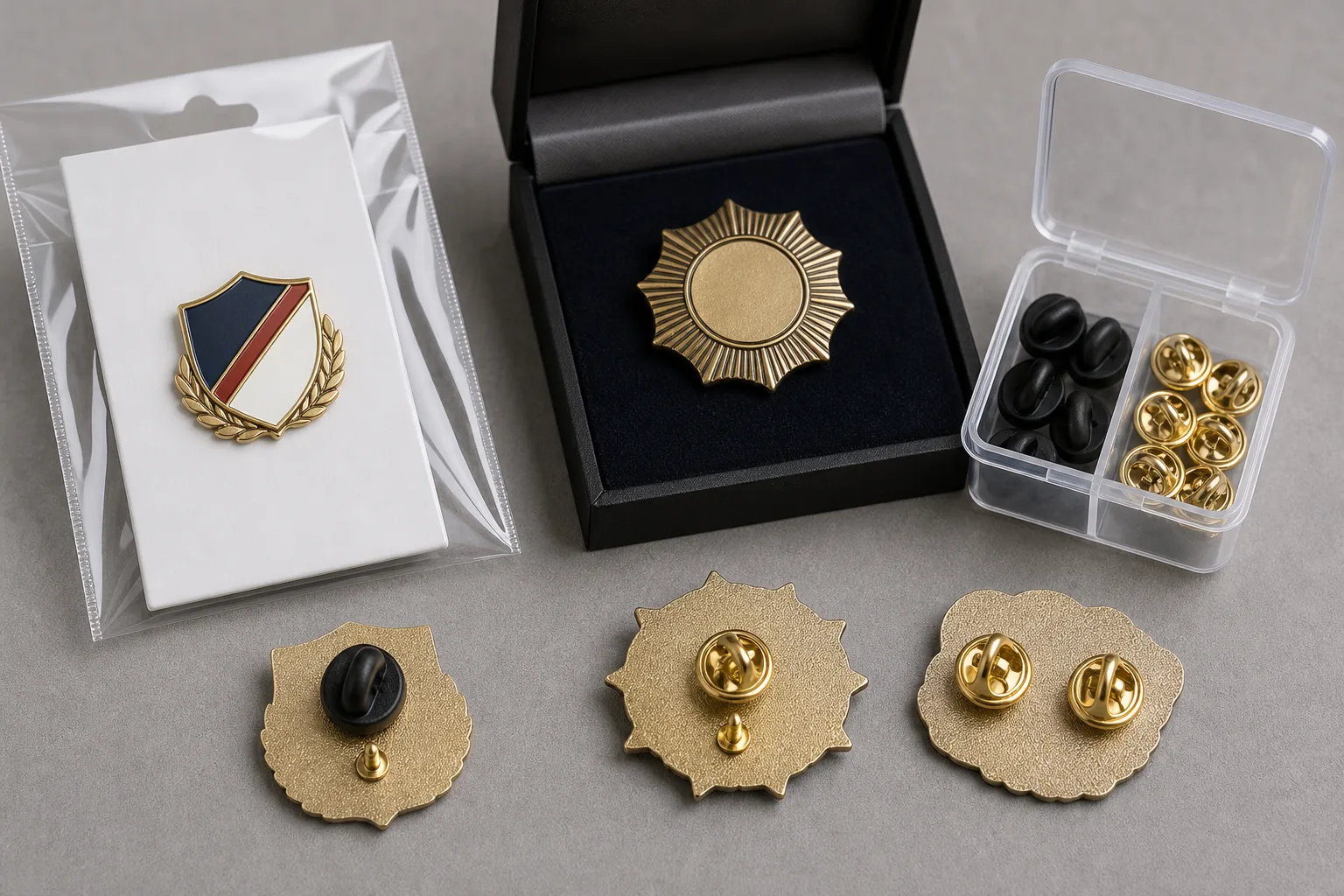
A collectible pin on a branded back card, a recognition badge in a small gift box, and a bulk-issued membership pin impose different requirements. Back-card holes must match the approved post layout. A box needs enough internal clearance for the pin and clutch. Bulk packing must limit movement that could expose the finish to neighboring metal parts.
Available packaging formats may include standard anti-scratch packing, individual OPP bags, bubble protection, velvet boxes, paper display boxes, and plastic display boxes. Suitability depends on dimensions, exposed finish, distribution, presentation, and shipping conditions. No packaging type should be assumed to be included in a base quotation.
State whether each spare backing should be attached to the pin, packed separately with the unit, grouped by carton, or held as replacement inventory. For service, achievement, anniversary, membership, or milestone programs, also define the number of badge variants and how recipients will distinguish them. Guidance for Award and Promotional Gift Wholesalers can help distributors align presentation with downstream handling.
Backing Specification and Validation Checklist Before Bulk Production
A complete specification should contain the following information:
- Pin product type and proposed construction route
- Final dimensions, thickness, and intended wearing direction
- Front artwork and rear artwork or instructions
- Finish, plating, color treatment, and color references
- Post count, positions, spacing, and usable rear attachment area
- Rubber clutch, butterfly clutch, or attachment left open for evaluation
- Intended garment, frequency of wear, and target user group
- Packaging format and spare-backing quantity
- Order quantity, design variants, destination, and required schedule
- Buyer-defined retention, repeated-use, warning, or documentation requirements
Before bulk production, check the rear layout against the approved artwork. Evaluate the proposed clutch on the intended garment, including rotation, fabric loading, finger handling, and contact with the wearer. Document any required test method instead of relying on an undefined request for a “secure” backing.
A custom sample, when selected, allows the buyer to assess the proposed appearance and construction. Not every order requires one. Sample approval and authorization for bulk production remain separate steps, and later changes require their own control.
Gairun states that, after tooling and trial forming, first articles are compared with approved 1:1 drawings for dimensions, thickness, and relief detail. Project tolerances must be specified separately. Gairun also states that finished products receive a 100% visual inspection for surface scratches and that relevant attachments used in the product are checked for secure fitting. Reconfirm the applicable inspection plan for the order; these controls should not be interpreted as laboratory testing or a defect-free guarantee.
Compliance requirements can change with product type, material, finish, intended use, attachment, packaging, and destination. Identify current warnings, documents, buyer standards, and test requirements for the actual order, especially for child-oriented distribution.
Gairun can begin artwork assessment from vector artwork, a usable PDF, or a hand-drawn concept, but no file is automatically production-ready. Submit the file with dimensions, quantity, variants, finish, colors, attachment choice or open question, packaging, destination, and schedule. The How to Order Custom Metal Products guide outlines the required inputs, or buyers can Book a Project Consultation for an unresolved backing configuration.
FAQ: Rubber Clutch vs Butterfly Clutch for Pins
Are rubber clutches or butterfly clutches more secure for enamel pins?
Neither is universally more secure. Retention depends on the clutch, post dimensions, fit, pin weight, post layout, garment, and handling. Specify a test method and acceptance criteria when measurable retention is required.
Which pin backing is more comfortable for daily lapel wear?
A rubber clutch is a practical starting point when soft rear contact is the priority. Comfort still depends on post length, garment thickness, badge weight, wearing position, and the individual wearer. Evaluate the assembled pin on the intended garment.
Should a large or irregular enamel pin use two posts and two clutches?
Often, but not automatically. Two posts can help control rotation in wide, elongated, or off-center designs. Rear attachment space, weight distribution, garment behavior, and decoration determine the final layout.
Can buyers order spare rubber clutches or butterfly clutches with custom pins?
Spare backs can be addressed as an order requirement, subject to current availability and compatibility. State the backing type, quantity, packing method, and whether replacements must match future repeat orders.
Are rubber clutches or butterfly clutches suitable for children’s badges?
Do not assume either is suitable. Both involve a sharp post and a small detachable component. Assess the age group, supervision, foreseeable use, warnings, alternative fasteners, and current destination-market requirements.
What should be specified in an RFQ when the pin backing has not yet been chosen?
Provide the artwork, dimensions, thickness, quantity, intended garment, wearing direction, user group, frequency of use, packaging, destination, and schedule. Mark the attachment as open for evaluation and identify priorities such as soft contact, formal metal appearance, anti-rotation performance, or spare-back handling.