
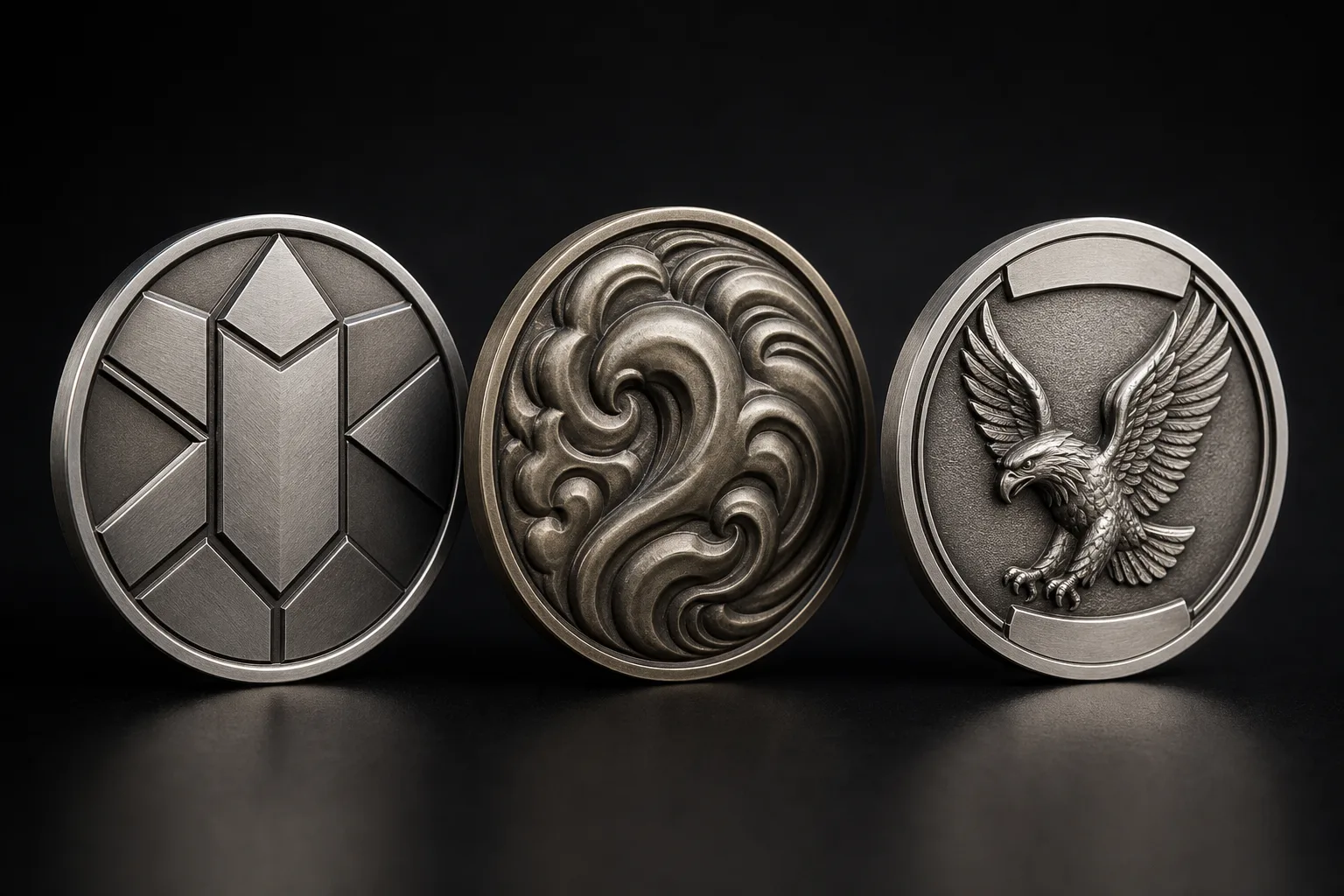
The practical choice between 2D and 3D relief depends on how the main subject achieves recognition. Choose 2D for crisp outlines, lettering, negative space, and separated color fields. Choose 3D when curvature, facial planes, overlapping forms, or gradual transitions define the subject. Use hybrid relief when the centerpiece needs sculpted volume but text, borders, dates, or color areas need controlled planes. Buyers sourcing Custom Challenge Coins should make this visual decision before treating material, forming method, finish, and thickness as final specifications.
2D vs 3D Challenge Coins: The Direct Relief Decision Framework
In challenge coin terminology, 2D does not mean completely flat or printed-only. A 2D design uses intentional raised, recessed, and layered planes. A logo can sit above a recessed field, while lettering, borders, and color cells occupy separate levels. The transitions are generally controlled and graphic rather than continuously rounded.
A 3D challenge coin design uses sculpted surfaces to model volume. Rounded cheeks, folded fabric, curved bodywork, feathers, or architectural forms can rise and fall through sloped transitions. The result behaves more like a small relief sculpture than a set of stacked graphic layers.
Hybrid relief combines both structures. It might place a sculpted portrait in the center while keeping the surrounding name, date, border, and colored emblem on stable 2D planes. This often gives buyers a clearer hierarchy than sculpting every available surface.
- Start with 2D when exact outlines, typography, color separation, or negative space carry the identity.
- Start with 3D when modeled shape, curvature, overlap, or organic form carries the identity.
- Start with hybrid when the dominant image needs volume and supporting information needs graphic control.
Geometric logos and text-led emblems therefore usually begin as 2D challenge coin artwork. Portraits, animals, rounded objects, and organic figures usually begin as 3D or hybrid. These are starting directions, not fixed production specifications. Final depth and detail depend on the approved artwork, dimensions, material, tooling route, and physical finish.
Match Logos, Portraits, Vehicles, and Crests to the Right Relief
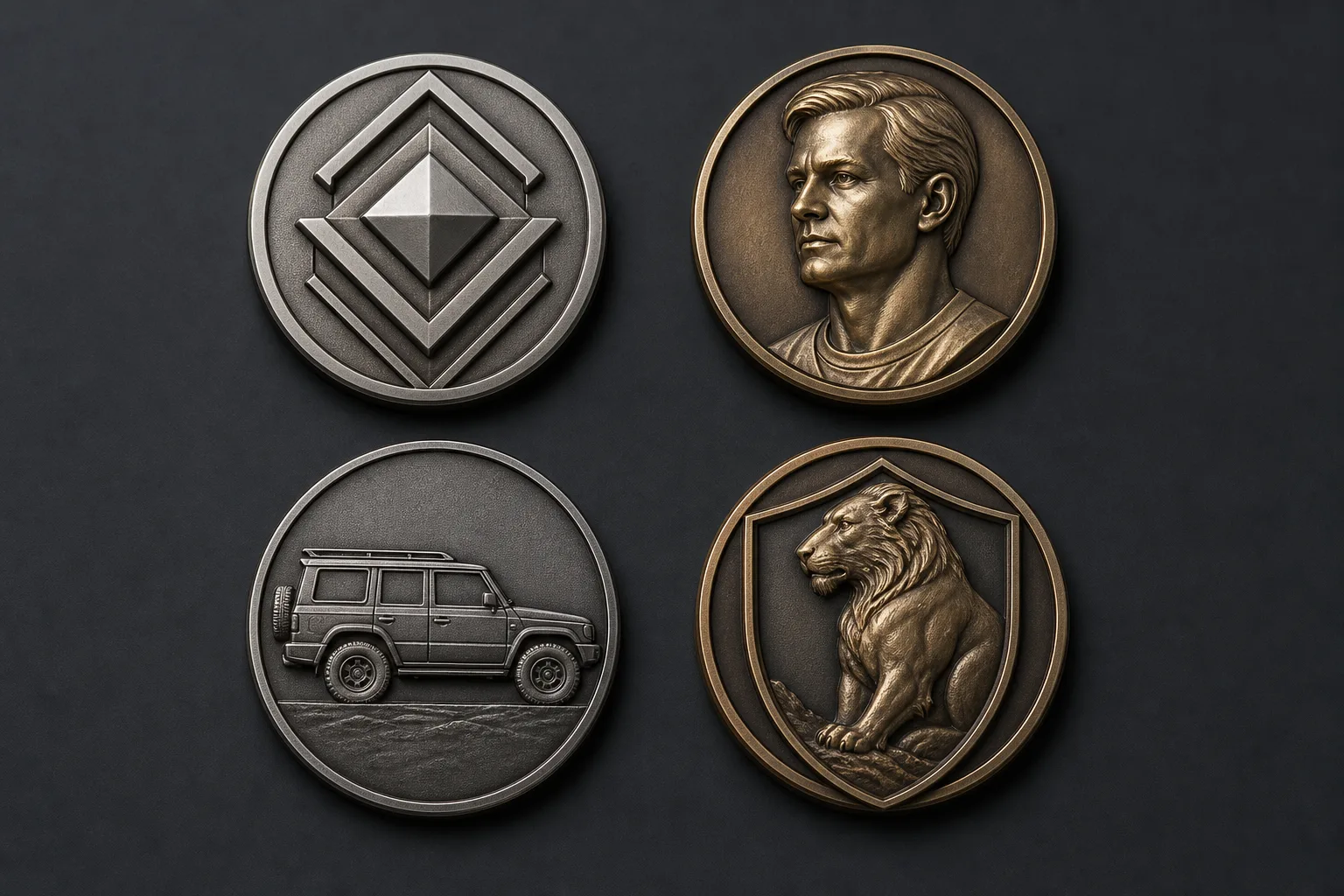
Logos: Begin with 2D relief when recognition depends on exact contours, small lettering, negative space, or separated brand colors. Selective 3D modeling can work when a dimensional symbol is the deliberate focal point, but sculpting should not distort protected brand geometry.
Portraits: Start with sculpted 3D relief when likeness depends on facial planes, hair, clothing, posture, or expression. A silhouette, line drawing, or intentionally graphic portrait may work better in 2D. A photograph should not be assumed to transfer line for line into metal; the approved sculpt must identify the features that carry likeness.
Vehicles: A side-profile outline, badge, or schematic illustration usually favors 2D levels. Consider 3D or hybrid relief when rounded body panels, wheels, armor, fuselage, perspective, or overlapping components are essential. Background scenery should remain subordinate unless it is part of the recognition objective.
Crests: Shields, ribbons, compartments, and mottos often suit layered 2D treatment. Animals, crowns, helmets, foliage, and other organic symbols may justify selective sculpting. Buyers using official crests, controlled insignia, team identities, or third-party logos must establish artwork authorization and name the person responsible for final proof approval.
Example 1 — corporate anniversary coin: The artwork contains a geometric logo, anniversary number, two brand colors, and a circular text ring. The initial choice is 2D because boundaries and typography carry recognition. It could change to hybrid if the approved identity requires the central symbol to appear dimensional.
Example 2 — service-recognition coin: The front shows a likeness-based bust, while the reverse contains a unit name and date. The initial direction is a 3D portrait with controlled 2D supporting text. It could shift to fully 2D if the authorized artwork is a silhouette rather than a modeled likeness.
Example 3 — sports collectible: A rounded mascot and ball favor 3D or hybrid relief. A flat team crest with distinct color compartments favors 2D. Complex mascots or irregular outlines may also justify assessing zinc-alloy die-cast construction, but that material and route are not universal choices.
2D vs 3D Challenge Coins: Buyer Decision Table
The following table translates observable artwork features into an initial direction. It separates the visual decision from the technical items that remain open.
| Observable artwork or use input | Practical implication for relief | Initial decision | What still requires confirmation |
|---|---|---|---|
| Geometric logo, flat colors, and text | Crisp boundaries and color cells carry recognition | 2D | Metal borders, color references, line transfer, and forming route |
| Realistic human or animal portrait | Likeness depends on rounded planes and gradual transitions | 3D subject with 2D supporting text | Sculpt interpretation, feature hierarchy, finish, and approval criteria |
| Heraldic shield, motto, and modeled animal | Graphic compartments and organic forms coexist | Hybrid | Which forms are sculpted, which stay planar, and workable color or plating boundaries |
| Side-profile line-art vehicle | Silhouette and linework dominate | 2D | Whether perspective, body curvature, or wheel depth changes the direction |
| Perspective vehicle or architectural landmark | Overlap and modeled volume carry recognition | 3D or layered hybrid | Material, thickness, tooling route, exposed high points, and finish treatment |
| Text-heavy membership or event coin | Information hierarchy and portability matter more than sculpted volume | 2D | Text legibility, variable-data zone, edge layout, and content moved to a packaging card |
Relief hierarchy should be established before choosing a production method. Selecting 3D does not automatically determine the material, thickness, plating, packaging, or forming route. A corporate anniversary, membership program, collector edition, and public-service award can all prioritize different combinations.
Plan Both Faces, the Border, and the Edge as One Relief Structure
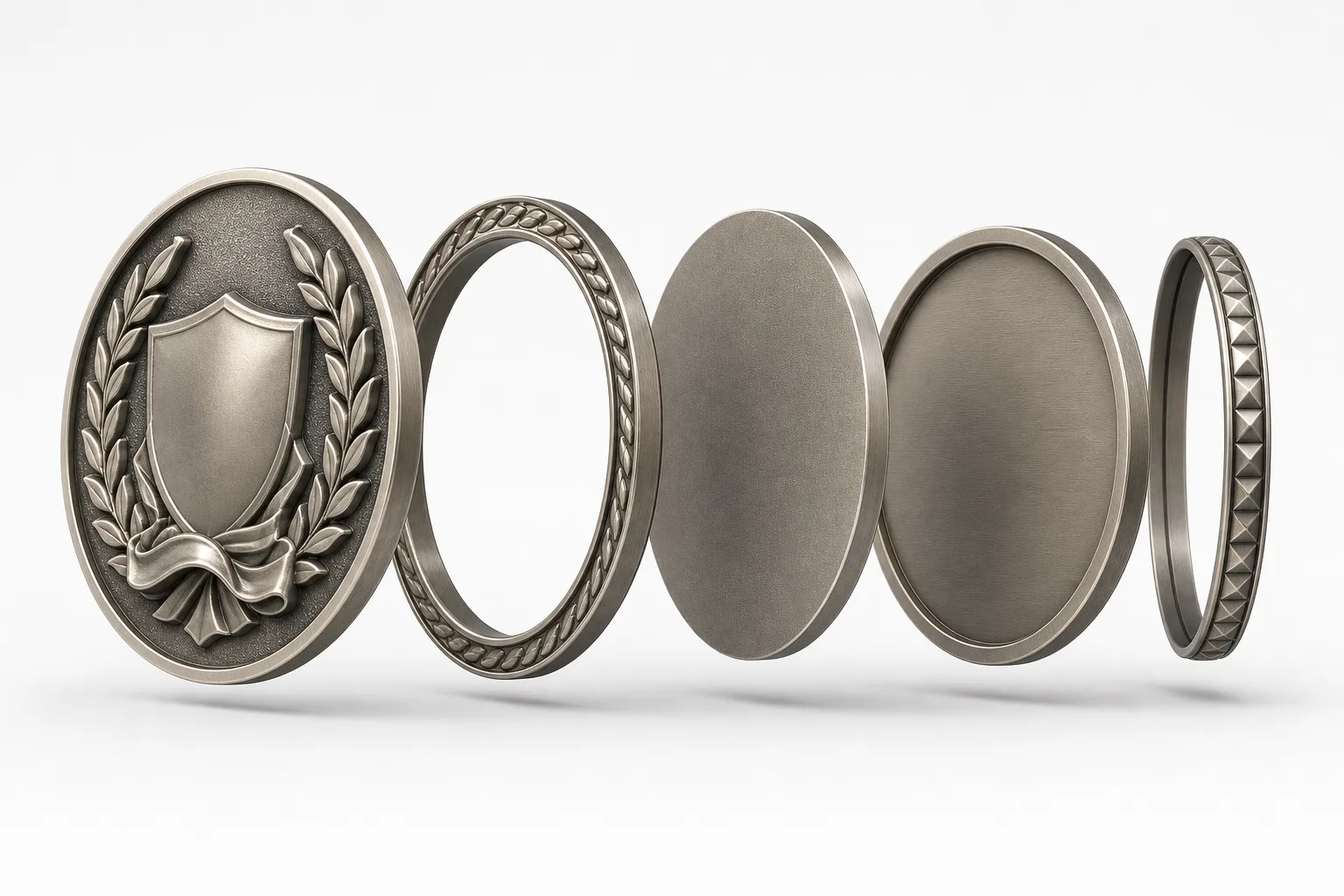
A coin is not two unrelated circular illustrations. Its front, reverse, border, thickness, and edge form one construction. Prepare a relief map that identifies the dominant subject, secondary symbols, text rings, fields, recessed color areas, rim, and proposed edge details.
The two faces do not need matching relief. A sculpted portrait can occupy the front while a controlled 2D reverse holds dates, a motto, organizational information, or serial data. The proof should show the buyer-selected front-to-back orientation and text direction rather than assuming a presentation convention.
Border height and continuity also need coordination with the highest parts of the subject. An overly dominant rim can visually contain the centerpiece too tightly. A weak or interrupted border can make the composition appear unfinished. The goal is a clear relationship among subject, field, rim, and edge.
Reserve a flat zone when names, membership numbers, dates, or later personalization are required. Confirm the final data format before locating that zone. Edge text and decorative edges should be addressed after the proposed forming route is assessed. Orientation, continuity, burr control, and contact comfort all affect the finished structure.
For government, military, public-safety, or association programs, the controlled approval process should also cover official names, ranks, unit information, insignia, and the direction of both faces. Artwork authorization should never be inferred from the presence of a supplied file.
Keep Text, Fine Detail, and Color Areas on Controlled Planes
A sculpted coin still needs quiet, controlled areas. Small text, legal wording, dates, serial fields, and mottos should generally sit on defined planes rather than cross changing 3D contours. Curved surfaces can alter stroke width, spacing, shadow, and apparent alignment.
Separate structural lines from decorative information. Structural lines may become metal borders or relief boundaries. Gradients, photographic shading, reflections, and fine texture may need simplification, printing, or removal, depending on the selected decoration method. No source file should be treated as automatically production-ready.
Colored areas usually need deliberate separation. Metal borders can define adjacent color cells, but buyers should not assume that every narrow line, tiny gap, or isolated detail will remain unchanged. A pre-tooling assessment may cover dimensions, thickness, relief, borders, color areas, component positions, and the intended production route.
Avoid sculpting the background merely because 3D relief is available. Excessive texture behind a portrait can compete with facial features. Sculpted borders can compete with central symbols, while raised decoration around small text can reduce visual contrast.
For event or promotional coins with dense information, move long URLs or QR codes to a branded card when appropriate. Any QR code retained on metal should be physically tested under the intended size, finish, lighting, and device conditions. Recognition and membership programs should likewise reserve a planar personalization area and check it against the final name or number list.
How Forming Route, Material, Finish, and Presentation Affect Relief
The decision between 2D and 3D challenge coins works alongside material, shape, thickness, finish, color layout, tooling, and presentation. A process name alone does not guarantee a particular depth, portrait likeness, or fine-detail result.
At a high level, stamping or die-struck forming can create controlled raised and recessed areas. Zinc-alloy die-casting can be considered for irregular shapes and more dimensional relief. Photo etching and hydraulic high-relief forming are other listed directions, but their suitability depends on the construction and decoration plan. Gairun’s Engineering Review and Design for Manufacturing is intended to connect these choices before tooling.
Tooling defines the part’s shape, dimensions, thickness, and relief. Gairun’s official Manufacturing and Finishing information describes the broader relationship among forming, surface preparation, and decoration. No tolerance, output, or feature-transfer result should be inferred from the name of a machine or process.
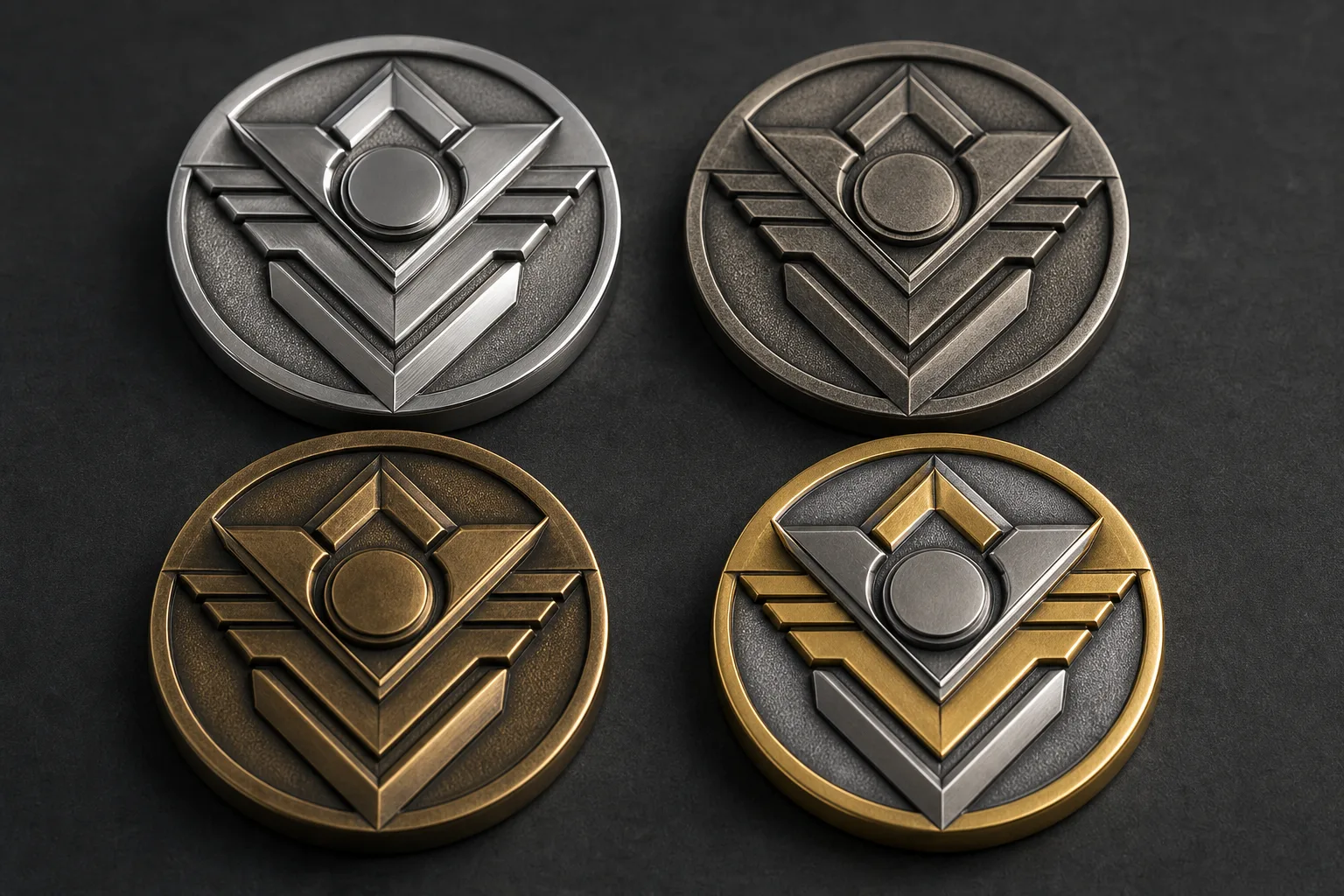
Finish changes how relief is perceived. Polished high points can contrast with recessed texture. Antique-style treatments can make low areas appear deeper. Gold, silver, nickel, black nickel, antique bronze, and antique silver are possible plating directions whose final tone must be coordinated with base metal, exposed areas, and approved finish references.
High-Relief and Dual-Plated Coins can use finish contrast to separate selected features. Dual plating requires clear boundaries and is not suitable for every geometry. Collector-oriented high relief also calls for attention to exposed high points, handling, edge comfort, insert clearance, and transport protection. Added thickness or complexity is not automatically an improvement.
Multi-layer, magnetic, removable, or moving structures require separate checks for assembly fit, retention, drop behavior, and packaging transport. Small detachable or magnetic parts can present detachment risks and may be unsuitable for young children.
Convert the Relief Choice into an Approved Artwork and Engineering Brief
A useful brief converts the visual direction into labeled production inputs. It should distinguish confirmed requirements from unresolved technical choices.
- State the intended use, quantity, overall dimensions, thickness target, destination, and presentation needs.
- Attach front and reverse artwork. Label elements as raised, recessed, flat, layered, sculpted, colored, textured, polished, or reserved for variable information.
- Identify the dominant subject and provide references for portraits, vehicles, crests, mascots, or landmarks.
- Mark priority details and acceptable simplifications instead of requesting unrestricted reproduction of every source detail.
- Define wording, dates, mottos, serial-number rules, color references, plating direction, border treatment, face orientation, and proposed edge style.
- Specify packaging, especially where a sculpted high point or special edge needs clearance and surface protection.
- Verify ownership or authorization for third-party brands and controlled insignia. Identify the person with final proof authority.
Gairun can begin artwork assessment from vector files, a usable PDF, or a hand-drawn concept. Under an OEM approach, production follows buyer-supplied artwork and specifications, while engineering checks and buyer approval remain necessary. Under an ODM approach, a sketch or broad concept can be developed further, but feasibility is not presumed before assessment.
Treat a 2D or 3D visual proof as one control point. It does not by itself confirm final physical depth, material behavior, finish tone, packaging fit, testing, or commercial terms. Tooling begins only after the relevant production artwork has been accepted.
If a custom sample is selected, define what will be evaluated: appearance, construction, relief hierarchy, color, finish, edge feel, and packaging fit where applicable. Sample acceptance and authorization for bulk production remain separate steps. Later artwork or construction changes need their own controlled approval.
For more preparation guidance, see Gairun’s Design and Artwork resources.
Frequently Asked Questions
Are 2D challenge coins completely flat?
No. They can contain raised, recessed, and layered metal. The term describes controlled planar levels rather than a printed-only or featureless surface.
Is 3D relief always better for a portrait?
No. Sculpted relief suits likeness-based portraits that depend on facial planes and volume. Silhouettes, line art, and graphic commemorative portraits may work better in 2D.
Can one coin combine a 3D centerpiece with 2D text and color areas?
Yes. This hybrid structure can preserve volume in the main subject while keeping lettering, borders, dates, and color cells on controlled planes. Feasibility still depends on the approved geometry and production route.
Which relief suits logos, crests, vehicles, and landmarks?
Logos usually begin as 2D. Crests often use layered 2D or hybrid relief. Side-profile vehicles favor 2D, while perspective vehicles and dimensional landmarks may favor 3D or hybrid.
Do material, plating, thickness, and edge style affect feasibility?
Yes. They interact with relief, exposed high points, color boundaries, forming, handling, and packaging. They should be specified as one construction rather than chosen independently.
What should buyers check before approving tooling?
Check dimensions, both faces, relief labels, text, color references, sculpt hierarchy, orientation, border, edge, material direction, finish, variable-data areas, packaging, authorization, and approval responsibility.